
How Much Does an Akhal Teke Horse Cost?
Last Updated on May 20, 2023
Written by CPA Alec Pow | Content Reviewed by  CFA Alexander Popinker
One of the most unique, as well as the oldest type of horse is the Akhal-Teke. It is very desirable for its cool coat colors and amazing endurance.
This Arabian horse is usually found in Turkmenistan, in the southern region of the country.
Experts call it the oldest domesticated horse breed on the planet.
People use the Akhal-Tekes nowadays for long-distance horse racing, show jumping, and dressage mounts.
But even so, before seeing if this horse is right for you, let’s see the Akhal-Teke horse price.
Akhal Teke Prices
The average Akhal Teke horse costs somewhere between just $5,000 and $50,000 or even more in the US if it is purebred. The final price will depend on factors like the quality of the horse, its health, size, history, parents, color, gender, and age, as well as the breeder and their geographical location.
On the global market, these horses can cost even more. For example, it isn’t unusual for a station or a properly trained show horse to reach a price of even $100,000, or in some rare instances, even more.
A very popular online horse classified website called EquineNow.com, for example, has several listings for this breed, with an average cost between $5,000 and $20,000 at the moment this article is written. Currently, there are around 50 active listings.
Talks on the HorseForum.com forum noted that this is a breed that can easily cost $35,000, although, on the lower range, some horses have been sold for as little as $5,000.
According to TekeHorse.com, the Akhal Teke price can vary to quite an extent, so they offer 12 rules you should consider when browsing the market. Among the most important things to consider are its age, speed, jumping ability, movement, health, training, size, prizes, how common or uncommon it is, its colors, and gender.
When it comes to age, conformation, color, show record, bloodlines, and training, these will be factors that will directly influence the cost of your Akhal Teke, but more about this below.
Akhal-Tekes are among the most unusual breeds of horses, which is why a lot of people consider them special. They are usually found in Russia, and Turkmenistan where they have their origins.
You might also like our articles about the cost of a pony, horse teeth floating, horse and carriage rental.
The truth is you will have a hard time finding the perfect horse for you, as they aren’t very common outside of Turkmenistan and Russia.
And it is so uncommon, that there are only about 8,000 Akhal-Teke horses all around the world. So their uniqueness and rarity are reasons for their high prices.
Factors that Influence the Akhal-Teke Breed Price
Here are just some of the things you should consider when figuring out the cost of an Akhal-Teke:
Age and Conformation
One of the most important factors that influence the price of the Akhal-Teke is its conformation to the breed because, unlike other horse types, they have an exotic build which is very impressive.
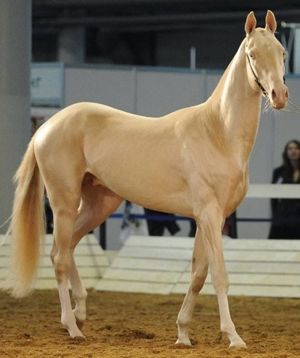
If you want a perfect Akhal-Teke horse, look for one with almond-shaped eyes, long years, a nice chiseled head, a long and high-set head, and a lean, athletic body.
A horse that meets all of these features will surely set you back quite a lot.
Age is another factor that, along with conformation, will add to the final cost. Look for an Akhal-Teke that is somewhere between 7 and 14 years old. This is to make sure that you’re getting a horse at its prime for both riding and driving. If you get a horse that is in its early 20s you will spend a lot less for it.
Show Records
Not a lot of Akhal-Tekes win shows, but it does happen that some specimens become the stars of the show ring. One example is the popular Akhal Teke stallion called Absent known for winning gold medals in dressage at the Olympics in 1960 and 1968, in addition to a bronze medal in 1964.
Dressage and racing horses are among the most expensive horses participating in shows. Avid buyers really love to get these very well-trained horses.
Training
A very important factor in deciding the cost of an Akhal-Teke is its level of training. They have great athletic capability which helps them to master dressage, show jumping, eventing, endurance, and basically any other types of shows.
Training a horse is surely not as cheap as you might think, as you will likely need an expert to work with it several times per week to keep it in the best possible shape. Show horses are generally kept in training to stay up to date with the high needs of competing. This is why it will be a lot more expensive to buy a horse that has been kept in proper show training than one that is just kept in a barn and ridden from time to time.
Their bloodlines
Bloodlines play a very important role in setting the average price of the Akhal-Teke, although this is the case for any other horse breed out there. Flawless breeding will also mean a higher price when it comes to a horse.
Within the Akhal-Teke breed, there are 3 sub-breeds. Type 1 is the most traditional breed, following the lines Gelishikili, Peren, and Kaplan. In Type 2, the horses are rather smaller sized and are known for their speed, being represented by the Karlovich and El lines.
For Type 3, horses have a bigger body and are known for their endurance, with the Arab and Dor-Bairam lines representing this sub-breed.
Today, there are 17 different lines within the breed. Some people look for specific sub-breeds and lines within Akhal-Tekes, which can increase the cost. A lot of the very best bloodlines originate from Europe, Russia, and Turkmenistan, so imported horses typically cost a lot more.
Their color
The impressive coat of an Akhal-Teke horse will also add to the price, as they come with a metallic shine that is seen better when they have those cream gene colors.
Their unique hair structure will give their coats that radiant appearance. Most people look for the shining coat of Cremellos, Perlinos, Buckskins, and Palominos in special, so they will obviously cost more.
Monthly Costs of an Akhal-Teke Horse
 Regular monthly costs related to owning an Akhal Teke horse healthy and happy should be taken into account before looking for an Akhal-Teke.
Training is not only important for show horses. Akhal Tekes are known to be kickers, mouthy, not tying or leading, You will likely spend about $1,000 per month on a good quality trainer.
The cost of acquiring stable equipment and trailering fees should also be considered. The needed equipment will be cheaper if bought used, but it will still be a cost you shouldn’t ignore.
Boarding will also add to the costs, as it can cost anywhere between $200 and $2,000 per month, depending on whether you keep your horse in a stall or a pasture.
Boarding means costs related to bedding, food, and usual care. A farrier will also be required periodically, every 6 to 8 weeks in general. They will charge you between $50 and $200.
Yearly costs related to veterinary care will be around $200 to $500, while dentistry will cost $100 to $300 every year or so.
You will have to get feed supplements and grain as well, which are priced at $100 to $200 per month. Vaccinations will cost around $150 per year and regular shoeing/ trimming would be $15 to $90.
You will likely spend around $80 per lesson for riding lessons.
Each show or event in which you want to enter you’re horse, as well as the additional training it needs to compete, will have a price tag. But if you win, you might get some of the money back in prize money or other prizes.
The buyer will usually be responsible for any fees related to shipping the equine, with costs depending on the distance that has to be traveled.
Important things to consider
The Akhal Teke looks like one of its descendants, the Persian Arab when it comes to its appearance. But its size is closer to the English thoroughbred, which is another descendant of his.
The Akhal Teke comes from arid and barren environments.
Other Alternatives Besides Purchasing
Considering that purchasing a horse isn’t practical for everybody, there are other alternatives. Renting and joint ownership are some options along with owning your own horse.
In many cases, horses are offered for rental by their owners. This offers you the chance to have partial or complete access to a horse at a fraction of the price. Another alternative is a minimal liability business (LLC) or partnership, which will split the expenses of purchasing and owning an Akhal-Teke.
How can I save money on the horse price?
A horse that has been previously owned by someone else will usually be cheaper. This is because this type of horse has already gone through training and vaccinations, especially if it comes from a reputable breeder.
The savings will be considerable in time, although it will take quite some time to gain the trust of the horse and make it understand that you are the new master.

Would love to no how much it costs
The price is right there in the article:)