
How Much Does a Bag of Apples Cost?
Updated on | Written by Alec Pow
This article was researched using 11 sources. See our methodology and corrections policy.
A bag of apples typically costs about $3 to $10 at U.S. grocery stores in 2026, depending on the variety and bag size. Common Gala, Fuji, Granny Smith, and Red Delicious apples often work out to around $1 to $1.75 per pound when bought by the bag, while premium varieties such as Honeycrisp commonly cost $2.50 to $3.50+ per pound.
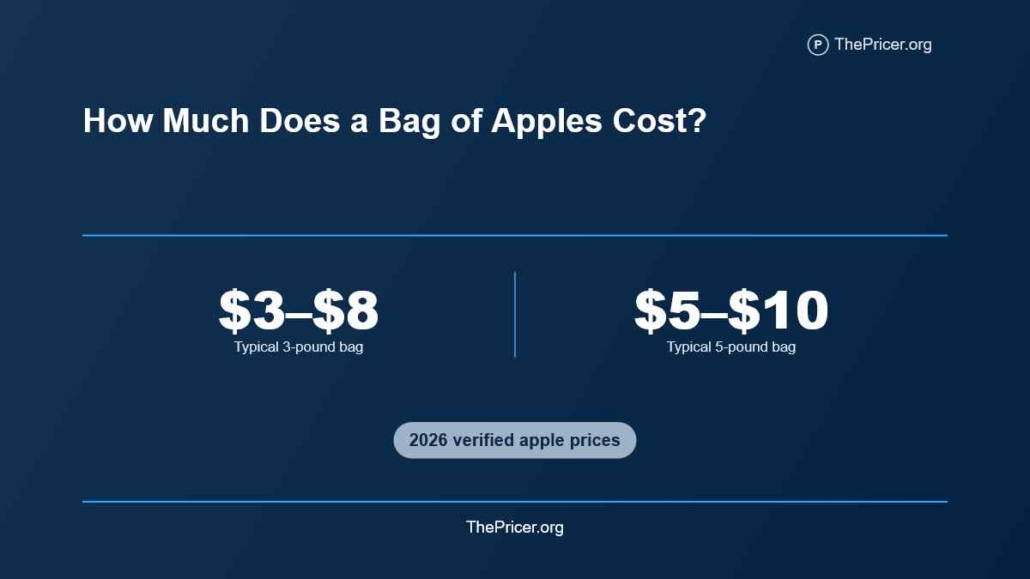
Three-pound bags generally cost around $3 to $8, while five-pound bags commonly land around $5 to $10. Organic, premium-variety, pre-sliced, or delivery-priced apples can cost considerably more.
Article Highlights
Jump to sections
- A 3-pound bag of apples typically costs $3–$8.
- A 5-pound bag commonly costs $5–$10 (at $30 per hour, earning that amount would take about 10 to 20 minutes, before taxes).
- Budget varieties can cost close to $1 per pound in bags.
- Honeycrisp commonly costs $2.50–$3.50+ per pound.
- Walmart currently lists a 3-pound Gala bag at $2.99.
- Kroger currently lists 3-pound Honeycrisp at $7.99.
- Bagged apples can cost less per pound than buying large premium apples individually.
- Variety, season, store, organic certification, and package size all affect the price.
How Much Does a Bag of Apples Cost?
Current grocery listings show a considerable price spread even among ordinary three-pound bags.
| Apple Variety | Current Example | Price per Pound |
|---|---|---|
| Gala | $2.99 / 3 lb. | $1.00 |
| Granny Smith | $3.99 / 3 lb. | $1.33 |
| Fuji | $3.99 / 3 lb. | $1.33 |
| Pink Lady | $4.29 / 3 lb. | $1.43 |
| Gala | $4.49 / 3 lb. | $1.50 |
| Honeycrisp | $7.99 / 3 lb. | $2.66 |
| Honeycrisp | $9.22 / 3 lb. | $3.07 |
| Red Delicious | $8.46 / 5 lb. | $1.69 |
These current examples come from Walmart’s bagged apple listings and Kroger’s current apple selection. Prices can change by ZIP code, promotion, and store.
Three-Pound Bags
Three pounds is one of the most common supermarket bag sizes.
A useful 2026 budget is:
- Budget / conventional varieties: $3–$5
- Premium varieties: $5–$8
- Honeycrisp and other expensive varieties: $7–$10+ (about 14 to 20 minutes at $30 per hour)
Walmart currently lists a 3-pound Gala bag for $2.99 and Granny Smith for $3.99, while its 3-pound Honeycrisp bag costs $9.22.
That means choosing Honeycrisp instead of Gala in this example costs:
$9.22 – $2.99 = $6.23 more per bag
For a household buying one bag every week, the annual difference would be:
$6.23 × 52 = $323.96
Five-Pound Bags
Five-pound bags can offer a lower price per pound, particularly for common varieties.
Kroger currently lists a 5-pound Gala bag around $5, or just $1 per pound. Walmart currently lists a 5-pound Red Delicious bag around $8.46, or about $1.69 per pound.
A realistic range for a conventional five-pound bag is therefore around $5 to $10 (about 10 to 20 minutes at $30 per hour).
Premium apples may exceed that range substantially.
Honeycrisp Cost More
Honeycrisp is routinely one of the more expensive widely available apple varieties.
In the current examples:
Walmart Honeycrisp: $3.07/lb.
Walmart Gala: about $1.00/lb.
That makes Honeycrisp more than three times the price per pound in that particular comparison.
Kroger shows a similar pattern, with 3-pound Honeycrisp at $7.99 compared with Fuji or Granny Smith at $3.99.
Why Prices Vary
Variety is only one factor.
Apple prices also change based on:
- Bag size
- Fruit size and grade
- Organic certification
- Growing region
- Harvest timing
- Storage costs
- Retailer
- Local promotions
- Delivery markup
The USDA Economic Research Service maintains monthly fruit price and trade datasets, which were most recently updated in September 2026.
USDA also maintains a separate fruit and vegetable retail-price database that includes apples and estimates prices per pound and per cup equivalent.
Bagged vs. Individual
Bags frequently provide better value when you will actually eat all of the fruit.
Suppose a 3-pound bag costs $3.99.
That equals:
$3.99 ÷ 3 = $1.33 per pound
If loose apples of the same variety cost $1.99 per pound, buying three pounds individually would cost:
3 × $1.99 = $5.97
The bag saves:
$5.97 – $3.99 = $1.98
That is a 33% saving.
The calculation changes if apples from a large bag spoil before they are eaten.
The Hidden Price
The hidden cost of a bargain bag is food waste.
Suppose you buy a five-pound bag for $6, or $1.20 per pound, but one pound spoils.
You paid $6 for only four pounds actually eaten:
$6 ÷ 4 = $1.50 per usable pound
The apparent $1.20-per-pound bargain effectively becomes $1.50.
For a household that eats only a few apples each week, a smaller bag may therefore cost less in practice even when its shelf price per pound is higher.
Orchard Prices
Buying at an orchard is not automatically cheaper than a supermarket.
Pick-your-own farms sell an experience as well as fruit, and prices depend heavily on region, variety, admission policies, and whether the apples are pre-picked or picked by the customer.
Orchards can still offer excellent value during harvest, particularly for larger quantities, seconds, or apples purchased for sauce, cider, baking, or preservation.
Apple harvest also varies by variety. USDA data show that major U.S. varieties are harvested from late summer into fall, with Gala arriving earlier and Red Delicious, Golden Delicious, Granny Smith, and others following through September and October.
Choosing the Right Variety

The least expensive apple is not always the best choice for a specific recipe.
University of Illinois Extension’s apple variety guide lists Ambrosia, Braeburn, Golden Delicious, Granny Smith, Honeycrisp, Jazz, Jonagold, Jonathan, and Pink Lady among varieties well suited to pies and baking.
It identifies Fuji, Gala, Golden Delicious, Granny Smith, Honeycrisp, and several others as useful for juice or cider.
Red Delicious is primarily a fresh-eating apple and is generally less suitable for baking because of its texture.
How Many Apples Per Pound?
There is no exact number because apple sizes vary, but a useful kitchen estimate is:
- About 4 small apples per pound
- About 3 medium apples per pound
- About 2 large apples per pound
A three-pound bag therefore contains roughly 6 to 12 apples, while a five-pound bag may contain around 10 to 20.
If a $4.49 Gala bag contains nine medium apples, each one costs:
$4.49 ÷ 9 = about $0.50 per apple
Nutrition
A medium raw apple with its skin weighs roughly 182 grams and contains approximately:
- 95 calories
- 25 grams of carbohydrate
- 4.4 grams of fiber
- Less than 1 gram of fat
- Less than 1 gram of protein
Those figures are reflected in USDA nutrient data reproduced in current FDA documentation.
The peel matters. That same dataset lists only around 2.1 grams of fiber in a comparable peeled apple versus 4.4 grams with the skin.
Apples and Diabetes
Whole fruit is part of a healthy eating pattern, but statements such as “an apple a day lowers diabetes risk by 28%” are too precise for the evidence.
A major prospective study involving more than 187,000 participants found that greater consumption of some whole fruits, including apples and pears, was associated with a lower incidence of type 2 diabetes.
For every three additional weekly servings of apples and pears, the study found a hazard ratio of 0.93, corresponding to about a 7% lower observed risk after adjustment for measured factors. It did not prove that apples themselves prevented diabetes.
The research is summarized by the Harvard T.H. Chan School of Public Health and published through Harvard’s research repository.
Whole fruit was associated with more favorable outcomes than fruit juice in that research.
Apples and Reflux
There is no general medical rule saying people with GERD must avoid apples in the evening.
The National Institute of Diabetes and Digestive and Kidney Diseases recommends identifying foods that personally trigger reflux symptoms.
For people who experience reflux at night, NIDDK says eating meals at least three hours before lying down or going to bed may improve symptoms.
Commonly reported triggers include citrus, tomatoes, alcohol, chocolate, caffeine, high-fat foods, mint, and spicy foods. Apples are not listed as a universal food to avoid.
Storing Apples
Refrigeration slows apple deterioration and is particularly useful when buying larger bags.
For long-term storage, keep apples cold and remove damaged fruit because bruised or decaying apples can deteriorate more quickly.
Apples can also be preserved by freezing, drying, canning, or making applesauce.
Penn State Extension’s 2026 apple preservation guide notes that firm varieties such as Granny Smith can be frozen after washing, peeling, coring, and slicing.
Oregon State University’s apple-preservation guidance also provides tested procedures for freezing, drying, and canning apples.
How to Spend Less
First, compare price per pound rather than the bag’s total price. A $5 five-pound bag is cheaper than a $4 three-pound bag even though the checkout price is higher.
Second, choose conventional varieties when flavor preference allows. Current Honeycrisp prices can be two to three times those of Gala, Fuji, or Granny Smith.
Third, buy the bag size your household can finish. A discount disappears when fruit goes into the trash.
Fourth, watch fall promotions. Apple supply is strongest around the main domestic harvest period, although modern controlled-atmosphere storage makes many varieties available throughout the year.
Finally, consider orchard seconds or cosmetically imperfect apples when making sauce, pies, cider, or preserves. Appearance matters far less once the fruit is peeled and cooked.
For more produce prices, ThePricer also covers the cost of strawberries, blueberries, and oranges.
What We Verified
Answers to Common Questions
How much does a bag of apples cost?
Most supermarket bags currently cost about $3 to $10. Three-pound bags typically run $3 to $8, while five-pound bags are commonly around $5 to $10.
How much is a 3-pound bag of apples?
Current examples range from $2.99 for Gala to more than $9 for Honeycrisp.
How much is a 5-pound bag of apples?
Expect roughly $5 to $10 for many common varieties. Current examples include a $5 Kroger Gala bag and an $8.46 Walmart Red Delicious bag.
How much do apples cost per pound?
Bagged conventional apples commonly work out to about $1 to $1.75 per pound. Honeycrisp can cost $2.50 to $3.50+ per pound.
Are bags of apples cheaper?
Often yes. Bagged apples frequently cost less per pound than comparable loose fruit, but only if you eat them before they spoil.
Which apples are best for apple pie?
University Extension guidance recommends varieties including Granny Smith, Golden Delicious, Honeycrisp, Braeburn, Pink Lady, Jonathan, and Jonagold, among others.
Can you freeze apples?
Yes. Extension guidance recommends firm, crisp varieties and provides tested methods for peeling, coring, treating, and freezing sliced apples.
Are apples good for people with acid reflux?
There is no universal rule. NIDDK advises people with GERD to identify their own food triggers and, for nighttime symptoms, avoid eating close to bedtime.
For most shoppers, the useful 2026 budget is therefore $3 to $8 for a three-pound bag and $5 to $10 for a five-pound bag. Basic Gala, Fuji, Granny Smith, and Red Delicious bags provide the lowest per-pound prices, while Honeycrisp and other premium varieties can cost two to three times as much.
Disclosure: Educational content, not financial advice. Prices reflect public information as of the dates cited and can change. Confirm current rates, fees, taxes, and terms with official sources before purchasing. See our methodology and corrections policy.