
How Much Does a Basset Hound Cost?
Updated on | Written by Alec Pow
This article was researched using 17 sources. See our methodology and corrections policy.
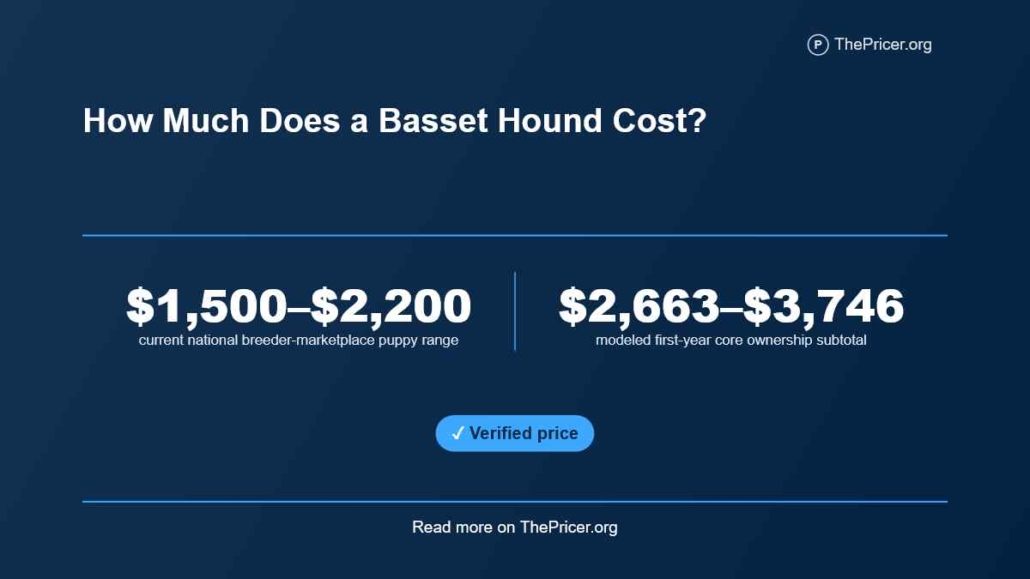
A Basset Hound puppy currently costs about $1,500 to $2,200 through the national breeder marketplace reviewed, while breed-rescue adoption can run from about $150 to $500 depending on age. Premium breeder programs can charge more than the mainstream range.
The purchase price is only the first layer because food, training, routine veterinary care, insurance, ear and skin maintenance, and breed-linked medical risks continue after the dog comes home.
Basset Hounds are heavy-bodied dogs on short legs, commonly weighing about 40 to 65 pounds. Their body shape, long ears, deep chest, and inherited disease risks make some expenses more relevant than generic grooming or toy budgets. A useful ownership estimate needs to separate acquisition price from first-year setup, recurring care, and the possibility of expensive orthopedic, eye, neurologic, or emergency treatment.
Article Highlights
Jump to sections
- National breeder pricing runs about $1,500 to $2,200 (at $30 per hour, earning that amount would take about 1.3 to 1.8 full-time workweeks, before taxes).
- One breed rescue charges $150 to $500 depending on the dog’s age.
- A documented breeder-puppy first-year core subtotal is about $2,663 to $3,746 before several common extras.
- A current dry-food example works out to roughly $418 to $668 per year.
- Breed-specific insurance data rises from about $540 to $600 per year at age one to $1,020 to $1,080 at age seven.
- Health-test records matter because Basset Hounds have breed-specific DNA and eye screening recommendations.
How Much Does a Basset Hound Cost?
Good Dog currently gives a national Basset Hound price of about $1,500 to $2,200 (about 1.3 to 1.8 full-time workweeks at $30 per hour). That is a cleaner current breeder-market anchor than older regional lists that mix backyard breeding, companion puppies, and show prospects. Individual programs can sit above it. One Missouri breeder lists a $700 deposit plus a $3,100 to $3,500 final payment, creating a purchase price of $3,800 to $4,200 before taxes and fees.
Rescue pricing follows a different structure. Basset Hound Rescue of Georgia publishes age-based adoption donations of $500 for puppies up to six months, $400 for dogs from seven months through two years, $350 for adults from three through eight years, and $150 for seniors. The rescue also lists veterinary work that may be performed while in rescue care, including exams, vaccinations, heartworm testing, spay or neuter, and microchipping.
| Acquisition route | Current price signal | What changes the comparison |
|---|---|---|
| Mainstream breeder marketplace | $1,500 to $2,200 | National expected range from the breeder marketplace reviewed |
| Premium breeder example | $3,800 to $4,200 | One documented breeder price before taxes and fees |
| Breed rescue | $150 to $500 | Age-based fee with veterinary work often completed before adoption |
A rescue fee and breeder puppy price do not buy identical things. Compare veterinary records, registration terms, health information, age, and included services before treating the sticker-price gap as the full financial difference.
What the Price Should Buy
A higher breeder price should be connected to records that a buyer can inspect. The American Kennel Club lists five recommended Basset Hound tests from the national breed club. They are an ophthalmologist evaluation plus DNA tests for MPS I, Basset Hound thrombopathia, Lafora disease, and primary open-angle glaucoma.
Those records provide a much stronger basis for comparing breeders than phrases such as champion lines or imported bloodlines.
The Basset Hound Club of America explains that breed-relevant genetic testing covers inherited conditions with very different consequences. Thrombopathia affects platelet function and can increase bleeding risk. Lafora disease is a late-onset neurologic disorder. MPS I is another inherited disease with a DNA test. A breeder who says the parents were tested should be able to identify the dogs and the actual results.
Glaucoma needs extra care in the comparison. The breed club warns on its buyer guidance page that a DNA-clear claim for primary open-angle glaucoma does not cover the more prevalent closed-angle form, for which it says no DNA test is available. The same page rejects “Miniature Basset” as a recognized variety and cautions buyers about marketing claims built around exaggerated “Euro-Basset” traits. Paying more for a label is different from paying for documented health work.
First-Year Cost
A first-year model can be built from current published inputs without pretending that every owner buys the same products. Start with the $1,500 to $2,200 (about 1.3 to 1.8 full-time workweeks at $30 per hour) breeder-puppy range. PetSmart currently charges $149 for a six-week puppy class. Current national veterinary data puts a routine dog visit at $56 to $129. Add the food and age-one insurance models developed later, at about $418 to $668 for food and $540 to $600 for insurance.
The calculated core subtotal is $2,663 at the low end and $3,746 at the high end. The low scenario is $1,500 + $149 + $56 + $418 + $540. The high scenario is $2,200 + $149 + $129 + $668 + $600. This is a ThePricer first-year scenario, not a national all-in average.
Several common expenses remain outside that subtotal. Puppy vaccines, parasite prevention, microchipping when the breeder has not done it, spay or neuter, crate, bed, bowls, leash, collar, toys, licensing, dental care, boarding, and emergencies can all add to the bill. CareCredit’s current veterinary cost table also lists microchipping at $48, dog dental cleaning at about $395, and monthly flea and tick prevention around $36. Those items show why the old “first year costs $1,000+” estimate was too vague to guide a buyer.
Food and Weight
Basset Hounds may be low to the ground, but they are not small dogs by weight. PetMD places the breed at about 40 to 65 pounds and notes that weight control matters because excess body weight adds stress to the joints and spine. A product-specific food model can put a realistic number behind that statement instead of using one flat allowance for every dog.
Purina’s adult feeding chart lists 244 to 292 grams per day for dogs weighing 36 to 50 pounds and 317 to 390 grams for dogs weighing 51 to 75 pounds. Chewy currently lists the matching 35-pound bag at $74.48. A 35-pound bag contains about 15.9 kilograms of food.
At 244 grams per day, a dog uses about 5.6 bags per year, costing roughly $418. At 390 grams per day, use rises to about nine bags, or roughly $668. The calculation is a product example, not a breed-wide food average. Activity, body condition, calorie density, treats, wet food, veterinary diets, and price changes will move the result.
Weight has a second financial effect. PetMD’s Basset Hound health profile identifies hip and elbow dysplasia, arthritis, patellar luxation, and IVDD among breed concerns. Keeping the dog at an appropriate body condition does not remove those risks, but it avoids adding unnecessary mechanical load to an already heavy, short-legged frame.
Ears, Skin, and Grooming
Basset Hounds do not need an elaborate haircut schedule. Their short coat sheds, and routine brushing plus bathing can handle much of the coat work at home. Petco’s bath-only service prices currently start at $32 for medium dogs and $39 for large dogs. Nail trimming starts at $12. Professional grooming can still be useful, but it should be treated as optional service spending rather than a mandatory $200 to $400 annual breed cost.
The ears and skin deserve more budget attention. PetMD identifies Basset Hounds among the breeds with a high rate of ear infections and links the risk to ear structure, moisture, and underlying skin disease. The breed profile also notes allergies, seborrhea, bacterial infections, yeast infections, and skin-fold problems. Recurrent ear or skin disease can turn a low-grooming coat into a recurring veterinary expense through examinations, cytology, medicated cleaners, prescription shampoo, and medication.
Owners who travel should separate grooming from boarding too. Rover’s current national sitter data puts home boarding at about $49.01 per day and house sitting at about $55.45 per day. A seven-day home-boarding stay is about $343.07 at that national figure. Travel care is optional, but for households that use it several times a year, it can exceed the dog’s salon-grooming budget.
Insurance Costlier With Age
Insurance is one of the clearer long-term changes in the Basset budget. Lemonade’s June 2026 Basset Hound premium data lists about $45 to $50 per month at age one, $50 to $55 at ages three and four, $60 to $65 at age five, and $85 to $90 at age seven. Annualized, the age-one range is $540 to $600, while the age-seven range is $1,020 to $1,080.
Both ends increase by $480 per year between those age examples. That extra amount is larger than the low end of the annual food example developed earlier. A flat lifetime insurance allowance can miss that age effect, especially for a breed with a 12 to 13 year lifespan.
Insurance does not prepay every veterinary service. Deductibles, reimbursement percentages, annual limits, exam-fee coverage, waiting periods, and pre-existing-condition rules affect the owner’s share after a claim. The current pet insurance cost page explains those policy mechanics. A buyer comparing plans should also check whether hereditary and congenital conditions are eligible under the chosen policy because several Basset-specific risks have a genetic component.
Health Risks
 The expensive side of Basset ownership is not routine grooming. It is the possibility of medical problems linked to body structure and inherited disease. The breed’s long back and short legs are associated with IVDD risk. Joint disease can involve hips, elbows, kneecaps, or later arthritis. Eye disease includes glaucoma. Ear and skin disease can recur. These conditions do not affect every Basset Hound, but they are more useful for financial planning than a generic annual “miscellaneous” allowance.
GDV deserves separate attention because Basset Hounds are deep-chested. PetMD’s current GDV guidance identifies the breed as at risk and describes gastric dilatation-volvulus as a life-threatening emergency that almost always requires surgery. A swollen abdomen, repeated unproductive retching, heavy drooling, or rapid deterioration warrants emergency veterinary assessment rather than a cost comparison at home.
The financial point is that one emergency can overwhelm a routine annual budget. A planned annual food bill near $418 to $668 is small next to surgery or hospitalization. Owners can see how emergency exam fees, imaging, stabilization, and hospital care build into the invoice in the current emergency vet cost analysis. Breed testing cannot remove every medical risk, but documented testing can stop a buyer from paying a premium for claims that are not backed by records.
Which Budget Fits?
A breeder puppy and a rescue dog can both fit a household budget, but included care changes the comparison. A $350 adult rescue may already have veterinary evaluation, vaccination history, microchipping, and spay or neuter work recorded. A $1,800 breeder puppy may provide known parentage and health-testing documentation. Age, current health, training needs, and included services shape the next year’s spending.
Training belongs in the choice because Basset Hounds are scent hounds with an independent streak. A $149 group course is modest beside the purchase price, and early leash work can be useful for a dog inclined to follow scent. Readers comparing formats can use current dog training costs to separate group instruction from private behavior work.
Makes sense if
- You can verify the recommended eye and DNA test results behind a breeder’s health claims.
- Your recurring budget can carry food, preventive care, ear and skin maintenance, and rising insurance premiums.
- You can keep a heavy, short-legged dog at an appropriate body condition.
- You have a plan for an emergency bill beyond routine annual spending.
Does not make sense if
- Your budget covers the puppy but not the first-year care that follows.
- You are paying extra mainly for marketing labels such as “Miniature” or exaggerated imported-type claims.
- You expect a short coat to mean no recurring ear, skin, nail, or bathing work.
- You need pet insurance to stay near the age-one premium for the dog’s full life.
Verification checks
- Checked the AKC breed size and behavior profile and confirmed the 40 to 65 pound weight band and the breed’s vocal nature.
- Confirmed the Basset Hound Club of America’s current health resources continue to cover glaucoma, thrombopathia, Lafora disease, MPS I, and IVDD research.
- Cross-referenced the current AKC DNA test list for Basset Hound thrombopathia, POAG, Lafora disease, and MPS I.
Answers to Common Questions
How much does a Basset Hound puppy cost?
Current national breeder-market pricing runs about $1,500 to $2,200. Premium individual breeders can charge above that range.
How much does it cost to adopt a Basset Hound?
The breed-rescue program reviewed charges $150 to $500 depending on age, with several veterinary services often completed while in rescue care.
How much does a Basset Hound cost in the first year?
The documented core breeder-puppy scenario is about $2,663 to $3,746 for purchase, one group class, one routine visit, food, and age-one insurance. Vaccines, preventatives, supplies, spay or neuter, and emergencies remain outside that subtotal.
How much does Basset Hound food cost per year?
The current product-specific dry-food model works out to roughly $418 to $668 per year across a feeding range that covers much of the breed’s adult weight band.
What health tests should a Basset Hound breeder show?
The current national breed-club recommendations include an ophthalmologist evaluation and DNA testing for MPS I, thrombopathia, Lafora disease, and primary open-angle glaucoma.
Disclosure: Educational content, not medical advice. Pricing varies by provider, location, and insurance. Confirm eligibility, coverage, and out-of-pocket costs with a licensed clinician and your insurer. See our methodology and corrections policy.