
How Much Does a Belly Button Piercing Cost?
Updated on | Researched and reviewed by Alec Pow, Founder & Pricing Investigator
Prices, claims, and calculations checked against 14 cited sources. See our research methodology and corrections policy.
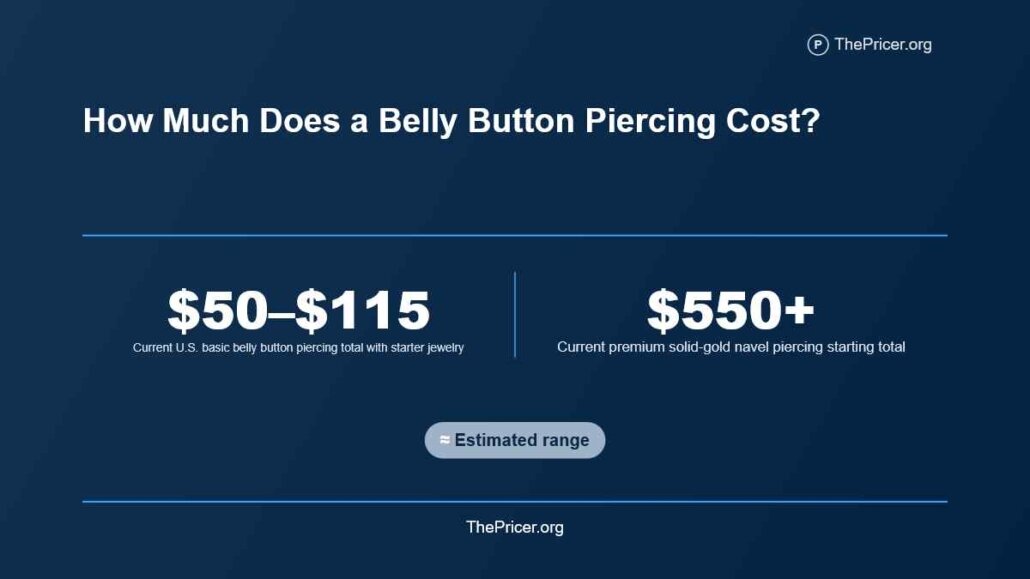
A belly button piercing currently costs about $50 to $115 with basic starter jewelry across the five U.S. studio offers reviewed for this update. A practical titanium setup often lands around $70 to $115, while premium solid-gold jewelry can push the first appointment above $500. The total depends on whether the studio bundles jewelry and saline into the service fee, the material and design of the starter jewelry, and whether your anatomy needs a different navel setup.
The price is only one part of the decision. Navel piercings commonly need many months to heal, and current professional aftercare does not recommend twisting the jewelry or mixing homemade saltwater. A safe budget should cover the piercing, suitable starter jewelry, and any aftercare product that is not already included.
Article Highlights
Jump to sections
- Five current studio offers reviewed here produce basic entry totals from $50 to $115.
- Implant-grade titanium setups in the reviewed offers run about $70 to $115.
- One premium studio lists a $50 service fee plus gold navel jewelry starting at $500.
- A lower piercing fee does not always mean a lower all-in price because jewelry may be separate.
- Navel piercings commonly need about 6 to 9 months or longer to heal.
- Sterile saline wound wash is preferred over homemade saltwater, and the jewelry should not be rotated during cleaning.
How Much Does a Belly Button Piercing Cost?
Current studio menus show why one national average can be misleading. Live By The Sword pricing lists a navel piercing at $50 with its standard steel jewelry included. The Piercings Club service is $70 and includes implant-grade titanium starter jewelry, consultation, the piercing service, and aftercare guidance.
Other studios separate labor from jewelry. Pierce Me Studio pricing lists a $60 navel service, titanium jewelry from $30, and a full-size saline spray included, creating a starting total of $90. Ahimsa navel pricing lists a $45 service fee plus titanium from $60, for a starting total of $105 before aftercare.
So Gold navel pricing lists a $50 service fee and titanium curved barbells from $65, putting its basic titanium start at $115. These five offers form a current observed span, not a statistically representative U.S. average.
| Current studio example | Service fee | Basic starter jewelry | Entry total |
|---|---|---|---|
| Live By The Sword | Included in $50 | Standard steel included | $50 |
| The Piercings Club | Included in $70 | Implant-grade titanium included | $70 |
| Pierce Me Studio | $60 | Titanium from $30 | $90 |
| Ahimsa Piercing Studio | $45 | Titanium from $60 | $105 |
| So Gold Studios | $50 | Titanium from $65 | $115 |
The table also explains why a broad body piercing cost range cannot replace a navel-specific quote. The service fee, starter jewelry, and aftercare bundle need to be compared together.
Jewelry Can Cost More
Starter jewelry can change the bill more than the piercing labor. At So Gold Studios, the cited $50 service fee combines with a titanium curved barbell starting at $65 for a $115 basic setup. Its gold decorative barbells start at $500, so the same $50 service fee can produce an opening total of at least $550.
That creates a useful matched comparison. Moving from the studio’s entry titanium setup to its entry gold setup adds at least $435. The gold starting total is about 4.8 times the titanium starting total, even though the piercing labor has not changed. Jewelry choice is the dominant price variable in that scenario.
The same logic applies at less expensive studios. A quoted piercing fee may cover only the piercer’s work, while a bundled offer may include both labor and starter jewelry. Ask whether the displayed price includes the curved barbell before comparing shops. Also ask whether decorative ends are part of the starting price or purchased separately.
A tip is optional and should not be treated as a mandatory piercing charge. Sales tax on jewelry can also vary by location. Those amounts can raise the amount paid at checkout, but they should stay separate from the core service-and-jewelry comparison.
The First Appointment
A useful quote names the piercing fee, starter jewelry, and aftercare. Pierce Me Studio’s cited offer is a clean worked example because its $60 service includes a full-size saline spray while titanium jewelry starts at $30. The minimum documented appointment total is $60 + $30 = $90 before optional tip and any local tax on jewelry.
Compare that with Ahimsa’s cited structure. Its service fee is lower at $45, but starter titanium begins at $60, making the starting total $105 before aftercare. The studio with the lower labor charge is $15 more expensive at the documented entry level because the jewelry price changes the result.
This is the price trap to watch. Comparing only the words “piercing fee” can make the wrong shop look cheaper. Ask for the first-appointment total using the exact starter jewelry the piercer recommends for your anatomy.
Aftercare may be included, sold separately, or obtained elsewhere. Professional jewelry changes during healing can also create another charge if the original bar needs a different length or style. There is no universal $50 removal fee and no responsible fixed estimate for medical treatment if a complication occurs. Those costs depend on the studio, healthcare setting, insurance, and the actual problem.
Anatomy and the Appointment
Navel piercings are anatomy-dependent. A current navel anatomy guide explains that tissue depth, rim shape, and how the navel behaves with movement can determine whether a traditional placement, floating navel, or no piercing is the better fit. A reputable piercer should inspect the tissue and how the navel changes when you sit, stand, and bend before committing to jewelry.
The procedure itself should use a sterile, single-use piercing needle rather than a household pin. Current Mayo Clinic piercing guidance advises choosing a trained piercer who uses a fresh sterile disposable needle and properly sterilizes reusable equipment. Pain is subjective, but the needle pass is brief. Tenderness and swelling can continue afterward while the tissue begins healing.
Do not choose a studio from price alone. Check how the piercer evaluates anatomy, what jewelry material is used, whether the size leaves room for swelling, and how reusable tools are sterilized. A nose piercing price can look similar on a menu, but the anatomy, jewelry shape, and healing demands are different.
The appointment should also include written or verbal aftercare. If a shop cannot tell you the jewelry material, does not open a sterile needle for the procedure, or treats every navel as suitable for the same placement, the low price does not make the service comparable.
Healing Takes Months
Navel piercings heal much more slowly than the old 6-to-8-week estimate. APP healing guidance contrasts a tongue piercing’s shorter healing period with a navel piercing that commonly takes 6 to 9 months or longer. A calendar date alone does not prove that the channel is fully healed.
 That long healing window changes the ownership cost. Starter jewelry may need to stay in place for months, and an early jewelry change should be handled by a qualified piercer if the size, style, or material causes a problem. Buying decorative jewelry immediately can be wasted spending if the piercing has not healed enough for it.
Healing can look uneven. Mild crusting, localized color changes, and periods of irritation can occur while the tissue matures. Friction from waistbands, snagging, pressure, and repeated handling can prolong irritation. Healing takes time.
Wait for the piercer to confirm that the piercing is mature enough before switching to heavy dangles or other decorative pieces. A jewelry purchase that is safe for a healed piercing may not be appropriate for a fresh one, which is another reason the initial jewelry budget should focus on fit and material rather than decoration.
Aftercare
Current APP aftercare guidance recommends sterile saline wound wash with 0.9% sodium chloride and no unnecessary additives. It no longer recommends mixing homemade sea-salt solution because mixtures can become too concentrated and irritate healing tissue.
The jewelry should not be twisted, spun, or rotated during cleaning. APP notes that movement is unnecessary and can irritate the piercing. Wash your hands before touching the area, spray with sterile saline as directed, and gently dry with clean disposable material. Avoid harsh products such as alcohol, hydrogen peroxide, and strong antiseptics unless a healthcare professional has instructed otherwise.
Submersion is another concern. APP advises avoiding pools, lakes, oceans, and hot tubs while a body piercing heals, or protecting the area with an appropriate waterproof film dressing when needed. Showering is different from soaking and does not require pointing water away from the piercing.
Do not buy the cheapest aftercare product solely to save a few dollars. Check the ingredient label. A sterile wound-wash saline with the recommended concentration is a better comparison point than contact-lens solution, nasal spray, or a homemade mixture. Good aftercare is inexpensive relative to premium jewelry, but it has a much larger role in the healing process.
Starter Jewelry Standards
The label “surgical steel” by itself does not prove that a piece is suitable for a fresh piercing. APP jewelry standards identify certified implant-grade steel and titanium specifications, including ASTM F138 steel and ASTM F136 or F67 titanium, along with suitable niobium and solid nickel-free gold that meets the stated requirements.
For gold, the APP material guidance supports solid 14k to 18k white or yellow gold that is suitable for initial wear and made without problematic nickel exposure. Plated or gold-filled jewelry should not be treated as equivalent to solid jewelry made for fresh piercings. Price alone cannot establish material quality.
Titanium is a common starter choice because implant-certified material is lightweight and can be made in properly finished body-jewelry designs. A curved barbell is common for traditional navel placement, while anatomy may call for a different configuration. Ask the piercer for the material specification and the jewelry maker if you want to verify what you are buying.
Decorative jewelry can wait. The same budgeting principle applies to tattoos and other body modification, where the cheapest visible option may not include the preparation and material quality that matter. Readers comparing another form of body art can see current tattoo pricing separately rather than treating piercing and tattoo fees as interchangeable.
Problems and Choosing a Studio
Body piercing breaks the skin and carries real risks. Mayo Clinic lists allergic reactions, skin infection, keloids, tearing, and bloodborne disease from contaminated equipment among possible complications. Worsening redness, pain, swelling, or pus can be reasons to seek medical advice rather than assuming every problem is normal healing.
An itchy red rash can also reflect irritation or a material sensitivity rather than infection. Current APP troubleshooting guidance separates common irritation problems from infection and notes that jewelry material, size, style, or aftercare can be involved. If infection is suspected, do not automatically remove the jewelry without discussing that decision with a healthcare professional because closure can complicate drainage.
Makes sense if
- You have anatomy that an experienced piercer considers suitable for the placement.
- You can budget for quality starter jewelry rather than only the service fee.
- You are prepared for a healing period measured in months.
- You can keep waistbands, snagging, and unnecessary handling away from the piercing while it heals.
Does not make sense if
- You are choosing a studio only because it has the lowest advertised fee.
- You want to change to heavy decorative jewelry within a few weeks.
- You plan to rotate the jewelry or use harsh cleaning products during healing.
- You cannot follow up with a piercer or healthcare professional if a problem develops.
A good studio should be able to explain its sterile setup, jewelry specifications, anatomy assessment, and aftercare policy before you pay. That difference matters.
Answers to Common Questions
How much does a belly button piercing cost with jewelry?
The five current U.S. studio offers reviewed here produce basic entry totals of about $50 to $115. Premium gold can move the first appointment above $500.
How long does a belly button piercing take to heal?
A navel piercing commonly needs about 6 to 9 months or longer. Some people may need more time before the channel is fully mature.
Should I twist a belly button ring while cleaning it?
No. Current professional aftercare guidance says rotating or moving the jewelry is unnecessary and can irritate a healing piercing.
What is the best starter material for a navel piercing?
Implant-certified titanium is a strong common choice. Suitable implant-grade steel, niobium, and properly made solid gold can also meet professional initial-jewelry standards.
Is a tip part of the piercing price?
No. A tip is discretionary and should be kept separate from the required service, starter-jewelry, and aftercare costs when comparing studios.
Disclosure: Educational content, not medical advice. Pricing varies by provider, location, and insurance. Confirm eligibility, coverage, and out-of-pocket costs with a licensed clinician and your insurer. See our methodology and corrections policy.