
How Much Does Boat Rewire Cost?
Updated on | Written by Alec Pow
This article was researched using 12 sources. See our methodology and corrections policy.
A professional boat rewire commonly costs about $5,000 to $30,000+ when the job reaches a substantial portion of the vessel’s electrical system. Smaller panel, wiring-bundle, or limited-circuit projects can stay below $5,000, while a complex yacht with AC and DC distribution, shore power, chargers, inverters, large battery banks, pumps, electronics, and difficult access can move beyond $30,000. A current marine repair estimate places complex electrical rewiring around $5,000 to $30,000+.
Labor usually decides whether the project lands near the bottom or top of that range. A 2026 marine electrician guide gives a broad published rate of $95 to $150 per hour. Current service shops can run higher. Neptune Marine Service posts $175 per hour, while Next Level Marine charges $250 for a mobile visit including the first diagnostic hour and $175 per hour afterward.
Boat length matters, but it is a poor shortcut by itself. The real invoice follows the number of circuits, wire routes, panel condition, access behind liners and cabinetry, battery and charging equipment, AC shore-power work, previous-owner modifications, and the hours needed to trace, remove, terminate, label, and test the system.
Article Highlights
Jump to sections
- A substantial professional boat rewire can land around $5,000 to $30,000+ (at $30 per hour, earning that amount would take about 1 to 5.8 months of full-time work, before taxes), with simpler partial jobs below that level and complex yachts capable of exceeding it.
- Current published marine labor examples run from about $95 to $175 per hour, with mobile call-out charges sometimes added.
- At $175 per hour, 40 labor hours cost $7,000, 80 hours cost $14,000, and 120 hours cost $21,000 before parts.
- Access can cost more than wire. Fifteen extra tracing or access hours at $175 per hour add $2,625.
- ABYC’s E-11 standard covers AC and DC electrical systems on boats, while federal USCG electrical requirements are a separate compliance layer.
- The common “3% voltage-drop rule” does not apply to every circuit. Published ABYC-based guidance uses 3% for specified critical circuits and permits 10% for many non-critical circuits.

How Much Does It Cost to Rewire a Boat?
| Professional labor scenario | At $150 (about 5 hours of work at $30 per hour)/hour | At $175/hour | What it can represent |
|---|---|---|---|
| 10 hours | $1,500 | $1,750 | Limited troubleshooting, wiring-bundle work, or several circuits |
| 40 hours | $6,000 | $7,000 | Substantial small-boat work or a contained panel and circuit refit |
| 80 hours | $12,000 | $14,000 | Large DC rewire or more involved cruiser project |
| 120 hours | $18,000 | $21,000 | Complex multi-system refit before material and equipment costs |
These are labor calculations, not national project averages. Wire, terminals, breakers, fuse blocks, distribution panels, battery cable, switches, heat-shrink, supports, labels, conduit, chargers, inverters, batteries, and replacement electronics can sit on top. A boatyard may also charge travel, marina access, haul-out, or subcontractor costs.
What You’re Actually Rewiring
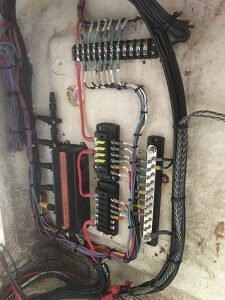
A full boat rewire is not simply pulling new cable from bow to stern. The electrical contractor may have to identify undocumented circuits, remove abandoned conductors, rebuild DC distribution, replace damaged protection devices, correct battery and charging connections, create new routes, label conductors, and test each load after installation. Boats with shore power add an AC system whose protection and grounding requirements differ from the DC side.
The American Boat & Yacht Council lists separate marine electrical standards including E-11 for AC and DC systems, E-2 for cathodic protection, E-10 for storage batteries, E-13 for lithium-ion batteries, and standards covering chargers, inverters, galvanic isolators, and other components. That is one reason a vague instruction to “ground the boat” can be misleading. DC negative, AC safety grounding, bonding, cathodic protection, and lightning systems are distinct parts of marine electrical design.
Federal requirements are another layer. The USCG electrical compliance guide points to 33 CFR 183.401 through 183.460 and warns that the guide is not a complete engineering manual. A professional quote may account for corrections that are not obvious when the owner first asks only for new wire.
Boat Length Is a Bad Shortcut
A 24-foot open fishing boat can be electrically simple. A similar-length boat packed with trolling-motor banks, pumps, livewells, lighting, sonar, radar, audio, chargers, and custom accessories can have far more circuits. The same problem grows on cruisers because the electrician may also encounter cabins, refrigeration, water systems, windlasses, generators, inverters, shore power, and several battery banks.
Wire footage can become much larger than boat length suggests. A detailed Westsail 32 rewire account reported using about 600 feet of wire, 300 to 400 ring terminals, 100 feet of chafe protection, and several hundred hours of owner labor. The project exceeded $5,000 (about 4.2 full-time workweeks at $30 per hour), although that historical total included non-electrical restoration items and should not be treated as a current professional quote.
The useful lesson is scale, not the old dollar amount. A 32-foot boat can require hundreds of feet of conductors because every circuit has a route out to the load and a return path. Each termination, support point, label, fuse, breaker, and inaccessible compartment can create additional labor.
Access Is the Hidden Cost
Wire itself can be cheaper than the time required to reach it. Current retail examples put 100 feet of 14 AWG marine wire at $25.09 and 100 feet of 12 AWG marine wire at $44.99. Those spools are only part of a proper wiring bill, but they show why labor can dominate.
At a $175 per hour shop rate, four hours of labor cost $700. That is more than 600 feet in a simple example consisting of four 100-foot 14 AWG spools and two 100-foot 12 AWG spools, which total $190.34. The comparison is not a wiring specification because an actual vessel needs gauges selected for its circuits. It shows the economics of access: a few hours spent removing panels, tracing mystery conductors, or working behind cabinetry can outweigh a large quantity of ordinary small-gauge wire.
This is where old boats can surprise owners. Previous repairs may have created splices, abandoned runs, unlabeled conductors, or equipment whose wiring no longer matches the panel. If a quote assumes open access and the technician instead spends 15 extra hours tracing and opening routes, the bill rises by $2,625 at $175 per hour.
A Worked 32-Foot Rewire Budget
Consider a planning scenario for a 32-foot cruiser that needs 70 hours of professional electrical labor. At the published $175 per hour rate used by multiple current mobile marine services, labor alone is $12,250.
Now add a small documented component basket. Four 100-foot spools of 14 AWG marine wire at $25.09 each cost $100.36. Two 100-foot spools of 12 AWG at $44.99 each add $89.98. A current 8-position breaker panel listing is $269.99, and a 12-circuit fuse block is $69.99.
Those cited items bring the documented subtotal to $12,780.32. If difficult access adds the 15 extra hours from the prior example, another $2,625 pushes the scenario to $15,405.32. That still excludes larger battery cable, terminals, individual fuses or breakers, heat-shrink, supports, labels, taxes, and any charger, inverter, battery, shore-power, or electronics replacement. The math explains why an owner can start with several hundred dollars of visible electrical hardware and still receive a five-figure professional quote.
Three Boat Rewire Scenarios
Simple open boat: 30 hours at $150 per hour produces $4,500 in labor. Add a modest panel, protection hardware, wire, and terminals and a substantial small-boat project can move above $5,000 even without an AC system.
Mid-size cruiser: 70 hours at $175 per hour produces the $12,250 labor figure used in the worked example. Access, multiple battery banks, pumps, electronics, and a larger distribution system can place the completed invoice in the mid-five figures.
Complex yacht: 140 hours at $175 per hour equals $24,500 in labor before parts. Add AC and DC panels, large cables, shore-power protection, chargers, inverters, batteries, and high-current equipment and a $30,000+ total is easy to reach. Major refits can run beyond that planning level.
When a Full Rewire Makes Sense
Makes sense if:
- Large parts of the existing system are undocumented, damaged, corroded, or built from repeated owner modifications.
- A major refit already has cabinetry, panels, or interior access opened, reducing duplicate access labor.
- New charging, battery, navigation, or comfort equipment requires a distribution system the old installation cannot support.
- A qualified marine electrician finds widespread deficiencies that make repeated isolated repairs poor value.
Does not make sense if:
- The fault is confined to one documented circuit and the rest of the system tests correctly.
- The quote assumes a complete replacement before the existing system has been inspected and scoped.
- The vessel is near disposal or sale and the repair cost cannot be justified by safe continued use or value.
- The proposed savings depend on an owner performing unfamiliar AC, shore-power, grounding, bonding, or safety-critical electrical work.
What We Verified
- Checked: current ABYC-based wiring guidance uses a 3% maximum voltage-drop table for specified critical circuits and a 10% table for many non-critical loads.
- Confirmed: current marine-service pages publish labor at $175 per hour and show that mobile service calls can include separate minimum or first-visit charges.
- Cross-referenced: ABYC’s current standards list separates AC/DC electrical systems, batteries, lithium batteries, cathodic protection, chargers and inverters, galvanic isolators, and lightning protection into different standards.
- Verified: the USCG compliance material covers federal electrical requirements but explicitly says its guide is not a complete boat-system engineering manual.
Related Boat Repair Costs
Electrical work is often uncovered during a larger restoration. If interior or deck access is already being opened, compare the timing with boat upholstery repair or fiberglass boat repair so the same areas are not dismantled twice. Boats kept out of the water may also need a separate boat lift budget unrelated to the electrical quote.
Ask the electrician to separate diagnostic labor, removal, new installation, major hardware, and optional equipment on the estimate. Also ask how added work will be authorized if hidden conditions appear. A quote with a lower hourly rate can finish higher if access assumptions are wrong or the scope expands after the old panels come apart.
Answers to Common Questions
How much does it cost to completely rewire a boat?
A substantial professional rewire can cost about $5,000 to $30,000+. A simple small boat may stay below that range, while a yacht with extensive AC and DC systems can exceed it.
How much does a marine electrician charge per hour?
Current published examples run from about $95 to $175 per hour. Some mobile or specialized work carries a call-out charge, higher diagnostic rate, or emergency premium.
Is boat wiring more expensive than the wire itself?
Often, yes. Routing, access, tracing, terminations, circuit protection, labeling, testing, and correcting old work can make labor much larger than the cost of ordinary small-gauge wire.
Does ABYC require 3% voltage drop on every boat circuit?
No. Published ABYC-based guidance uses 3% for specified critical circuits and allows 10% for many non-critical circuits. Circuit design should be based on the applicable standard rather than one blanket percentage.
Can I save money by rewiring the boat myself?
There may be owner-performed tasks that a marine electrician agrees are suitable, such as preparing access or documenting existing equipment. AC shore power, grounding, bonding, high-current battery work, and safety-critical circuits should not be treated as generic DIY cost-saving jobs.
Disclosure: Educational content, not financial advice. Prices reflect public information as of the dates cited and can change. Confirm current rates, fees, taxes, and terms with official sources before purchasing. See our methodology and corrections policy.