
How Much Does a Brick Mailbox Cost?
Updated on | Researched and reviewed by Alec Pow, Founder & Pricing Investigator
Prices, claims, and calculations checked against 8 cited sources. See our research methodology and corrections policy.
A professionally installed brick mailbox currently costs about $825 to $1,275 for a typical project, with an average near $1,050. Prebuilt brick mailboxes commonly cost about $600 to $1,200 installed, while custom site-built masonry mailboxes generally run $700 to $1,500. Elaborate designs with multiple boxes, lighting, large vault inserts, planters, stone accents, or substantial site work can exceed $1,500 to $3,000+.
Before spending money on bricks or hiring a mason, check your local road authority, city or county building department, HOA, and local Post Office. A brick mailbox can meet USPS mailbox-height requirements and still be prohibited locally because a rigid masonry column can become an unyielding roadside collision hazard.
Article Highlights
Jump to sections
- A typical professionally installed brick mailbox currently costs about $825 to $1,275.
- Prebuilt brick mailboxes commonly run $600 to $1,200 installed.
- Custom site-built brick mailboxes generally cost $700 to $1,500.
- At the midpoint of current ranges, going custom adds about $200, or 22.2%, over a prebuilt installation.
- Masonry labor currently runs roughly $55 to $125 per hour for additional custom work in one national cost guide.
- Permits can add about $45 to $145, while electrical permits may apply if the mailbox includes wired lighting.
- USPS generally places curbside mailboxes 41 to 45 inches high with the door 6 to 8 inches back from the curb or road edge.
- Some cities and state road agencies prohibit rigid brick or stone mailbox structures in the public right-of-way.
- A locking mailbox insert can improve mail security, but a brick surround alone does not prevent mail theft.

How Much Does a Brick Mailbox Cost?
| Brick mailbox project | Current price range | What the price generally represents |
|---|---|---|
| Typical professional installation | $825 to $1,275 | Current national project range |
| Prebuilt brick mailbox | $600 to $1,200 | Delivery and installation on a prepared/new base |
| Custom site-built brick mailbox | $700 to $1,500 | Built on-site to selected design |
| Real brick or stone project | $600 to $1,500 | Current masonry project range |
| Faux-brick project | $650 to $1,700 | Lightweight masonry-look construction |
| Common brick mailbox repair | $150 to $400 | Cracks, mortar, or minor brick damage |
Angi’s July 2026 cost data puts a professionally installed brick mailbox at $825 to $1,275, with an average project cost of approximately $1,050. Its current estimates place real brick or stone projects around $600 to $1,500.
HomeGuide’s current brick-mailbox cost guide lists prebuilt brick mailboxes at $600 to $1,200 installed and custom site-built designs at $700 to $1,500.
Those ranges are more useful than estimating a mailbox from the price of 1,000 bricks. A typical mailbox uses only a fraction of that quantity, while labor, foundation work, brick matching, minimum material purchases, delivery, the mailbox insert, and site conditions can matter more than the commodity price of brick.
Check the Rules Before You Build
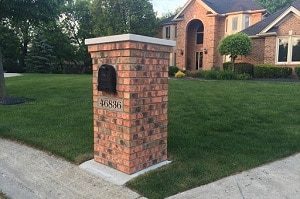
A brick mailbox is unusual among home-improvement projects because the most important question may be whether you are legally allowed to build it where the mail carrier needs it.
The USPS curbside mailbox guidance generally calls for the bottom of the mailbox or mail-entry point to be 41 to 45 inches above the road surface. The mailbox door is generally positioned 6 to 8 inches back from the curb.
USPS also says the best supports are stable but able to bend or fall away if struck by a vehicle and specifically warns against unyielding supports such as concrete posts. A large brick column raises the same roadside-safety concern.
The Postal Service’s formal curbside mailbox standard also tells customers to contact their local Post Office before installing a mailbox so the placement and height can be verified for the particular road.
Meeting those postal dimensions does not automatically make a brick structure legal. USPS regulates delivery requirements, while state and local road authorities can regulate fixed structures placed in a public right-of-way.
Some Places Prohibit Brick Mailboxes
Local rules vary dramatically.
For example, the City of West Des Moines currently says it does not permit heavy stone or brick mailbox structures in the right-of-way because they can create a collision hazard. The city encourages owners of existing masonry mailboxes to replace them with breakaway designs.
North Carolina rules provide another example. Current NCDOT guidance prohibits brick columns and other rigid mailbox supports within the right-of-way on certain state highway additions and requires non-rigid mailbox posts instead.
Other communities permit masonry mailboxes but transfer much of the risk back to the homeowner. The Village of Homer Glen’s masonry mailbox permit and waiver explicitly warns that masonry mailboxes do not easily give way on impact and can create a dangerous roadside obstacle. Applicants must agree to indemnification provisions relating to the structure.
The Federal Highway Administration also discusses heavy and hazardous mailboxes in its roadside-design guidance and promotes crashworthy or yielding roadside features. The FHWA summary of the Roadside Design Guide specifically identifies heavy mailboxes as a roadside-safety concern.
For that reason, obtain the answer to these questions before ordering materials:
- Is a rigid masonry mailbox permitted in the public right-of-way?
- Does the city or county require a permit?
- Does the road authority require a breakaway support?
- Are there maximum width or height rules?
- Does the HOA restrict mailbox design?
- Where does the local Post Office want the mailbox opening positioned?
What Does Going Custom Really Add?
Current HomeGuide ranges let us normalize the cost of prebuilt and custom brick mailboxes rather than simply saying one is “more expensive.”
Prebuilt installed range:
$600 to $1,200
Midpoint:
($600 + $1,200) ÷ 2 = $900
Custom site-built range:
$700 to $1,500
Midpoint:
($700 + $1,500) ÷ 2 = $1,100
Difference:
$1,100 – $900 = $200
Percentage premium:
$200 ÷ $900 = 22.2%
At the midpoint of these current published ranges, choosing a custom site-built mailbox adds about $200, or 22%, over a prebuilt brick installation.
That relatively modest midpoint difference can make custom construction attractive when the goal is to match the brick, mortar color, trim, or architectural details of the house. The actual quote can differ substantially if the design includes complex arches, multiple mailboxes, large stone caps, planters, or electrical work.
Faux Brick Is Not Cheaper
Lightweight faux masonry sounds like it should always save money. Current project ranges show why that assumption should be checked rather than accepted.
Angi currently gives:
Real brick or stone: $600 to $1,500
Midpoint:
($600 + $1,500) ÷ 2 = $1,050
Faux brick:
$650 to $1,700
Midpoint:
($650 + $1,700) ÷ 2 = $1,175
Difference:
$1,175 – $1,050 = $125
Percentage:
$125 ÷ $1,050 = 11.9%
The midpoint of the current faux-brick range is therefore about 12% higher than the midpoint for real brick or stone.
This does not mean faux brick will always cost more. Product design, shipping, installation method, foundation requirements, and local labor can change the comparison. It shows that faux brick should be evaluated for weight, installation speed, safety, and appearance rather than assumed to be the cheapest option.
What Changes the Brick Mailbox Price?
Prebuilt versus custom construction is a major factor. A prebuilt column can arrive substantially finished, while custom masonry is laid at the property.
Foundation conditions matter because a heavy masonry structure needs adequate support. Excavation, poor soil, drainage problems, frost conditions, or removal of an existing concrete base can increase labor.
Brick matching can add expense when the goal is to match an older house. A commonly stocked brick is usually easier to source than an unusual discontinued color or size.
Mailbox inserts range from inexpensive standard metal boxes to larger locking or vault-style units.
Multiple mailboxes require wider structures and more masonry work. Local rules become especially important because a wider fixed object can create an even larger roadside obstruction.
Curves, arches, corbels, stone caps, and detailed brickwork add masonry labor.
Lighting can require electrical cable, trenching, fixtures, a transformer or switch, and possibly a separate electrical permit.
Current Angi data puts masonry labor for additional custom work at approximately $55 to $125 per hour, although many brick-mailbox contractors quote the complete project rather than billing strictly by the hour.
For comparison with heavier masonry projects around a home, see our guide to block foundation repair costs.
Beyond the Mason’s Quote
Permit fees: Angi currently estimates a brick-mailbox building permit at around $45 to $145. Requirements differ by jurisdiction.
Electrical permits: Wired mailbox lighting can require another permit as well as electrical labor.
Old mailbox removal: Removing and disposing of an existing mailbox can add around $45 to $90 in current Angi estimates.
Mailbox insert upgrades: Current inserts can range from inexpensive standard boxes to locking or high-capacity vault inserts costing hundreds of dollars.
Lighting and wiring: HomeGuide currently estimates a basic mailbox light around $50 to $100, while running new wiring from the house can bring the lighting portion to roughly $150 to $450.
Planters and decorative elements: Built-in planters, address plaques, reflectors, caps, keystones, and specialty masonry increase the project price.
Road-authority requirements: A municipality may require a special permit, waiver, relocation, or a completely different breakaway design. Discovering that after masonry work begins can be extremely expensive.
Damage liability: A masonry mailbox in a right-of-way may not be reimbursed at full replacement value if damaged by road construction or a snowplow. Some jurisdictions also warn owners about liability associated with rigid structures.
For other exterior projects where foundation and finish choices can move the total substantially, compare the cost of an in-ground hot tub setup.
DIY Brick Mailbox Cost
DIY construction can reduce labor expense, but it should begin with regulatory approval rather than a trip to the masonry supplier.
HomeGuide currently estimates basic materials for a conventional brick mailbox at about $100 to $340, depending on the design. Its example uses roughly 150 to 200 bricks, mortar, a concrete base, framing lumber, and a mailbox insert.
Tools can change the economics substantially. A homeowner may need:
- Shovel and digging tools
- Wheelbarrow
- Masonry trowel
- Level
- Concrete forms
- Masonry saw or suitable cutting equipment
- Mixing equipment
- Eye, hand, hearing, and respiratory protection
Buying or renting tools can erase part of the DIY savings, especially for a one-time project.
A custom masonry mailbox with a new footing generally takes about 2 to 3 days in current professional estimates because the footing must be installed and allowed to develop enough strength before the remaining masonry work proceeds. A beginner may need considerably longer.
DIY also carries a costly failure mode: a leaning or poorly bonded column can require partial or complete reconstruction. The foundation, drainage, brick bonds, mortar joints, cap, mailbox insert, and dimensions all need to work together.
Maintenance and Repair Costs
A well-built brick mailbox can last for decades, but it should not be treated as maintenance-free or promised a universal 50-year lifespan.
Inspect the structure periodically for:
- Cracked or missing mortar
- Loose or spalling bricks
- Movement or leaning
- Water penetration around the cap
- Freeze-thaw damage
- Rust or failure of the mailbox insert
- Vehicle or snowplow impact damage
Angi currently puts common brick-mailbox repairs around $150 to $400. More serious leaning or impact damage can cost more and may make full replacement more sensible.
There is no good reason to assume every brick mailbox needs complete mortar replacement every five to ten years or sealing every one to two years. Maintenance should follow the condition of the masonry, climate, brick type, mortar, and any recommendations that apply to the specific construction.
The original metal mailbox insert may also need replacement long before the surrounding masonry fails.
Three Brick Mailbox Cost Scenarios
Case 1: Basic prebuilt installation
A homeowner chooses a prebuilt brick mailbox at the midpoint of the current $600 to $1,200 installed range.
($600 + $1,200) ÷ 2 = $900
A permit at the midpoint of the current $45-$145 estimate adds:
($45 + $145) ÷ 2 = $95
The illustrative project becomes about:
$900 + $95 = $995
before unusual site preparation or upgrades.
Case 2: Custom mailbox with wired lighting
A custom mailbox is priced at the current midpoint of $1,100. The homeowner adds new mailbox lighting and wiring at the midpoint of HomeGuide’s $150 to $450 range:
($150 + $450) ÷ 2 = $300
Total:
$1,100 + $300 = $1,400
Permit costs or premium mailbox inserts could move the total higher.
Case 3: DIY materials
A homeowner buys materials at the midpoint of the current $100 to $340 DIY-material range:
($100 + $340) ÷ 2 = $220
If $150 in tool rental or purchases is needed:
$220 + $150 = $370
That can still be much cheaper than professional construction, but only if the homeowner already has the masonry skills to produce a safe, level, code-compliant structure and local rules actually permit it.
Is a Brick Mailbox Worth It?
A brick mailbox can be worthwhile for homeowners who want masonry that matches the house, prefer the appearance of a substantial entrance feature, and live somewhere that permits a rigid structure at the mailbox location.
It can improve curb appeal, but there is not strong evidence that a $1,000 brick mailbox reliably raises a home’s resale value by a measurable amount. It should therefore be treated primarily as a design and durability purchase rather than an investment with a guaranteed financial return.
Brick also does not automatically make the mail itself secure. A standard unlocked metal insert surrounded by masonry can still be opened normally. If mail theft is the concern, specify a USPS-compatible locking insert and understand how outgoing mail and package delivery will work.
The most expensive brick mailbox is also not automatically the best one. A lighter breakaway or faux-masonry system may be the better solution on a road where rigid structures are prohibited or where collision exposure is a concern.
If the mailbox is part of a larger exterior renovation, costs can add up quickly alongside projects such as hardwood stair installation or other architectural upgrades around the property.
Answers to Common Questions
How much does a brick mailbox cost installed?
A typical professionally installed brick mailbox currently costs about $825 to $1,275. Prebuilt installations commonly run $600 to $1,200, while custom site-built mailboxes generally cost about $700 to $1,500.
How much does it cost to build a brick mailbox yourself?
Current basic material estimates are roughly $100 to $340, but tool purchases or rentals, permits, disposal, and mistakes can increase the DIY total substantially.
How much more does a custom brick mailbox cost?
Using current midpoint prices, a custom mailbox costs about $1,100 versus $900 for prebuilt installation, a difference of approximately $200 or 22%.
Are brick mailboxes legal?
Not everywhere. Some cities and state road agencies prohibit heavy brick, stone, or other rigid mailbox structures in the public right-of-way because they can become roadside collision hazards. Other communities allow them with permits or liability waivers. Check locally before construction.
What height should a brick mailbox be?
USPS generally calls for the bottom of the mailbox or mail-entry point to be 41 to 45 inches above the road surface, with the mailbox door about 6 to 8 inches behind the curb or road edge. Contact the local Post Office before installation because road conditions can change the required position.
Does a brick mailbox increase home value?
It can improve curb appeal, but there is no reliable evidence that a brick mailbox produces a predictable dollar-for-dollar increase in resale value. Buy it primarily for appearance, functionality, and durability rather than guaranteed ROI.
Is a brick mailbox more secure?
The masonry surround is physically durable, but the security of the mail depends mainly on the mailbox insert. A locking insert can offer additional theft resistance, while a normal unlocked box remains accessible regardless of the brick surrounding it.
How long does a brick mailbox last?
Properly designed masonry can last for decades, but lifespan depends on foundation stability, climate, freeze-thaw exposure, water management, mortar quality, traffic impacts, and maintenance. The metal mailbox insert may need replacement before the surrounding brickwork does.
Disclosure: Educational content, not financial advice. Prices reflect public information as of the dates cited and can change. Confirm current rates, fees, taxes, and terms with official sources before purchasing. See our methodology and corrections policy.