
How Much Does Broken Axle Repair Cost?
Updated on | Written by Alec Pow
This article was researched using 8 sources. See our methodology and corrections policy.
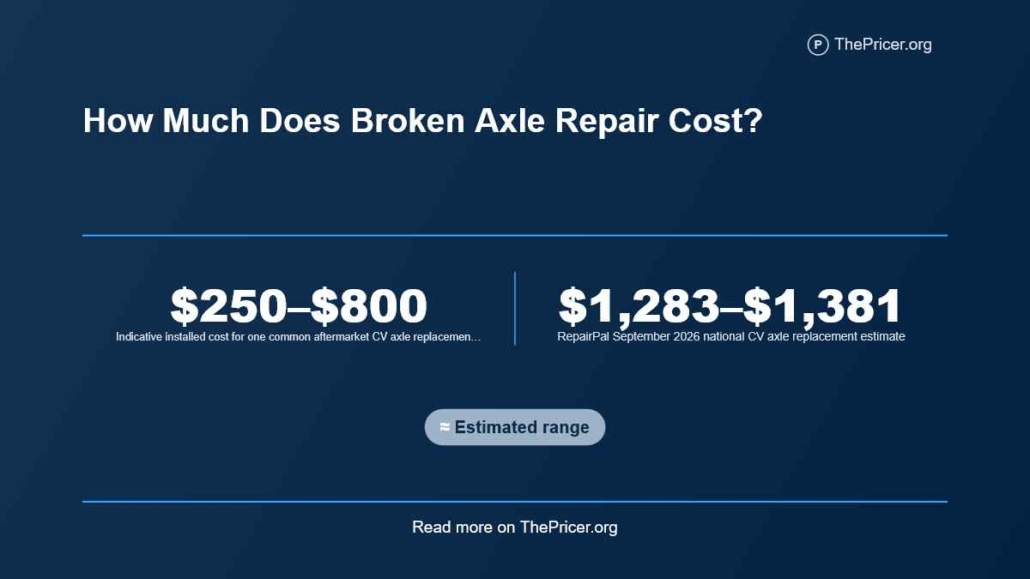
Broken axle repair typically costs $250 to $800 for replacing one common passenger-car CV axle with an aftermarket assembly. However, RepairPal’s September 2026 national estimate is considerably higher at $1,283 to $1,381 for CV axle replacement and $1,010 to $1,132 for axle shaft replacement. The difference comes largely from the parts included in each estimate.
A damaged axle is not always the same repair. A front-wheel-drive car may need a complete CV axle assembly, while a rear-wheel-drive truck could need an axle shaft, bearing, seal, or differential repair. These components have different labor requirements and replacement prices.
Before approving the work, the repair shop should identify the failed component and provide a vehicle-specific estimate. A damaged CV boot, clicking joint, bent axle shaft, and failed rear differential should not all be priced as a complete axle replacement.
Article Highlights
Jump to sections
- Many common aftermarket CV axle replacements can cost approximately $250 to $800 (at $30 per hour, earning that amount would take about 1 to 3.3 full-time workdays, before taxes) per axle, depending on the vehicle and labor.
- RepairPal’s September 2026 national CV axle estimate is $1,283 to $1,381, using substantially higher parts pricing.
- RepairPal estimates conventional axle shaft replacement at $1,010 to $1,132.
- Aftermarket CV axle assemblies can cost approximately $60 to $150 in some applications, before installation.
- CV boot replacement may cost $411 to $528, creating an important repair-versus-replacement decision.
- A genuinely broken or severely damaged axle should be inspected before the vehicle is driven again.
How Much Does Broken Axle Repair Cost?
The largest pricing mistake is treating every axle problem as an identical repair. The RepairPal CV axle estimate, updated September 3, 2026, places national replacement costs at $1,283 to $1,381 (about 1.1 to 1.2 full-time workweeks at $30 per hour). It assigns approximately $1,075 to parts and $208 to $306 to labor.
Meanwhile, AutoZone’s CV replacement guide describes replacement axle parts around $60 to $150 for some vehicles, with labor around $150 to $350.
The estimates are not necessarily contradictory. They represent very different parts and vehicle mixes. A common aftermarket axle for an older compact car can be much less expensive than a manufacturer-specific assembly for a newer or more complicated vehicle.
| Repair | Price or estimate | Scope |
|---|---|---|
| Common aftermarket CV axle replacement | $250–$800 | Indicative installed shopping range, per axle |
| RepairPal CV axle replacement | $1,283–$1,381 | National estimator, parts and labor |
| RepairPal axle shaft replacement | $1,010–$1,132 | National estimator, parts and labor |
| Aftermarket CV axle assembly | $60–$150+ | Selected parts only |
| Professional CV boot replacement | $411–$528 | National estimate, parts and labor |
| Differential seal or moderate repair | $150–$1,200+ | Different repairs within the axle assembly |
| Major rear differential replacement | $2,500–$6,000+ | Full assembly replacement on some vehicles |
The table distinguishes complete axle assemblies from individual components and differential work. A lower-priced aftermarket repair should not be compared directly with a dealer’s original-equipment quote without checking the part number, warranty, and included work.
Front CV Axle vs. Rear Axle Costs
Most front-wheel-drive cars have two front CV axle assemblies. These transfer torque from the transaxle to the wheels while allowing steering and suspension movement.
A replacement CV axle generally includes the shaft, inner and outer constant-velocity joints, protective boots, and clamps. This makes it possible to replace several potentially worn components in one operation.
AutoZone’s current axle catalog includes thousands of vehicle-specific assemblies. One Duralast Gold example was listed at $151.99 (about 5.1 hours of work at $30 per hour), illustrating the lower parts prices available for certain applications.
However, the correct axle depends on the model year, engine, drivetrain, and installation position. Driver-side and passenger-side assemblies may differ in length, splines, or joint design.
The rear axle presents a different set of possibilities. Some rear-wheel-drive trucks use solid axle housings with individual axle shafts, bearings, seals, and a differential. Independent rear suspensions may use CV-type half-shafts.
The RepairPal axle shaft estimator reports $1,010 to $1,132, including $244 to $357 in labor and approximately $766 to $775 in parts.
A damaged rear differential is a separate expense. ThePricer’s differential repair cost guide explains why gear, bearing, seal, and complete housing repairs can cost substantially more than replacing one axle shaft.
What Causes an Axle to Fail?
 Axle damage can result from joint wear, torn protective boots, contamination, corrosion, impact damage, or problems elsewhere in the drivetrain.
On CV axles, rubber boots protect the joints and retain lubricating grease. When a boot splits, grease can escape and water or grit can enter, accelerating wear.
NAPA’s CV diagnostic guidance identifies several common symptoms.
- Clicking when turning may indicate a worn outer CV joint.
- Clunking during acceleration or deceleration can indicate inner-joint wear or another drivetrain problem.
- Grease around the inner wheel area can indicate a torn CV boot.
- Shudder under acceleration may involve an inner CV joint, intermediate shaft, or engine mount.
- Humming or growling can also result from wheel bearings rather than the axle itself.
A vibration that increases only with road speed is not reliable proof of a failed CV axle. NAPA points out that wheel imbalance, damaged tires, and bent rims are often more likely causes.
This is why diagnosis matters. Replacing an axle without establishing the cause may leave the original vibration or noise unchanged.
Parts and Labor Breakdown
The final repair bill combines the replacement component, removal and installation labor, and any necessary related materials.
Labor rates vary substantially. AAA’s 2026 labor-rate analysis reports that nearly half of surveyed U.S. general repair shops charge between $120 and $159 per hour.
AutoZone describes many CV axle replacements as requiring approximately 1.5 to 3 labor hours. Applying AAA’s hourly range gives a calculated labor budget of approximately $180 to $477.
The calculation is illustrative. Vehicle-specific flat-rate labor guides may assign a different time, and difficult access or corrosion can increase the job.
Additional items can include replacement axle nuts, transmission seals, gear oil or transmission fluid, and hardware. Some replacement assemblies include the relevant nut, while others require it separately.
Alignment should not automatically be added to every axle quote. Some repairs disturb suspension geometry, while others do not. Ask the technician whether the procedure requires a follow-up alignment or whether an existing handling problem justifies one.
A Worked Axle Replacement Budget
Consider a hypothetical front-wheel-drive car requiring one complete aftermarket CV axle. The following model uses a published retail part example and a labor rate inside AAA’s surveyed range.
- Aftermarket CV axle assembly at $151.99
- Two hours of labor at $140 per hour, totaling $280
- Replacement axle nut and small-parts allowance of $20
- Fluid top-up allowance of $25
- Calculated subtotal of $476.99
The axle is a documented retail example, while the two-hour duration and extra allowances are modeling assumptions. This is not a quote for a particular vehicle. Taxes, shop fees, and unrelated repairs are excluded.
Labor represents approximately 58.7% of the modeled total, while the axle assembly represents about 31.9%.
Now suppose the same job requires a manufacturer-specific axle costing an assumed $700 instead of $151.99. With the other inputs unchanged, the repair would total $1,025.
That is an increase of $548.01, even though the labor and repair procedure remain identical. It demonstrates why the choice and availability of a compatible axle can influence the bill more than a modest difference in shop hourly rates.
It also helps explain the wide gap between inexpensive aftermarket examples and RepairPal’s higher national parts allowance.
CV Boot or Whole Axle?
A torn boot does not always mean the axle joints are damaged beyond repair. If the boot has failed recently and the joint remains clean and serviceable, installing a new boot may preserve the original axle.
However, boot replacement can require removing the axle, dismantling the joint, cleaning it, applying new grease, and installing clamps.
ThePricer’s CV boot replacement cost guide reports a professional replacement estimate of $411 to $528, based on RepairPal’s August 2026 figures.
That creates a noteworthy comparison. The illustrative complete aftermarket axle replacement calculated above costs $476.99, which falls inside the national boot-repair range.
If a shop quotes $475 to service the boot and $500 to install a compatible complete axle, the difference is only $25. Replacing the entire assembly may be worth considering, especially if the joint already shows wear.
If the original axle is an expensive or specialized assembly, rebuilding a healthy joint with a new boot may offer better value. The correct decision depends on its condition and the reliability of the available replacement.
AutoZone notes that complete replacement assemblies have become increasingly common because their ready-to-install construction reduces the labor involved in servicing individual joints.
Hidden Costs of Axle Damage
An axle replacement can uncover additional problems, particularly when a joint has operated without sufficient grease or a shaft has been damaged in a collision.
Potential extras include a leaking transmission output seal, damaged wheel bearing, compromised suspension component, or worn intermediate shaft.
The Firestone technical guide warns that complete axle failure can leave the vehicle without drive and may damage nearby brake or suspension components.
Not every clicking axle needs all these repairs. Any additional work should be supported by inspection findings rather than automatically included in a generic package.
The original article also assumed that rear axle repair is always more expensive than front axle repair. That is not reliable. The exact drivetrain, component being replaced, and parts availability determine which job costs more.
Routine engine oil changes are not a direct maintenance procedure for CV joints. Their lubrication is normally contained within the boot, while differential assemblies use their own specified gear oil.
For other vehicle repair expenses, ThePricer’s guides to coil pack replacement and timing belt replacement cover unrelated engine repairs that should not be confused with drivetrain work.
Is a Broken Axle Safe to Drive?
A completely broken axle or a severely damaged joint can cause the vehicle to lose drive, become stranded, or suffer additional mechanical damage. The safest response is to stop driving and arrange inspection or towing.
A clicking CV joint may still transmit power for some time, but the remaining service life cannot be reliably predicted from the noise alone.
A recent NAPA intermediate-shaft bulletin describes excessive play, grease leakage, clunking, vibration, and loss of drive as reasons for prompt inspection.
When the symptoms are severe, the car should not be driven to test how much longer the axle will last. A technician should determine whether the vehicle is safe to move.
Makes sense to repair if
- The failed axle or joint has been accurately identified.
- A compatible replacement assembly is available with an appropriate warranty.
- The surrounding transmission, suspension, and wheel components are serviceable.
- The repair cost is reasonable relative to the vehicle’s condition and remaining use.
Does not make sense to authorize the quoted repair yet if
- The shop has diagnosed an axle solely from a general vibration.
- The quote does not identify whether the fault is an axle shaft, CV joint, bearing, or differential.
- Additional components are proposed without inspection findings.
- A high-priced original-equipment part is specified without discussing compatible alternatives.
What We Verified
- RepairPal’s September 2026 CV axle and axle shaft estimates are higher than many aftermarket parts-based examples.
- AutoZone publishes lower-priced replacement assemblies for selected vehicle applications.
- AAA’s surveyed labor-rate figures support significant variation in installation costs.
- CV boot repair and complete axle replacement can have overlapping total prices.
- NAPA and Firestone identify symptoms that require diagnosis rather than automatic axle replacement.
- The worked repair totals are illustrative calculations, not vehicle-specific shop invoices.
Answers to Common Questions
How much does it cost to replace one CV axle?
Many common aftermarket replacements can cost approximately $250 to $800 installed. RepairPal’s broader national estimate is $1,283 to $1,381. The actual quote depends heavily on the specific vehicle and replacement part.
Is replacing a rear axle more expensive?
Not necessarily. A simple rear axle shaft replacement may cost less than a specialized front CV assembly. Major rear differential repairs can be much more expensive. The failed component matters more than its location alone.
Can I drive with a broken axle?
A confirmed broken or severely damaged axle should be treated as unsafe to drive. Arrange professional inspection and towing when necessary. Clicking or vibration may have several causes, but should be diagnosed promptly.
Is it cheaper to replace a CV joint or the entire axle?
Often the complete axle is competitive because the new assembly includes the joints and boots. A professional boot replacement can cost $411 to $528, while some aftermarket complete-axle jobs cost a similar amount. Compare quotes for the same vehicle.
Should both CV axles be replaced together?
Not automatically. If only one assembly is worn or damaged, replacing that side may be sufficient. The other axle should be inspected for torn boots, joint play, leaks, and related symptoms before additional work is recommended.
Disclosure: Educational content, not financial advice. Prices reflect public information as of the dates cited and can change. Confirm current rates, fees, taxes, and terms with official sources before purchasing. See our methodology and corrections policy.