ThePricer Media
  • Latest: The Cost to Cool an AI Data Center
  • Cost Guides
  • News & Investigations
  • Daily Price Puzzle (60s)
  • Methodology
  • Press & Mentions
  • Contact
  • Click to open the search input field Click to open the search input field Search
  • Menu Menu
Auto

How Much Does Car Headliner Repair Cost?

Updated on July 22, 2026 | Written by Alec Pow
This article was researched using 7 sources. See our methodology and corrections policy.

Car headliner repair usually costs $250 to $900 when an automotive upholstery shop removes the existing molded board, strips away the failed fabric and foam, installs new foam-backed material, and puts the roof lining back into the vehicle. A simple sedan can land near $250 to $500, while a large SUV, panoramic-roof vehicle, luxury model, or headliner with several overhead components may cost $600 to $1,500. Buying a complete factory headliner assembly can raise the project to $1,500 to $3,000 or more.

A DIY headliner replacement generally costs $50 to $250 for fabric, high-temperature adhesive, trim tools, brushes, clips, and cleaning supplies. The lower cash cost transfers removal, board cleaning, fabric fitting, and reassembly to the owner. Sunroof shades, covered visors, damaged boards, broken pillar clips, water-leak diagnosis, mold treatment, overhead consoles, side-curtain airbags, and factory-only materials can all sit outside the initial quote.

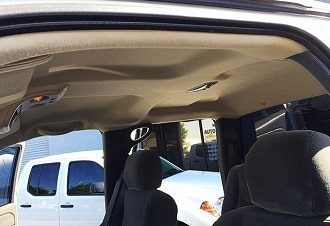
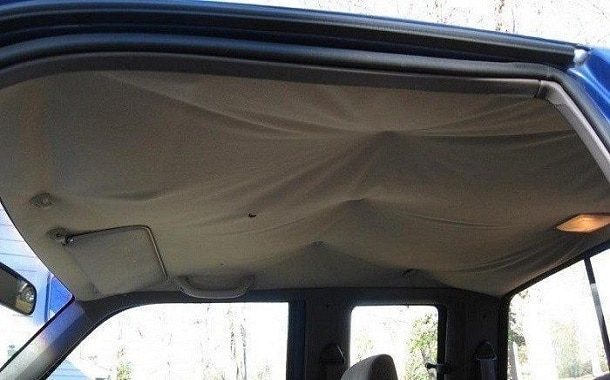
A car headliner is the molded interior roof panel covered with foam-backed fabric. Most widespread sagging occurs because the thin foam layer deteriorates into powder, not because intact fabric simply needs another spray of glue.

Article Highlights

Jump to sections
  • Does Car Headliner Repair Cost?
  • Recovering or Replacing the Board
  • Why the Fabric Starts Sagging
  • What the Shop Must Remove
  • Sunroofs Add Separate Work
  • Water Damage Comes First
  • Three Realistic Totals
  • Professional recovery of an existing headliner board usually costs $250 to $900 (at $30 per hour, earning that amount would take about 1 to 3.8 full-time workdays, before taxes).
  • A complete OEM headliner assembly can cost $1,500 to $3,000 or more with installation.
  • DIY fabric, adhesive, tools, and clips commonly total $50 to $250.
  • A sunroof shade, two visors, leak diagnosis, and replacement clips can add $400 to $700.
  • Spraying glue through broadly sagging fabric often fails because degraded foam remains between the fabric and board.
  • Water leaks must be repaired before new headliner material is installed.
  • Roof trim may sit beside curtain airbags, wiring, sensors, microphones, lights, and energy-absorbing components.
Car Headliner Repair Cost

How Much Does Car Headliner Repair Cost?

Headliner Project Planning Cost What the Price Usually Covers
Small edge repair $50 to $200 (about 1.7 to 6.7 hours of work at $30 per hour) Localized adhesive work or a minor fabric correction
Simple sedan board recovery $250 to $500 Removal, stripping, new fabric, adhesive, and installation
Large car, SUV, or truck $400 to $900 Larger board, more trim, more fabric, and added labor
Sunroof or overhead-console headliner $500 to $1,200 Board recovery around roof openings and overhead equipment
Luxury or panoramic-roof vehicle $800 to $1,500+ Complex trim, multiple shades, electronics, and premium material
Complete OEM assembly $1,500 to $3,000+ New molded factory part plus removal and installation
DIY recovery $50 to $250 Fabric, adhesive, trim tools, brushes, clips, and supplies
Temporary pin or fastener repair $10 to $40 Holding loose fabric up without restoring the failed foam

Midwest Fabrics places most professional headliner replacement work at $250 to $900, depending on vehicle size, fabric, roof features, and labor. AutoZone gives a wider $200 to $1,500 professional range because its estimate includes both ordinary fabric recovery and more difficult vehicles. These ranges are planning numbers rather than national menu prices. Automotive upholstery shops usually quote after seeing the year, make, model, sunroof configuration, board condition, and amount of trim that must be removed.

Current owner reports support the lower half of that range for common vehicles. One Volkswagen GTI owner reported paying about $450 for a completed headliner job, while another was quoted roughly $400 for upholstery work only if the owner removed and reinstalled the board. These examples are anecdotal and location-specific, but they reveal an important quote difference: “recover this loose board” and “take my complete car and return it finished” are not the same service.

Related guides

  • How Much Does Fiberglass Boat Repair Cost?
  • How Much Does A Convertible Top Replacement Cost?
  • How Much Does Curb Rash Repair Cost?

Recovering or Replacing the Board

Most sagging headliners do not require a new molded board. The upholstery shop removes the existing board, takes off the old fabric, brushes or scrapes away the crumbled foam, repairs minor cracks, applies new foam-backed material, and reinstalls the original assembly. This is commonly called headliner recovering, even though many price guides use “replacement” for the same process.

A true factory replacement is different. The shop or dealer orders an entire vehicle-specific assembly. The part may contain a molded substrate, attached insulation, impact-absorbing blocks, cutouts for lights and consoles, wiring channels, sunroof openings, clips, and factory trim details. Availability can be poor on older cars, and the size of the part makes shipping expensive.

One Honda Ridgeline owner reported a dealer price of about $2,600 (about 2.2 full-time workweeks at $30 per hour) for the factory part before installation. Upholstery quotes for recovering the existing board were $300 and $600, with the higher quote excluding the sunroof and charging $150 per visor. The report is anecdotal, but the price gap illustrates why the two options should never be blended into one average. A $600 fabric-recovery quote and a $2,600 OEM part quote describe different purchases.

Why the Fabric Starts Sagging

A headliner normally combines a visible knit or woven fabric, a thin foam backing, and a molded substrate. Heat, age, humidity, ultraviolet exposure, water intrusion, and repeated temperature changes break down the foam. The material may first loosen near the windshield, rear glass, dome light, sunroof opening, or door edge, then spread across the ceiling.

Once the foam turns to dust, spraying adhesive through the visible fabric rarely creates a durable bond. The glue sticks to loose residue instead of a clean board. It may also soak through the material, create dark patches, harden one section, or leave lumps that remain visible after the fabric is pushed upward. A broad sag usually needs the old material removed so the board can be cleaned.

A temporary pin, twist fastener, or support strip can keep fabric away from the driver’s view. That may be reasonable on a low-value vehicle awaiting sale, restoration, or later repair. It does not renew the foam, restore the factory appearance, or address a roof leak. Temporary hardware should also be positioned with care because wiring, airbags, insulation, and roof components may sit above the board.

What the Shop Must Remove

The headliner board is larger than the opening through which it must leave the cabin. A technician may remove sun visors, grab handles, dome lights, microphones, overhead consoles, coat hooks, weatherstripping, pillar trim, sunroof trim, rear interior panels, and sections around the hatch or doors. Seats may need to recline or come out so the board can be rotated without cracking.

The board itself can become brittle with age. Creasing it sharply may leave a permanent fold, while forcing it through a narrow opening can crack corners or damage attached foam. New clips may be needed because older plastic retainers often break during removal. A quote that includes full vehicle removal and installation should cost more than one covering only the fabric work on a board delivered to the shop.

Roof trim may also sit beside side-curtain airbags. NHTSA recall procedures for curtain-airbag work repeatedly require technicians to lower or remove headliners, disconnect wiring where needed, protect the airbag from foreign material, and avoid trapping anything between the airbag and trim. A general upholstery shop does not need to perform airbag repair, but it must know how the vehicle’s roof trim and safety systems are arranged.

Sunroofs Add Separate Work

A sunroof creates a large opening that must be wrapped cleanly without pulling the fabric out of alignment. The headliner may also contain a separate sliding shade covered in matching material. Panoramic roofs can use two shades, long tracks, motors, switches, wiring, drainage channels, wind deflectors, and narrow trim sections. Recovering the main board does not automatically include every movable panel.

The estimate should list the main headliner, sunroof shade, visors, pillars, overhead console, and any matching trim separately. The Ridgeline quote cited above charged $150 for each visor and required an in-person inspection before pricing the sunroof. Two visors alone would add $300 to the initial headliner price.

A complex roof can also change the removal route. Some boards cannot leave through a door without substantial interior disassembly. Others may need a seat removed or, in rare cases, glass access. The technician should explain the planned route before starting because a low quote that excludes disassembly can become a much larger invoice after the vehicle arrives.

Water Damage Comes First

Water stains around the headliner may come from clogged or disconnected sunroof drains, a leaking windshield seal, roof antenna, roof rack, hatch seal, body seam, or previous collision repair. Recovering the board before finding the leak can ruin the new fabric and leave odor, mold, stained insulation, or damaged electronics above the ceiling.

RepairPal identifies clogged or misrouted sunroof drain tubes as a common cause of water entering through the sunroof or headliner. Its 2025 Dodge Caliber data places general diagnosis around $122 to $179. That is only diagnosis. Drain repair, windshield resealing, antenna-gasket replacement, drying, mold treatment, and damaged electrical parts can create separate charges.

A water-damaged ceiling may be part of a larger interior project. If moisture has reached the floor insulation or carpeting, compare the roof work with the cost to replace wet car carpeting. A leak that has softened the board may also prevent simple recovery, forcing repair or replacement of the substrate.

Three Realistic Totals

Simple sedan recovery: Use a professional base quote of $350. Add $30 for replacement clips and $25 for a small board-edge repair. The subtotal is $405. With a modeled 7% sales tax, the checkout total reaches $433.35. This scenario assumes no sunroof, no water leak, reusable visors, and a board that can leave through a door without unusual disassembly.

Sunroof vehicle with matching pieces: Start with $500 to recover the main board. Add $175 for the sliding shade, two visors at $150 each, $40 for clips, and $150 for leak diagnosis. The complete project reaches $1,165 before tax and before the leak itself is repaired. The original $500 headliner quote represents only 42.9% of the modeled total.

Owner-delivered board: Assume a shop charges $250 to strip and recover a loose headliner board, compared with $450 to handle removal and installation. Add $35 for trim tools, clips, and cleaning supplies used by the owner. The cash total becomes $285, saving $165. The owner accepts the risk of broken trim, damaged wiring, a cracked board, and several hours of labor to earn that saving.

Labor Transfer

The price difference between a loose-board quote and a complete-car quote reveals how much of a headliner invoice is not fabric. In the modeled comparison above, the shop’s full service is $450, while board recovery alone is $250. Removal and reinstallation account for $200, or 44.4% of the full-service quote. Once the owner buys $35 in tools and clips, the real cash saving falls from $200 to $165.

Time changes the calculation again. A recent GTI owner described spending about 30 hours across three days on removal and reinstallation, while local shops wanted about $400 to recover the board only. That is one difficult model-specific account, not a normal time estimate. At an owner time value of $20 per hour, 30 hours represents $600 in personal time before materials or professional upholstery work. Paying for complete removal would have been financially defensible even before the risk of broken clips and trim was counted.

The calculation does not mean DIY is always poor value. A simple older sedan, intact trim, available workspace, and careful owner can make the lower cash cost worthwhile. The point is that a board-delivery price should not be advertised as the complete headliner-replacement cost.

DIY Fabric and Tools

AutoZone places DIY headliner replacement around $50 to $250. Its current universal foam-backed replacement kits are priced around $62 to $69, depending on color and configuration. A current 3M automotive headliner adhesive can costs $27.49.

A practical DIY basket may include a $68.99 fabric kit, $27.49 adhesive, $20 trim-tool set, $15 brush and scraper supplies, and $20 in replacement clips. The total is $151.48 before tax. A larger vehicle may require more fabric or adhesive, while custom microsuede or factory-match material can cost more.

Use an adhesive intended for automotive headliners and the selected material. 3M describes its headliner adhesive as designed to bond heavyweight automotive fabrics, foam, carpet, and related materials. Cabin roofs experience high temperatures, so a general craft adhesive that softens in heat may release even when the fabric installation initially looks acceptable.

Material Changes the Quote

Professional car headliner replacement and roof lining repairStandard foam-backed knit is light, stretchable, and suited to molded contours. It is commonly the least expensive professional material and the easiest to match on an ordinary sedan. Factory-style colors such as gray, beige, black, and tan are widely available, though an exact match to aged visors and pillars may be difficult.

Microsuede, imitation suede, and genuine Alcantara can cost more and demand more careful fitting. Heavier material may resist stretching around deep recesses, sunroof edges, handles, and console openings. It can also reveal small board imperfections that ordinary knit would hide. Leather and thick vinyl are unsuitable for many unsupported molded boards unless the shop has planned the weight, seams, and attachment method.

A headliner project can form part of a larger cabin restoration. Matching seats, door panels, pillars, and roof material should be quoted as a complete design rather than ordered piecemeal. Current car reupholstery costs show why seats, foam, airbag seams, carpeting, and headliner work belong in separate line items even when one upholstery shop performs all of them.

Hidden Safety Components

A headliner is not always decorative fabric attached beneath bare metal. A General Motors recall documented replacement headliners that were missing specified energy-absorbing foam blocks. NHTSA records said the affected assemblies could fail to meet part of the federal interior-impact requirement. The repaired parts included the required blocks. This does not mean recovering fabric changes crash performance on every car, but it proves that some headliner assemblies contain safety-related structures.

Kia has also recalled vehicles involving headliner plates that form part of the energy-absorbing structure and sit near curtain-airbag deployment areas. The service procedure required removal of visors, handles, weatherstripping, pillar trim, and clips before the headliner could be lowered. This is the same hidden labor that makes some roof-liner jobs expensive.

A shop quote should state how microphones, emergency-call modules, wiring, sensors, curtain-airbag trim, overhead lights, and impact-absorbing parts will be handled. Decorative fabric may be recoverable while damaged structural attachments or factory components require replacement.

When Repair Makes Sense

Makes sense if:

  • The molded board remains intact and can be recovered rather than replaced.
  • Broad sagging makes a temporary adhesive repair unlikely to last.
  • The vehicle is worth keeping and the loose fabric affects comfort, appearance, or visibility.
  • The quote includes trim removal, new foam-backed material, clips, and reinstallation.
  • Any water leak has been found and corrected before upholstery work begins.

Does not make sense if:

  • The repair price approaches the value of a poor-condition vehicle with other major problems.
  • A small edge can be reattached cleanly without replacing the entire surface.
  • The quote covers fabric but excludes the damaged board, shades, visors, and necessary leak repair.
  • The installer cannot explain how roof wiring and curtain-airbag trim will be handled.
  • A complete OEM assembly is being sold when the original board can be recovered safely.

A stained headliner does not automatically need replacement. Light surface marks may respond to careful professional interior cleaning, provided the foam and adhesive remain stable and the fabric is not saturated. Compare replacement with interior car detailing costs when dirt rather than structural sagging is the main complaint. Excess moisture and aggressive scrubbing can worsen weak adhesive, so the cleaner should inspect the material first.

What We Verified

  • Checked: Current professional headliner recovery commonly falls between $250 and $900.
  • Confirmed: AutoZone places DIY headliner work at $50 to $250 and professional work at $200 to $1,500.
  • Cross-referenced: A current universal foam-backed headliner kit is listed at $68.99.
  • Verified: RepairPal identifies damaged sunroof drain tubes as a cause of headliner leaks and lists general diagnosis at $122 to $179 for one affected model.
  • Checked: NHTSA recall records confirm that some replacement headliners contain energy-absorbing foam blocks tied to interior-impact compliance.
  • Confirmed: Current owner reports show a large gap between recovering an existing board and purchasing a new factory assembly.

Answers to Common Questions

How much does it cost to fix a sagging car headliner?

A professional recovery usually costs $250 to $900. Small edge repairs may cost less, while panoramic roofs, luxury vehicles, and damaged boards can exceed $1,000.

Can a sagging headliner be glued back up?

A clean detached edge may be reattached. Broad sagging usually returns because the old foam has deteriorated and must be removed from the board.

How long does headliner replacement take?

A simple vehicle may be completed in one working day. Complex trim, sunroofs, curing time, board repairs, or leak work can extend the job to two days or longer.

Is DIY headliner replacement difficult?

The fabric work is manageable on some cars. Removing the board intact, working around trim and airbags, and fitting it back through the cabin create most of the difficulty.

Does insurance cover a damaged headliner?

Age-related sagging is normally maintenance. Coverage may apply when a covered event such as collision damage, vandalism, fire, or storm-related water intrusion caused the damage, subject to the policy and deductible.

Disclosure: Educational content, not financial advice. Prices reflect public information as of the dates cited and can change. Confirm current rates, fees, taxes, and terms with official sources before purchasing. See our methodology and corrections policy.

by Alec Pow
ThePricer cost research Independent price research used by media, universities and public institutions.

We research provider pricing, market examples, buyer reports, hidden fees and public records.

Methodology · Citations · Newsroom
© 2014 - 2026 - ThePricer Media, LLC, 4 Grove Street, New York, NY, 10014, Phone: (212) 431-2441
We don’t use affiliate links or paid placements. All sources are cited only for verification.
  • Link to X
  • Link to LinkedIn
  • Link to Facebook
  • Link to Instagram
  • Link to Pinterest
  • Link to Youtube
  • Contact Us
  • About Us
  • Press & Mentions
  • Careers
  • Meet the Founder
  • Privacy Policy
  • Editorial Ethics
  • Methodology
  • Corrections
  • Disclosure
  • Terms and Conditions
Scroll to top Scroll to top Scroll to top