
How Much Does Cataract Surgery Cost?
Updated on | Written by Alec Pow
This article was researched using 14 sources. See our methodology and corrections policy.
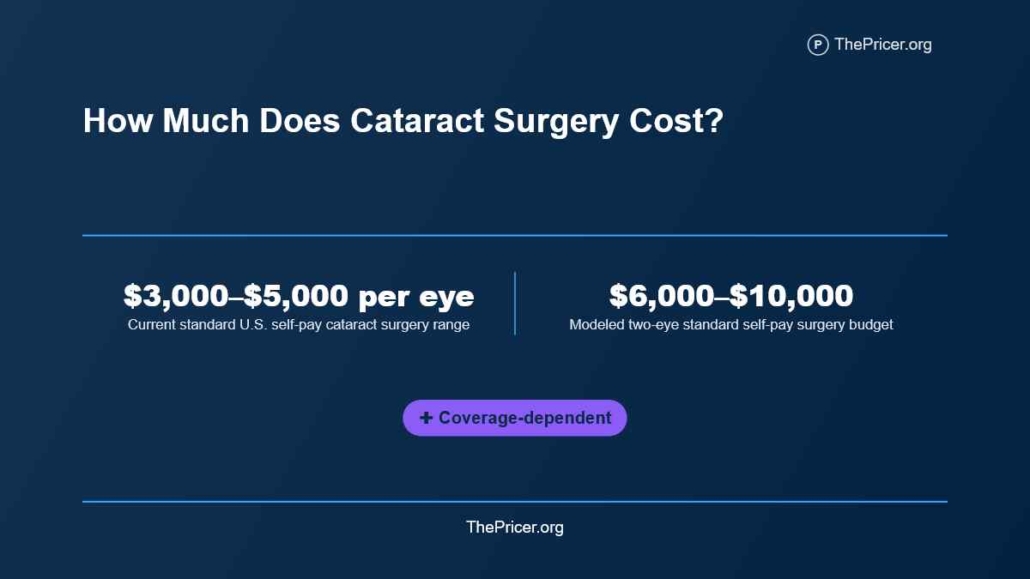
Standard self-pay cataract surgery commonly costs about $3,000 to $5,000 per eye in the United States according to a current clinical estimate. Premium lens choices can push the total higher. With Original Medicare, covered standard surgery follows federal cost-sharing rules that change with the facility setting and deductible status. The bill depends on the facility, lens type, insurance, case complexity, and services bundled into the quote.
Article Highlights
Jump to sections
- Standard self-pay cataract surgery often falls around $3,000 to $5,000 (at $30 per hour, earning that amount would take about 2.5 to 4.2 full-time workweeks, before taxes) per eye.
- Original Medicare’s 2026 average patient share is $343 in an ASC versus $563 in a hospital outpatient department for routine surgery.
- The 2026 Part B deductible is $283.
- Premium IOL upgrades can add roughly $2,000 to $5,000 per eye depending on the lens and provider.
- Posterior capsule opacification can create a later YAG laser bill even though the cataract itself does not grow back.
How Much Does Cataract Surgery Cost?
Current all-inclusive ASC cash prices include published standard-IOL packages of $1,675 (about 1.4 full-time workweeks at $30 per hour) in Georgia, $3,500 in Florida, and $4,200 in California. Those packages include the surgeon, facility, and anesthesia according to the price review. They are location-specific offers, not a national average.
Cataract surgery is priced per eye, and the lens selection can change the bill sharply. Using the cited $3,000 to $5,000 per-eye standard self-pay estimate, two eyes create a calculated planning budget of roughly $6,000 to $10,000 before premium upgrades or separately billed services. Medicare follows a different payment structure, so its patient-share figures should not be compared with cash package prices as if they are the same kind of quote.
| Pricing situation | Current amount | Scope |
|---|---|---|
| Standard self-pay planning range | $3,000 to $5,000 per eye | Standard surgery with a monofocal IOL |
| Published ASC cash packages | $1,675 to $4,200 per eye | Selected all-inclusive 2026 provider packages |
| Original Medicare at an ASC | $343 average patient share | Routine CPT 66984 after applicable deductible rules |
| Original Medicare at a hospital outpatient department | $563 average patient share | Routine CPT 66984 after applicable deductible rules |
| Premium lens upgrade | $2,000 to $5,000 per eye | Elective refractive functionality above the conventional lens benefit |
What Cataract Surgery Does
A cataract is a cloudy area in the eye’s natural lens. The National Eye Institute cataract guidance describes blurred or hazy vision, faded colors, glare, and reduced night vision among the common effects. Cataract surgery removes that cloudy natural lens and replaces its focusing function with a clear artificial intraocular lens, usually called an IOL. NEI reports that about 9 in 10 people see better after the procedure. The implanted lens remains inside the eye after healing, while the removed natural lens cannot form another cataract.
Cataract surgery does not use the same mechanism as LASIK or other corneal refractive surgery. It treats an opacity inside the natural lens rather than reshaping the cornea. A refractive procedure such as EVO ICL surgery keeps the natural lens in place, while refractive lens exchange replaces a clear natural lens for refractive reasons.
Those procedures can involve similar implant terminology but different diagnoses, coverage rules, and patient goals. Each eye is evaluated separately, and the implant is selected for that eye. A cataract quote should be compared with other cataract quotes that include the same lens class and care setting.
Medicare Costs in 2026
Original Medicare creates one of the clearest cost comparisons because the same routine cataract code has different facility payments. At an ASC, Medicare’s 2026 approved amount for CPT 66984 is $1,717 (about 1.4 full-time workweeks at $30 per hour), made up of a $462 doctor fee and a $1,255 facility fee. Medicare pays about $1,374 and the average beneficiary share is $343 after the deductible rules are satisfied.
At a hospital outpatient department, the approved amount rises to $2,819. The doctor fee remains $462, while the facility portion rises to $2,357. Medicare pays about $2,256 and the average beneficiary share becomes $563. The setting matters. The hospital outpatient route adds $1,102 per eye to the Medicare-approved total and $220 per eye to the average patient share.
Across two routine surgeries, that setting difference becomes $2,204 in approved spending and about $440 in beneficiary share. This calculation assumes the same CPT code for both eyes and compares national Medicare averages. It does not include extra services or the effect of supplemental coverage.
The 2026 Part B deductible is $283. A patient who has not met that deductible may owe more than the Procedure Price Lookup’s average coinsurance figure. A patient who already met it earlier in the year would not add the full deductible again.
Self-Pay and Two-Eye Costs
People without insurance need to compare the full cash package rather than a single posted procedure line. Published ASC packages show why. The current cash-price review cited earlier lists standard-IOL surgery at $1,675, $3,500, and $4,200 per eye at three surgery-center examples. The wide span reflects geography and provider pricing even before a premium lens is selected.
A two-eye budget at the $3,000 to $5,000 per-eye planning range is $6,000 to $10,000. This is a calculated scenario, not a published national package. It assumes both eyes use standard treatment and the per-eye quote is complete.
The main trap is an incomplete quote. A 2026 hospital-price analysis found that some published CPT 66984 cash prices cover only part of the surgical episode, while surgeon or anesthesia charges may be separate. Ask whether the price includes the surgeon, facility, anesthesia, standard IOL, preoperative measurements, routine postoperative visits, and prescribed medications.
Preoperative eye measurements select the IOL power and evaluate the eye before surgery. A separate routine visit may also be needed outside the surgical package. Readers pricing that piece can compare current eye exam costs without insurance, while recognizing that a surgical cataract evaluation can involve different testing and billing.
Standard vs Premium IOL
Medicare covers the conventional cataract benefit, including a conventional IOL, when the surgery meets coverage rules. The CMS vision-services guidance says patients who request presbyopia-correcting or astigmatism-correcting IOL functionality can be responsible for the extra lens and professional services tied to that non-covered functionality. The covered cataract portion and the elective refractive upgrade should be separated on the estimate.
Current industry financial reporting gives a useful scale. RxSight’s 2026 annual report says U.S. premium cataract patients may pay about $2,000 extra for a toric IOL and about $2,000 to $5,000 for other premium lenses, while the payer still reimburses the conventional cataract portion. That means premium functionality can add roughly $4,000 to $10,000 for two eyes if both receive an upgrade in that cited range.
Current clinic pricing shows the same pattern with named lens categories. Pacific Eye Institute lists a toric IOL upgrade at $2,300 per eye, an advanced-tech IOL at $3,250 per eye, and a Light Adjustable Lens at $5,000 per eye. Two matching upgrades would be $4,600, $6,500, or $10,000. Those are clinic-specific upgrade prices, not nationwide averages.
Premium lenses may reduce dependence on glasses for selected patients, but they are not the same purchase as the medically necessary cataract removal itself. A quote should show the conventional covered portion and the elective upgrade as separate dollar amounts.
What a Cataract Quote Includes
A complete cataract estimate should identify the surgeon fee, facility fee, anesthesia, IOL category, preoperative measurements, postoperative care, and any separate medication charges. The IOL line should state whether it is a standard monofocal lens or an elective toric, multifocal, extended-depth-of-focus, or adjustable option. If the clinic uses a femtosecond laser, ask which part is part of covered cataract care and which part is connected to elective refractive work.
One price can hide several billing relationships. The surgeon may bill separately from the ASC or hospital, and an anesthesia group can send another claim. A premium lens quote may describe only the upgrade while insurance still receives claims for the covered surgical portion. The same patient can see a cash price, an insurer-negotiated amount, and a separate premium upgrade on different documents.
Get the estimate in writing before surgery when possible. Ask which fees are per eye, whether routine follow-up is bundled, how long postoperative coverage lasts, and what happens if surgery is rescheduled. If both eyes need treatment, request separate estimates for each eye because the lens selection or complexity can differ.
A retinal operation is a different billing path. A patient who also has retinal disease should not compare a cataract package with the price of detached retina surgery as if the services were substitutes.
Recovery, Glasses, and Later YAG
Healing continues after the procedure, and vision can change as the eye settles. Follow-up visits are used to check the incision, eye pressure, inflammation, and the final visual result. Some patients still need glasses after surgery because a standard monofocal IOL usually targets one main viewing distance and because residual refractive error can remain. Postoperative medicines and eyewear are worth asking about when the clinic explains what its surgical package includes.

The natural cataract does not grow back after the cloudy lens is removed, but posterior capsule opacification can blur vision later. EyeWiki reports PCO in 20% to 50% of patients within two to five years. PCO develops when cells cloud the capsule that remains behind the IOL. It is often called a secondary cataract, but the artificial lens itself has not developed another cataract. Symptoms can include renewed haze, glare, and reduced contrast after an initially successful operation.
When YAG laser capsulotomy is medically appropriate, Medicare’s 2026 CPT 66821 data show an average patient share of $115 in an ASC and $167 in a hospital outpatient department. The approved amounts are $576 and $836. The laser creates an opening in the clouded capsule rather than replacing the IOL. This later possibility belongs in long-term cost planning even though many patients never need the procedure.
Insurance and Quote Comparisons
Private insurance and Medicare Advantage plans use their own deductibles, copays, coinsurance, networks, and authorization rules. Covered surgery can still leave a patient with out-of-pocket costs, while premium refractive lens functionality may remain a separate self-pay choice.
A cash package and a Medicare patient share are different payer arrangements. The cash quote may bundle surgeon, facility, anesthesia, and lens costs. The Medicare figure is the beneficiary portion of a larger approved amount. Compare what the same patient would owe under each available payment path.
Makes sense if
- The quote separates covered standard surgery from elective lens upgrades.
- The facility and surgeon are both in network when insurance is being used.
- The estimate states whether anesthesia and routine follow-up are included.
- The per-eye total is clear before planning the second eye.
Does not make sense if
- A facility-only price is compared with an all-inclusive package.
- A premium lens fee is presented as the full cataract surgery price.
- A Medicare coinsurance figure is treated as a self-pay market price.
- The quote omits who bills for anesthesia or postoperative care.
Strabismus surgery pricing concerns eye-muscle alignment, while cataract surgery replaces a cloudy natural lens.
Verification
- Checked the 2026 complex cataract code and confirmed average patient shares of $377 in an ASC and $597 in a hospital outpatient department.
- Confirmed the Original Medicare coverage rule that beneficiaries pay 20% of the Medicare-approved amount for covered cataract surgery after meeting the Part B deductible.
- Cross-referenced Medicare’s benefits guide and confirmed that covered cataract surgery may use traditional surgical techniques or lasers.
Answers to Common Questions
How much does cataract surgery cost without insurance?
A practical standard self-pay budget is about $3,000 to $5,000 per eye. Published all-inclusive ASC packages can fall below or above that range depending on location and scope.
How much does cataract surgery cost with Medicare in 2026?
For routine CPT 66984, the national average patient share is $343 at an ASC and $563 at a hospital outpatient department, subject to the $283 Part B deductible and any supplemental coverage.
How much can a premium cataract lens add?
Current evidence places many premium upgrades around $2,000 to $5,000 per eye, with the exact amount tied to the lens and provider.
Does cataract surgery include glasses?
Some patients still need glasses after surgery. Coverage for eyewear depends on the payer, plan, frame choice, and prescription.
Can a cataract come back after surgery?
The removed natural cataract does not return. Posterior capsule opacification can blur vision later and may be treated with YAG laser capsulotomy.
Disclosure: Educational content, not medical advice. Pricing varies by provider, location, and insurance. Confirm eligibility, coverage, and out-of-pocket costs with a licensed clinician and your insurer. See our methodology and corrections policy.