
How Much do Cockatiels Cost?
Updated on | Written by Alec Pow
This article was researched using 13 sources. See our methodology and corrections policy.
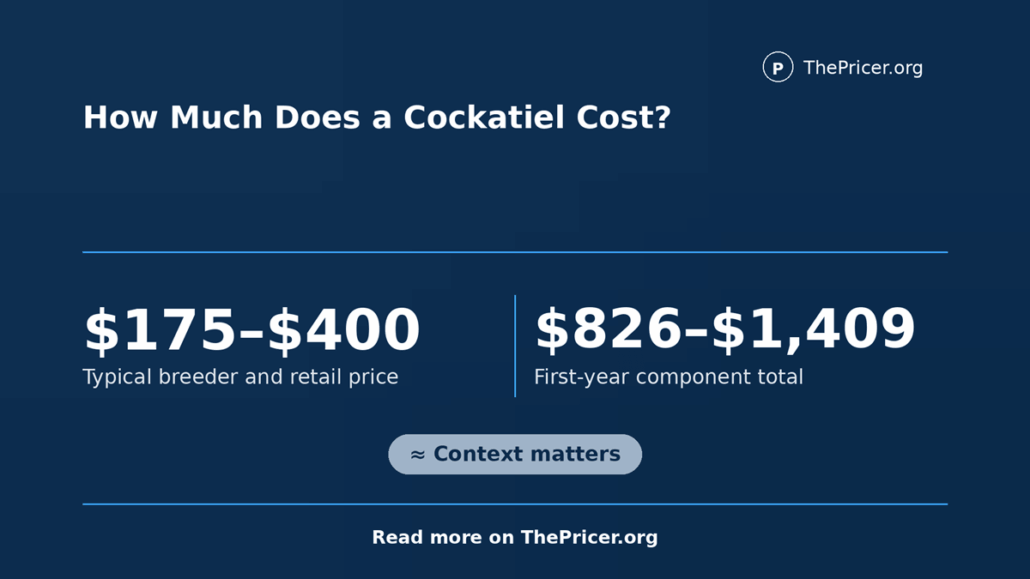
A cockatiel currently costs about $175 to $400 in many U.S. breeder and retail channels, with some current breeder listings reaching $499. Current breeder listings show birds from $175 to $499, while a national pet-store listing prices an assorted cockatiel at $399.99.
The bird is only part of the bill. The source-linked line items below produce first-year component totals from $826.28 to $1,408.98 before tax, major medical care, and every toy or perch purchase. That makes roughly $900 to $1,500+ a more useful starting budget than the bird price alone.
Cockatiel pricing is driven by seller type, age, color mutation, hand-raising, DNA sexing, disease testing, transport, and what comes with the bird. A cheap listing and a fully weaned, tested companion bird should not be treated as the same product.
Article Highlights
Jump to sections
- Current U.S. seller prices cover a wide band, from lower-priced breeder birds to much higher pet-store and specialty listings.
- Rescue adoption is not automatically free, and the fee may reflect intake, care, and placement work.
- The first-year bill includes housing, transport, veterinary care, food, enrichment, and cleaning supplies in addition to the bird.
- A source-linked first-year component stack below works out to roughly $826 to $1,409 (at $30 per hour, earning that amount would take about 0.7 to 1.2 full-time workweeks, before taxes) before tax, emergency treatment, and several optional purchases.
- A low purchase price can lose its advantage if the bird needs a replacement cage, immediate veterinary work, or paid transport.
- Long ownership turns small monthly care costs into thousands of dollars.
How Much Does a Cockatiel Cost?
The cleanest way to price a cockatiel is to separate acquisition from setup. Rescue, breeder, and pet-store prices answer what the bird costs. The cage, carrier, veterinary visit, food, and recurring care answer what ownership costs.
| Cost item | Current price signal | What the number represents |
|---|---|---|
| Rescue adoption | $150 to $300 (about 0.6 to 1.3 full-time workdays at $30 per hour) | A 2026 rescue fee schedule lists cockatiels in this band. |
| Hand-fed, DNA-sexed breeder bird | $250 to $375 | A hand-fed breeder price list includes DNA testing in the bird price. |
| Cockatiel cage | $116.99 to $329.99 | Current cage recommendations show examples at these two price points. |
| Travel carrier | $16.29 to $36.99 | Current bird carrier listings include basic portable options in this band. |
| New-client mobile veterinary visit | $183 | Published mobile-vet fees list a $128 establishment exam plus a $55 travel fee. |
| Small-bird long-term care funding signal | $30 per month or $360 per year | A lifetime-care funding schedule uses this amount for one small bird, including a cockatiel. |
Those numbers produce a useful floor rather than a national average. Using the lowest rescue fee, lower cage and carrier examples, the published new-client mobile-vet total, and the small-bird annual care figure gives $826.28. Using a $499 breeder listing, the higher cage example, the higher carrier example, the same vet total, and the same annual care figure gives $1,408.98. Neither figure includes sales tax, major medical treatment, or every toy and perch a household may buy.
The long-run math matters too. Funding routine care at $360 per year for 15 years totals $5,400. That is a scenario calculation, not a forecast for every bird, but it shows why the purchase price is a small part of long ownership.
What You Are Actually Buying
A cockatiel, Nymphicus hollandicus, is a small Australian parrot and a member of the cockatoo family. The long tail, crest, whistle-heavy vocal style, powder-producing feathers, and social behavior separate it from a budgie even though both are often sold as starter companion birds. A cockatiel also needs more than a decorative cage and a bowl of seed.
The ownership package includes safe housing, room to move, varied perches, chewable and foraging items, daily food and water care, routine cleaning, handling time, and access to a veterinarian who treats birds. A buyer comparing a cockatiel with the cost of a parakeet should compare the full setup and care pattern rather than the price tag on the animal. A hand-raised bird, a breeder bird kept for reproduction, and an adult rescue can also arrive with very different handling, health, and housing histories.

What Pushes a Cockatiel to the High End
Color can move the asking price, but mutation alone is a poor way to judge value. Current listings show normal, pied, pearl, cinnamon, whiteface, lutino, and combination birds at different prices, with seller, location, age, sexing, handling, and documentation mixed into the number.
Testing is one hidden part of that premium. One Maryland breeder states that its DNA-sexing and pathogen lab work costs $65 (about 2.2 hours of work at $30 per hour) per bird, and its current breeder checkout terms also apply a 3% card-processing surcharge while cash avoids that charge. A $400 bird paid by card would add $12 at that rate. This is a location-specific example, not a rule for every breeder.
Do not compare a cheap unweaned bird with a fully weaned companion bird whose sex and testing are documented. The lower number may leave the buyer paying for services or taking on care tasks that were already included in the higher price. Shipping can create another false comparison because some breeder listings include local pickup only while others allow transport at the buyer’s expense.
The Bird Is Only the Start
The cage is the largest setup purchase for many cockatiel homes. Cheap starter cages can work as temporary transport or quarantine housing, but the main enclosure has to leave room for movement, perches, food dishes, toys, and the bird’s long tail. Replacing an undersized cage after a few months turns the first cage into a sunk cost.
A carrier belongs in the starting budget as well. It is used for veterinary visits, moves, boarding handoffs, and emergencies. A cardboard box is not a practical long-term substitute for a secure bird carrier.
Food spending is easy to understate because a cockatiel should not live on an inexpensive seed mix alone. Veterinary feeding guidance places formulated pellets at roughly 75% to 80% of the diet, with fruits, vegetables, and greens limited to no more than 20% to 25%. The same guidance says a bird eating that level of pellets does not normally need routine vitamin supplements unless a veterinarian directs otherwise.
That changes the old article’s budget logic. Vitamins should not be treated as an automatic monthly purchase, and “bird seed” is not a complete food budget. The household bill can include pellets, fresh vegetables, a smaller amount of fruit, training treats, replacement food dishes, cage liners, and cleaning products.
The first-year burden is still much lower than for a larger parrot. Someone comparing this setup with the cost of an Indian Ringneck parrot is dealing with a different cage size, purchase market, and long-term supply bill.
After the Cage Comes Home
Veterinary care is the biggest open-ended risk. The table’s $183 example is only one published new-client visit structure. Blood work, imaging, medication, hospitalization, surgery, after-hours care, and travel to a clinic that treats birds can raise the invoice quickly. A low-cost bird is not protected from a high-cost illness.
Boarding is another easy miss for households that travel. A week away can turn a small nightly charge into a meaningful extra bill, especially when medication or special handling is involved. Pet sitters can be another route, but the person needs to be comfortable with birds rather than only dogs and cats.
Insurance is available for cockatiels, but it should be compared with a dedicated emergency reserve. Coverage limits, exclusions, reimbursement rules, waiting periods, and pre-existing-condition terms can matter more than the headline premium.
Then there is replacement spending. Cockatiels chew, soil perches, wear toys, and scatter food. A household that buys the cage once but budgets nothing for replacement enrichment is leaving out part of normal care. Air cleaning may also matter in homes where feather dust is a problem, though the need and equipment cost vary by room and household.
Three Realistic Cockatiel Budgets
Lower-cost adoption scenario
Take a $200 rescue fee, the $116.99 cage example, a $16.29 carrier, the $183 published new-client mobile-vet total, and $360 for a year of small-bird care funding. The total is $876.28. The bird itself is less than one-quarter of that first-year stack.
Worked example: retail bird and practical setup
A buyer pays $399.99 for the bird, then uses the lower $116.99 cage example, a $36.99 carrier, the $183 vet example, and $360 for the annual care figure.
- Cockatiel: $399.99
- Cage: $116.99
- Carrier: $36.99
- Initial veterinary visit plus travel: $183
- One year of routine small-bird care funding: $360
- First-year total: $1,096.97
The bird represents about 36% of this worked total. Roughly 64% sits outside the purchase price, before emergency treatment and extra household purchases.
Higher-price bird and larger cage scenario
Use a $499 breeder listing, a $329.99 cage, a $36.99 carrier, $183 for the same new-client vet example, and $360 for the annual care figure. The total reaches $1,408.98. The bird is about 35% of the stack, so paying more for the animal does not make the cage and care costs disappear.
Who This Cost Makes Sense For
Makes sense if:
- You can pay for a properly sized cage and carrier before bringing the bird home.
- You have access to a veterinarian who treats birds and money set aside for an unplanned visit.
- You can budget for pellets, fresh food, toys, replacement perches, and cleaning supplies for years.
- Your household can handle daily noise, feather dust, scattered food, and regular cage cleaning.
- You want a social companion bird and have time for daily interaction and supervised activity.
Does not make sense if:
- The purchase price uses nearly all of the money available for the pet.
- You are relying on the smallest cheap cage as the permanent home.
- No nearby clinic treats birds and there is no travel plan for veterinary care.
- Frequent travel would leave the bird without a qualified sitter or boarding option.
- You are choosing only by color while ignoring health history, weaning status, behavior, and seller documentation.
What We Verified
- Checked that bird owners can search for specialist care through the avian veterinarian directory maintained by the Association of Avian Veterinarians.
- Confirmed that cockatiels appear among eligible bird species on a current bird insurance page, where bird coverage is stated to start at less than $21 per month depending on coverage.
- Cross-referenced travel planning against published bird boarding rates, which list cockatiels at $12 per night in the little-bird category.
Related Bird Costs
Cockatiels sit between very low-cost small birds and much more expensive parrots in both purchase price and setup. A Hyacinth Macaw cost comparison shows how cage, food, veterinary, and long-term care expenses change when bird size and rarity rise sharply. The useful comparison is not bird price against bird price. It is first-year total against first-year total.
Answers to Common Questions
How much does a cockatiel cost in 2026?
Many current U.S. breeder and retail prices sit around $175 to $400, with some listings close to $500. Rescue fees can be lower.
How much should I budget for the first year?
The source-linked scenarios above land around $826 to $1,409 before tax, major medical care, and every optional supply purchase.
Are rare cockatiel colors always more expensive?
No. Mutation can affect the asking price, but age, handling, weaning status, sexing, testing, seller, and documentation can matter just as much.
How much does cockatiel insurance cost?
One U.S. bird insurer states that bird plans start below $21 per month, but the actual premium and coverage depend on the policy and bird.
Is adopting a cockatiel cheaper than buying one?
It can be, but adoption is not free in every rescue. A lower acquisition fee also does not remove cage, food, carrier, and veterinary costs.
Disclosure: Educational content, not medical advice. Pricing varies by provider, location, and insurance. Confirm eligibility, coverage, and out-of-pocket costs with a licensed clinician and your insurer. See our methodology and corrections policy.