
How Much Does it Cost to Build a Duplex?
Updated on | Written by Alec Pow
This article was researched using 9 sources. See our methodology and corrections policy.
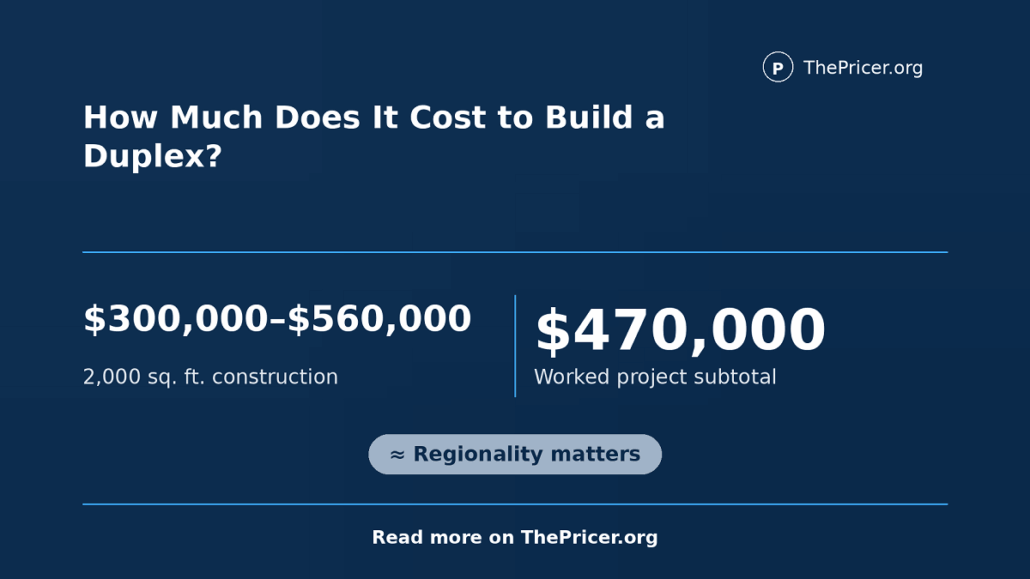
Building a duplex typically costs about $150 to $280 per square foot before land, putting a 2,000-square-foot two-family building around $300,000 to $560,000 for construction. A stacked, unit-over-unit duplex can run about $150 to $190 per square foot, while a side-by-side layout can run about $160 to $280 per square foot, according to a current duplex construction cost guide.
The amount needed to complete the project can be higher than the builder’s square-foot quote. Land, architecture and engineering, zoning or development approvals, utility extensions, site work, financing, owner-paid fees, and contingency can sit outside the construction contract. The first budgeting question is whether a quoted $300,000, $400,000, or $500,000 is the hard construction price or the all-in development budget.
A duplex is one building containing two separate dwelling units. The units may sit beside each other or one above the other, and that configuration affects foundation area, roof area, plumbing runs, electrical layout, accessibility, and total cost.
Article Highlights
Jump to sections
- Current published duplex estimates run about $150-$280 (at $30 per hour, earning that amount would take about 0.6 to 1.2 full-time workdays, before taxes) per square foot, excluding land.
- A 2,000-square-foot duplex works out to roughly $300,000-$560,000 for construction.
- Stacked duplexes are estimated around $150-$190 per square foot, versus $160-$280 for side-by-side construction.
- Architecture for new construction is commonly priced around 8%-15% of construction cost when a percentage fee is used.
- Land, regulatory costs, utilities, financing, and owner contingency can sit outside a contractor’s base bid.
- Construction loans are normally short-term, funded through advances or draws, and can carry higher interest rates than long-term purchase mortgages.
How Much Does It Cost to Build a Duplex?
| Duplex example | Published construction range | Calculated construction cost |
|---|---|---|
| 1,500 sq. ft. at general duplex range | $150-$280 (about 0.6 to 1.2 full-time workdays at $30 per hour)/sq. ft. | $225,000-$420,000 |
| 2,000 sq. ft. stacked | $150-$190/sq. ft. | $300,000-$380,000 |
| 2,000 sq. ft. side-by-side | $160-$280/sq. ft. | $320,000-$560,000 |
| 2,500 sq. ft. at general duplex range | $150-$280/sq. ft. | $375,000-$700,000 |
| 3,000 sq. ft. at general duplex range | $150-$280/sq. ft. | $450,000-$840,000 |
These figures exclude land. They are useful for early planning, but a local builder’s plan-specific bid carries more weight than a national square-foot range once drawings and site conditions are known.
Regional variation is substantial even outside the duplex market. The National Association of Home Builders found that contractor-built single-family homes started in 2024 had a national median price of $166 per square foot, with regional medians ranging from about $129 in East South Central states to more than $190 in New England. That NAHB regional analysis is not a duplex price list, but it shows why one national construction number cannot describe every market.
What You’re Actually Paying For
A builder’s contract can cover excavation, foundation, framing, roofing, windows, siding, insulation, drywall, plumbing, electrical, HVAC, cabinetry, flooring, fixtures, paint, and general contractor overhead, but contract scope varies. Some bids include permits, design coordination, utility work, landscaping, appliances, driveway work, or final grading. Others do not.
The latest NAHB Cost of Construction Survey found that direct construction represented 64.4% of the average new single-family sales price in 2024. The builder cost survey is not duplex-specific, but it provides a useful warning: the physical construction is only one part of the amount tied up in a completed residential property.
Do not take a builder’s $200 (about 6.7 hours of work at $30 per hour)-per-square-foot proposal and automatically add separate national estimates for framing, labor, materials, and GC profit. Those items are often already inside the quoted construction price. The reliable approach is to request an inclusions-and-exclusions schedule with the bid.
Three Duplex Budget Scenarios
Compact stacked duplex: two units sharing a 2,000-square-foot building can land around $300,000 to $380,000 using the published $150 to $190 per square foot stacked range. A smaller foundation and roof footprint can help control cost, although accessibility, sound separation, and stair design still affect the plans.
Side-by-side rental duplex: the same 2,000 total square feet calculates to $320,000 to $560,000 at the published $160 to $280 per square foot range. The wider footprint can add foundation and roof area, while separate ground-level entries may fit tenants or owner-occupants better.
Larger 3,000-square-foot duplex: applying the broad $150 to $280 per square foot range gives $450,000 to $840,000 before land. This case shows why size can move the project more than a few thousand dollars of finish substitutions.
For the two 2,000-square-foot layouts, the low-end difference is $20,000, while the high-end difference reaches $180,000. That spread is not a guaranteed side-by-side surcharge. Market, design, finish level, site conditions, and local labor can outweigh the layout effect.
The Hidden Price
Land is the clearest excluded cost because a lot in a rural market cannot be compared with a teardown lot in a high-cost city. The better formula is:
All-in duplex cost = land + construction contract + design/engineering + development and utility costs + financing/carry + owner contingency.
Regulatory and development costs can be much larger than a simple permit fee. In June 2026, NAHB estimated that federal, state, and local regulation accounted for $131,734, or 26.4%, of the average $499,500 new single-family sales price used in its study. Of that amount, $46,795 was attributed to regulation during land development and $84,939 to regulation during construction. The 2026 NAHB regulatory-cost study should not be applied dollar-for-dollar to a duplex, but it shows why zoning, code, review, and development requirements cannot be reduced to a universal $2,000-$6,000 permit allowance.
Ask the city, county, utility providers, and design team for project-specific numbers for plan review, building permits, impact fees, water and sewer taps, electric or gas extensions, stormwater requirements, driveway or right-of-way work, and any zoning or entitlement process. A parcel that already has suitable utility service and duplex zoning can have a very different development budget from an unserved or rezoning-dependent lot.
Architect, Engineering, and Contingency Costs
Architect fees are not always billed as a percentage. The American Institute of Architects says architects may charge hourly, a stipulated sum, per square foot, or as a percentage of construction cost. For new construction, its consumer guidance gives a typical percentage range of about 8%-15%. The AIA fee guidance also explains that project complexity and scope affect the arrangement.
If a duplex has a $400,000 construction budget and the architect’s agreed fee is 10%, the design fee is $40,000. If the builder’s $400,000 contract already includes architectural services through a design-build arrangement, adding another $40,000 would double count the same scope. Confirm the contract structure first.
AIA separately describes a design contingency of roughly 5%-10% of construction cost as a planning allowance. Using 7.5% on a $400,000 construction budget gives $30,000. That reserve is not a prediction that $30,000 will be spent. It is money held for uncertainty while scope and pricing become more definite.
Worked Example: A $400,000 Build Is Not Always a $400,000 Project
Assume a builder quotes $400,000 for the hard construction of a duplex and the contract explicitly excludes architecture, land, financing, and owner contingency.
- Hard construction contract: $400,000
- Architect at an illustrative 10%: $40,000
- Owner contingency at an illustrative 7.5%: $30,000
- Subtotal before land, financing, and project-specific development costs: $470,000
The arithmetic is $400,000 + $40,000 + $30,000 = $470,000. That is already $70,000 above the contractor’s number without inserting a fictional national lot price or permit package. The actual all-in total still needs the local land, utilities, fees, site work, and financing numbers.
This is why a $400,000 builder quote and a $400,000 project budget are not automatically the same thing.
Financing Can Add Five Figures

Construction loans should not be budgeted using a universal 5%, 7%, or 10% interest assumption. The Consumer Financial Protection Bureau describes a construction loan as short-term financing that commonly carries a higher interest rate than a longer-term home mortgage, with money advanced as construction progresses.
Freddie Mac’s 2026 homebuilding guidance likewise explains that a construction loan can require interest payments during construction and may later be replaced by permanent mortgage financing. A construction-to-permanent structure can reduce the need for a second closing, depending on the lender and loan program.
An illustrative carrying-cost calculation shows why this matters. If the average outstanding construction balance over a year were $250,000 and the effective annual interest cost were 8%, the simple annual interest calculation would be $250,000 × 8% = $20,000. That is not a current quoted loan rate. It shows how financing can add a five-figure cost even when the construction contract itself does not change.
Does Building a Duplex Work as a Rental?
Rental economics should be tested against the all-in development cost, not just the hard construction bid. Suppose a finished duplex costs $600,000 all-in and each unit could rent for $2,000 per month. Gross scheduled rent would be $2,000 × 2 × 12 = $48,000 per year.
The gross rent yield in that simplified example is $48,000 ÷ $600,000 = 8%. That is not an 8% profit. Property taxes, insurance, vacancy, repairs, turnover, utilities paid by the owner, management, financing, reserves, and capital replacements still have to come out of the rent.
Local rent matters just as much as local construction cost. Our guide to apartment rental costs shows why a rent assumption should be based on the target market rather than one national number.
When Building a Duplex Makes Sense
Makes sense if:
- The parcel already permits two dwelling units or the entitlement path is clear.
- Local rents support the all-in development cost after vacancy and operating expenses.
- You have a detailed construction bid showing what is included and what remains owner-paid.
- You can carry financing, contingency, and schedule delays without depending on a perfect opening date.
Does not make sense if:
- The deal works only when land, utility extensions, financing, or regulatory fees are omitted from the budget.
- You are stacking separate labor, material, and GC percentages on top of a contractor quote that already includes them.
- The project requires uncertain rezoning and the land purchase assumes approval will occur.
- Projected rents barely cover debt service before taxes, insurance, vacancy, and maintenance are added.
For a broader construction benchmark, building a single-family house provides a useful comparison. A duplex can share parts of the site, roof, foundation, and utility infrastructure, but it also adds a second kitchen, more plumbing fixtures, separation requirements, and another complete dwelling unit.
What We Verified
- Checked: current duplex-specific published pricing at $150-$280 per square foot, excluding land, with stacked and side-by-side ranges separated.
- Confirmed: U.S. Census maintains the Survey of Construction covering new single-family and multifamily construction, while the strongest public square-foot benchmarks still show substantial regional variation.
- Cross-referenced: AIA’s consumer guidance supports multiple architect fee structures rather than one mandatory percentage.
- Verified: CFPB and Freddie Mac both describe construction financing as temporary or phased financing rather than a standard purchase mortgage with one universal rate.
Related Building Costs
A duplex buyer comparing other construction methods can look at Zip Kit home costs, where the advertised shell price also leaves substantial site, foundation, utility, mechanical, and finish work outside the starting number.
Finish selections can move a duplex budget after the floor plan is set. Current interior decorator costs provide context for optional design help, but decorative services should remain separate from required architectural and engineering work.
Answers to Common Questions
How much does it cost to build a 2,000-square-foot duplex?
A current published construction range of $150 to $280 per square foot puts a 2,000-square-foot duplex around $300,000 to $560,000 before land. Stacked designs are estimated around $300,000 to $380,000, while side-by-side designs span roughly $320,000 to $560,000.
Does the cost per square foot include land?
No in the duplex benchmark used here. Land should be added separately because lot prices are local and can overwhelm the national construction range.
Is a stacked duplex cheaper to build?
It can be. Current published estimates put stacked duplexes around $150 to $190 per square foot, below the $160 to $280 range for side-by-side construction. The actual result depends on the plans, lot, market, foundation, finishes, and local code requirements.
How much should I budget beyond the contractor quote?
There is no safe universal percentage because contractor scopes differ. Check whether architecture, engineering, permits, utility work, site work, appliances, landscaping, financing, and contingency are included. Add only the items excluded from the actual bid.
How much do architects charge for a duplex?
AIA says architects use several billing methods. When a percentage of construction cost is used for new construction, its consumer guidance gives a typical range around 8%-15%. A design-build contractor may already include architecture in its price.
Is building a duplex a good investment?
It depends on the all-in project cost and local rents. Compare realistic rent with financing, taxes, insurance, vacancy, repairs, management, utilities, and replacement reserves rather than judging the project from gross rent alone.
Disclosure: Educational content, not financial advice. Prices reflect public information as of the dates cited and can change. Confirm current rates, fees, taxes, and terms with official sources before purchasing. See our methodology and corrections policy.