
How Much Does it Cost to Enclose a Porch?
Updated on | Written by Alec Pow
This article was researched using 13 sources. See our methodology and corrections policy.
Enclosing an existing porch can cost as little as $2,000 to $5,000 for a basic screened enclosure, while converting the same space into a three-season room can cost roughly $7,000 to $55,000. A fully insulated four-season enclosure with real windows, electrical work, heating and cooling can cost $16,000 to $70,000 or more.
The price depends on what “enclosing a porch” actually means. Adding insect screens to an existing roofed porch is a relatively light retrofit. Installing windows and weatherproof wall panels is a different project. Turning a porch into legal year-round living space can require structural upgrades, insulation, code-compliant windows, electrical work, HVAC, permits, and possibly foundation improvements.
Article Highlights
Jump to sections
- Screening an existing porch typically costs about $2,000 to $5,000.
- Three-season porch enclosures commonly fall around $7,000 to $55,000.
- Four-season or year-round enclosures often cost $16,000 to $70,000+.
- A basic existing-porch screen retrofit commonly runs about $10 to $25 per square foot.
- Windows alone can add several thousand dollars, with individual installed units often costing $300 to $2,500.
- A dedicated mini-split can add roughly $2,000 to $5,000.
- Foundation, structural, electrical, and permit requirements can turn a modest enclosure into a major renovation.
- A sunroom or porch enclosure should usually be treated as a lifestyle improvement rather than an investment that fully pays for itself at resale.

How Much Does It Cost to Enclose a Porch?
For an existing porch that already has a sound roof, floor, posts, and foundation, the enclosure itself can start near $2,000 to $5,000 when screens are the only major addition.
Current screened-porch prices put enclosing an existing porch at about $10 to $25 per square foot. A 200-square-foot porch therefore works out to roughly $2,000 to $5,000.
The price moves sharply higher once glass and year-round construction enter the project. Current enclosure data gives a national average around $17,815, with an overall range from roughly $2,050 to $50,000. Three-season rooms run around $7,000 to $55,000, while year-round sunroom-style enclosures can reach $16,000 to $70,000.
| Type of porch enclosure | Typical 2026 cost |
|---|---|
| DIY/basic screen system | $500–$2,500+ |
| Professionally screened existing porch | $2,000–$5,000 |
| Three-season enclosure | $7,000–$55,000 |
| Four-season/year-round enclosure | $16,000–$70,000+ |
| High-end custom sunroom conversion | $40,000–$80,000+ |
This explains why the old $10,000-to-$30,000 average was too broad to be genuinely useful. A homeowner adding mesh screens and a homeowner creating conditioned living space are not buying the same project.
Screened Porch
A screened enclosure is the least expensive option when the porch already has a usable roof, floor, framing, and foundation.
Current 2026 pricing puts a professional screen enclosure around $2,000 to $4,000 for many existing porches. Larger spaces and premium screen systems move higher. Screened-porch data places retrofit costs around $5 to $20 per square foot, depending on materials and complexity.
The raw screen itself is inexpensive. Fiberglass can cost only about $0.25 to $0.50 per square foot and aluminum roughly $0.35 to $0.70. Frames, track systems, doors, fasteners, trim, carpentry, and labor are what turn inexpensive mesh into a multi-thousand-dollar finished enclosure.
A branded DIY system illustrates the difference. Screen Tight estimates roughly $2 per square foot for its components, fiberglass screen, spline, and screws.
If a porch has 400 square feet of actual screen openings, that suggests around:
400 × $2 = $800 in screening-system materials
That does not include repairing posts, adding a door, painting, replacing railings, hiring labor, or correcting damaged framing.
This is the best candidate for DIY because screening does not normally require the same thermal, structural, and weatherproofing work as converting a porch into conditioned living space.
Three-Season Rooms
A three-season enclosure adds considerably more weather protection than screens but is not necessarily designed to perform like the rest of the house during severe winter or summer weather.
These rooms commonly use windows or removable panels, weather-resistant wall systems, and more substantial doors. They may have limited insulation and portable heating or cooling, but they are typically not integrated into the home’s full thermal envelope.
Current national data places three-season enclosures around $7,000 to $55,000. The broad range reflects the condition of the existing porch and the amount of glass involved.
A homeowner with an intact 12-by-16 covered porch may only need window panels, framing modifications, weather sealing, electrical additions, and finishes. Another porch may need reinforcing, new flooring, drainage correction, roof work, and upgraded support before the windows can even be installed.
Products such as Eze-Breeze windows sit in this middle ground. They can provide better weather protection than ordinary screening without automatically turning the porch into conventional year-round interior space.
Four-Season Rooms
A four-season enclosure is where the project becomes much closer to a conventional home addition.
Current sunroom guidance places full sunroom projects around $22,000 to $72,600. Four-season spaces normally require insulated construction, better windows, weather sealing, and permanent heating and cooling.
The existing porch also has to be suitable for the additional load and intended use. Posts or footings built for an open porch may not automatically be adequate for insulated walls, heavy windows, drywall, HVAC equipment, and year-round occupancy.
This is one reason a seemingly simple request to “put windows around the porch” can turn into a structural renovation.
For comparison, see our broader guide to sunroom costs, which covers purpose-built additions rather than only enclosing an existing porch.
Windows Drive the Budget
Glass can become one of the largest costs in a three- or four-season conversion.
Current 2026 window pricing puts individual professional replacements around $300 to $2,500 each, with an average near $750. Window price data shows why a wall of glass quickly changes the project total.
Suppose a porch design needs eight windows averaging $750 installed:
8 × $750 = $6,000
If the homeowner upgrades to larger custom units averaging $1,250, the same eight openings cost:
8 × $1,250 = $10,000
That is a $4,000 difference without changing the porch size at all.
For a true four-season room, thermal performance also matters. ENERGY STAR guidance rates windows by climate-specific U-factor and solar heat gain performance. A wall of poorly chosen glass can make a porch uncomfortable and increase heating or cooling demand.
Readers comparing higher-end window packages can also see our current Pella window prices.
The Hidden Price
The hidden costs are what separate a $4,000 enclosure from a $40,000 conversion.
Structural repairs come first. Rotted posts, undersized joists, damaged decking, weak footings, or a leaking roof need to be corrected before enclosing the structure.
Foundation work can become especially expensive. A screen porch does not create the same load or energy requirements as a finished year-round room. If existing piers or footings are inadequate, reinforcing or rebuilding them can add thousands.
Electrical work is another common surprise. New outlets, lighting, ceiling fans, dedicated circuits, and HVAC power can range from a few hundred dollars into several thousand. Current electrical estimates put minor work around $150 to $600 and complicated addition work around $2,000 to $10,000.
Heating and cooling can add another major line item. A ductless mini-split commonly costs about $2,000 to $5,000 installed, with more elaborate systems moving higher. Mini-split pricing puts the average around $3,000.
Finishes add up as well: drywall, trim, paint, flooring, baseboards, blinds, window treatments, and exterior siding can together add thousands to a room that looked nearly finished after framing and windows were installed.
Finally, enclosing an open structure can reveal drainage and moisture problems that were previously harmless. Wind-driven rain, slab moisture, roof runoff, and condensation matter more once the space contains finished walls, flooring, furniture, and electrical equipment.
A Worked Budget
Consider a 12-by-16-foot existing porch, or 192 square feet, with a sound roof and floor.
A homeowner wants to turn it into a comfortable three-season room rather than a basic screened porch.
| Framing modifications | $2,500 |
| Windows and exterior door | $6,500 |
| Weatherproofing and insulation | $2,000 |
| Electrical work | $1,500 |
| Interior/exterior finishes | $2,500 |
| Permit/design allowance | $800 |
| Illustrative total | $15,800 |
|---|
That works out to about:
$15,800 ÷ 192 = $82.29 per square foot
Now add $3,000 for a mini-split, $3,500 for structural or foundation reinforcement, and $3,000 for better insulated glazing and finishes. The project reaches:
$25,300, or about $132 per square foot.
The porch dimensions never changed. The scope did.
This is the central budgeting lesson: a per-square-foot number means very little until the intended enclosure type is defined.
Permits and Code
The old article treated permits mostly as a $500-to-$2,000 fee. The bigger issue is not the permit fee itself but what the approval process may require the project to include.
Requirements vary considerably by location. Fairfax County guidance, for example, specifically lists screen porches and sunrooms among residential projects requiring permits.
Austin handles legally established porch enclosures through its residential review system as well.
Other jurisdictions are less restrictive for very light work. Charlotte County, Florida, currently allows standard insect screening of certain existing covered porches without a building permit when the footprint is not changed.
This variation is why homeowners should check locally before assuming that “the porch already exists” means no approval is needed.
The project may trigger structural review, setback requirements, energy rules, electrical permits, mechanical permits, window requirements, or inspections once the room’s use changes.
DIY vs. Professional
DIY makes the most sense at the screening end of the market.
A homeowner who is comfortable installing a track system, spline, screen mesh, trim, and a screen door can potentially build a basic enclosure for a fraction of professional pricing.
Assume a 200-square-foot porch would cost $4,000 professionally but $1,200 in DIY materials and tools. The apparent saving is:
$4,000 – $1,200 = $2,800
If the work takes 50 hours, the homeowner is effectively saving:
$2,800 ÷ 50 = $56 per hour
That can be an attractive trade for an experienced DIYer.
The equation changes for a four-season room. Structural framing, glass installation, flashing, water management, electrical wiring, HVAC, insulation, and code compliance leave much more room for expensive mistakes. A leak behind a finished wall or an undersized footing can erase the labor saving very quickly.
A practical compromise is to leave framing, windows, electrical work, HVAC, and structural changes to professionals while handling painting, trim, or other low-risk finish work yourself.
Ongoing Costs
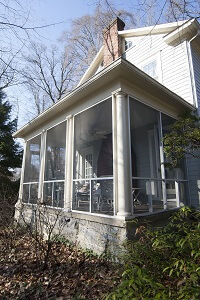 A screened porch has limited operating cost but still needs maintenance. Torn or sagging screen eventually needs replacement, and current rescreening costs range widely depending on size and material.
Three- and four-season spaces introduce more expensive ownership items. Windows eventually need seals or hardware repaired. Painted wood needs maintenance. Heating and cooling add to utility bills. Roof or flashing problems become more consequential because the space now contains interior finishes.
A four-season room may also affect property taxes and insurance if it increases recognized living area or replacement value.
This recurring cost is easy to overlook because the original porch may have required little more than occasional cleaning and painting.
Does It Add Value?
The old article suggested homeowners could recover 50% to 80% of their porch-enclosure spending. That is too confident for such a broad category.
Current resale estimates put sunroom returns more around 20% to 50%, depending on construction, location, and whether the room genuinely adds useful conditioned space.
A simple screen enclosure may make a home more attractive without being treated as conventional interior square footage. A four-season room built and permitted to standards similar to the rest of the house has a stronger argument for contributing real value.
Even then, a $40,000 enclosure should not be assumed to add $40,000 to the sale price.
For example, a $30,000 project with a 40% return adds an estimated:
$30,000 × 40% = $12,000 in resale value
The homeowner’s remaining $18,000 is effectively the cost of enjoying the space rather than an investment recovered at sale.
That does not make the project a poor decision. If the family uses the room every day for ten years, the lifestyle value can be far more important than resale percentage.
What We Verified
We compared current 2026 porch-enclosure estimates, screened-porch pricing, sunroom costs, screen materials, window costs, HVAC prices, electrical-work ranges, energy-efficiency guidance, rescreening costs, permit rules from multiple U.S. jurisdictions, and current resale-value estimates.
The research required several major corrections to the older article. We separated screened, three-season, and four-season projects rather than treating all porch enclosures as $10,000-to-$30,000 renovations. We removed the old $100-to-$200-per-square-foot blanket estimate because basic screening can be far cheaper while conditioned conversions can cost more.
We also replaced the universal $500-to-$2,000 permit assumption with jurisdiction-specific guidance, removed the 50%-to-80% resale claim, and corrected the statement that screened porches cost $100 to $200 per square foot. Current existing-porch screening is commonly closer to $10 to $25 per square foot.
The most useful rule is to price the project by intended use: bug protection, weather protection, or true year-round living space.
Answers to Common Questions
What is the cheapest way to enclose a porch?
Screens are the cheapest practical enclosure for an existing covered porch. A professional retrofit commonly costs around $2,000 to $5,000, while an experienced DIY homeowner may spend considerably less on materials.
How much does it cost to turn a porch into a room?
A three-season room commonly costs about $7,000 to $55,000. A true four-season conversion can cost $16,000 to $70,000+, especially when structural work, insulated windows, HVAC, and electrical upgrades are needed.
How much does it cost to screen a 200-square-foot porch?
At current typical retrofit pricing of about $10 to $25 per square foot, a 200-square-foot existing porch costs roughly $2,000 to $5,000 to screen professionally.
Do I need a permit to enclose a porch?
Often, especially when adding permanent walls, windows, electrical work, HVAC, or conditioned living space. Simple screening may be exempt in some jurisdictions. Check with the local building department before starting.
Can an existing porch become a four-season room?
Possibly, but the existing foundation, framing, roof, and floor need to support the new loads and meet applicable requirements. Some porches need substantial reinforcement before they can function as year-round living space.
Does an enclosed porch count as living space?
Not automatically. A room generally needs to satisfy local requirements for permanent enclosure, access, heating and cooling, structural construction, and other applicable code provisions before it can be treated as finished living area.
Does enclosing a porch increase home value?
Usually to some degree, but current estimates suggest a typical sunroom-style enclosure may recover roughly 20% to 50% of its cost rather than paying for itself completely.
Disclosure: Educational content, not financial advice. Prices reflect public information as of the dates cited and can change. Confirm current rates, fees, taxes, and terms with official sources before purchasing. See our methodology and corrections policy.