
How Much Does a Private Investigator Cost?
Updated on | Written by Alec Pow
This article was researched using 12 sources. See our methodology and corrections policy.
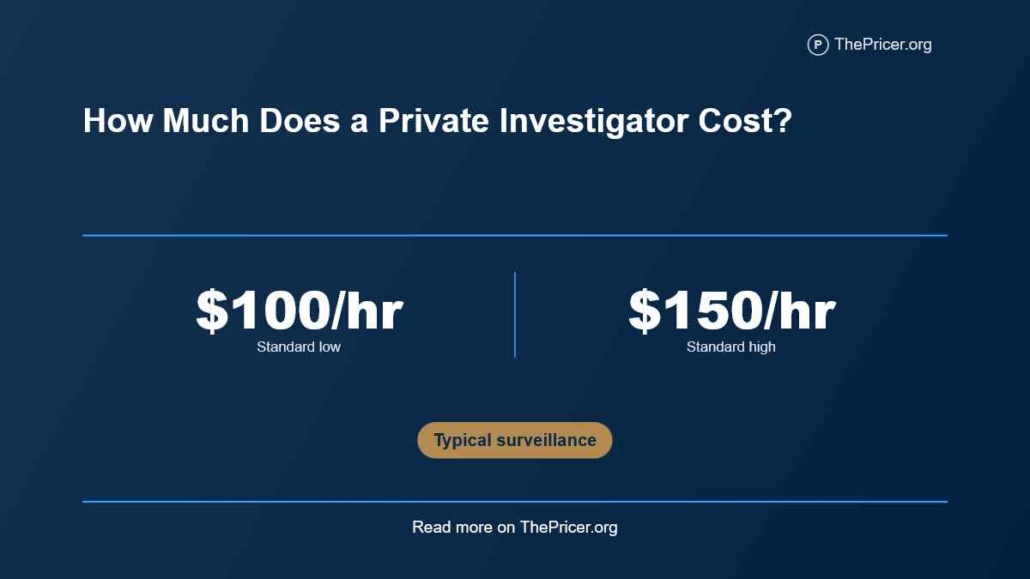
A private investigator in the United States commonly charges about $100 to $150 per hour for standard one-investigator surveillance based on published U.S. rate cards reviewed in September 2026. Some firms advertise lower or higher rates, and specialist work can move well beyond that band. The hourly number also does not show the full bill because retainers, minimum surveillance blocks, mileage, travel, database fees, report preparation, rush work, and additional investigators may all add cost.
For a short assignment, a client may spend several hundred dollars. Multi-day surveillance can move into the low thousands, while complex financial, corporate, interstate, or technical investigations can reach $5,000 to $15,000+. The right comparison is not simply hourly rate versus hourly rate. It is the complete price for the scope, staffing, travel, reporting, and evidence you actually need.
Article Highlights
Jump to sections
- Published standard surveillance rates reviewed for this update cluster around $100 to $150 (at $30 per hour, earning that amount would take about 3.3 to 5 hours of work, before taxes) per hour for one investigator.
- A four-hour surveillance minimum can create a practical starting bill of $400 to $600 even if the useful activity lasts less than four hours.
- Published retainers range from about $500 to $5,000+, depending on case complexity and expected fieldwork.
- Background checks can be sold at fixed prices, while field surveillance is more often billed by time.
- Mileage, travel, rush scheduling, database fees, report work, and second investigators can raise the final invoice well above the quoted hourly rate.
How Much Does a Private Investigator Cost?
Current published rate cards give a clearer picture than a single national average. R&D Investigations publishes $100 to $150 per hour for standard investigations in its May 2026 pricing guide. Brooks Detective Agency in Florida publishes a $125 hourly standard rate and requires at least four consecutive surveillance hours per day. Gateway Investigations in the St. Louis area publishes $100 per hour with a four-hour minimum.
That puts many ordinary surveillance assignments around $100 to $150 (about 3.3 to 5 hours of work at $30 per hour) per hour before extras. The market is wider than that narrow band. Crossroads Investigations describes a broader professional range of $75 to $250 per hour for 2026. R&D lists specialized digital, complex fraud, and corporate due-diligence work at $150 to $400+ per hour, showing why technical or corporate assignments should not be priced like ordinary local surveillance.
| Published example | Price | Important scope |
|---|---|---|
| Gateway Investigations | $100/hour | St. Louis-area surveillance, four-hour daily minimum |
| Brooks Detective Agency | $125/hour | Standard rate per investigator, four-hour surveillance minimum |
| Rambo Investigations | $100/hour | Starting daytime surveillance rate in Central Florida |
| R&D Investigations | $100 to $150/hour | Published 2026 standard-investigation range |
What the Hourly Fee Covers
An investigator’s hourly fee usually buys professional time rather than a guaranteed result. Surveillance can involve planning, driving to a location, waiting without being noticed, following a subject, recording lawful observations, organizing video or photographs, and producing a written account. A case can consume hours even when the subject barely moves, so firms rarely promise a result within a fixed number of hours.
Scope also changes the meaning of an hourly quote. One investigator working a local daytime assignment is not equivalent to a two-person mobile team operating at night across several jurisdictions. Litigation Investigators publishes $125 per hour plus mileage for a single investigator, then prices additional team members separately. Compare how many investigators the rate covers, when billing starts, and whether travel or reporting is extra.
Desk research is easier to scope in advance, so background checks, records searches, and locates are more likely to carry fixed prices than open-ended field surveillance.
Retainers and Minimum Hours
A retainer is money paid in advance and applied against future investigative charges under the firm’s agreement. It is not automatically the final case price. Brooks requires a $1,500 (about 1.3 full-time workweeks at $30 per hour) nonrefundable retainer for general investigations and surveillance. Litigation Investigators lists a $500 retainer covering the first four hours of single-investigator surveillance. R&D publishes basic-case retainers of $1,000 to $3,000 and complex or surveillance retainers of $3,000 to $5,000+.
Minimum-hour rules can matter as much as the retainer. At a four-hour minimum, a firm charging $100 per hour creates a minimum field-time charge of $400 for that surveillance day. At $125 per hour, the floor becomes $500. At $150 per hour, four hours equals $600. Three separate surveillance days at a $125 rate and four-hour minimum create at least $1,500 in field time before mileage or other expenses, even if each day produces only a short period of useful activity.
Ask whether unused retainer money is refundable, left as a future credit, or treated as earned when paid. Those policies differ. Brooks states that its retainer is nonrefundable while unused hours remain as a future credit. R&D says unused retainer money is typically refunded at the end of the assignment. A cheaper hourly quote can be less attractive if its minimum or retainer terms are worse for a short case.
Prices by Investigation Type
Not every private investigation should be priced like surveillance. Defined research tasks can carry flat or project fees because the investigator can estimate the workload more closely. Gateway publishes a detailed personal, criminal, and civil background check at $150. Rambo Investigations advertises background investigations starting at $150. Litigation Investigators lists concealed asset investigations starting at $1,750. Those prices buy different work and should not be blended into one average.
The same R&D pricing guide lists basic background checks around $200 to $500, extensive checks around $500 to $1,000+, locating a person around $300 to $1,000, and corporate investigation retainers around $5,000 to $15,000+. These are provider-published ranges, not government-set fees.
A private investigator’s background research is not automatically suitable for regulated employment or tenant screening. The Federal Trade Commission explains that third-party background information used for employment decisions can trigger Fair Credit Reporting Act requirements, including disclosure and permission rules. A people-search product and an FCRA-compliant employment report are different products.
A related cost comparison is the price of a background check when the need is limited to records rather than field investigation. Financial disputes may instead call for a forensic accountant if the main question involves tracing money rather than observing a person.
Charges Beyond the Hourly Rate
 Mileage is one of the easiest extras to overlook. Some firms charge from their office to the surveillance location, others include local mileage, and some bill travel time as well as distance. Gateway publishes $0.65 per mile outside parts of its local area. That is a firm-specific client charge, not a universal mileage rule.
The distinction matters because the IRS changed the optional business mileage rate during 2026. The rate started at $0.725 per mile, then the IRS revised it to $0.76 per mile for business travel from July 1, 2026. A private firm can set its own client mileage charge, so a published investigator mileage fee should not automatically be described as the federal mileage rate.
Other extras can include parking, tolls, hotels, airfare, database charges, records fees, report preparation, video processing, rush scheduling, equipment, court appearances, and testimony. Gateway lists lodging at $120 per day on qualifying distant assignments. Brooks says parking, tolls, database fees, records costs, specialized equipment, lodging, and other approved case expenses can sit outside ordinary investigative time. Ask which extras apply and whether the retainer covers them.
Three Cost Scenarios
Short local surveillance. Using Gateway’s published $100 per hour rate and four-hour minimum, one four-hour surveillance block costs $400 before any applicable out-of-area mileage or outside expense. Two separate four-hour days would be $800. The client is buying time, not a promised finding.
Two-day surveillance with travel. Take a 12-hour assignment priced at Gateway’s $100 per hour, split across two days, plus an illustrative 120 billed miles at the firm’s stated $0.65 per mile. Field time is $1,200. Mileage adds $78. The combined amount is $1,278 before parking, special records, or other outside costs. The arithmetic is 12 × $100 plus 120 × $0.65.
Higher-rate multi-day case. At the top of R&D’s published standard-investigation range, $150 per hour, 18 hours of field work equals $2,700 before mileage and database charges. If the same case needs another six hours, the extra block adds $900. Expected hours can matter more than a small difference in the hourly rate.
Case duration can dominate the bill. A $100 investigator working 30 hours costs $3,000 in labor, while a $150 investigator working 16 hours costs $2,400. The lower hourly rate is not automatically the lower-cost engagement if the scope, staffing, efficiency, or minimums differ.
When Hiring One Makes Sense
A private investigator can make financial sense when the answer has material value and a clear use. Custody, fraud, missing-person, asset, and litigation matters may justify the expense when the information affects a larger decision. Set a defined question, spending cap, and deliverable.
In divorce cases, proof of infidelity does not create the same financial effect in every state. The old assumption that proving an affair will pay for itself is too broad. Before spending thousands, ask counsel what fact must be established and whether it can affect property, custody, support, or another disputed issue.
Makes sense if
- The evidence could affect a legal claim, safety decision, asset recovery, or financial exposure worth much more than the investigation fee.
- The assignment has a precise target, such as locating a person, documenting activity during defined hours, or tracing a specific asset.
- An attorney or other relevant professional has identified evidence that would be useful rather than merely interesting.
- The engagement agreement caps spending or requires approval before the retainer is replenished.
Does not make sense if
- You mainly want confirmation of a suspicion with no practical use for the result.
- A cheaper records search can answer the question without field surveillance.
- The expected fee approaches or exceeds the money at stake.
- You cannot define what result or deliverable would make the investigation useful.
Licensing and Legal Checks
Licensing is state-specific, so verify the investigator or agency where the work is performed. California’s Bureau of Security and Investigative Services provides a public private-investigator license lookup. Florida explains its private investigation license classes under Chapter 493.
A license does not make every requested tactic lawful. Federal and state law can limit access to records, recording, tracking, private-property entry, impersonation, credit information, and surveillance methods. Do not hire an investigator to obtain information through unlawful conduct. For litigation, screening, family law, or sensitive data, put the authorized scope in writing and involve counsel when needed.
Credentials matter for specialist work. A firm selling digital forensics, financial tracing, counter-surveillance, or expert testimony should identify who performs it and what the rate buys. For a financial records dispute, compare the investigator’s scope with the price of a forensic audit before paying a surveillance-oriented firm to solve an accounting problem.
Answers to Common Questions
How much does a private investigator cost per hour?
Published U.S. examples reviewed for this update put many standard surveillance assignments around $100 to $150 per hour for one investigator. Broader investigative rates can run below or above that range.
How much is a private investigator retainer?
Published retainers can start around $500 and reach $5,000+ for surveillance and more involved matters. Complex corporate cases can require much larger advances.
How much does a private investigator cost for one day?
A four-hour minimum at $100 to $150 per hour creates a starting field-time charge of roughly $400 to $600. A longer eight-hour surveillance day would be $800 to $1,200 at those same hourly rates before extras.
Can a private investigator charge a flat fee?
Yes. Background research, locates, records work, and defined packages are more likely to use flat pricing than open-ended surveillance. The contract should state exactly what work and deliverables the flat fee includes.
Is the retainer the total cost?
Usually not. A retainer is commonly an advance balance that billed time and expenses reduce. Ask when it must be replenished and what happens to unused money when the case ends.
Disclosure: Educational content, not financial advice. Prices reflect public information as of the dates cited and can change. Confirm current rates, fees, taxes, and terms with official sources before purchasing. See our methodology and corrections policy.