
How Much Does it Cost to Open a Hookah Bar?
Updated on | Written by Alec Pow
This article was researched using 11 sources. See our methodology and corrections policy.
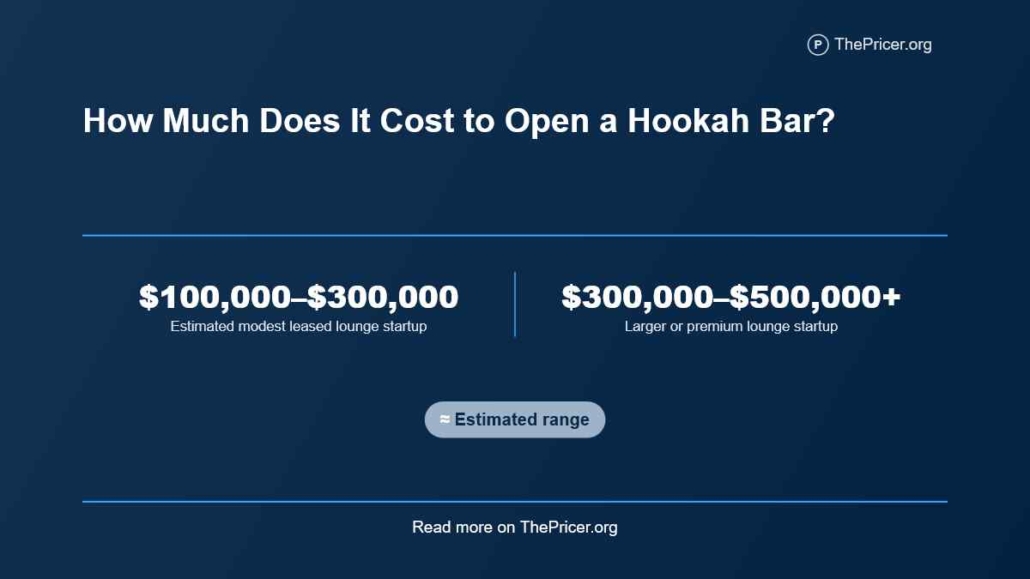
Opening a hookah bar in the United States can require approximately $100,000 to $300,000 for a modest leased lounge, while a larger venue with substantial renovations, specialized ventilation, and upscale furnishings may cost $300,000 to $500,000 or more. These are planning estimates, not verified national averages. Purchasing the building adds a separate real-estate investment.
The largest financial risk is not necessarily the hookah equipment. It is spending money on a commercial property that cannot legally operate as an indoor smoking establishment. Before signing a lease, owners need to confirm smoking exemptions, zoning, fire requirements, and the feasibility of installing the necessary ventilation.
Article Highlights
Jump to sections
- A modest leased hookah lounge may require an estimated $100,000 to $300,000 (at $30 per hour, earning that amount would take about 1.6 to 4.8 years of full-time work, before taxes) in startup funding.
- Major renovations and premium furnishings can push investment beyond $500,000.
- Specialized ventilation may add tens of thousands of dollars, depending on the building and engineering requirements.
- Monthly overhead must be modeled separately from opening expenses and variable supplies.
- Some jurisdictions restrict new hookah establishments regardless of the owner’s construction budget.
- Working capital and construction contingency should remain available after opening.
How Much Does It Cost to Open a Hookah Bar?
A hookah lounge combines hospitality expenses with tobacco-related licensing and fire-safety considerations. Restaurant construction estimates provide a useful comparison, although they do not automatically establish the cost of a permitted smoking lounge.
Toast’s 2026 restaurant startup estimates place conventional restaurant openings around $175,000 to $750,000 (about 2.8 to 12 years of full-time work at $30 per hour), depending on the concept and property. Hookah-specific planning estimates published by eFinancialModels for lounge projects include a lower-cost model near $70,000 and more expensive configurations exceeding $250,000. These models use different assumptions and are not measured national averages.
| Startup expense | Illustrative budget |
|---|---|
| Lease deposits and pre-opening occupancy | $8,000–$30,000 |
| Renovation and interior construction | $25,000–$100,000 |
| Ventilation and mechanical work | $15,000–$50,000 |
| Furniture, lighting, and decor | $10,000–$40,000 |
| Hookah equipment and opening inventory | $5,000–$20,000 |
| Permits, professional services, and insurance | $5,000–$20,000 |
| POS, security, signage, and marketing | $5,000–$20,000 |
| Initial operating reserve | $25,000–$75,000 |
These are illustrative allocation ranges for a leased establishment, not independent supplier quotations. They are meant to help owners request comparable bids. Adding every upper endpoint would describe a different project from adding every lower endpoint.
Construction condition matters enormously. In an earlier independent restaurant opening survey, remodeling an existing restaurant was substantially less expensive than converting an unrelated commercial space. The historical figures should not be treated as current hookah lounge quotations, but the underlying distinction remains useful.
Choosing a Property
Leasing an existing hospitality property can reduce spending on restrooms, electrical systems, plumbing, counters, and seating. A former bar, however, is not automatically approved for indoor smoking. Its existing ventilation may have been designed for temperature control rather than smoke removal.
Property costs should be separated into recurring rent, deposits, pre-opening rent, and tenant improvements. Purchasing commercial real estate is a different financial transaction and should not be mixed into the startup estimate for a leased lounge.
A hypothetical $5,000 (about 4.2 full-time workweeks at $30 per hour) monthly lease requiring three months of payments or security before occupancy would tie up $15,000. Four additional months of rent during construction would cost another $20,000. That creates $35,000 in occupancy spending before the first customer arrives.
A landlord should approve the proposed use, mechanical alterations, roof penetrations, charcoal handling, signage, operating hours, and anticipated occupancy in writing. A lease contingency tied to regulatory approval can protect an owner from becoming obligated to occupy an unusable location.
Ventilation and Smoke Safety
Ventilation deserves its own engineering budget. Equipment selection depends on building volume, exhaust capacity, make-up air, heating and cooling loads, neighboring tenants, and applicable mechanical and fire codes. There is no universal ventilation package that makes indoor hookah smoking lawful.
The CDC’s hookah health guidance explains that charcoal combustion creates carbon monoxide and other toxic substances. Secondhand hookah smoke also contains harmful emissions from tobacco and the heating source. Water filtration does not make the smoke safe.
A mechanical engineer should assess exhaust, replacement air, equipment placement, monitoring, and operating procedures. The quoted system cost must include installation, electrical connections, controls, commissioning, and any building modifications.
Air filtration and carbon monoxide monitoring are not substitutes for legal permission or adequate engineering. Owners should also establish procedures for charcoal storage, ignition, disposal, employee exposure, and emergency response.
Hookah Equipment and Supplies
Equipment spending depends on how many simultaneous sessions the lounge can support. A compact venue might purchase 20 working hookahs plus replacement bowls, hoses, bases, seals, and cleaning equipment. A high-capacity operation could require substantially more equipment and storage.
The opening inventory also includes compliant shisha products, charcoal, disposable mouthpieces, cleaning supplies, and replacement components. Supplier quotes should identify whether hookahs are commercial-duty products and whether taxes, shipping, and replacement parts are included.
The FDA’s hookah tobacco product guidance covers the devices and related components used in this market. Product compliance, lawful sourcing, and inventory controls belong in the operating budget rather than being treated as incidental purchases.
A short food and beverage menu can reduce the need for a full commercial kitchen, although local food-service requirements still apply. Owners considering extensive dining service should compare the investment with the costs of opening a coffee shop or another hospitality business before assuming that additional menu revenue justifies construction.
Licenses and Smoking Restrictions
Legal eligibility should be established before the owner commits to construction. Requirements may include a business license, tobacco retail authorization, zoning approval, building permits, fire inspections, food-service licensing, and a separate alcohol license if alcohol service is permitted.
New York City illustrates why a generic license budget is insufficient. Its non-tobacco hookah permit rules state that new applications are no longer accepted. The published annual renewal fee of $25 applies to qualifying existing permit holders, not entrepreneurs seeking to open a new establishment.
The city’s hookah establishment requirements also distinguish permitted non-tobacco service from tobacco shisha restrictions. A low administrative fee therefore does not mean a new lounge can obtain permission to operate.
At the federal level, the FDA’s Tobacco 21 requirements prohibit tobacco sales to customers under 21. Retailers must check photo identification for purchasers under 30 under the applicable federal rules.
Local tobacco taxes, flavored-product restrictions, employment rules, and fire requirements can alter both the business model and ongoing costs. Regulatory review should be conducted with the relevant authorities before financing or signing a binding lease.
Monthly Operating Expenses
Monthly overhead includes rent, utilities, payroll, insurance, security, marketing, repairs, software, professional services, and financing obligations. Shisha, charcoal, mouthpieces, food, and beverages add variable costs that rise with sales.
An illustrative small lounge could budget $5,000 for rent, $15,000 for loaded payroll, $2,500 for utilities and maintenance, and $2,500 for insurance, marketing, software, and administration. Fixed and relatively stable operating commitments would then total $25,000 per month, before inventory replenishment and loan payments.
That figure is a scenario, not a measured industry average. Staffing schedules, minimum wages, local occupancy costs, opening hours, insurance underwriting, and owner compensation could change it considerably.
The Small Business Administration’s startup guidance recommends identifying one-time and monthly costs separately and projecting ongoing expenses rather than considering opening-day spending alone.
A Complete Startup Budget
Consider a hypothetical leased lounge with moderate renovation requirements, a limited nonalcoholic menu, and enough equipment for several groups at once. Assume local authorities have confirmed that its proposed smoking operation is legally permissible.
- Lease deposits and pre-opening rent: $18,000
- Renovation and construction: $65,000
- Engineered ventilation installation: $35,000
- Furniture and lighting: $24,000
- Hookahs and opening inventory: $12,000
- Professional fees, permits, and insurance: $11,000
- POS, security, signage, and promotion: $10,000
- Construction contingency: $10,000
- Initial operating reserve: $75,000
The modeled funding requirement is $260,000. Construction and ventilation consume $100,000, or about 38.5% of the total. The operating reserve represents another 28.8%. This illustrates why estimating only the equipment and interior furnishings can badly understate the required capital.
The $75,000 reserve covers three months at the modeled $25,000 fixed-cost level. It would last longer if revenue offsets cash expenses, but less time if inventory, debt payments, or unexpected repairs increase spending.
The Hidden Price of Delays
Construction overruns are not the only threat. Rent, insurance, financing costs, and certain utilities may begin before revenue. Delayed inspections or mechanical redesigns can exhaust cash that was intended to support the opening months.
Using the earlier $5,000 monthly rent assumption, a three-month permitting delay creates $15,000 in additional rent alone. If financing and other holding costs add an assumed $2,000 monthly, the delay consumes $21,000.
That is 8.1% of the entire $260,000 example budget without buying a single additional hookah. This compounded cost supports negotiating rent commencement terms, construction access, permit contingencies, and adequate cash reserves before occupying the premises.
Revenue and Break-Even Sales
Hookah service is commonly priced by session or shared device rather than by individual smoker. Philadelphia’s Luna Lounge published menu lists a large hookah service at $40, with seating for groups of two to four. That is one venue’s advertised offer, not a national average.
Suppose a lounge generates an average $40 hookah transaction and retains 70% of revenue after its assumed direct variable costs. With fixed expenses of $25,000 monthly, break-even hookah revenue would be about $35,714 per month.
At $40 per session, the lounge would need roughly 893 paid sessions monthly, or about 30 per day over 30 operating days. This calculation excludes financing payments and income taxes, and the 70% contribution assumption must be replaced with actual inventory, labor-allocation, and payment-processing figures.
A lower contribution margin changes the result. If variable expenses consume 40% rather than 30% of sales, the required revenue becomes approximately $41,667, equivalent to about 35 sessions daily. The difference shows why transaction volume and direct operating costs matter more than unsupported promises of high profit margins.
Food, drinks, events, and private bookings may diversify revenue, but each also creates incremental staffing, inventory, licensing, or equipment requirements. Serving alcohol should never be presumed compatible with local hookah rules.
Financing the Lounge
Owners may combine personal capital, investor funding, equipment financing, and commercial loans. The financing structure must account for construction spending, the time before opening, working capital, and debt payments after launch.
The SBA’s 7(a) loan program can support eligible business uses including equipment, improvements, furniture, and working capital. Whether a particular hookah business qualifies requires lender review and application of the program’s eligibility rules.
Debt increases the cash-flow threshold. A lounge that covers its rent, employees, and supplies can still operate at a cash deficit when monthly principal and interest are added. Financing projections should show both operating break-even and cash remaining after debt service.
Choosing the Right Business Model
Three practical models carry different financial risks. A small lounge using an already suitable commercial property minimizes construction exposure. A larger premium lounge raises seating and revenue capacity but commits more money to furnishings, staff, and mechanical systems. Purchasing an existing licensed business may provide infrastructure and customers, but only if permits, financial statements, and lease rights survive the transaction.
An existing operating venue requires careful due diligence. Review sales records, tax returns, occupancy reports, inventory, equipment condition, supplier invoices, lease transfers, permit transferability, and documented violations. The acquisition price must not be confused with the cash needed for improvements and continued operation.
Makes sense if
- Written regulatory confirmation supports the proposed location and business model.
- Ventilation and construction costs have been professionally estimated.
- Realistic customer volume supports rent, payroll, inventory, and debt obligations.
- Funding includes contingency and adequate operating reserves.
Does not make sense if
- The business depends on obtaining a permit that is unavailable to new applicants.
- The landlord cannot approve essential exhaust or building modifications.
- The entire investment is spent before opening.
- Profit projections rely on unverified sales or assumed rapid payback.
Other location-based business models deserve comparison before committing to major construction. The startup economics of a commercial laundromat illustrate how specialized infrastructure can consume capital even when customer-facing equipment seems relatively straightforward.
Answers to Common Questions
Can you open a hookah bar with $50,000?
It may be possible in an unusually small, already-equipped, legally approved venue, but $50,000 is insufficient for many new commercial buildouts. Ventilation, construction, deposits, and operating reserves can exceed that amount.
What is the biggest hookah bar startup expense?
Construction and mechanical work can dominate the budget, particularly when converting ordinary retail space. A second-generation hospitality location may reduce renovation expenses but still require extensive smoking-related modifications.
How much can a hookah lounge earn monthly?
There is no dependable universal figure. Revenue depends on sessions served, average transaction value, operating days, and additional purchases. Profit requires covering variable expenses, fixed costs, debt payments, and applicable taxes.
How much cash should remain after opening?
Owners should model several months of expenses rather than allocating all funding to construction. At a fixed operating cost of $25,000 per month, a three-month reserve is $75,000, before any additional debt payments or variable costs.
Does installing ventilation make indoor hookah smoking legal?
No. Local smoking restrictions, licensing eligibility, zoning rules, and fire requirements still apply. Mechanical compliance is only one part of securing lawful operating permission.
Disclosure: Educational content, not financial advice. Prices reflect public information as of the dates cited and can change. Confirm current rates, fees, taxes, and terms with official sources before purchasing. See our methodology and corrections policy.