
How Much Does It Cost to Rent a Banquet Hall?
Updated on | Written by Alec Pow
This article was researched using 14 sources. See our methodology and corrections policy.
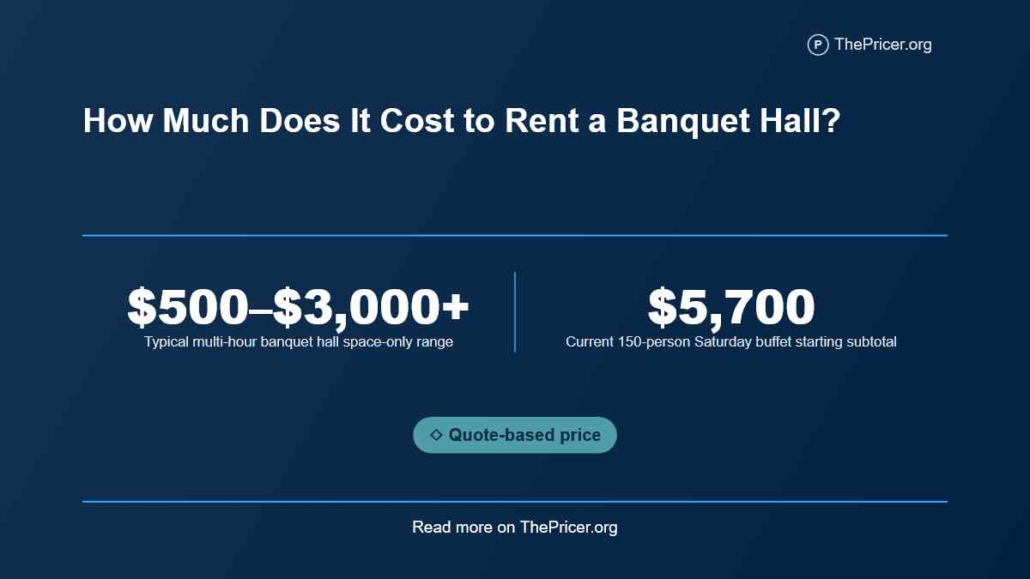
Based on current hall rental guidance and published community-hall pricing, renting a banquet hall in the United States can cost about $500 to $3,000+ for the space alone on many multi-hour events. Full-service weddings and hotel receptions can climb far beyond that once food, drinks, staffing, service charges, and tax are added.
The useful budget is not the room fee alone. Guest count, food-and-beverage rules, cleaning, security, deposits, alcohol service, setup time, and overtime can change the payable total by hundreds or thousands of dollars.
Article Highlights
Jump to sections
- Many rental-only banquet events cost about $500 to $3,000+ (at $30 per hour, earning that amount would take about 0.4 to 2.5 full-time workweeks, before taxes) for the space.
- Current marketplace asking rates include $151 per hour in Washington and $213 per hour in Los Angeles.
- Cleaning, security, deposits, alcohol service, and minimum spends can raise the final bill.
- One current 150-person Saturday buffet starts at $5,700 before service charge and sales tax.
- Hotel staff charges, house charges, and tax may sit outside a food-and-beverage minimum.
How Much Does It Cost to Rent a Banquet Hall?
Current published prices show a wide spread even before food enters the calculation. Peerspace reports current local asking rates from recent booking activity, while VFW halls publish direct public schedules. These figures are market and venue examples rather than a national average, but they show how location, capacity, booking length, and included amenities change the base charge.
| Current example | Published base price | Useful pricing detail |
|---|---|---|
| Los Angeles banquet hall data | $213 (about 7.1 hours of work at $30 per hour)/hour average asking rate | Most bookings run about 5 hours |
| Washington banquet hall data | $151/hour average asking rate | Most bookings run about 4 hours |
| VFW Post 8241 rates | $125/hour | $125 cleaning fee and $400 refundable security deposit |
At the current Los Angeles marketplace rate and common five-hour booking length, the arithmetic is about $1,065 for space before add-ons. Washington’s current $151 average over its common four-hour booking length works out to about $604. Those calculated figures are not quotes for a particular property. They show why location and booking duration can move a rental-only budget even when the event format stays similar.
Community halls can sit below large-market averages, but their contracts may shift costs into deposits, cleanup, alcohol rules, or staffing. A low base price deserves a line-by-line comparison with what is included. Tables, chairs, kitchen access, setup time, parking, sound equipment, and cleanup can carry real value when another venue prices them separately.
Food and Beverage Minimums
Hotel banquet pricing often works differently from a community hall. The hotel may set a minimum amount that the group must spend on banquet food and beverages. Meeting-room rental can then be discounted, bundled, or handled separately. A minimum is a spending commitment, not a forecast of what guests will consume. If the contract requires $10,000 (about 8.3 full-time workweeks at $30 per hour) in qualifying food and drink revenue and the group orders only $8,500, the agreement can still leave the group responsible for the minimum.
A current Los Angeles Airport Marriott document states that the minimum banquet food-and-beverage revenue guarantee is set when the event is contracted and that certain charges do not count toward it. The hotel’s outside-catering contract terms identify a 19% food-and-beverage staff charge, an 8% house charge, and 7.75% sales tax outside the minimum revenue guarantee. That structure can make the payable bill much higher than the minimum alone suggests.
The property’s separate 2026 banquet catering terms state that the house charge is retained by the hotel to offset non-labor expenses and is not a tip distributed to employees. That distinction can prevent double counting or mistaken assumptions about gratuity. Before comparing hotel proposals, ask which charges count toward the minimum and which are added after the minimum has been met.
What the Rental Price Covers
A banquet hall quote can represent several very different purchases. A rental-only hall may give the host access to the room, tables, chairs, kitchen, parking, and basic cleanup responsibilities. A hotel ballroom may pair the room with catering, service staff, linens, china, glassware, bars, audiovisual support, and a required food-and-beverage commitment. Some venues charge one flat rental amount, while others bill by the hour or build the room cost into a per-person event package.

That distinction matters. A bare-room rental can become more expensive than a higher advertised package after tables, staffing, cleaning, bar service, and equipment are purchased separately. A package can move the other direction when it includes services the event does not need. The contract controls the bill.
Capacity also needs to match the planned setup rather than the building’s maximum occupancy. A hall that can hold 200 people standing may seat far fewer once banquet tables, a buffet line, dance floor, DJ area, stage, and accessible pathways are added. Ask for the seated capacity in the layout you plan to use, then compare that number with the guest list. Readers comparing a banquet room with a simpler space can use current general hall rental costs as a separate baseline.
Catering and Bar Costs
Catering can exceed the hall rental itself once the guest list grows. WeddingWire’s current wedding catering cost data lists about $27 per person for buffet service and $40 per person for plated service. At 150 guests, that works out to $4,050 for the buffet benchmark and $6,000 for the plated benchmark before any venue-specific service charges, taxes, bar package, rentals, or upgraded menu items.
The service style affects more than food quantity. Plated meals require coordinated service labor, while a buffet can need more food volume even with lower serving labor. A venue may include china, linens, tables, serving staff, or cleanup in the catering price, while an outside caterer may quote some of those items separately. Compare the same scope before treating a lower per-person menu as cheaper.
Alcohol can be priced per person, by consumption, through drink tickets, or as bartender labor plus purchased beverages. The banquet hall may forbid outside alcohol or require its own bar staff. An open bar cost can become one of the largest variable expenses on a long reception because both guest count and service duration affect the bill. Ask whether bartenders, ice, mixers, glassware, corkage, liquor permits, and gratuity are included before accepting a beverage quote.
Fees Beyond the Room
Cleaning, security, deposits, overtime, and staffing can turn an attractive rental price into a much larger contract. VFW Post 8541’s current banquet-hall terms list Saturday nonmember rent at $1,100, a mandatory $300 cleaning fee, bartender labor at $18 per hour, security at $45 per officer per hour, a $300 reservation deposit, and two security officers for alcohol events above 100 attendees.
A refundable or conditional deposit should be separated from the expected event expense in a budget, but it still affects how much cash must be available before the event. Cleaning charges belong in the event cost when they are nonrefundable. Cancellation deadlines, damage rules, and overtime penalties can turn a refundable deposit into a real expense, so the agreement should state each condition that can cause the venue to retain it.
Equipment and entertainment can create another layer. Some halls include projectors and sound systems, while others charge for audiovisual gear or require approved technicians. A reception with dancing may need separate live band pricing, DJ equipment, staging, uplighting, or electrical access. Valet parking, chair upgrades, linens, table setup, and extra staffing can have the same effect. Ask for a written list of inclusions and optional charges rather than assuming the room comes fully equipped.
A 150-Guest Saturday Example
A current full-service example shows how fast per-person pricing becomes a five-figure event. St. Josaphat Banquet Center’s Saturday buffet menu lists $38 per person with a 150-person minimum and states that prices are subject to an 18% service charge and 6% sales tax. Multiplying 150 guests by $38 produces a menu subtotal of $5,700.
The 18% service charge alone adds $1,026, bringing the subtotal to $6,726 before sales tax and before any optional upgrades. Tax treatment can depend on the contract and jurisdiction, so a final taxed total should come from the venue’s invoice rather than a generic formula. The key cost finding is simpler: the published $38 per person menu becomes at least $44.84 per person after the stated service charge, before tax.
Using the current VFW Post 8541 rates already cited, a five-hour illustrative Saturday event for more than 100 people with alcohol starts with $1,100 room rent and $300 mandatory cleaning. Two required security officers for five hours add $450. Assuming one venue bartender works the same five hours, bartender labor adds $90. The calculated expense reaches $1,940 before food and beverages. The cleaning and staffing add $840, about 76% on top of the advertised Saturday hall rate. The $300 security deposit affects cash required but is not counted in that expense total because it is a deposit rather than a stated mandatory fee.
Date, Time, and Guest Count
Saturday evenings tend to carry the strongest demand, but the size of the discount for another day varies by venue. An hourly hall can create savings two ways: a lower weekday rate and a shorter required minimum. A fixed event package can instead use different guest minimums, food prices, or room fees by day. Ask for the same guest count and same event duration on at least two dates so the quotes can be compared without changing the event itself.
Guest count creates thresholds that are easy to miss. A larger group may need a bigger room, another security officer, more bartenders, more tables, or a higher food-and-beverage commitment. A smaller group can have the opposite problem when the venue has a minimum guest count. Cutting the guest list does not always reduce the contract proportionally when the room or catering package has a fixed minimum.
Event time also extends beyond the hours guests are seated. Setup, vendor load-in, decorating, sound checks, cleanup, and overtime can be billed differently from event hours. Some halls include a setup window, some discount it, and some bill every reserved hour. A reception scheduled for five guest-facing hours can occupy the property much longer. Ask how the venue defines billable time before comparing an hourly quote with a flat package.
Choosing the Right Venue
A banquet hall fits events that need seated dining, dancing, catering access, and a weather-proof indoor space. Community and veterans halls can work well for hosts who want to bring their own caterer or decorations. Hotel ballrooms can reduce vendor coordination because catering, staff, tables, glassware, and event management may sit under one contract. That convenience can carry a higher minimum spend.
Do not compare bare hall rent with a full wedding-venue statistic as if both buy the same service. The Knot’s current venue spending data puts average wedding venue spending at $12,900, but the figure reflects venues with service scopes far beyond a room-only rental. A school auditorium rental can fit an event centered on a presentation or performance rather than food service and dancing.
Makes sense if
- You need seated dining, a dance floor, and space for a large guest list.
- Included furniture, kitchen access, parking, or staff replace outside rentals.
- The venue’s catering and bar rules match the event plan.
- The contract total stays within budget after required fees are counted.
Does not make sense if
- The room is far larger than the guest list and carries a high minimum spend.
- Mandatory in-house catering conflicts with the menu or budget.
- Cleaning, security, overtime, or bar rules erase the apparent savings.
- A simpler room or performance venue fits the event with fewer paid extras.
Answers to Common Questions
How much does it cost to rent a banquet hall?
Many rental-only banquet events cost about $500 to $3,000+. Premium spaces and full-service hotel packages can cost much more.
How much is a banquet hall for 150 guests?
The room can cost from hundreds to several thousand dollars. One current 150-person Saturday buffet starts at $5,700 before service charge and sales tax.
Are tables and chairs included?
Sometimes. The contract should state the included furniture, setup, linens, and equipment.
Do banquet halls require a deposit?
Many do. Current examples include refundable security deposits from $200 to $700, with venue-specific refund rules.
Is a weekday banquet hall cheaper?
It can be. Compare complete quotes for the same guest count, hours, and services.
Disclosure: Educational content, not financial advice. Prices reflect public information as of the dates cited and can change. Confirm current rates, fees, taxes, and terms with official sources before purchasing. See our methodology and corrections policy.