
How Much Does Rotted Exterior Door Frame Cost?
Updated on | Written by Alec Pow
This article was researched using 12 sources. See our methodology and corrections policy.
Repairing a rotted exterior door frame generally costs $100 to $700 for localized professional work, while a straightforward frame replacement can cost $200 to $550. More involved repairs affecting the jamb, threshold, casing, or surrounding opening may run $350 to $850 or substantially more if hidden structural water damage is discovered.
A small patch of decayed trim can sometimes be repaired with inexpensive wood filler and a new finish. A rotted hinge jamb, softened threshold support, or deteriorated rough opening presents a different problem because the repair must restore both security and weather resistance.
Homeowners should distinguish the decorative casing, the jamb supporting the door, and the structural framing behind it before comparing contractor quotes. Replacing an entire prehung exterior door is another project with additional material and labor costs.
Article Highlights
Jump to sections
- Basic professional door-frame replacement typically costs $200–$550.
- More substantial frame repairs can cost $350–$850.
- Small DIY repairs may require only $15–$100 in supplies.
- A current 12-ounce Bondo wood-filler listing costs $22.98.
- Major water damage may require repairs beyond the frame itself.
- A correct repair must address the water source, not just the damaged surface.

How Much Does Rotted Exterior Door Frame Repair Cost?
Angi’s July 2026 frame replacement estimates place conventional door-frame replacement at $200 to $550, depending on the material, labor, and existing opening.
Its separate September 2026 door repair data reports $350 to $850 for door-frame repairs. That figure covers a broader set of repair jobs and should not be treated as the minimum price for every small rotted section.
HomeGuide’s door-frame repair cost research lists ordinary exterior-frame replacement at approximately $112 to $382, with more elaborate colonial entry-door frames reaching $676 to $1,490.
| Repair Scope | Published Price | Typical Situation |
|---|---|---|
| Small DIY rot repair | $15–$100 | Localized nonstructural damage |
| General professional door repair | $50–$700 | Varied minor and extensive work |
| Basic frame replacement | $200–$550 | Standard frame and accessible opening |
| More involved frame repair | $350–$850 | Greater damage or fitting work |
| Decorative colonial entry frame | $676–$1,490 | Specialized frame and trim |
| Underlying structural repairs | Site-specific quote | Damaged sill, studs, or sheathing |
These figures describe different categories of work rather than charges to add together. A carpenter’s complete replacement quote may already include demolition, new jamb materials, fastening, and basic sealing.
The original article’s $550 to $1,650 range may fit some complicated projects, but presenting it as the universal price of replacing a rotted exterior frame overstates the cost of straightforward jobs.
How Rot Changes the Repair Scope
Exterior door frames include several components with different functions. The casing or brickmould finishes the exposed edge of the opening, the jamb holds the hinges and strike plate, and the threshold and sill assembly manage the lower edge of the doorway.
Water exposure often begins near the lower jamb ends, where rain splash, snow accumulation, failed caulking, or poorly drained thresholds keep wood damp. The damage may remain confined to decorative trim or extend into wood supporting the door.
Angi’s July 2026 rot repair guidance distinguishes small surface deterioration from severe decay extending through the frame. It recommends assessing soft and crumbling wood, removing damaged material, and replacing the frame where its integrity has been compromised.
A homeowner can examine suspicious wood gently with a screwdriver. Softness, crumbling fibers, persistent dampness, or paint peeling repeatedly around the lower jamb are reasons for closer inspection.
However, discoloration alone does not establish structural rot. Staining may result from moisture or surface contamination without significant loss of wood strength.
There is no verified rule that a frame with less than 25% damage is automatically suitable for DIY repair, as the original article suggested. A small amount of decay around a critical hinge or locking point can matter more than a larger cosmetic defect elsewhere.
Repair Instead of Replace?
Localized damage is often repairable when surrounding wood remains sound, the moisture source has been corrected, and the affected area does not carry critical hinge or latch loads.
This Old House’s 2026 exterior rot repair instructions present an approximately $150 epoxy restoration project. The process involves removing decayed material, preparing the remaining wood, filling the damaged area, and restoring its finish.
Such work is most suitable for small, accessible sections. The filler should not be assumed to restore the full load-bearing capacity of a severely deteriorated structural member.
Replacing one lower jamb section can be another option. A carpenter may remove the decayed section, fit sound replacement wood or an appropriate repair component, and restore the joint and finish.
Angi’s jamb repair estimates put an ordinary professional jamb repair near $240, while acknowledging that water damage to the frame or subfloor can increase the cost.
A complete replacement becomes more compelling when the frame is significantly deteriorated, the door no longer closes securely, or several areas would need separate major repairs.
Structural deterioration around the rough opening requires broader inspection. Replacing only the visible jamb does not correct decayed studs, sheathing, or damaged threshold support behind it.
DIY Materials and Real Retail Prices
Small rot repairs are relatively inexpensive because the homeowner buys limited material and provides the labor. The product itself may cost much less than a contractor’s minimum service charge.
Home Depot currently lists Bondo 12-ounce wood filler at $22.98. The product is intended for repairing damaged wood surfaces and requires appropriate preparation before application.
Its wood restoration product selection also lists an eight-ounce 3M rotted-wood restorer at approximately $23.98.
Using both products, a homeowner spends about $46.96 before sandpaper, primer, paint, masking supplies, or tools. A simple patch may not require both products; the repair method should determine the materials purchased.
For an illustrative repair, assume $46.96 for those products, $18 for abrasives and application materials, and $25 for primer and paint. The resulting material budget is $89.96, excluding tax and tools already owned.
This is a modeled supply basket, not a documented retail checkout total. The additional amounts are assumptions.
The hidden limitation is that inexpensive materials do not make every damaged frame a suitable DIY project. If decay reaches critical hinge fasteners, the strike plate, or the concealed structural opening, professional assessment may be necessary.
What Makes Replacement More Expensive?
The replacement method determines what the contractor must remove and rebuild. Installing a stock jamb into an otherwise sound opening is usually less complicated than reconstructing an opening after prolonged water intrusion.
HomeGuide’s exterior entry-door cost analysis distinguishes frame and trim repairs from complete door installation. Its ordinary exterior-door repair estimates range around $100 to $300, while replacing the full door system is a separate purchase.
Work may become more expensive when the contractor must remove interior casing, detach siding or brickmould, repair the sill, correct an out-of-square frame, replace weatherstripping, and repaint exposed surfaces.
Removing and rehanging the existing door can also add labor. If the old door is warped or damaged, retaining it may not produce a properly operating finished assembly.
Home Depot’s exterior door installation price comparison reports basic exterior installation labor around $398 to $998, with the door unit and unexpected framing repairs potentially charged separately.
That labor figure cannot simply be added to a frame-only replacement quote. It describes a different service scope. Homeowners should request separate prices for repairing the existing frame, replacing the frame while retaining the door, and installing a completely new prehung unit.
The Hidden Cost of Waterproofing
One of the most expensive mistakes is replacing rotten wood without correcting the route by which water reached it.
JELD-WEN’s pre-hung exterior door installation instructions specify sill-pan flashing and drainage provisions. The pan is intended to direct water outward rather than allowing it to remain beneath the threshold or move into the building assembly.
Pella’s door installation documentation also describes maintaining a continuous water-resistant barrier around relevant exterior openings. The manufacturer guidance is installation-specific, not a flat price schedule for repairing rot.
A properly repaired opening may therefore require more than visible caulking. Depending on construction, the contractor may need to investigate flashing, the weather barrier, drainage, and damaged substrate beneath the threshold.
Therma-Tru’s manufacturer warranty explanations distinguish ordinary wood deterioration from defects involving genuine rot-resistant frame components.
That distinction matters when a homeowner compares a lower-priced wood jamb with a composite replacement. The warranty should identify the covered frame components and exclusions, not merely promise that a door is weather resistant.
A repair that restores the cosmetic appearance but leaves the water source untreated risks further deterioration and another expense.
A Complete Replacement Budget
Consider a hypothetical homeowner with substantial rot at the lower exterior jamb but a reusable door slab and sound structural framing. A contractor quotes $475 for replacing the frame assembly, within Angi’s published conventional replacement range.
Assume the written quote excludes decorative repainting and minor weatherproofing materials, but includes removal and ordinary installation labor.
- Frame replacement, quoted-scope assumption: $475
- Additional flashing and sealant allowance: $75
- Finish painting allowance: $150
- Modeled completed total: $700
The two additional line items are explicitly assumed allowances. This is not an observed contractor invoice or a market average for flashing and painting.
The difference between the frame-only amount and finished project is $225, increasing the initial estimate by approximately 47.4%. That is the financially important distinction: a seemingly moderate frame quote can grow when excluded finishing work is added.
Suppose a second contractor includes equivalent sealing and finishing within an $650 complete quote. That bid would be $50 cheaper than the modeled first offer, despite the higher headline price.
The comparison only holds if both contractors address the same damage and provide comparable weatherproofing. A lower quote that ignores a defective sill pan is not equivalent to a complete repair.
For much wider damage, the cost of repairing dry rot elsewhere in the structure becomes relevant. That is a separate repair category, not a compulsory addition to every door project.
How to Prevent Rot Returning
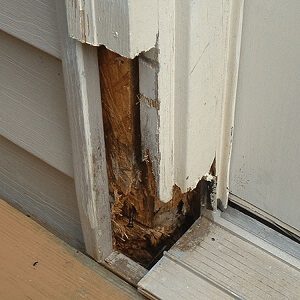
Wood decay develops where moisture remains long enough to damage the material. Splashback near the threshold, failed coatings, blocked drainage, and flashing defects can expose an entry frame repeatedly.
Regular maintenance should focus on the lower jamb ends, casing joints, sill, threshold, adjacent siding, and drainage around the doorway. Peeling paint or caulk that continually fails deserves investigation before another coating is applied.
Consider whether a storm door, overhang, or drainage change would reduce weather exposure, but do not assume every storm door prevents rot. Some installations can trap moisture if ventilation and drainage are inadequate.
The general door-frame replacement costs are useful when the damage is not specifically associated with rot. The current article focuses on the added decisions created by water exposure and the need to assess hidden deterioration.
Makes sense if
- The damage is localized, surrounding wood is sound, and the cause has been corrected.
- A new jamb or frame can be installed without replacing a serviceable door.
- The contractor includes weatherproofing and finishing in a clearly itemized proposal.
- A rot-resistant replacement component suits the existing door assembly.
Does not make sense if
- Filler would conceal deterioration around hinges or the locking mechanism.
- Water damage extends into the rough opening or structural members.
- Repeated patches are proposed without fixing the moisture entry point.
- A complete prehung replacement provides better value for a damaged door and frame.
What We Verified
- Compared 2026 Angi frame replacement and repair estimates with HomeGuide’s narrower project prices.
- Inspected current wood-filler and rot-restorer retail examples.
- Reviewed manufacturer instructions addressing exterior-door flashing and water drainage.
- Checked Therma-Tru’s distinction between wood rot and covered rot-resistant components.
- Opened related ThePricer door installation, frame replacement, and dry-rot articles.
- Separated sourced price ranges from assumed costs in the worked example.
Answers to Common Questions
How much does it cost to repair a rotted door frame?
Professional work can range from roughly $100 to $700 for localized repairs, with more involved frame repairs commonly reaching $350 to $850. Structural damage may increase the bill.
Can a rotten exterior door frame be repaired without replacing it?
Yes, if decay is localized and enough sound material remains. Damaged wood must be removed, the repair completed appropriately, and the moisture source corrected.
How much does complete frame replacement cost?
A straightforward replacement typically costs approximately $200 to $550, excluding unusual structural or finishing work. Decorative or custom frames can cost more.
Is epoxy strong enough for a rotten hinge jamb?
Epoxy is useful for selected cosmetic and localized repairs, but should not be assumed to restore the required strength around hinge screws or locking hardware. A professional should evaluate significant decay in those locations.
Will a composite door frame prevent future wood rot?
Composite components can avoid the particular decay problems of exposed wood, but correct flashing, drainage, installation, and maintenance are still essential to protecting the surrounding wall.
Disclosure: Educational content, not financial advice. Prices reflect public information as of the dates cited and can change. Confirm current rates, fees, taxes, and terms with official sources before purchasing. See our methodology and corrections policy.