
How Much Does Coolant Hose Replacement Cost?
Updated on | Researched and reviewed by Alec Pow, Founder & Pricing Investigator
Prices, claims, and calculations checked against 16 cited sources. See our research methodology and corrections policy.
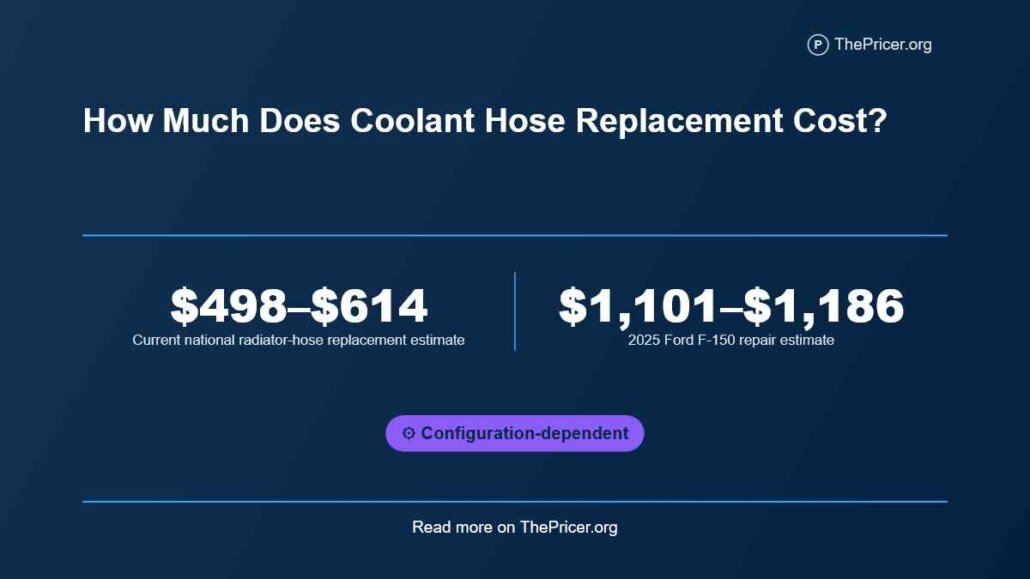
Coolant hose replacement on a U.S. passenger vehicle now lands around $500 to $600 in current national radiator-hose estimators, but the real bill can be far lower or much higher by vehicle and hose design. RepairPal currently estimates $498 to $558, while Kelley Blue Book puts radiator hose replacement at $536 to $614. Specific vehicles in current data range from roughly $285 to more than $1,100.
The phrase coolant hose also covers different jobs. A radiator hose, heater hose, bypass line, and modular hose assembly can use different parts and labor. Newer assemblies may include branches, quick connectors, sensors, or restrictors, so the expensive part may be the assembly rather than the rubber tube. Diagnosis matters too because a coolant leak can come from another cooling-system component.
Article Highlights
Jump to sections
- RepairPal currently estimates radiator hose replacement at $498 to $558.
- Kelley Blue Book gives a national radiator-hose estimate of $536 to $614.
- A 2024 Honda Accord is currently estimated at $291 to $336, while a 2018 Ford F-150 is $711 to $785.
- A 2025 Ford F-150 estimate reaches $1,101 to $1,186.
- RepairPal’s national heater-hose estimate is $573 to $648, higher than its radiator-hose estimate.
- Coolant hoses should be inspected for leaks, cracks, swelling, soft spots, and bulges rather than replaced on one universal mileage schedule.
How Much Does Coolant Hose Replacement Cost?
The strongest current national references place radiator-hose replacement near the mid-$500s. The RepairPal national estimate is $498 to $558, made up of about $126 to $185 in labor and roughly $372 in parts. Taxes, fees, location differences, and related repairs are excluded. The Kelley Blue Book estimate is $536 to $614.
Those two national estimators have midpoint values of about $528 and $575. The difference is $47, or about 9% of the lower midpoint. That gap is a useful reminder that an online estimator is a planning tool rather than a quote for one VIN, engine, city, and repair shop.
Independent shop research also shows a wide vehicle spread. A five-mechanic radiator study reported hose-repair estimates of $286 for a 2017 Honda Civic, $700 for a 2017 Ford F-150, and $725 for a 2019 BMW 740i. These are three documented vehicle examples, not a national average.
A shop quote becomes easier to compare when it separates the exact hose or hose assembly, labor, coolant, clamps, taxes, and any diagnostic charge. A lower estimate may cover a simple molded hose, while a higher estimate may include a multi-branch assembly or harder access. The repair scope can matter as much as the headline total.
Which Coolant Hose Failed?
A car has more than one line carrying engine coolant. The upper radiator hose moves hot coolant from the engine toward the radiator, while the lower radiator hose returns cooled fluid toward the engine. Heater hoses carry coolant between the engine and heater core. Some vehicles also use bypass lines and molded assemblies that split into several branches.
This distinction changes the bill. RepairPal currently puts a national heater hose estimate at $573 to $648, compared with $498 to $558 for its radiator-hose estimate. The midpoint difference is about $83, making the heater-hose midpoint roughly 16% higher. Access and attached components can change the labor and parts mix.
The hose name on a quote should match the failed component. A coolant leak alone does not prove that the radiator hose is bad. The source can also be a radiator, water pump, thermostat housing, reservoir, fitting, or another connection. A broader coolant leak repair diagnosis may be the better starting point when the leak source has not been confirmed. The part name on the estimate also helps prevent a heater-hose quote from being compared with a radiator-hose price as though the jobs were identical.
Why Modern Hoses Cost More
The hose itself may be cheap. The assembly may not be. Gates describes modern modular coolant hose designs that can contain branches, quick connectors, sensors, and restrictors in one application-specific unit. The same manufacturer uses EPDM rubber, synthetic reinforcement, plastic, and steel across some assemblies.
Retail listings show how fitment changes the parts bill even on one truck family. A Gates upper hose listed for a 2015 to 2020 Ford F-150 is currently $43.95 for the hose. A different Gates modular hose compatible with selected 2017 to 2020 F-150 applications is $85.95 at retail. They are not interchangeable parts, so the two prices should not be treated as a matched comparison.
Engine, hose position, fittings, and access can matter more than the vehicle badge. A low online hose price does not establish the installed repair cost because the mechanic may need a different molded assembly, fresh coolant, clamps, or extra access work. Gates also recommends replacing clamps when a new coolant hose is installed. A detailed estimate should identify whether the replacement is one molded line or a larger assembly and whether fittings and clamps are supplied with that part. That detail explains many price gaps that look excessive at first glance.
Model-Year Price Examples
Current model estimates show why make-only averages are weak. The table uses September 2026 RepairPal data where available and keeps the vehicle year visible. Taxes, fees, geography, and related repairs are outside these figures.
| Vehicle example | Current estimated repair | What stands out |
|---|---|---|
| 2024 Honda Accord | $291 to $336 | About $193 parts and $98 to $143 labor |
| Toyota Camry | $285 to $351 | About $145 parts and $140 to $206 labor |
| 2018 Ford F-150 | $711 to $785 | About $552 parts and $159 to $233 labor |
| Jeep Grand Cherokee | $433 to $469 | Current 2025 estimate reaches $621 to $695 |
Year can change the price inside one nameplate. RepairPal lists a 2010 F-150 at $369 to $403 and the 2018 F-150 at $711 to $785. Their midpoints are about $386 and $748. The later truck’s midpoint is about 94% higher, which is why an estimate for “an F-150 hose” without year and engine can miss by hundreds of dollars.
The 2025 F-150 is an even stronger warning against old brand averages at $1,101 to $1,186. A shop quote should identify the exact hose or assembly and the vehicle configuration before a reader compares it with an online range.
Parts, Labor, and Coolant
A professional hose quote can contain three different cost layers. The vehicle-specific hose or assembly is one. Labor to reach, remove, and install it is another. The cooling system then has to be refilled and bled correctly. RepairPal describes the standard process as draining coolant as needed, removing the failed hose, inspecting the connection points, installing the new hose and clamps, adding fresh coolant, bleeding air, and checking for leaks.
The 2024 Accord provides a clean worked total. Its $193 parts estimate plus $98 to $143 labor equals $291 to $336. Parts represent about 57% to 66% of that quoted range, so this is not a repair where labor automatically dominates the bill. Taxes, fees, location, and related repairs remain outside the estimate.
DIY supply costs can look much lower when the failed part is simple. A current Ford-compatible 50/50 coolant listing is $17.97 per gallon. Pairing a chosen two-gallon supply allowance with the previously cited $43.95 F-150 upper hose gives an illustrative retail basket of $79.89 before clamps, tax, tools, disposal, or any different coolant specification. Two gallons is a planning quantity here, not a stated fill requirement for every F-150.
DIY or Shop Repair
Some radiator hoses are accessible with basic hand tools. Others are buried behind covers, intake plumbing, fan shrouds, or tight connectors. RepairPal warns that procedures vary sharply by vehicle and that some cars need special filling or bleeding procedures after the hose is changed. A repair that leaves trapped air in the cooling system is not complete just because the new hose is attached.
DIY makes the most financial sense when the leak source has been confirmed, the hose is accessible, the correct molded replacement is known, and the service information gives a clear refill and bleed procedure. The owner also needs a safe plan for catching and disposing of coolant. Do not open a hot, pressurized cooling system.
Shop service makes more sense when diagnosis is uncertain, the vehicle uses a modular assembly, access is poor, or the system needs pressure testing and a controlled bleed. A cheap part can still produce an expensive repair if reaching it requires substantial disassembly. Related work may also be found during inspection. A radiator flush, thermostat replacement, or water pump replacement is a separate job and should not be added unless the vehicle actually needs it.
Symptoms and Replacement
 Visible coolant, a falling coolant level, engine overheating, cracks, swelling, bulges, and soft sections can point to hose deterioration. Oil contamination can also weaken rubber and cause swelling. A pressure test may be used when the leak is not obvious. Smell or noise alone is not enough to identify a hose because several cooling-system failures can create similar symptoms.
There is no single replacement mileage that applies to every vehicle. Gates recommends inspection around 60,000 miles and calls out soft spots, cracked ends, and bulges as replacement signs. RepairPal says replacement intervals vary by vehicle and driving conditions.
Condition matters more than an automatic 60,000 to 90,000-mile replacement rule. Follow the maintenance information for the exact vehicle and inspect hoses during cooling-system service. If one hose has failed from age or contamination, checking the rest of the system at the same visit can prevent a second coolant-loss event soon after the repair.
Protecting the Cooling System
A hose leak should be separated from a radiator, thermostat housing, water pump, reservoir, or fitting leak before parts are ordered. Guessing at the source can turn a small repair into repeated parts purchases. RepairPal’s replacement procedure also calls for inspecting the radiator neck or thermostat housing where the hose connects because a damaged connection can keep leaking after a new hose is installed.
A professional estimate should identify the exact failed hose, the part number or part class, labor, coolant handling, clamps, and any diagnostic charge that applies. It should also state whether tax, shop supplies, pressure testing, or related repairs are outside the quoted total. That makes two quotes easier to compare on the same scope.
Makes sense if
- The leak or hose damage has been confirmed before parts are ordered.
- The quote identifies the exact hose or modular assembly being replaced.
- The repair includes correct refill, bleeding, and a leak check.
- You compare quotes using the same vehicle, engine, hose position, and parts scope.
Does not make sense if
- A shop gives one generic hose price without identifying the failed part.
- You assume a low retail hose price equals the full installed repair.
- You replace a hose by mileage alone when inspection shows no defect and the manufacturer gives different guidance.
- You keep driving after a major coolant loss or active overheating condition.
Verification
- Checked current service-price coverage for upper and lower hose cost drivers and access differences.
- Confirmed EPDM hose construction and current inspection guidance from Gates.
- Cross-referenced application-specific hose fitment for a 2018 Ford F-150.
Answers to Common Questions
How much does coolant hose replacement cost?
Current national radiator-hose estimators are around $498 to $614. Specific vehicles can fall below $300 or rise above $1,100 depending on year, engine, hose design, and access.
How much is labor for radiator hose replacement?
RepairPal’s current national estimate assigns about $126 to $185 to labor, but vehicle-specific jobs can differ sharply.
Can I replace a coolant hose myself?
Some accessible hoses are reasonable DIY jobs for owners with the correct service information and tools. Complex assemblies, uncertain leaks, and vehicles with special bleeding procedures are better suited to professional service.
Should coolant hoses be replaced every 60,000 miles?
No universal replacement rule applies to every vehicle. Around 60,000 miles is a useful inspection point from Gates, while replacement should follow hose condition and the vehicle manufacturer’s maintenance guidance.
Can I drive with a leaking coolant hose?
Driving with an active coolant leak can lead to rapid coolant loss and overheating. A vehicle that is overheating or losing substantial coolant should not be driven until the cause is addressed.
Disclosure: Educational content, not financial advice. Prices reflect public information as of the dates cited and can change. Confirm current rates, fees, taxes, and terms with official sources before purchasing. See our methodology and corrections policy.