ThePricer Media
  • Latest: When Is an Electric Car Actually Cheaper?
  • Cost Guides
  • News & Investigations
  • Daily Price Puzzle (60s)
  • Methodology
  • Press & Mentions
  • Contact
  • Click to open the search input field Click to open the search input field Search
  • Menu Menu
Family & Lifestyle, Cooking & Eating

How Much Does Deer Processing Cost?

Updated on August 19, 2026 | Written by Alec Pow
This article was researched using 10 sources. See our methodology and corrections policy.

Deer processing commonly costs about $90 to $150 for basic whole-deer cutting and packaging in current processor price lists. That base fee is only the starting point. Ground meat, sausage, snack sticks, jerky, caping, after-hours drop-off, and specialty ingredients can push the final bill to $250 to $500+ for a deer with a substantial specialty-meat order.

Current examples range from $92 for basic processing at one Midwest processor to $150 at another. What comes with that fee varies. One shop includes skinning, choice cuts, burger, and chili grind, while another charges $140 for cutting, vacuum packaging, and freezing but bills grinding separately.

The most important number is therefore not just the advertised processing fee. Ask what that fee includes, whether specialty products are priced from raw or finished weight, whether minimum quantities apply, and whether sausage or ground venison will contain only meat from your deer.

Article Highlights

Jump to sections
  • Does Deer Processing Cost?
  • What You’re Actually Paying For
  • The Hidden Price: Specialty Meat
  • Raw Weight vs Finished Weight
  • Minimum Orders
  • Caping, Deposits, and Other Charges
  • Meat Will You Get Back?
★ Prefer ThePricer on Google
  • Basic whole-deer processing currently runs about $90 to $150 (at $30 per hour, earning that amount would take about 3 to 5 hours of work, before taxes) in several published processor menus.
  • Grinding and packaging can add roughly $0.75 to $2.00 per pound when it is not included in the base fee.
  • Fresh and smoked sausage commonly costs about $2.50 to $6.50 per pound, depending on recipe and processor.
  • Snack sticks commonly run about $4.25 to $9.35 per pound.
  • Jerky can cost roughly $5 to $13 per pound, but raw-weight and finished-weight prices cannot be compared directly.
  • Current caping charges for a shoulder mount range from about $30 to $75 in published examples.
  • A field-dressed 120-pound deer may produce about 70 pounds of boneless freezer meat under favorable conditions.
  • Hunters in CWD areas should ask whether their deer will be processed individually and follow state testing recommendations.
Deer Processing Cost

How Much Does Deer Processing Cost?

Processing service Current planning price What to check
Basic whole-deer processing $90 to $150 (about 3 to 5 hours of work at $30 per hour) Whether skinning, grinding, vacuum packing, and freezing are included
Grinding and packaging $0.75 to $2.00 per pound Whether fat, beef, or pork is added
Fresh sausage and brats $2.50 to $6.50 per pound Minimum quantity and whether added pork is included
Summer or smoked sausage $3.75 to $7.50 per pound Cheese, jalapeño, smoking, and minimum batch size
Snack sticks $4.25 to $9.35 per pound Raw versus finished weight and flavor surcharges
Jerky $5 to $13 per pound Whether the processor bills raw meat or finished dried jerky
Caping for taxidermy $30 to $75 Whether after-hours work costs extra
Deposit Often $80 to $150 Usually credited toward the final bill rather than added to it

For current examples, Cushman Meats lists basic deer processing at $92, while Ottea Game Processing charges $95 to $110 based on carcass weight and includes skinning, choice cuts, burger, and chili grind in its basic processing package.

A&J Deer Processing currently lists whitetail processing at $100, while River Bend charges $140. Den’s Country Meats lists a hanging-deer price of $150. Those headline numbers are not directly interchangeable because the included services differ.

Related guides

  • How Much Does a Bag of Flour Cost?
  • How Much Does Pizza Hut Cost?
  • How Much Does Spaghetti Cost?

What You’re Actually Paying For

A deer processor turns a harvested animal or boneless venison into freezer-ready cuts and, when requested, manufactured products such as burger, breakfast sausage, summer sausage, snack sticks, jerky, hot dogs, or smoked meats.

The work can include intake and tagging, skinning, trimming shot-damaged or contaminated tissue, separating muscles, cutting steaks and roasts, grinding trim, adding pork or beef, seasoning, stuffing casings, smoking or drying specialty products, wrapping or vacuum sealing, labeling, freezing, and storing the finished order until pickup. Some shops process each animal separately from start to finish. Others keep steaks and roasts separate but combine ground or sausage meat into production batches. Those differences matter when comparing prices and when a hunter wants only meat from a specific deer returned.

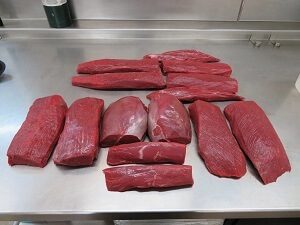
Deer meat processed and packaged

A hunter comparing the processing bill with store-bought meat can also look at the current cost of venison per pound. Hunter-harvested meat is not necessarily free once licenses, fuel, equipment, processing, and usable yield are included.

The Hidden Price: Specialty Meat

Basic processing often covers steaks, roasts, trim, and packaging. Turning that trim into smoked sausage, sticks, jerky, or other finished products can add more than the original whole-deer fee.

Current A&J specialty pricing includes smoked sausage at $4.00 per pound, jalapeño-cheese smoked sausage at $4.75, summer sausage at $4.00, snack sticks at $6.00, and air-dried jerky at $6.50 per pound of raw weight.

River Bend’s current wild-game menu charges $2.00 per pound for ground venison, $3.25 to $4.00 for fresh sausage, $4.50 to $5.25 for summer sausage, $5.50 to $6.00 for snack sticks, and $13.00 (about 26 minutes at $30 per hour) for jerky.

Consider a deer for which the hunter pays:

  • Basic processing: $140
  • 20 pounds of summer sausage × $4.50 = $90
  • 10 pounds of ground venison × $2.00 = $20
  • Total: $250

That order is already $110 above the advertised base processing fee before caping, jerky, premium ingredients, card charges, or after-hours service.

Raw Weight vs Finished Weight

One of the easiest ways to misread a deer-processing menu is to compare specialty prices without checking the weight basis.

Ottea prices jerky at $6.95 per pound of raw weight. Rihm Foods instead lists jerky at $9.50 per pound of finished weight and says it takes approximately 2.5 pounds of deer meat to produce one pound of finished jerky.

Start with 10 pounds of raw venison.

At a processor charging $6.95 per pound of raw weight:

10 × $6.95 = $69.50

Using Rihm’s stated 2.5-to-1 yield, 10 pounds of raw venison produces about 4 pounds of finished jerky. At $9.50 per finished pound:

10 ÷ 2.5 = 4 pounds
4 × $9.50 = $38.00

The menu showing $9.50 per pound looks more expensive than the one showing $6.95, but in this example the processing charge is $31.50 lower. Rihm’s 2025-26 processing information makes the conversion unusually clear.

Minimum Orders

Specialty products are often produced in batches, so a low per-pound price may come with a minimum order.

Cushman currently requires only 4 pounds for many sausages, sticks, and jerky products. A&J requires a 15-pound minimum for its produced products. Arnold Deer Processing has minimums ranging from 5 pounds for jerky to 20 pounds for many smoked sausages in its current price list.

Suppose a smoked sausage costs $4.90 per pound but has a 20-pound minimum:

20 × $4.90 = $98.00 minimum specialty charge

If the hunter only wanted 8 pounds of sausage, the minimum can matter more than the advertised per-pound price.

Premium ingredients create another layer. Cheese, pepper jack, bacon, jalapeño, or other additions may raise the per-pound price. Compare the complete recipe rather than assuming every summer sausage or snack stick is priced alike.

Caping, Deposits, and Other Charges

Hunters planning a shoulder mount should tell the processor before skinning begins. Current published caping prices include $30 at Cushman, $45 at Arnold, $50 at A&J, and $75 at Den’s.

Caping is different from tanning the hide. Caping prepares the skin for a taxidermist. Tanning is a separate preservation process and should not be assumed to be included. For the larger trophy budget, see the cost of taxidermy and the more specific deer mount cost.

Deposits are also common. River Bend requires an $80 deposit, Arnold requires $90, A&J requires $100, and Den’s currently lists $150 for a whole hanging deer.

A deposit normally reduces what remains due. If the completed processing order costs $300 and the hunter already paid a credited $100 deposit:

$300 total – $100 deposit = $200 remaining balance

The true cost is still $300, not $400.

After-hours service can add another charge. Arnold, for example, lists ordinary skinning at $35 but after-hours skinning at $55. Its normal caping charge is $45 versus $65 after hours. This is more useful than assuming every processor applies one standard rush percentage.

How Much Meat Will You Get Back?

The percentage of usable venison depends on what starting weight is being discussed. Live weight, field-dressed weight, skinned carcass weight, and boneless packaged weight are not interchangeable.

North Dakota State University’s venison yield guidance says a field-dressed deer can yield about 61% boneless freezer meat when shot damage is limited. Its example uses a 120-pound field-dressed deer and estimates about 70 pounds of boneless meat.

The simple 61% calculation gives:

120 × 61% = 73.2 pounds

Actual take-home weight may be closer to 70 pounds after trimming. Poor shot placement, contamination, damaged shoulders, excess fat, bone removal, and discarded tissue can reduce that number.

If a hunter pays $250 for processing and receives 70 pounds of packaged venison, the processing cost alone equals:

$250 ÷ 70 = $3.57 per pound

A $400 specialty-heavy order with the same yield costs about $5.71 per pound just for processing.

Getting Your Own Deer Back

Chronic wasting disease adds an important question that a simple price comparison misses. The CDC currently advises hunters in areas with CWD activity to check state recommendations, strongly consider testing deer before eating the meat, avoid handling brain and spinal tissues, and not eat meat from an animal that tests positive.

The CDC also specifically tells hunters using a commercial processor to consider asking whether their animal can be processed individually. Its current CWD guidance for hunters says individual processing helps make sure you receive only meat from your animal.

Processor practices vary. A&J states that each deer is processed individually and that the deer brought in is the deer returned. Den’s says its steaks and roasts are tied to the customer’s deer, but ground meat, sausage, and smoked products may contain meat from multiple deer because those products are made in large batches. The Den’s processing policy is a good example of why hunters should ask before placing a specialty order.

This issue deserves extra attention in CWD management areas. CDC researchers have also studied contamination of meat-processing equipment after CWD-positive venison passes through grinders, reinforcing the value of following current wildlife-agency and processor guidance.

Three Deer Processing Cost Scenarios

Basic cut-and-wrap deer

A hunter pays $100 for standard processing with cutting, grinding, and packaging included. No sausage, jerky, caping, or premium ingredients are requested.

Total: about $100

Worked example: mixed freezer order

Use River Bend’s current menu for an illustrative order:

  • Basic processing: $140
  • 10 pounds ground venison × $2.00 = $20
  • 15 pounds summer sausage × $4.50 = $67.50
  • 5 pounds snack sticks × $5.50 = $27.50
  • Caping: $40
  • Total: $295.00

The specialty products and caping add $155, increasing the base price by about 111%.

Specialty-heavy order

Suppose basic processing costs $150, then the hunter orders 20 pounds of specialty smoked sausage at $6.00 per pound and 10 pounds of jerky billed at $8.00 per pound.

  • Basic processing: $150
  • Sausage: $120
  • Jerky: $80
  • Total: $350

That is before tax, card charges, caping, or other services. The example shows why an advertised basic processing fee should not be treated as the likely final bill for a hunter ordering several specialty products.

Before You Drop Off a Deer

Makes sense if:

  • You have the processor’s current written price list and know what basic processing includes.
  • You know whether specialty products are charged on raw or finished weight.
  • You have checked minimum-order quantities before dividing the deer among sausage, jerky, and steaks.
  • You have asked whether ground and specialty products remain separate by animal.
  • You understand the deposit, pickup deadline, payment surcharge, and after-hours policy.

Does not make sense if:

  • You are comparing processors only by their base whole-deer fee.
  • You assume a $5-per-pound specialty product has no minimum order.
  • You need CWD testing but have not discussed how the processor handles the carcass while results are pending.
  • You want a shoulder mount but have not told the processor to cape the deer correctly.

Call before the hunt and ask how the processor wants the animal delivered. Do not assume every shop wants the same carcass condition. River Bend says it will not accept partially or fully skinned deer, while A&J offers field dressing as a separate service.

For meat quality, Utah State University’s venison handling guidance recommends refrigerating a skinned carcass promptly, especially when outside temperatures exceed 45°F, and keeping wrapped venison at 40°F or colder.

What We Verified

  • Checked current processor menus showing basic whole-deer charges from about $92 to $150.
  • Confirmed that basic processing packages differ in whether they include skinning, grinding, vacuum packaging, and freezing.
  • Cross-referenced current sausage, snack-stick, jerky, and grinding prices across multiple processors.
  • Verified that specialty meat may be priced from either raw weight or finished weight, which can reverse an apparent price comparison.
  • Confirmed current processor minimums ranging from 4 pounds to 20 pounds or more for certain specialty products.
  • Checked CDC guidance recommending that hunters in CWD areas consider testing and ask commercial processors about individual processing.
  • Verified a current extension benchmark of roughly 70 pounds of boneless meat from a 120-pound field-dressed deer with limited shot damage.

Answers to Common Questions

How much does it cost to process a deer?
Basic whole-deer processing currently costs about $90 to $150 in several published processor menus. Adding sausage, sticks, jerky, caping, or other services can push the final order to $250 to $500+.

How much does deer sausage processing cost?
Current processor menus commonly charge about $2.50 to $7.50 per pound depending on the sausage style, smoking, cheese, pork content, and minimum batch size.

How much does deer jerky processing cost?
Current examples range from roughly $5 to $13 per pound. Check whether that means raw venison weight or finished jerky weight before comparing processors.

How much meat do you get from a deer?
NDSU estimates that a 120-pound field-dressed deer with limited shot damage may yield around 70 pounds of boneless freezer meat. Actual yield varies with animal size, shot damage, trimming, and cut choices.

Will a processor give me meat from only my deer?
Not always. Some processors keep every animal separate, while others return your own steaks and roasts but combine trim for ground meat, sausage, or smoked products. Ask before ordering, particularly if CWD testing or individual processing matters to you.

Disclosure: Educational content, not financial advice. Prices reflect public information as of the dates cited and can change. Confirm current rates, fees, taxes, and terms with official sources before purchasing. See our methodology and corrections policy.

by Alec Pow
2 replies
  1. jerry sharp
    jerry sharp says:
    September 7, 2022 at 9:02 pm

    Your statement saying the average deer will yield 50% of it’s body weight in boneless meat is far from correct.. there are so many variable that effect meat yield ….. Shot placement is very important when considering meat yield . A deer shot through the front shoulders will cause 10-15% meat loss . A deer brought in dirty will need to be cleaned . sometime the dirt has to be cut off which causes meat loss. Big deer have big bones.. I have not processed a deer that I got 50% of boned out clean meat. A 80 pound doe will not yield 40 pounds of clean boneless meat

    • Josh Preis
      Josh Preis says:
      December 1, 2022 at 2:52 pm

      I agree 100% with the comment above after field dressed you are looking at 1/3 of the dressed weight (no way even 1/3 total deer weight) in meat back. This is a much more realistic expectation. If gut shot much less also. Most people do not field dress and wash out properly once out of the field even more loss.

Comments are closed.

ThePricer cost research Independent price research used by media, universities and public institutions.

We research provider pricing, market examples, buyer reports, hidden fees and public records.

Methodology · Citations · Newsroom
© 2014 - 2026 - ThePricer Media, LLC, 4 Grove Street, New York, NY, 10014, Phone: (212) 431-2441
We don’t use affiliate links or paid placements. All sources are cited only for verification.
  • Link to X
  • Link to LinkedIn
  • Link to Facebook
  • Link to Instagram
  • Link to Pinterest
  • Link to Youtube
  • Contact Us
  • About Us
  • Press & Mentions
  • Careers
  • Meet the Founder
  • Privacy Policy
  • Editorial Ethics
  • Methodology
  • Corrections
  • Disclosure
  • Terms and Conditions
Scroll to top Scroll to top Scroll to top