
How Much Does Entropion Surgery Cost for Dogs?
Updated on | Researched and reviewed by Alec Pow, Founder & Pricing Investigator
Prices, claims, and calculations checked against 11 cited sources. See our research methodology and corrections policy.
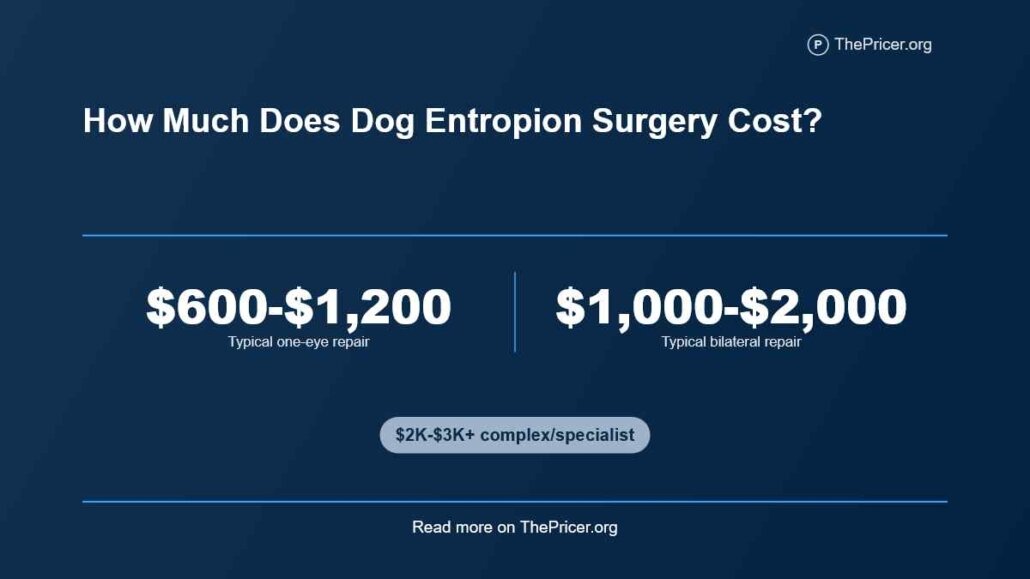
Dog entropion surgery commonly costs about $600 to $1,200 for a straightforward one-eye correction at published U.S. general-practice and nonprofit surgical clinics, while bilateral surgery often runs around $1,000 to $2,000. Complex cases and treatment by a board-certified veterinary ophthalmologist can reach $2,000 to $3,000 or more.
The quote may be calculated per eye, per eyelid, or as one bundled bilateral procedure. That difference explains why two apparently similar entropion estimates can be hundreds or even thousands of dollars apart.
Article Highlights
Jump to sections
- One-eye surgery: published 2026 examples range from about $633 to $1,200.
- Both eyes: current published examples run about $1,012 to $2,000.
- Specialist or complex repair: can reach $2,000-$3,000+.
- Bloodwork: may add around $130-$160 at clinics that price it separately.
- Important: puppies and dogs with temporary pain-induced entropion do not always go directly to permanent surgery.
How Much Does Entropion Surgery Cost for Dogs?
A useful 2026 budget is approximately $600-$1,200 for a straightforward unilateral correction and $1,000-$2,000 when both eyes require surgery.
Published clinic prices illustrate the spread:
| Provider Example | One Eye / Unilateral | Both Eyes / Bilateral |
|---|---|---|
| Anicira Manassas, VA | $697 | $1,048 |
| Anicira San Diego, CA | $633 | $1,012 |
| Affordable Veterinary Surgery | $600 published entropion procedure price | |
| Bourbon City Animal Hospital, KY | $1,200 | $2,000 |
The published Virginia surgery schedule charges $697 for one eye and $1,048 for both for pets under 50 pounds. Larger dogs carry additional weight charges.
The same nonprofit’s San Diego pricing is $633 for one eye and $1,012 for both eyes for pets under 50 pounds.
Another surgical center publishes entropion correction at $600. Its base surgical prices include the physical examination, IV catheter and fluids, anesthesia, monitoring, recovery care, and rechecks.
At the higher end of general-practice pricing, a Kentucky hospital currently lists $1,200 unilateral and $2,000 bilateral entropion/ectropion surgery.
Some Quotes Reach $2,000-$3,000+
Entropion pricing changes dramatically when the case moves from a straightforward eyelid correction to specialist ophthalmic surgery.
A 2025 veterinary cost guide places entropion surgery around $500 at the lower end and $2,000 or more when a veterinary ophthalmologist performs the operation.
A 2026 analysis of published U.S. veterinary fee schedules found prices stretching as high as $3,000 for more expensive or complex cases.
A specialist quote can be appropriate when several eyelids are involved, the dog has complicated facial folds, corneal damage is already present, the first correction failed, or reconstructive techniques are needed.
A higher specialist quote therefore should not automatically be compared with a $600 straightforward general-practice repair as though the two estimates cover identical cases.
Is the Price Per Eye or Per Eyelid?
Ask this before comparing estimates.
Some practices quote one price per eye. Others charge according to the number of eyelids being surgically corrected. Still others bundle both eyes into one bilateral price.
A dog could have entropion affecting only part of one lower lid, both lower lids, or multiple upper and lower eyelids.
That means “$700 for entropion surgery” tells you very little unless the estimate identifies exactly which lids are being corrected and what services are included.
What Is Entropion?
Entropion occurs when part or all of an eyelid rolls inward toward the eye.
Hair or eyelashes can then rub against the cornea whenever the dog blinks.
The American College of Veterinary Ophthalmologists explains in its clinical overview of entropion that the condition can affect an upper lid, lower lid, one eye, or both eyes.
Continued rubbing can cause pain, discharge, corneal ulceration, scarring, and, in severe untreated cases, corneal perforation and impaired vision.
Many cases are related to inherited facial and eyelid conformation, although entropion can also develop secondarily to scarring or another painful eye condition.
Does Every Dog Need Surgery?
No.
Established anatomical entropion often requires permanent surgical correction, but not every inward-rolling eyelid should immediately be operated on.
The Merck Veterinary Manual distinguishes permanent conformational entropion from temporary or spastic entropion.
A painful corneal ulcer or other eye inflammation can make a dog squint so strongly that the eyelid temporarily rolls inward. Treating the underlying source of pain can sometimes allow the eyelid to return to a normal position.
That makes the eye examination important before surgery is booked.
Entropion in Puppies
Permanent surgery is also handled differently in a growing puppy.
Very young dogs can be treated with temporary eyelid-tacking sutures. These stitches hold the lid away from the cornea while the head and facial tissues continue developing.
Some puppies need tacking more than once.
Once facial anatomy becomes more mature, a veterinarian can determine whether permanent surgery is still necessary and how much correction is appropriate.
This staged approach helps avoid removing too much tissue from a face that is still changing.
During Permanent Surgery
The goal is to reposition the eyelid margin so hair no longer rubs against the cornea.
The veterinarian typically removes a carefully measured strip or crescent of skin beside the affected eyelid and closes the incision with sutures. The tension created by the repair rotates the lid margin outward into a more normal position.
The procedure is performed under anesthesia.
It is not accurate to describe the operation simply as trimming the “inner eyelid” or automatically removing damaged eye tissue. If entropion has already caused a corneal ulcer or other eye injury, that problem may need its own treatment.
Surgeons also tend to be conservative with the first correction because excessive tissue removal can create the opposite problem, an outward-rolling eyelid called ectropion.
Hidden Cost: Corneal Damage
The surgery itself may not be the most expensive part if entropion has already injured the eye.
Corneal irritation can progress to ulceration, pigmentation, scarring, infection, or more severe damage.
Those complications can require additional eye medications, diagnostic staining, repeat examinations, or separate corneal treatment.
This is also why delaying an eye examination simply to shop for the lowest surgical quote can be a false economy when a dog is squinting, tearing heavily, rubbing the eye, or keeping the eyelids closed.
Entropion surgery corrects eyelid position. It cannot necessarily reverse vision already lost from permanent corneal scarring.
What Else Can Be Added?
Whether an advertised price is truly all-inclusive depends on the clinic.
For example, the Virginia Anicira location prices pre-anesthetic bloodwork separately at $130. Its California location currently charges $160 when bloodwork is needed.
A quote may also separate the initial eye examination, medications, Elizabethan collar, follow-up examination, or treatment of an existing corneal ulcer.
Rather than automatically adding generic figures for anesthesia and medication, ask the clinic for an itemized estimate. Some published surgical prices already include anesthesia, fluids, monitoring, recovery, and rechecks.
That prevents double-counting costs that are already bundled.
A Simple Cost Calculation
Consider a dog quoted $1,200 for unilateral surgery.
If pre-anesthetic bloodwork costs another $160, the starting total becomes:
$1,200 + $160 = $1,360
At a $30 hourly wage, earning $1,360 represents about 45 hours of work before taxes.
For a $2,000 bilateral surgery plus $160 bloodwork:
$2,160 ÷ $30 = 72 hours of work
Medication or treatment for existing corneal damage could push either total higher.
General Veterinarian or Ophthalmologist?
A board-certified veterinary ophthalmologist is not mandatory for every uncomplicated entropion repair.
Many general veterinarians and surgical practices perform straightforward eyelid corrections.
Specialist evaluation becomes particularly useful when the anatomy is complicated, several eyelids are involved, a previous operation needs revision, corneal disease is significant, or the veterinarian believes a more specialized reconstruction is needed.
ACVO notes that many eye problems can be managed by general practitioners while specialists provide additional expertise when a case warrants referral.
If you want to verify specialist credentials, the college maintains an official veterinary ophthalmologist directory.
What Is the Prognosis?
The prognosis after appropriate correction is generally excellent.
ACVO states that proper diagnosis and treatment offer an excellent outlook for maintaining a comfortable, healthy, visual eye.
That is more defensible than publishing a blanket “85%-90% success rate.”
Some dogs require a second adjustment because surgeons deliberately try to avoid overcorrecting the lid on the first operation.
A newer ACVO discussion of alternatives to entropion surgery describes definitive correction by board-certified veterinary ophthalmologists as having a near-100% success rate, but that figure should not be treated as a national complication rate for every type of entropion surgery.
Will Pet Insurance Pay?
Coverage depends on the policy and when symptoms first appeared.
Entropion is frequently associated with inherited facial conformation, so owners should check whether a policy covers hereditary and congenital conditions.
Some insurers do.
For example, one current dog-insurance policy description includes hereditary and congenital conditions, diagnostics, specialist care, and surgery, but excludes conditions that were already present or showing signs before coverage began.
That distinction is critical.
Buying insurance after a veterinarian has already documented inward-rolling lids, eye irritation, or related symptoms generally will not turn that existing condition into a covered claim.
There is therefore no responsible universal statement that insurance will pay “50% to 90% of entropion surgery.” Reimbursement depends on the insurer, deductible, reimbursement structure, exclusions, medical history, and policy terms.
Ways to Manage the Cost
Start by comparing complete estimates rather than headline surgery fees.
A $700 quote that excludes the exam, bloodwork, anesthesia, medication, and follow-up may ultimately cost more than a $1,000 bundled surgical package.
Ask whether both eyes can be corrected during one anesthetic event when medically appropriate. Published bilateral prices show that the second eye often costs considerably less than purchasing two completely separate unilateral procedures.
For owners who need financing, the Anicira hospitals reviewed for this guide currently accept options including CareCredit and Scratchpay. Financing lowers the immediate cash requirement but can increase total cost if interest or financing fees apply.
A second opinion is particularly useful when the proposed surgery is unusually expensive, when several eyelids are involved, or when the diagnosis might represent pain-induced secondary entropion rather than a permanent anatomical problem.
You might also like our articles about the cost of dewclaw removal, hernia surgery, or tail docking for your dog.

What We Verified
2026 surgery price: Straightforward published U.S. prices currently cluster around $600-$1,200 for unilateral repair and roughly $1,000-$2,000 for bilateral correction. Complex and specialist cases can cost $2,000-$3,000 or more.
Billing method: Entropion is not universally priced “per eye.” Veterinary practices may charge per eye, per affected eyelid, or as a bundled bilateral procedure.
Treatment: Established anatomical entropion generally requires surgical correction, while young puppies may first receive temporary tacking and pain-induced spastic entropion can sometimes resolve when the underlying eye problem is treated.
Outcome: The prognosis after appropriate treatment is generally excellent. The old blanket 85%-90% success-rate figure is not a reliable universal benchmark, and permanent corneal scarring present before surgery may limit visual recovery.
Answers to Common Questions
How much does dog entropion surgery cost?
A practical 2026 U.S. budget is about $600-$1,200 for one-eye surgery and approximately $1,000-$2,000 for both eyes at many general and lower-cost surgical practices. Complex treatment or a veterinary ophthalmologist can cost $2,000-$3,000 or more.
Does every dog with entropion need surgery?
No. Permanent anatomical entropion commonly requires surgery, but temporary entropion caused by eye pain may resolve after the underlying problem is treated. Young puppies can also receive temporary eyelid-tacking sutures while their facial anatomy develops.
What is the success rate of entropion surgery?
There is no good universal 85%-90% rate that applies to all dogs and all surgeons. ACVO describes the prognosis after proper correction as excellent. Revision can occasionally be required, and pre-existing corneal scarring may cause permanent vision loss even when the eyelid itself is successfully corrected.
Does pet insurance cover entropion surgery?
It can if the policy covers hereditary or congenital conditions and the entropion was not already present or symptomatic before coverage began. A previously diagnosed or symptomatic case will usually be treated as pre-existing, so coverage must be checked against the individual policy.
Disclosure: Educational content, not medical advice. Pricing varies by provider, location, and insurance. Confirm eligibility, coverage, and out-of-pocket costs with a licensed clinician and your insurer. See our methodology and corrections policy.