
How Much Does the Elide Fire Extinguisher Ball Cost?
Updated on | Written by Alec Pow
This article was researched using 8 sources. See our methodology and corrections policy.
An Elide Fire Extinguishing Ball currently works out to about $87.50 per ball in one current manufacturer-direct offer: Elide’s online store lists a two-pack of its Mini Red 400-gram balls for $175, reduced from a listed $239. Historically, Elide Fire USA sold its U.S. models for approximately $95 to $120 each.
For U.S. buyers, however, price is no longer the most important consideration. The U.S. Consumer Product Safety Commission currently warns consumers not to purchase or sell Elide fire extinguishing balls and says existing units should no longer be used. The warning was updated on July 17, 2026.
That changes the conclusion of this cost guide substantially. Although Elide products continue to be marketed internationally, a U.S. homeowner comparing an Elide ball with a conventional fire extinguisher should follow the CPSC warning rather than choosing between them on price alone.
Article Highlights
Jump to sections
- A current manufacturer-direct offer lists two Mini Red Elide balls for $175, equal to about $87.50 each.
- The CPSC says Elide Fire USA previously sold affected models for around $95 to $120 each.
- The CPSC currently tells U.S. consumers not to buy, sell, or use Elide fire extinguishing balls.
- Current Elide specifications describe a 5-year life for the Mini Red model, not the 10 years sometimes quoted online.
- The ball activates through contact with a flame. It is not a smoke detector and does not simply activate because room temperature reaches a preset threshold.
- A conventional UL-rated household extinguisher can cost around $28, making certified conventional protection substantially cheaper as well as the option recommended by U.S. safety authorities.

How Much Does an Elide Fire Extinguisher Ball Cost?
The Elide Fire product line does not have one universal retail price. Different sizes and distributors operate in different countries, and U.S. sales have been affected by the CPSC safety warning.
The clearest current manufacturer-linked retail example we found is the Mini Red ELB02-1 package. It is listed at $175 for two balls, down from a displayed regular price of $239.
| Elide pricing reference | Price |
|---|---|
| Current Mini Red two-pack | $175 |
| Calculated current price per ball | $87.50 |
| Former Elide Fire USA price reported by CPSC | $95-$120 each |
The $199 to $299 range previously associated with the product should therefore not be presented as today’s normal Elide price.
Shipping, import taxes, local distributor margins, and product size may still change what an international buyer pays. Availability also differs substantially by country.
The U.S. Warning
This product needs an unusually prominent safety qualification because U.S. regulators have specifically addressed it.
The CPSC says Elide fire extinguishing balls can fail to extinguish a fire, potentially exposing users to burns and smoke inhalation. The agency evaluated the devices with reference to the UL 299 dry-chemical fire-extinguisher test method and said the products do not meet its requirements.
The CPSC also identified the absence of features found on conventional portable extinguishers, including a pressure indicator, locking device, self-closing valve, and directional nozzle. The warning applies to the ELB01, ELB02-1, and ELB02-2 models previously sold in the United States.
Importantly, this is a warning rather than a normal manufacturer-coordinated recall. The CPSC states that Elide Fire USA, now known as E FIRE USA, has not agreed to recall the products or provide a remedy.
California went further. A California State Fire Marshal bulletin says the Elide device was not tested to the UL 299 and UL 711 standards required for portable extinguishers under California rules. The bulletin says it has been illegal since 2013 to order, market, sell, or distribute the device in California as a portable fire extinguisher.
Elide’s Position
There is an important other side to the dispute. Elide’s manufacturer maintains that the fire ball is a different type of fire-suppression product and should not be judged exactly like a conventional handheld extinguisher.
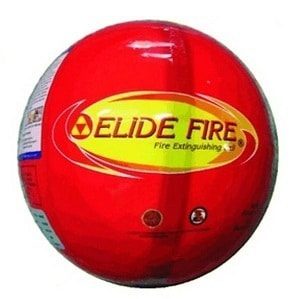
The manufacturer’s current product information describes the ball as an automatic fire-suppression device that can either be installed near a fire risk or thrown or rolled toward a small fire.
After the 2024 CPSC warning, company representatives publicly argued that regulators had applied standards designed for conventional extinguishers to a different product category. The manufacturer continues to point to international tests, CE-related documentation, Thai standards, and other certifications.
That disagreement does not change the practical recommendation for a U.S. consumer: the CPSC warning remains active in 2026.
How It Activates
Older descriptions of the Elide ball often make it sound like a sophisticated fire-detection system that senses smoke or increasing room temperature. That is inaccurate.
Current manufacturer documentation says the device is flame activated. Elide’s own FAQ states that the ball activates only through direct contact with flame.
Depending on the model, the external fuse or triggering mechanism activates after several seconds of flame exposure and disperses dry chemical extinguishing material around the immediate area.
The current Mini Red product specification says the ball can withstand temperatures up to approximately 85°C and activates only when it touches flame. In other words, a hot room by itself is not supposed to set it off.
This distinction is especially important if someone is considering an Elide ball for an empty garage, electrical panel, machine, or similar area. The device needs fire to reach its activation point before it can respond.
Five-Year Lifespan
The old 10-year life claim is another material correction.
Current manufacturer information for the Mini Red model lists a 5-year lifespan. Elide’s Middle East distributor likewise states that the product lasts up to five years without refilling or routine maintenance.
There have been different Elide models and historical technical documents, so buyers may encounter conflicting lifetime claims online. For a current product, the label and model-specific manufacturer documentation matter more than a generic statement about every Elide ball.
A five-year replacement schedule changes the economics substantially compared with assuming the product lasts ten years.
Elide vs. Regular Extinguisher
A conventional home extinguisher does not necessarily cost more than an Elide ball. In fact, current retail pricing shows the opposite.
For example, First Alert lists its HOME1 rechargeable 1-A:10-B:C extinguisher at $27.99. It is designed for common household fires involving materials such as wood and paper, flammable liquids, and electrical equipment and is UL rated.
| Product example | Approximate price |
|---|---|
| Elide Mini Red, current two-pack | $175 |
| Elide Mini Red, calculated each | $87.50 |
| First Alert HOME1 conventional extinguisher | $27.99 |
At those prices, one $87.50 Elide ball costs about 3.1 times as much as the $27.99 conventional extinguisher.
The full $175 Elide two-pack costs roughly the same as six $27.99 extinguishers before tax. That calculation does not mean a home needs six extinguishers; it simply puts the product-price difference into perspective.
If you are budgeting for conventional equipment instead, see our guides to fire extinguisher recharging costs, fire hydrant costs, and fire truck costs for other parts of the fire-protection cost picture.
Worked Home Example
Consider a homeowner who was thinking about placing two automatic balls in a garage and utility area.
At the current $175 two-pack price, the Elide purchase would cost $175.
Two $27.99 UL-rated household extinguishers would cost approximately $55.98. The immediate price difference is therefore about $119.02.
That is not a claim that two handheld extinguishers provide exactly the same type of coverage as an automatically positioned device. Their operating methods are different. It does show, however, that the Elide product should not be described as a low-cost substitute for conventional portable extinguishers.
Maintenance Costs
 One of Elide’s main advertised advantages is the absence of traditional extinguisher servicing during its stated service life.
That comparison needs context. Workplace fire extinguishers are subject to specific inspection and maintenance requirements. Under OSHA’s portable fire-extinguisher rules, employers generally must visually inspect workplace extinguishers monthly and provide annual maintenance checks.
Those requirements are one reason a commercial fire-safety budget cannot be reduced to the purchase price of the extinguisher itself.
For homeowners, the cost equation is different, but a conventional extinguisher still needs to remain accessible, undamaged, properly pressurized where applicable, and within its manufacturer instructions.
The Hidden Cost
The biggest hidden cost of the Elide ball is not maintenance. It is the possibility of purchasing a device that does not satisfy the fire-protection requirement you actually need to meet.
A business cannot assume that installing automatic fire balls eliminates requirements for approved portable extinguishers, sprinklers, alarms, or other code-required systems. That question depends on the building, occupancy, local fire code, and authority having jurisdiction.
The certification issue also deserves attention. UL Solutions has warned that some fire-extinguishing balls sold online have displayed unauthorized UL certification marks. UL said it had not evaluated fire-extinguishing balls and recommended keeping a UL Certified extinguisher readily accessible.
For a commercial buyer, purchasing an inexpensive supplemental device and then discovering that approved extinguishers are still required means paying twice.
Does the Ball Work?
This question is more complicated than promotional demonstrations suggest.
A peer-reviewed study examining fire-extinguishing balls found very different results depending on the fire scenario. In experimental building-fire tests, the balls initially affected the fire but did not prevent it from restarting, and firefighters ultimately had to extinguish the demonstration fire conventionally. The researchers reported more promising results on a small short-grass fire.
That finding does not prove that an Elide ball can never suppress a small incipient fire. It does reinforce the problem with making broad claims that one ball will reliably extinguish any household, vehicle, electrical, or industrial fire.
Fire conditions vary by fuel, ventilation, fire size, placement, and the amount and distribution of extinguishing agent.
What We Verified
We checked the July 2026 version of the CPSC safety warning, the California State Fire Marshal’s bulletin, current Elide manufacturer specifications, Elide’s current retail store, UL Solutions guidance, OSHA’s extinguisher requirements, current conventional-extinguisher pricing, and published experimental research.
That research produced several important corrections to the older version of this article. The old $199 to $299 price range is not a reliable representation of current pricing. The product should not be described as having a universal 10-year life. Current Mini Red documentation gives five years. The ball is flame activated rather than being a smoke detector or simple temperature-triggered device.
Most importantly, we removed recommendations telling U.S. readers that the product is an excellent or proven replacement for conventional fire extinguishers. U.S. safety authorities currently advise the opposite.
Answers to Common Questions
How much does an Elide Fire Extinguisher Ball cost?
A current manufacturer-direct listing prices two Mini Red balls at $175, which works out to $87.50 per ball. CPSC records say the three affected U.S. models were formerly sold for approximately $95 to $120 each.
Is the Elide Fire Ball recalled?
The CPSC has issued a stop-use warning, but it says Elide Fire USA has not agreed to conduct a recall or offer consumers a remedy. U.S. consumers are nevertheless advised by the CPSC to stop using the products.
Should I buy an Elide Fire Ball in the United States?
The CPSC currently says consumers should not purchase or sell Elide fire extinguishing balls. Its warning was still current after a July 17, 2026 update.
Does an Elide ball replace a regular fire extinguisher?
U.S. consumers should not treat one as a replacement. The CPSC recommends purchasing extinguishers that meet the appropriate UL safety standard, and UL recommends keeping a UL Certified extinguisher readily accessible.
Does the Elide ball detect smoke?
No. Current manufacturer information describes it as flame activated. It must come into contact with flame to activate automatically.
Does an Elide Fire Ball last 10 years?
Current specifications for the Mini Red product state a 5-year lifespan. Buyers should check the documentation for their exact model rather than relying on older generic lifespan claims.
What should I do if I already own one?
In the United States, the CPSC recommends stopping use and taking the product to a local fire department or hazardous-waste disposal facility for disposal guidance. Do not simply assume it can go into ordinary household trash because the device includes a pyrotechnic activation component.
Disclosure: Educational content, not financial advice. Prices reflect public information as of the dates cited and can change. Confirm current rates, fees, taxes, and terms with official sources before purchasing. See our methodology and corrections policy.
I need solution for my Godown
Is it good for a commercial kitchen – like restaurant? In a family kitchen?
Meaning, what happens to food items? Or stored items like rice bags, etc.
There is no ordering info in USA.