
How Large Should a Family Emergency Fund Be?
Published on | Written by Alec Pow
This article was researched using 14 sources. See our methodology and corrections policy.
For most U.S. families, an emergency fund should cover 3 to 6 months of essential household expenses, with the higher end carrying more weight when one income supports the household, earnings are unstable, dependents have fixed care costs, or a major home, car, or medical shock would be hard to absorb.
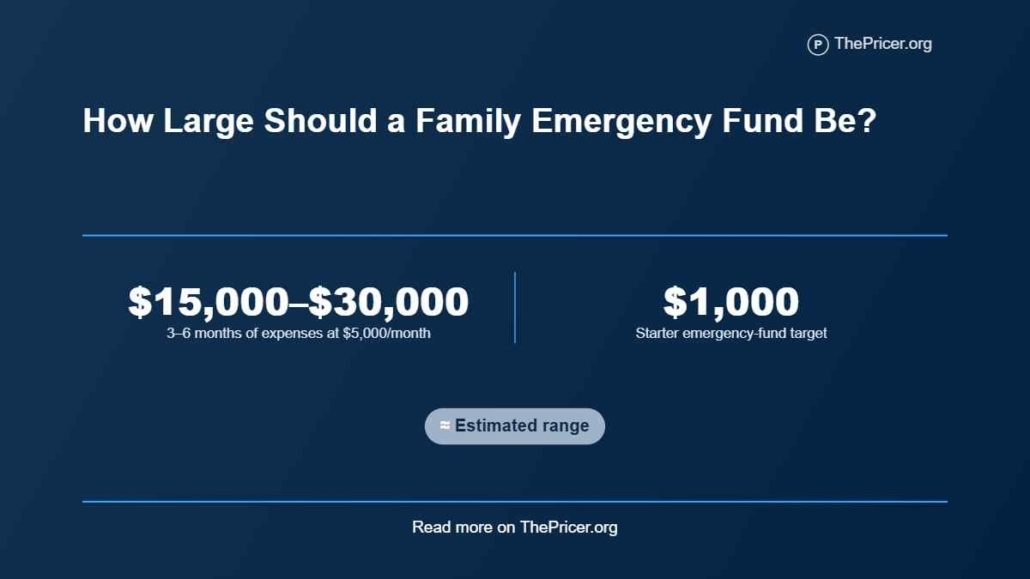
Fidelity’s current guidance starts with $1,000 and then aims for 3 to 6 months of essential expenses. If a family’s emergency-period budget is $5,000 a month, that baseline becomes $15,000 to $30,000. The useful target comes from the bills that would still need to be paid after an income loss, plus any separate cash buffer for a large one-time shock.
The Federal Reserve supplies current evidence on emergency-savings readiness and unexpected household expenses, the Bureau of Labor Statistics tracks unemployment duration, Fidelity and Vanguard provide consumer reserve frameworks, KFF and HealthCare.gov define major medical-cost exposure, and the FDIC sets deposit-insurance rules for bank savings.
Together, those entities frame the family emergency-fund decision around four practical inputs: monthly essential spending, likely income interruption, large one-time risks, and safe access to cash. Family size affects the result through actual obligations such as childcare, housing, insurance, transportation, and debt payments rather than through a fixed per-person formula.
Article Highlights
Jump to sections
- A 3 to 6 month reserve turns a $5,000 (at $30 per hour, earning that amount would take about 4.2 full-time workweeks, before taxes) essential monthly budget into $15,000 to $30,000.
- A starter reserve can be much smaller while a family builds toward the full target.
- Single-income households, variable earners, and families with rigid care costs often need more runway than households with two stable incomes.
- A repair or medical shock can cut an income-loss reserve by a full month or more.
- Childcare, insurance premiums, minimum debt payments, and transportation belong in the calculation when they would continue during a job loss.
Calculate Your Monthly Burn
Start with the amount the family would need for one month under an emergency budget, not the amount normally spent during a comfortable month. Include housing, basic utilities, groceries, required insurance premiums, transportation needed for work or job hunting, childcare that cannot be cancelled quickly, minimum debt payments, and recurring medical or prescription costs. Remove restaurant spending, vacations, elective shopping, extra debt payments, and savings contributions that could be paused. The result is the family’s emergency monthly burn.
That distinction can change the target by thousands of dollars. A household spending $7,500 (about 6.3 full-time workweeks at $30 per hour) in a normal month might be able to cut to $5,000 during an income interruption. Three months would then require $15,000, not $22,500. Six months would require $30,000, not $45,000.
Vanguard separates emergency needs into spending shocks and income shocks. Its two-part emergency fund framework suggests a smaller spending-shock reserve of half a month’s living expenses or $2,000, whichever is greater, while income-shock savings move toward the familiar 3 to 6 month range. That structure helps a family avoid treating every surprise bill as a reason to hold six months of full lifestyle spending.
Pick the Right Runway
Three months can be a workable target for a household with two stable incomes, low fixed costs, strong insurance, and room to cut spending quickly. Six months has a stronger case when one paycheck covers most necessities, a job search could take longer, or the family cannot reduce care and housing costs without disruption. The Federal Reserve reported that 55% of adults had savings for three months of expenses in 2025 through its latest household savings findings. That figure describes preparedness, not a recommended minimum.
Current labor data give the 3 to 6 month rule useful scale. In August 2026, the Bureau of Labor Statistics reported an unemployment duration of 11.4 weeks at the median and 26.3 weeks at the mean in its unemployment duration table. Dividing those figures by 4.33 weeks per month gives about 2.6 months and 6.1 months. ThePricer’s calculation shows that the common 3 to 6 month reserve roughly spans those two current duration markers. It is not a forecast for a newly laid-off parent. Severance, a spouse’s income, unemployment benefits, occupation, location, and hiring conditions can push the family’s cash need lower or higher.
Add Family Risk
Family size matters less than the structure of the household’s obligations. Two adults with similar earnings in unrelated industries may be able to use a shorter reserve if one paycheck can cover most essentials. A single-income household with children has no second paycheck to absorb a layoff. A household with commission, contract, seasonal, or self-employment income may face a different problem, because income can fall without a formal job loss. Parents also tend to have less room to cut housing, food, transportation, and care expenses quickly.
The Federal Reserve’s 2025 data make that family gap visible. Only 47% of parents living with their own children under age 18 reported having three months of emergency savings, compared with 57% of other adults in the emergency savings data. That does not prove parents need a larger fund, but it shows why family-specific cash planning deserves more detail than a single multiplier. A household with specialized employment, one primary earner, limited paid leave, or little spending flexibility can test six months first, then add or subtract based on resources that would actually remain available during a disruption.
Protect Against Big Shocks
An income-loss reserve can fail if it also has to absorb a large repair. Federal Reserve survey data show that 59% of adults had at least one major unexpected expense in the prior 12 months. Among people who reported the amount of each type, 21% of major vehicle repairs or replacements, 27% of major home or appliance repairs, and 16% of unexpected major medical expenses reached at least $5,000 (about 4.2 full-time workweeks at $30 per hour) in the Fed’s unexpected expense distributions.
The effect on runway is easy to miss. A family spending $5,000 a month that holds a three-month fund has $15,000. If a $5,000 repair lands just before a layoff, the reserve falls to $10,000, which covers only two months. A family that wants three full months left after one assumed $5,000 shock would need $20,000.
That is four months of its emergency burn, even though the income-loss target is still three months. This is a scenario, not a claim that every family needs a separate $5,000 reserve. Home condition, car reliability, insurance deductibles, warranties, and dedicated sinking funds change the needed amount.
Count Childcare and Medical Exposure
 Childcare can stay expensive even when income falls. In the Federal Reserve’s 2025 survey, families paying for childcare had a median monthly payment of $1,083. Families using at least 20 hours of paid care each week had a median monthly payment of $1,517, based on the Fed’s childcare payment data. Six months at $1,517 equals $9,102. A parent who must retain a childcare slot while interviewing or starting a new job may need much of that expense in the emergency budget. A parent who can pause care may need less.
Medical exposure needs separate treatment because a deductible, premium, and out-of-pocket maximum are different costs. KFF found average aggregate family deductibles of $3,118 for PPO plans and $5,095 for high-deductible plans with a savings option among covered workers in plans using that deductible structure in its 2025 employer health survey. Marketplace plans can have 2026 family out-of-pocket limits as high as $21,200 under federal Marketplace limits.
Do not add that maximum automatically to six months of expenses. Existing HSA cash and medical amounts already included in the monthly burn can cover part of the same risk. Families reviewing marketplace exposure can also compare the details in the ACA health insurance cost guide.
Three Family Scenarios
These scenarios use chosen monthly amounts rather than national averages. Their purpose is to show how the same formula changes with household structure. The middle case also provides an itemized worked total. A family should replace every line with its own emergency-period number and remove any expense that would genuinely stop during an income interruption.
| Scenario and scope | Monthly essential burn | Income-loss runway | Separate shock assumption | Modeled target |
|---|---|---|---|---|
| Stable dual-income household | $4,200 | 3 months | $0 | $12,600 |
| Single-income family with dependents | $6,000 | 6 months | $5,000 | $41,000 |
| Variable-income household | $7,000 | 6 months | $5,000 | $47,000 |
For the single-income family, assume $2,100 housing, $400 utilities and communications, $900 groceries and household basics, $600 insurance premiums, $1,200 childcare, $500 transportation, and $300 minimum debt payments. Those items total $6,000 a month.
Six months equals $36,000. Adding an assumed $5,000 repair buffer produces a calculated scenario target of $41,000. The variable-income case uses the same shock allowance and a larger monthly burn, producing $42,000 for six months plus $5,000, or $47,000. Families comparing childcare line items can use current center pricing in the Kiddie Academy cost guide.
Avoid Double Counting
A family can overshoot its target by counting the same protection twice. If $4,000 is already reserved in an HSA for medical bills, adding the full health-plan deductible again to the emergency fund may duplicate part of the same exposure. The same issue appears with a home-repair sinking fund, a car-repair account, or prepaid annual insurance. Count resources by the job they can perform and by whether they would remain available during an emergency. Retirement accounts and home equity are different because access can carry taxes, penalties, market risk, borrowing limits, or delays.
Unemployment insurance can reduce the cash gap, but it should not be treated as a full paycheck. The U.S. Department of Labor says benefits are based on a percentage of recent earnings up to a state maximum and can be paid for a maximum of 26 weeks in most states, subject to state eligibility rules in its unemployment insurance fact sheet. A cautious family can build the reserve without assuming benefits, then view approved benefits as extra runway once the actual amount is known.
Predictable child-related costs also belong outside the emergency fund when they are already budgeted. Broader recurring family expenses are covered in this cost of raising a child reference.
Keep the Cash Accessible
Emergency money has a different job from long-term investment money. It needs to be available when a bill or income interruption arrives. An emergency fund is cash set aside for unplanned expenses or a temporary financial disruption. That means the account should favor access and principal stability over chasing a higher return that comes with meaningful market risk. A checking account can be too easy to spend from, while an account with transfer delays may be inconvenient for urgent bills. Many families use a separate savings account and keep a smaller amount immediately reachable.
Account protection matters once the reserve becomes large. FDIC deposit insurance covers qualifying deposits up to $250,000 per depositor, per insured bank, for each ownership category under the agency’s deposit insurance rules. A family emergency fund will often sit far below that amount, but joint accounts and other deposits at the same bank still affect how coverage is calculated. The emergency reserve also does not need to be built in one move. A family can reach a starter amount, then one month, three months, and its chosen full target. That sequence turns a large number into several measurable savings milestones.
Answers to Common Questions
Is three months enough for a family emergency fund?
It can be enough for some dual-income households with stable jobs, flexible spending, and strong insurance. A single-income family or a household with variable earnings may want to test a six-month reserve against its own fixed obligations.
Should childcare be included in emergency savings?
Include childcare that would continue during a job search, notice period, or return to work. If care can be paused without losing a needed place, the emergency-period amount may be lower than the normal monthly bill.
Should a medical deductible be added on top of six months of expenses?
Not automatically. Check whether medical spending is already represented in the monthly burn, an HSA, or another dedicated reserve. Adding the same exposure twice can inflate the target.
Where should a family keep emergency cash?
A separate liquid deposit account can keep the money accessible without mixing it with everyday spending. Families using an FDIC-insured bank should also check how account ownership and other deposits affect insurance coverage.
What should a family save first if the full target feels too large?
Build a starter reserve, then one month of essential expenses, then three months. After that, extend toward the family’s chosen full runway and add a separate shock allowance only when the household’s risks justify it.
Disclosure: Educational content, not financial advice. Prices reflect public information as of the dates cited and can change. Confirm current rates, fees, taxes, and terms with official sources before purchasing. See our methodology and corrections policy.