
How Much Are Franchise Royalty Fees?
Published on | Written by Alec Pow
This article was researched using 14 sources. See our methodology and corrections policy.
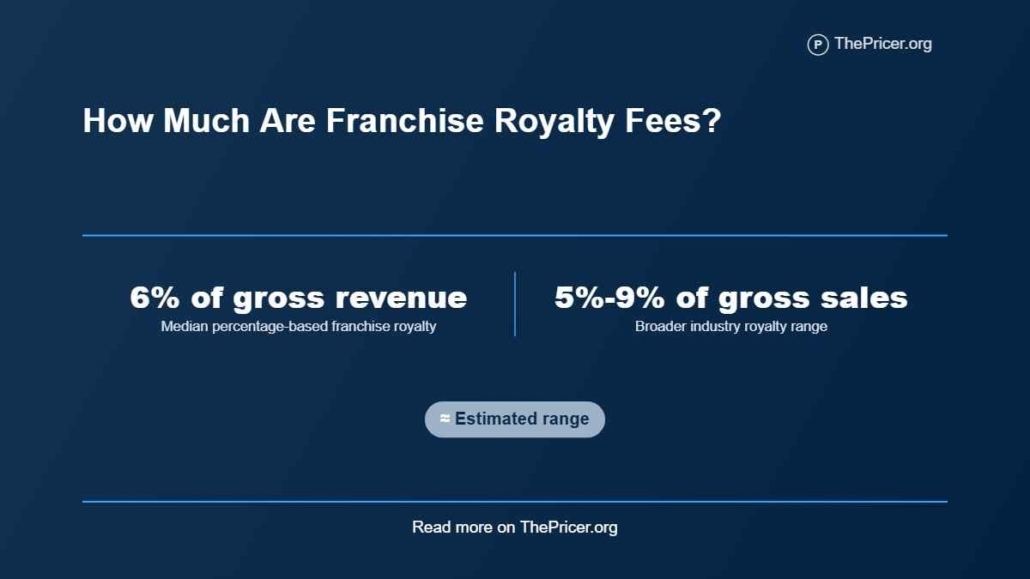
Franchise royalty fees in the United States commonly run near 6% of gross revenue for systems that use a percentage royalty. A 2026 review of 2,385 active U.S. FDDs reports a 6.0% median royalty, while fixed-dollar, tiered, and other non-percentage formulas fall outside that median. The royalty is an ongoing payment for the right to operate within the franchise system, not the one-time initial franchise fee.
Advertising contributions, technology charges, local marketing requirements, minimum royalties, and fixed monthly payments can raise or reshape the recurring cost. A prospective owner should compare the payment base, frequency, minimums, escalation language, and contract version rather than treating one percentage as the entire recurring bill.
The cost is tied to the franchisor-franchisee agreement, the Franchise Disclosure Document, FDD Item 6, gross sales definitions, brand advertising funds, technology fees, minimum royalties, and fixed royalties. Dunkin, The UPS Store, Jersey Mike’s, Great Clips, Anytime Fitness, D1 Training, and McDonald’s show how brands can use different recurring-fee formulas. The FTC Franchise Rule supplies the federal disclosure framework, while the signed franchise agreement controls the operator’s contractual payment terms.
Article Highlights
Jump to sections
- A large 2026 FDD dataset places the median percentage royalty at 6.0% of gross revenue.
- Dunkin currently lists a 5.9% royalty rate plus a 5% advertising rate.
- Anytime Fitness uses a current fixed royalty of $842 (at $30 per hour, earning that amount would take about 3.5 full-time workdays, before taxes) per month, subject to disclosed conditions.
- D1 Training’s minimum can make the effective royalty exceed its advertised 7% rate at lower sales.
- At an illustrative $1.2 million in annual sales, one royalty percentage point equals $12,000 per year.
What a Royalty Pays For
A royalty is an ongoing payment from the franchisee to the franchisor for the continuing right to operate under the brand and franchise system. The FTC guidance on continuing royalties says royalties may be based on a percentage of weekly or monthly gross income and may continue even when the outlet is losing money. That feature separates a royalty from profit sharing. The payment base can be sales before payroll, rent, food, supplies, debt service, and owner compensation reduce the operator’s income.
The royalty also differs from the initial franchise fee paid to enter the system. A franchisor may charge both, then require separate advertising or technology payments. The economic question is not only the headline percentage. The franchisee needs the definition of the sales base, the payment frequency, any exclusions, any minimum, and the other required recurring charges. Two contracts with the same headline royalty can produce different cash demands if one defines gross sales more broadly or adds a floor.
That distinction matters before profit estimates enter the discussion. Gross sales measure money collected by the business, not the amount left for the owner. A royalty calculated from the top line can remain due during a weak month when labor and occupancy costs leave little operating profit.
How Much Are Franchise Royalty Fees?
Current brand disclosures show several percentage structures near the broad benchmarks, but the adjoining fees vary. The table keeps the royalty and advertising components separate so a royalty-only figure is not compared with a combined figure. It also preserves each brand’s own sales-base wording where the source provides it.
| Brand | Royalty structure | Other recurring percentage | Scope note |
|---|---|---|---|
| Dunkin | The current franchise page lists a 5.9% royalty | 5% advertising | Both stated on gross sales |
| The UPS Store | The franchise FAQ allocates 5% to royalty | 3.5% marketing | Combined 8.5% of adjusted gross monthly sales |
| Jersey Mike’s | The latest SEC filing states a 6.5% royalty | 5% advertising fund | Latest agreement form, terms may vary |
| McDonald’s | The franchisor update sets the rate at 5% for stated scenarios | Not compared here | Some existing restaurant situations are not subject to the increase |
The table shows why the brand name and agreement matter as much as a national benchmark. Dunkin and Jersey Mike’s have similar-looking royalty rates, yet their required advertising percentages raise the recurring top-line burden. The UPS Store expresses its two main percentages as one 8.5% collection from adjusted gross monthly sales, then identifies the royalty and marketing shares. McDonald’s illustrates another issue, since a new restaurant and an existing restaurant transaction can sit under different royalty treatment.
Readers comparing a shipping center with a restaurant should also avoid treating the same percentage as the same business cost. Margin structure, staffing, rent, inventory, and capital needs differ. For a brand-specific follow-up, the The UPS Store cost profile places its recurring fees beside startup expenses.
Current Royalty Benchmarks
The large-sample median in the opening answer is a center point, not a universal rate. A second 2026 dataset reports a 5.9% median across 154 brands that disclose a flat percentage royalty. Its middle half runs from 5.0% to 6.0%. The narrower dataset reinforces the idea that mid-single-digit royalties are common among simple percentage formulas, while excluding brands that use more complex structures.
The International Franchise Association gives a wider reference point. Its franchise operating-cost guidance says royalty fees can average roughly 5% to 9% of gross sales. That range should not be applied as a quote for a named brand. Food, business services, fitness, hotels, tax services, and other franchise categories can use very different formulas and support packages.
Dataset design also changes the reported benchmark. Flat-dollar systems cannot be placed into a percentage median without selecting a revenue assumption. Tiered royalties need a sales level before one rate can be calculated. A fee reported as a percentage of adjusted gross sales may also differ from one based on gross receipts. The current FDD is the starting point for a specific opportunity, while the signed franchise agreement supplies the contractual terms.
Fixed and Minimum Royalties
Percentage royalties are not the only structure. The 2026 Anytime Fitness disclosure lists a fixed monthly royalty of $842 (about 3.5 full-time workdays at $30 per hour) per center. That equals $10,104 per year before any other recurring charges. The same disclosure says the franchisor may replace the fixed fee on notice with a percentage royalty of up to 8% of gross revenue. A flat fee produces a falling effective percentage as sales rise while it remains fixed.
One useful comparison is the sales level where that $10,104 annual fixed royalty equals a 6% percentage royalty. Dividing $10,104 by 0.06 gives $168,400 in annual sales. Above that assumed comparison point, $10,104 is less than 6% of sales. Below it, the fixed charge consumes more than 6%. This is a calculated comparison, not an Anytime Fitness sales forecast.
D1 Training works in the opposite direction. Current filing data state the royalty as the greater of 7% of gross sales or a minimum that rises from $1,950 per month to $2,450, then $2,950 from the third applicable year onward. The year-three floor is $35,400 per year. Dividing that by 7% gives a sales crossover of about $505,714. At an illustrative $400,000 in annual sales, the floor equals 8.85% of sales. The D1 Training cost analysis gives further brand context.
What Sales Turn Into Fees
Percentage points become large dollar amounts once a unit reaches seven-figure sales. At an illustrative $1.2 million (about 19.2 years of full-time work at $30 per hour) in annual gross sales, a 5% royalty equals $60,000 per year, a 6% royalty equals $72,000, and an 8% royalty equals $96,000. Those figures isolate the royalty. They do not include advertising, technology, rent, payroll, inventory, or debt.
ThePricer’s ten-year sensitivity model starts with the same assumed $1.2 million first-year sales. If sales stay flat, cumulative sales are $12 million, so each one royalty percentage point costs $120,000 over ten years. With 3% annual sales growth, cumulative sales reach about $13.76 million and one point becomes about $137,567. With 5% annual growth, cumulative sales reach about $15.09 million and one point becomes about $150,935.
This sensitivity is useful when two franchise systems differ by only one point and appear nearly identical on the fee sheet. The difference can exceed six figures over a ten-year horizon even before advertising charges are compared. It remains a scenario, not a prediction. Real sales may fall, rise unevenly, or change after a transfer, relocation, remodel, or contract renewal.
Fees Beyond the Royalty
A royalty rarely tells the full recurring-cost story by itself. Brand advertising funds may be charged as another percentage of sales. Technology can be a fixed monthly payment. Local marketing can sit outside the national fund. A franchise agreement may also list renewal, transfer, audit, training, or late-payment charges that apply only after a triggering event. Those items should stay separate in a model until the operator knows which are recurring, conditional, or one-time.
The difference is visible in the 85°C Bakery Cafe fee profile. Its current FDD-derived figures include a 6.5% royalty, a 1% marketing contribution, and about $1,300 per month for required software and IT support. At an illustrative $1 million in annual sales, the fixed technology cost alone adds $15,600 per year before the percentage charges. That makes a comparison based only on the royalty incomplete.
Advertising deserves its own line because it does not serve the same purpose as the royalty. A brand may collect a national fund while also imposing local spending. Technology charges can also rise independently of sales. The correct recurring-cost model lists each compulsory payment, its calculation base, its payment period, and its escalation rule. Optional purchases should not be folded into the mandatory total.
A Worked Annual Cost
Consider an illustrative Dunkin unit with $1.2 million in annual gross sales. Using the Dunkin rates cited in the comparison table, the royalty is 5.9% and the advertising rate is 5%. Using those published inputs, the royalty is $70,800 and the advertising charge is $60,000. Together they total $130,800 per year, equal to 10.9% of the assumed gross sales.
The arithmetic is straightforward. $1.2 million multiplied by 5.9% produces $70,800. The same sales multiplied by 5% produces $60,000. Adding the two gives $130,800. The calculation is a ThePricer scenario, not a claim that a typical Dunkin unit records $1.2 million in sales.
The total also is not a profit estimate. It excludes food, wages, payroll taxes, occupancy, insurance, repairs, utilities, technology, financing, taxes, and other operating expenses. The purpose of the worked total is to show how two top-line percentages interact before the franchisee pays the rest of the store’s bills.
The exercise also shows why an advertising percentage should not be silently folded into a royalty benchmark. A buyer comparing Dunkin’s 5.9% royalty with a brand quoting an 8% all-in percentage would be comparing different scopes unless both documents are separated into the same fee categories.
How to Compare the FDD
 Federal disclosure rules give buyers a place to find the fee mechanics. Under the Item 6 disclosure rule, franchisors must state the type of other fee, its amount, due date, and remarks, including a formula where one applies. Item 6 can include royalties, advertising, renewals, transfers, audits, training, and other payments. The franchise agreement should then be checked for definitions and contractual language tied to those charges.
Do not stop at the number in the royalty row. Check what counts as gross sales, whether taxes or refunds are excluded, whether a minimum applies, when the franchisor can change the fee, and whether an advertising fund is separate. Match the fee schedule against a downside sales case as well as an expected sales case. A floor that never binds in a strong year can become expensive in a weak year.
Makes sense if
- The unit model remains workable after royalty and all required recurring payments.
- The downside case still works when a minimum fee applies.
- Competing brands are compared on the same sales base and fee scope.
- The current FDD and agreement support every fee in the cash-flow model.
Does not make sense if
- The projected profit works only before royalty and required advertising.
- A royalty-only rate is compared with another brand’s combined recurring rate.
- An old directory figure replaces the current disclosure.
- A fixed or minimum charge is treated as though it moves with sales.
Answers to Common Questions
What is a normal franchise royalty fee?
For percentage-based U.S. franchises, current datasets cluster near 6% of gross revenue, with a broader industry reference range around 5% to 9%. Fixed, minimum, and tiered systems need separate calculations.
Are royalty fees based on profit?
Many are based on gross sales or gross revenue rather than profit. That means the royalty can remain due even when a location has little or no operating profit.
Is the advertising fee included in the royalty?
Often it is separate. Brand disclosures may list a royalty plus a distinct advertising fund, local marketing obligation, or technology charge. The current FDD shows the required structure for the system being evaluated.
Can a minimum royalty cost more than the advertised percentage?
Yes. If a contract requires the greater of a percentage or a dollar floor, lower sales can make the floor equal a higher effective percentage of revenue. D1’s current structure supplies a documented case.
Where should a buyer verify the fee?
Review the current FDD Item 6 and the franchise agreement. Check the rate, calculation base, due date, minimums, escalation terms, and adjoining compulsory payments before placing the figure into a business plan.
Disclosure: Educational content, not financial advice. Prices reflect public information as of the dates cited and can change. Confirm current rates, fees, taxes, and terms with official sources before purchasing. See our methodology and corrections policy.