
How Much Can a Major Internet Outage Cost the Economy?
Published on | Written by Alec Pow
This article was researched using 15 sources. See our methodology and corrections policy.
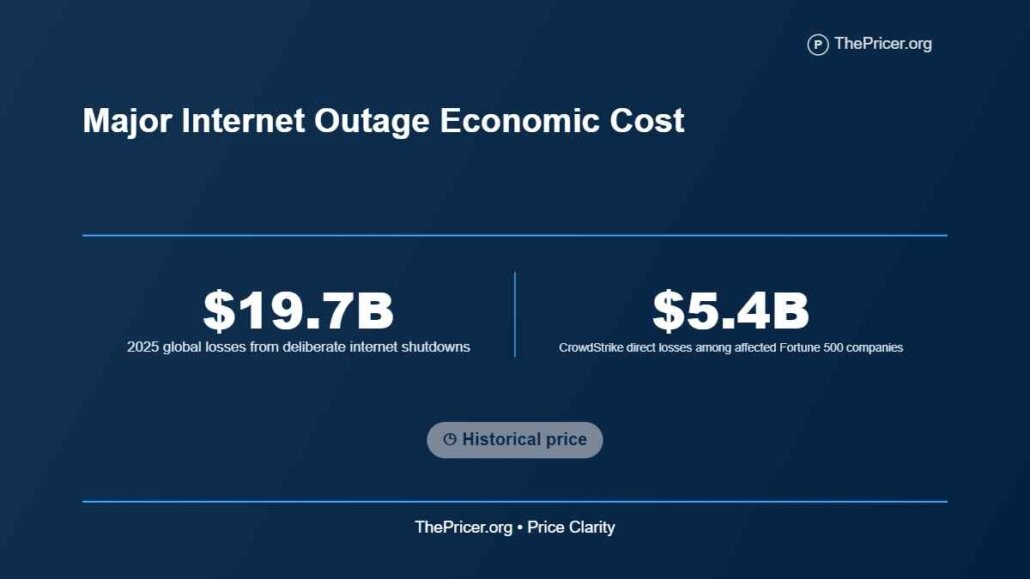
A major internet outage can cause economic losses ranging from millions to billions of dollars, depending on the number of people affected, the duration, and which services fail. Top10VPN estimated that deliberate internet shutdowns worldwide caused $19.7 billion in economic damage during 2025.
Separately, insurance analytics firm Parametrix estimated $5.4 billion in direct financial losses among affected U.S. Fortune 500 companies after the July 2024 CrowdStrike technology outage.
Those figures measure different things. The 2025 estimate concerns government-imposed internet restrictions accumulated over a year, while CrowdStrike was a widespread software failure that disrupted computers and business services, not a general shutdown of internet connectivity.
There is no reliable universal cost per minute for an entire national economy. The financial damage depends on whether transactions disappear permanently, businesses can catch up, and essential services remain operational.
Article Highlights
Jump to sections
- Government-imposed internet disruptions caused an estimated $19.7 billion in worldwide economic losses during 2025.
- The 2024 CrowdStrike incident generated an estimated $5.4 billion in direct losses among affected U.S. Fortune 500 companies, excluding Microsoft.
- Parametrix estimated $540 million to $1.08 billion in insured CrowdStrike losses, substantially less than the total direct impact.
- In Uptime Institute’s 2025 survey, 57% of respondents with impactful outages reported losses above $100,000, and roughly one in five exceeded $1 million.
- Cloudflare’s November 2025 disruption affected many internet services, but no authoritative consolidated economic-loss total was established.
- Lost revenue, postponed transactions, downtime costs, and permanent GDP losses must be calculated separately.
How Much Can a Major Internet Outage Cost the Economy?
Economic losses vary according to the type of event. A local telecommunications failure affects a particular customer base. A major cloud provider outage can interrupt thousands of dependent applications. A government-imposed national blackout can prevent large portions of the population from accessing internet services.
The following published estimates concern different incidents and methodologies. They should not be interpreted as directly comparable prices for identical disruptions.
| Event or study | Estimated financial impact | Scope |
|---|---|---|
| 2025 deliberate shutdowns | $19.7 billion | Worldwide, full year |
| 2024 deliberate shutdowns | $7.69 billion | Worldwide, full year |
| July 2024 CrowdStrike failure | $5.4 billion | Affected U.S. Fortune 500 companies |
| CrowdStrike insured-loss estimate | $540M–$1.08B | Modeled insurance portion |
| Major IT outages in Uptime survey | Over $100,000 | 57% of affected survey respondents |
| Severe IT outages in Uptime survey | Over $1 million | About 20% of affected respondents |
Top10VPN’s 2025 shutdown cost report analyzed 212 major government-imposed restrictions across 28 countries. Its estimates include prolonged internet blackouts, social media restrictions, and severe throttling.
The Uptime Institute’s 2026 outage analysis examines major data center and infrastructure incidents rather than nationwide internet shutdowns. Its survey figures describe the experiences of affected respondents, not the proportion of all businesses suffering seven-figure losses.
The $5.4 Billion CrowdStrike Failure
On July 19, 2024, a faulty CrowdStrike software update caused widespread failures on Windows systems. Airlines, healthcare organizations, financial institutions, and other businesses experienced substantial disruption.
Parametrix estimated $5.4 billion in direct financial losses among U.S. Fortune 500 companies, excluding Microsoft, in its CrowdStrike impact analysis.
The firm’s July 2024 loss breakdown assigned approximately $1.94 billion to healthcare companies and $1.15 billion to banking companies.
Those two industries represented roughly 57% of the estimated losses, reflecting how dependent critical operations can be on functioning digital systems.
Independent Axios reporting noted that about one-quarter of Fortune 500 companies experienced disruption and that Parametrix estimated average losses around $43.6 million for affected companies.
It is important not to call this an internet blackout. Connectivity remained available for many users, but critical computers and applications were unusable. The event illustrates the financial consequences of a shared technology dependency failing at scale.
The 2025 Cloudflare Outage
 Cloudflare’s network helps websites and applications deliver content, filter traffic, and protect services. A failure can therefore affect many unrelated businesses simultaneously.
Cloudflare’s November 18, 2025 incident report states that significant network failures began at 11:20 UTC. Core traffic had largely recovered by 14:30 UTC, and all Cloudflare systems were functioning normally by 17:06 UTC.
The cause was a software-related configuration problem that generated an unexpectedly large file used by the company’s Bot Management system. It was not a cyberattack.
Some websites and applications displayed errors, while others experienced intermittent failures. Affected customers did not necessarily suffer identical downtime durations.
Third-party monitoring company Blue Triangle’s incident analysis documented how switching traffic to an alternative content-delivery provider helped restore its own service.
No independently verified consolidated dollar loss for the entire Cloudflare event was established in the sources examined. Multiplying one company’s downtime by an arbitrary industry loss rate would produce a speculative total, not a measured economic cost.
Cloud Outage Spreads Across Businesses
Large cloud services support authentication, storage, payment processing, messaging, databases, and application hosting. A single technical failure can affect several of these functions at once.
On October 20, 2025, Amazon Web Services experienced a significant disruption in its Northern Virginia region. Amazon’s official incident update identifies DNS resolution problems involving regional DynamoDB endpoints, followed by secondary problems affecting other systems.
AWS reported that services had returned to normal operation by 3:01 p.m. Pacific time on October 20, although some delayed work still needed processing.
Reuters’ outage reporting documented disruption to numerous consumer applications and business services worldwide.
ThePricer’s separate AWS outage cost analysis examines per-minute financial exposure, service credits, and business continuity strategies in more detail.
For economy-wide analysis, the critical issue is shared dependence. If thousands of businesses rely on the same provider for essential functions, an apparently localized technical problem can create geographically widespread consequences.
Government Internet Shutdowns
Government-imposed internet restrictions represent a different kind of economic disruption because authorities intentionally prevent connectivity or access to selected services.
Top10VPN’s 2024 global shutdown report estimated $7.69 billion in losses across 167 major restrictions affecting 28 countries.
For 2025, its estimate increased to $19.7 billion. This does not mean all worldwide internet failures cost that amount. The research specifically concerns deliberate restrictions included in its dataset.
NetBlocks provides a Cost of Shutdown methodology for estimating economic effects using measures of national economic activity and digital connectivity.
The Internet Society’s internet shutdown policy brief uses its own economic modeling framework and emphasizes that shutdowns disrupt productivity, commerce, and time-sensitive transactions.
These models are useful for comparing scenarios, but results depend on assumptions about the affected population, duration, economic output, and services restricted.
A nationwide blackout in a digitally intensive economy cannot be assigned the same hourly cost as blocking one social media platform in a smaller market.
Business Downtime Losses
The simplest business estimate starts with normal revenue during the affected period, then determines how much spending or production was genuinely lost.
Suppose an online retailer generates an average of $120,000 in daily sales and experiences a six-hour checkout outage during a normal trading day.
Assuming sales are evenly distributed across 24 hours, the sales value exposed during the disruption is $30,000. That is 25% of daily revenue.
However, not every interrupted sale becomes permanently lost. Some customers return later, while others cancel their purchases or switch to competitors.
If 40% of the affected sales are recovered after service resumes, the remaining 60% represents $18,000 in potentially lost revenue.
Revenue is not profit or GDP. The retailer would also need to examine merchandise costs, refunds, additional labor, incident-response expenses, and business that was simply postponed.
The existing website development cost guide provides background on infrastructure and ongoing operating expenses, which should be distinguished from revenue lost during downtime.
A Complete Six-Hour Outage Example
Consider a hypothetical online retailer experiencing six hours of unavailable checkout service. Its normal daily sales are $120,000, and sales are assumed to be distributed evenly across the day.
Assume 40% of affected orders return after restoration. Also assume the retailer incurs extra support labor, technical recovery charges, and customer compensation.
- Sales exposed during six hours: $30,000
- Sales recovered afterward: $12,000
- Potential permanently lost revenue: $18,000
- Technical recovery labor: $2,500
- Additional customer support: $1,200
- Customer compensation: $800
- Total modeled revenue loss plus added expenses: $22,500
The $22,500 figure is a combined business-impact measure, not net profit lost. It includes forgone sales revenue and separately assumed incremental costs.
If the business earns a 30% contribution margin on sales, the contribution lost on $18,000 of unrecovered revenue is $5,400. Adding the $4,500 incremental expenses gives a narrower modeled financial impact of $9,900.
That distinction matters because describing lost revenue as lost profit usually exaggerates the financial damage.
The Hidden Cost of Recovery
Outages do not necessarily stop costing money when a status page turns green.
Organizations may need to process delayed orders, reconcile payment records, restart manufacturing systems, contact customers, investigate failed transactions, and repair corrupted or inconsistent data.
The Uptime Institute’s 2025 annual outage study found that 54% of respondents reporting significant outages estimated their latest incident exceeded $100,000, with approximately 20% reporting losses over $1 million.
These totals include costs beyond the immediate service interruption, such as recovery, missed opportunities, and reputational damage.
Uptime also cautions that outage reporting is incomplete and cost estimates are subject to uncertainty.
Another frequently overlooked expense is financial protection. ThePricer’s cyber liability insurance cost guide explains why business interruption coverage, policy exclusions, and coverage limits can materially change the amount an affected company ultimately bears.
Insurance coverage should not be assumed automatically for every software failure, internet disruption, or cloud outage.
Insurance Does Not Cover Every Loss
Parametrix estimated that only approximately 10% to 20% of the Fortune 500’s modeled CrowdStrike losses would be covered by applicable cyber insurance arrangements.
Against the estimated $5.4 billion direct loss, that produces a covered-loss range of approximately $540 million to $1.08 billion.
The implied remaining losses are approximately $4.32 billion to $4.86 billion, using that insurance estimate alone.
These calculations should not be interpreted as confirmed final insurance settlements. Coverage depends on policy conditions, deductibles, waiting periods, exclusions, and whether a particular failure meets the definition of a covered incident.
Independent Bloomberg reporting published by Fortune also described how nonmalicious software failures can create difficult coverage questions and leave large portions of business losses uninsured.
It is therefore important to distinguish an estimated total economic loss from the amount paid by insurers, technology providers, or government authorities.
What an Internet Outage Means
At the national level, economic impact depends on how long productive activity stops and how much can resume afterward.
For example, a payment authorization failure might postpone transactions that eventually settle successfully. A canceled flight, spoiled refrigerated product, or permanently lost appointment may never be recovered.
Critical infrastructure outages also introduce consequences that are not adequately captured by sales totals.
The FCC’s 2024 AT&T outage investigation found that a mobile network failure lasting at least twelve hours affected more than 125 million devices, blocked more than 92 million voice calls, and prevented more than 25,000 attempts to reach emergency services.
Those service disruptions cannot responsibly be assigned a financial value simply by multiplying missed calls by a generic price.
The effect of an outage also depends on whether alternative networks, manual workarounds, or redundant systems remain available.
Makes sense if
- You distinguish temporary transaction delays from permanent economic losses.
- You identify the actual population, industries, and services affected.
- You include recovery costs and operational consequences.
- You compare economic models only when their scope and assumptions are compatible.
Does not make sense if
- You apply a large enterprise’s downtime cost per minute to the whole economy.
- You treat a software failure and a nationwide internet blackout as identical events.
- You add lost revenue, insured losses, and economic output estimates without checking overlap.
- You assume all postponed online sales disappeared permanently.
Answers to Common Questions
How much can a major internet outage cost per hour?
There is no reliable universal figure. The cost depends on the region, affected businesses, type of failure, recovery time, and share of economic activity permanently lost.
What was the most expensive recent technology outage?
The July 2024 CrowdStrike incident is a prominent example, with approximately $5.4 billion in estimated direct losses among affected U.S. Fortune 500 companies. It was a software failure rather than an internet blackout.
How much did internet shutdowns cost in 2025?
Top10VPN estimated $19.7 billion in global economic losses from deliberate government-imposed internet restrictions during 2025. It does not include every accidental outage.
Do companies recover revenue after an internet outage?
Often some revenue is recovered when delayed customers return or transactions are completed. Other opportunities, such as time-sensitive bookings or sales, may disappear permanently.
Does cyber insurance pay for internet outages?
Some business interruption policies cover qualifying technology failures, but coverage depends on the insurer, terms, exclusions, and waiting periods. Not every outage results in an insured claim.
Disclosure: Educational content, not financial advice. Prices reflect public information as of the dates cited and can change. Confirm current rates, fees, taxes, and terms with official sources before purchasing. See our methodology and corrections policy.