
How Much Compensation Do 9/11 Victims Get?
Published on | Written by Alec Pow
This article was researched using 15 sources. See our methodology and corrections policy.
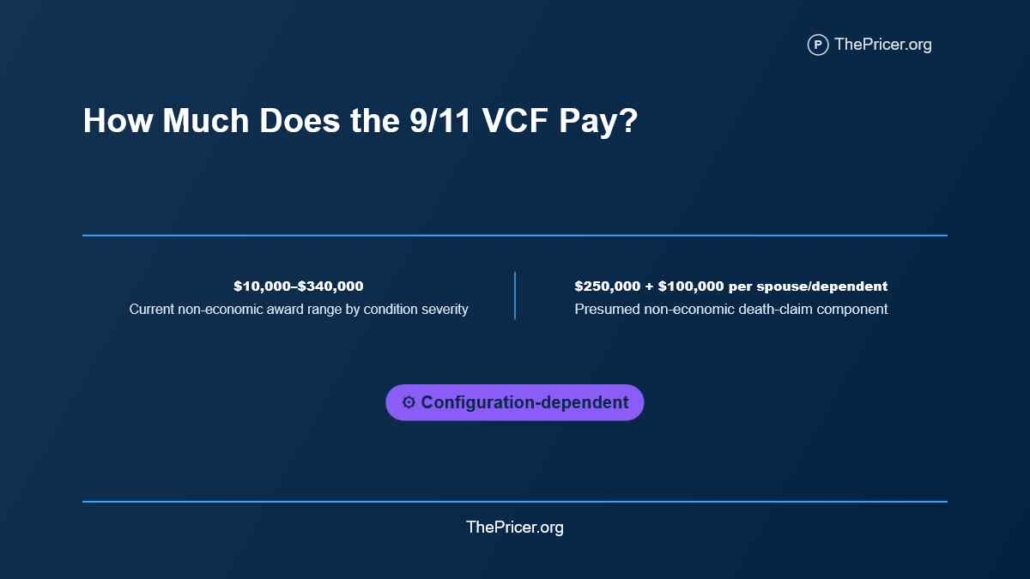
The September 11th Victim Compensation Fund does not pay one standard amount. The VCF’s current non-economic award ranges start at $10,000 for milder non-cancer conditions, reach $90,000 for severe non-cancer conditions, and reach $250,000 for one cancer. Certain multiple severe conditions can reach $340,000.
The final award can be much larger because eligible economic loss may be added before collateral offsets are subtracted. A 9/11-related death claim uses a separate family formula. Calling $250,000 the universal “cancer payout” can misstate what a claimant may receive.
Article Highlights
Jump to sections
- Non-economic awards can run from $10,000 (at $30 per hour, earning that amount would take about 8.3 full-time workweeks, before taxes) for milder non-cancer cases to $250,000 for one cancer, with up to $340,000 for certain multiple severe conditions.
- A deceased victim’s presumed component is $250,000, plus $100,000 for a spouse and each dependent.
- Economic loss can add lost earnings, employment benefits and other eligible losses before offsets.
- The annual gross-income ceiling used in lost-earnings calculations is $255,610 per year of loss.
- The reopened fund had awarded more than $18.56 billion to more than 77,000 claimants through August 31, 2026.
- The federal claim-filing deadline is October 1, 2090.
How Much Does the 9/11 VCF Pay?
The current VCF calculation begins with three parts. The Department of Justice adds non-economic loss to eligible economic loss, then subtracts applicable collateral offsets. The current compensation calculation policy sets a maximum non-economic loss of $250,000 (about 4 years of full-time work at $30 per hour) for one cancer and $90,000 for one non-cancer condition. Lower-severity non-cancer awards can begin at $10,000. The same policy allows an aggregate non-economic award up to $340,000 in certain cases involving multiple severe conditions.
Those numbers are only one layer of the award. A claimant with an eligible occupational disability can also have past or future earnings loss, while some claims can include lost employment benefits, qualifying out-of-pocket medical expenses or replacement services. The current methodology limits earnings and employment benefits counted as gross income to $255,610 for each year of loss. That ceiling is an input to the economic-loss calculation, not a maximum VCF payout.
| VCF award component | Current amount or rule | What the figure means |
|---|---|---|
| Lower-severity non-cancer loss | From $10,000 | Non-economic loss, with severity documentation able to change the award |
| One non-cancer condition | Up to $90,000 | Standard statutory non-economic ceiling |
| One cancer | Up to $250,000 | Non-economic ceiling, not a total-award ceiling |
| Multiple severe conditions | Up to $340,000 | Current policy ceiling for qualifying combined severe conditions |
| Death component | $250,000 plus $100,000 per spouse or dependent | Presumed non-economic wrongful-death component before economic loss and offsets |
| Annual earnings input | Up to $255,610 | Annual gross-income ceiling used in economic-loss calculations |
Cancer and Non-Cancer Awards
Cancer claims do not all receive $250,000 (about 4 years of full-time work at $30 per hour). VCF policy bases non-economic compensation on the type and severity of the condition and its effect on daily life, rather than the number of certified conditions. Current cancer awards can fall below the statutory cap when the medical evidence supports a lower severity level.
Non-cancer conditions work differently. The maximum standard non-economic award is $90,000, while milder or well-controlled conditions can begin at $10,000. Emphysema, interstitial lung disease and sarcoidosis are treated as presumptively severe under current policy. Conditions such as asthma, chronic rhinosinusitis, GERD and several other respiratory or digestive conditions may require recent medical evidence before the VCF raises the non-economic amount above its lower baseline.
More WTC Health Program certifications do not automatically multiply the award. Severity and daily-life impact carry more weight than the diagnosis count. Medical documentation can move an award within those boundaries. The $250,000 figure caps one cancer’s non-economic component, not eligible economic loss added elsewhere in the formula. Treatment expense is a separate money question, including chemotherapy costs that can arise outside the VCF award calculation.
How Much Do Death Claims Pay?
A deceased claim can be much larger than the widely repeated $250,000 figure. The current deceased-victim policy requires a properly appointed Personal Representative and treats the cause of death as a key part of the claim. When the death is tied to an eligible 9/11-related condition, the compensation calculation can include the wrongful-death component, eligible economic loss and applicable offsets.
An illustrative family scenario with a spouse and two dependents starts with these presumed non-economic amounts.
- Deceased victim $250,000
- Spouse $100,000
- Two dependents $200,000
- Calculated subtotal $550,000
The $550,000 subtotal comes before eligible economic loss and collateral offsets. A spouse with no dependents produces $350,000, while a spouse and one dependent produces $450,000. These are calculated components, not guaranteed final checks.
The final award can rise when eligible lost earnings, benefits, replacement services or burial expenses are added. It can also fall when collateral offsets apply. Families dealing with funeral expenses may separately face costs such as cremation and memorial expenses, but the VCF does not simply reimburse every end-of-life cost. Documentation, causation and the fund’s compensation rules still control what enters the award.
Economic Loss Can Raise the Award
Economic loss is where some VCF awards move far beyond the cancer and non-cancer headline limits. For a personal-injury claim, future lost earnings usually require proof of a permanent partial or total occupational disability tied to an eligible 9/11 physical condition. The current calculation policy uses an annual gross-income ceiling of $255,610 for each year of loss, including covered employment benefits that fall within the statutory definition of gross income. The fund then applies its methodology for taxes, work-life expectancy, disability, present value and other inputs.
Out-of-pocket medical expenses can also qualify in certain cases. The VCF’s medical-expense instructions require detailed proof tying each claimed expense to an eligible condition and showing that the claimant actually paid the amount. The instructions require claimed medical expenses to exceed $5,000, with at least $5,000 in valid expenses verified before reimbursement is considered.
Replacement services can create another economic component when an eligible condition or death removes household work the victim used to perform. Covered tasks can include cleaning, cooking, grocery shopping, childcare, home repairs and certain other household services under the VCF methodology.
These categories explain why two people with the same cancer diagnosis can receive very different total awards. One claimant may have little or no compensable wage loss. Another may lose years of earnings and employment benefits, producing a much larger economic calculation before offsets.
What Can Reduce the Final Payment?
The hidden money issue is collateral offsets. The VCF formula subtracts certain compensation a claimant received, or became entitled to receive, because of the same eligible 9/11 injury or death. The categories can include disability pensions, Social Security benefits, workers’ compensation, life insurance in death claims, Public Safety Officers’ Benefits and settlements from 9/11-related litigation. The exact treatment depends on the type of benefit and the loss component against which the offset applies.
A large economic-loss calculation does not guarantee an equally large increase in the final payment. The VCF’s guidance on large offsets warns that an amendment may add nothing when existing offsets exceed the new loss being claimed. A disability pension tied to the same eligible condition can also offset part of a lost-earnings calculation.
The comparison with ordinary litigation also needs care. The VCF is a federal no-fault compensation program, not a normal tort settlement. Claimants have rules involving prior 9/11 lawsuits, and certain lawsuit settlements can enter the offset calculation. A civil case can carry substantial filing, discovery and attorney expenses, which is why the economics differ from the cost of bringing a lawsuit through the court system.
Is There an Average VCF Payout?
There is no single current average that safely answers what a new claimant will receive. The VCF publishes a weekly compensation decisions file covering individual determinations since 2013. The public data classify awards by claim type, condition group, economic-loss status and award range. That structure is useful for seeing the distribution of decisions, but it does not turn unlike cancer, non-cancer, deceased and amended claims into one meaningful personal estimate.
The latest DOJ program figures show why a shortcut is risky. Special Master Allison Turkel reported more than $1.8 billion awarded across more than 9,800 award determinations in 2025. Dividing those rounded figures produces roughly $184,000 per determination. She also reported more than 750 new claims per month and more than $18.56 billion awarded to over 77,000 claimants through August 31, 2026. None of those program totals should be treated as the expected payout for a new claimant.
Historical averages create another trap. The original 2001 to 2004 fund reported an average deceased-victim award of $2,082,128 after offsets and a median of $1,677,633. Awards in that historical death-claim table ranged as high as $7.1 million. Those figures describe the original VCF and should not be presented as the expected payout for a cancer or responder claim filed under the current program.
Who Can Still Qualify in 2026?
The VCF is not restricted to FDNY, NYPD or first responders. Current eligibility and deadline rules can cover residents, workers, students, visitors, volunteers and cleanup workers in eligible exposure areas. A claim requires a qualifying 9/11-related physical condition and proof of presence at an eligible site during the applicable period.
The program remains active 25 years later. New claims continue to arrive, so eligibility is still a current issue rather than a closed historical question. Civilians who were exposed in qualifying areas can be eligible under the same federal program as responders when they meet the physical-condition, presence and other claim requirements.
A claim may apply if
- You have a qualifying 9/11-related physical condition and can document eligible presence.
- You are a responder, worker, resident, student, volunteer or visitor who falls within the program’s exposure rules.
- You are the authorized Personal Representative of someone whose eligible condition contributed to death.
A claim may not apply if
- You cannot establish presence at an eligible site during the required period.
- Your claimed condition is not an eligible 9/11-related physical condition.
- A lawsuit or filing issue prevents the claim from satisfying the VCF’s legal requirements.
One deadline can cause confusion this week. New York’s separate World Trade Center workers’ compensation registry has a September 11, 2026 registration deadline for qualifying rescue, recovery and cleanup workers. The state WTC registry deadline is not the federal VCF claim-filing deadline.
How Long Does a Claim Take?
There is no single processing time for every case. The VCF says claims are reviewed in first-in, first-out order after a complete claim form and required information are submitted. Its September 2026 timing guidance says the fund is working toward determinations within one year of submission for a complete claim or amendment when all information needed to process it has been supplied.
Complex compensation claims can take longer because lost earnings, pensions, Social Security records and other third-party information need to be matched to the VCF calculation. The one-year target applies to a complete submission with the information needed for review, not to an incomplete file waiting on material records.
The decision date and payment date are separate stages. Once an award has been issued and all payment information is complete, Treasury processing follows the VCF’s payment procedure. Claimants should treat the one-year target as a review goal for a complete submission that is ready for review, not as a promise that every new claim will be paid exactly 12 months after the first form is filed.
Do You Need a VCF Lawyer?
No attorney is required to file a VCF claim. The fund’s current attorney policy states that claimants may file without a lawyer and that attorney fees cannot exceed 10% of the VCF award. The VCF does not reimburse the claimant for the lawyer’s fee, so that charge comes out of the claimant’s compensation under the attorney-client agreement.
At the 10% maximum, a $90,000 award could carry up to $9,000 in attorney fees, leaving $81,000. A $250,000 award could carry up to $25,000, leaving $225,000. At $340,000, the maximum fee would be $34,000, leaving $306,000. These are illustrations, not a claim that every lawyer charges the cap.
Legal help can be useful when presence evidence, disability records, probate, prior litigation or economic-loss calculations are difficult. A simpler claim with strong records may be easier to file without paid representation. The VCF says attorney involvement does not give a claim priority, so a lawyer should not be treated as a way to buy faster review.
Verification
- Checked the VCF’s current payment procedure, which says payment should usually reach the designated bank account within about two months after the award letter when required information is complete.
- Confirmed through the CDC’s June 2026 program statistics that 145,275 members were currently enrolled in the WTC Health Program and that lifetime cancer certifications totaled 57,044. CDC labels the dashboard data preliminary and informational.
- Cross-referenced the fund’s permanent authorization, which appropriates the funds needed to pay approved claims and extends the federal claim-filing deadline to October 1, 2090.
Answers to Common Questions
What is the average 9/11 VCF payout?
There is no reliable single current average for a new claimant. Claim type, severity, economic loss, amendments and offsets can change awards sharply.
How much does the VCF pay for cancer?
Eligible cancer non-economic awards usually fall between $90,000 and $250,000. Added economic loss can push the total above $250,000.
Can families still get 9/11 compensation in 2026?
Yes. A Personal Representative can pursue an eligible deceased claim when the death is tied to a qualifying 9/11-related condition.
Is the VCF still funded?
Yes. Permanent authorization funds approved claims, and the federal claim-filing deadline runs to October 1, 2090.
Is September 11, 2026 the federal VCF deadline?
No. That date concerns New York’s separate workers’ compensation registry. The federal VCF claim-filing deadline is October 1, 2090, with separate VCF registration rules.
Disclosure: Educational content, not financial advice. Prices reflect public information as of the dates cited and can change. Confirm current rates, fees, taxes, and terms with official sources before purchasing. See our methodology and corrections policy.