
How Much Could Saudi Arabia’s Pipeline Shutdown Cost?
Published on | Written by Alec Pow
This article was researched using 14 sources. See our methodology and corrections policy.
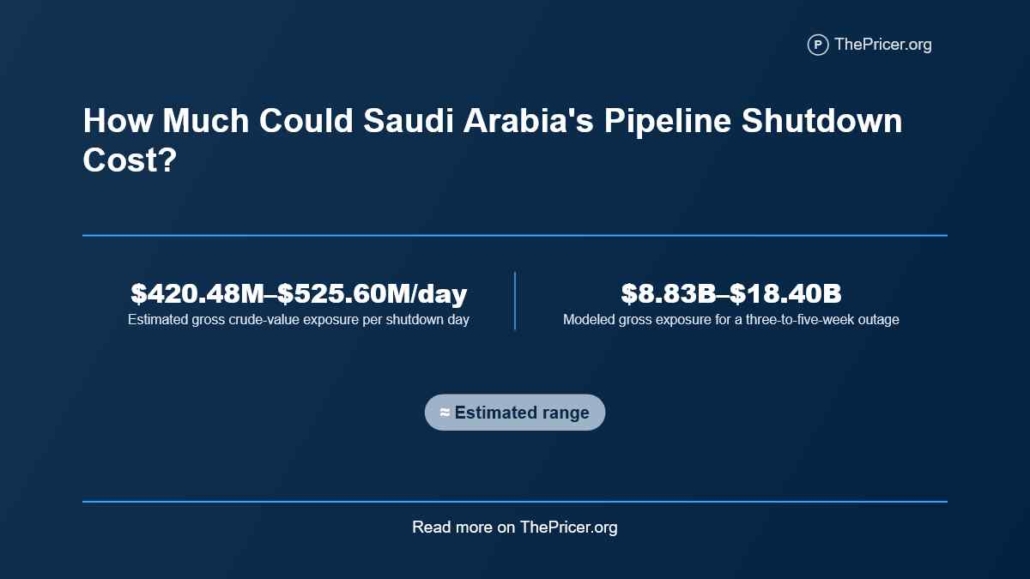
Saudi Arabia’s East-West Pipeline shutdown exposes crude flows worth roughly $420.48 million to $525.60 million per day at a Brent benchmark of $105.12 per barrel, based on reported 4M-5M recent flow. The pipeline was shut after September 10 attacks, according to the Saudi Energy Ministry statement.
That daily range measures the market value of crude tied to the route, not a confirmed daily loss for Saudi Aramco. Storage, Gulf-port loadings, Oman transfers, delayed cargoes, and later delivery can keep part of that value from becoming lost revenue.
Article Highlights
Jump to sections
- Recent East-West Pipeline flow has been reported near 4 million to 5 million barrels per day, below its maximum physical capacity.
- At $105.12 (at $30 per hour, earning that amount would take about 3.5 hours of work, before taxes) per barrel, that flow carries gross crude value of about $420.48 million to $525.60 million per day.
- A three-week to five-week outage would expose about $8.83 billion to $18.40 billion of gross crude value before storage, rerouting, later delivery, and production changes.
- Yanbu export-ready stocks were estimated at five to seven days, making outage duration a bigger cost driver than small daily oil-price moves.
- No public September 2026 repair bill has been disclosed, so a precise infrastructure-repair total would be speculative.
How Much Could Saudi Arabia’s Pipeline Shutdown Cost?
The cited 4 million to 5 million barrels-per-day band gives a practical current-flow range rather than the line’s maximum rating. The dated Brent input is $105.12 (about 3.5 hours of work at $30 per hour) per barrel on September 16. Using reported recent throughput instead of the 7 million-barrel maximum keeps the model tied to the flow that was exposed when the line stopped. It also prevents nameplate capacity from being misread as daily lost sales. Those inputs make the calculation reproducible and keep the unit consistent at dollars per shutdown day.
The calculation is direct. Four million barrels multiplied by $105.12 equals $420.48 million. Five million barrels multiplied by $105.12 equals $525.60 million. Each one-million-barrel step changes daily gross exposure by $105.12 million at the same benchmark. This ThePricer estimate is a daily gross throughput-value range for reported recent flow at a dated Brent benchmark. It is not Aramco’s realized selling price, profit margin, tax receipt, or confirmed revenue loss. Saudi crude grades sell under their own pricing formulas, and a barrel that leaves through another terminal or sells several days later has not vanished economically.
What the Shutdown Cost Means
A pipeline shutdown can create several different costs at the same time. One is the value of crude that would normally move through the line. Another is the physical repair expense. A third is the extra logistics bill from moving barrels through Gulf terminals, ship-to-ship transfers, or longer tanker routes. A fourth appears at customer refineries when buyers replace delayed Saudi barrels with other grades. Treating all four as one number would overstate some losses and hide others.
The East-West Pipeline, also called Petroline, connects Saudi Arabia’s eastern oil system with Yanbu on the Red Sea. Saudi Aramco said the system reached a maximum of 7 million barrels per day in the first quarter of 2026, supporting west-coast exports, according to its first-quarter operating update. EIA later described 5 million barrels per day of that capacity as available for exports, with the balance serving domestic needs, in its July pipeline analysis. Capacity, export availability, and actual throughput are different quantities, so a cost model must use the flow that was really at risk rather than automatically multiplying the 7 million-barrel ceiling.
Outage Length Changes the Bill
Duration changes the exposure faster than modest movement in the oil benchmark. Two regional officials told the Associated Press that most of the pipeline could remain out of service for three to five weeks, though partial flow could return sooner. That three-to-five-week repair estimate is not an official Saudi restart timetable. It is best used as a sensitivity range alongside shorter cases.
| Illustrative outage | At 4M bpd | At 5M bpd |
|---|---|---|
| 3 days | $1.26 billion (about 20 thousand years of full-time work at $30 per hour) | $1.58 billion |
| 7 days | $2.94 billion | $3.68 billion |
| 21 days | $8.83 billion | $11.04 billion |
| 35 days | $14.72 billion | $18.40 billion |
The table is an exposure model, not a forecast of Saudi losses. Its highest case assumes 5 million barrels per day remain unavailable to the pipeline for 35 days and values every barrel at the same $105.12 benchmark. A seven-day high-flow worked case separates the 5 million-barrel flow into a 4 million-barrel base worth $2.943 billion over seven days and an upper 1 million-barrel layer worth $735.84 million. Together they produce $3.679 billion.
The total includes gross benchmark crude value and excludes storage withdrawals, rerouting, later sales, grade differentials, freight, insurance, repair spending, and production costs. Actual loss falls below the gross figure when barrels come from storage, move through another export path, or sell later.
Storage Buys Limited Time
 Storage turns a pipeline outage into a race between inventory and repair. Reuters reported that Yanbu had enough export-ready crude for about five to seven days at the time of the shutdown, based on industry sources, and said Saudi Arabia had some supply available through Egyptian storage as well. The same report said the kingdom had not published a repair duration and that market estimates ranged from quicker restoration to several weeks. Those details appear in the Yanbu inventory report.
Comparing that inventory window with the reported three-to-five-week repair scenario produces a useful second ThePricer calculation. Five days of stock covers about 14.3% of a 35-day outage. Seven days covers 33.3% of a 21-day outage.
The result means the publicly reported Yanbu cushion spans only about 14% to 33% of the long repair window on a simple duration basis. It does not prove that every stored barrel matches every customer’s grade or loading schedule. It does explain why the economic cost can jump after the first week if pipeline flow stays weak and substitute export channels cannot carry enough crude.
Rerouting Cuts the Revenue Loss
Saudi Arabia has already changed the route that some crude takes to market. Reuters reported on September 16 that Aramco offered Arab Light, Arab Medium, and Arab Heavy to Asian buyers through ship-to-ship transfers off Sohar, Oman. The same report said daily loadings at Ras Tanura and Juaymah had doubled to about 4 million barrels, while Yanbu loadings were suspended and some European September cargoes had been cancelled. Those Oman and Gulf rerouting moves are the main reason gross pipeline value should not be called lost revenue.
The entity connection matters financially. Petroline normally carries crude west to Yanbu. When Petroline fails, Gulf terminals such as Ras Tanura and Juaymah become more important. Cargoes can then move through constrained Gulf waters or be transferred near Sohar outside Hormuz.
Each bridge in that chain changes cost, timing, security exposure, and which buyer receives which grade. A barrel shifted from Yanbu to Sohar may create extra freight or handling expense without creating a full barrel of lost sales. A cancelled cargo has a stronger revenue effect than a rescheduled cargo, and shut-in production has a stronger production effect than either one.
The Repair Bill Is Still Unknown
No Saudi government or Aramco disclosure reviewed for this article gives a September repair price. That gap should remain visible rather than being filled with a construction-cost guess. The official shutdown announcement cited at the start says technical teams secured the pipeline and began evaluating its safety, but it does not disclose damaged component counts, pumping-station scope, materials, contractor charges, or a capital budget. The statement leaves repair scope and timing open.
An April 2026 attack supplies a useful recovery reference but not a repair-price proxy. In that earlier event, the Saudi Energy Ministry said about 700,000 barrels per day of East-West pumping capacity had been lost before the system returned to its full 7 million-barrel-per-day capability within a short period, according to the April ministry recovery update. The September attack may involve a different set of facilities and a different repair sequence, so multiplying an old capacity loss by a guessed cost per barrel would create a false estimate. Gross crude-flow exposure can be modeled from public numbers, while the physical repair bill stays unknown until Saudi authorities or Aramco disclose enough scope to price it responsibly.
Buyers Face Replacement Costs
The shutdown also moves cost outside Saudi Arabia. Poland’s Orlen said it bought 16 million barrels of extra crude for refineries in Poland, Lithuania, and the Czech Republic after disruptions to Saudi supply. Reuters reported that the company sourced replacement deliveries from Norway, Britain, Algeria, Kazakhstan, Azerbaijan, and the Americas, and that Saudi Aramco had supplied about 40% of Orlen’s oil. The 16-million-barrel replacement program shows how a pipeline problem can become a procurement problem for refiners.
At the article’s Brent benchmark, 16 million barrels have a nominal crude value of about $1.68 billion. The arithmetic is 16 million multiplied by $105.12. That number is not Orlen’s incremental outage cost because its actual purchase prices, grade differentials, freight, insurance, and contract terms are not public in the cited report.
The useful connection is economic rather than accounting. If a refiner replaces a cancelled Saudi cargo with a more expensive grade or longer voyage, part of the outage burden appears in procurement and logistics instead of Aramco’s ledger. Related tanker economics are covered in oil tanker rerouting costs.
When Exposure Becomes a Real Loss
The largest numbers in an outage model become real losses only after offsets run out. A barrel that sits in Yanbu storage for two days and later ships is delayed inventory. A barrel rerouted through Ras Tanura and transferred near Oman carries new logistics costs but can still generate a sale. A barrel that cannot be produced because storage and export routes are full is closer to a true production loss. A cargo cancelled under contract can shift revenue, replacement costs, or both depending on how it is rescheduled.
This hierarchy is the useful way to read the $420.48 million to $525.60 million daily figure. It starts with pipeline throughput value, then asks how much inventory absorbs, how much alternative logistics move, how many deliveries are delayed, and how much production is actually shut in. It also connects naturally to the wider chokepoint question. Petroline was built to reduce dependence on Hormuz, while Yanbu still depends on Red Sea access. Readers comparing those routes can use the related analysis of a one-day Hormuz closure and Hormuz security costs.
Useful estimate if
- The flow input reflects reported recent throughput rather than maximum capacity.
- The oil benchmark is dated and identified.
- Storage, rerouting, later delivery, and production cuts remain separate.
- The result is labeled gross exposure instead of confirmed profit loss.
Misleading estimate if
- The full 7 million-barrel capacity is treated as lost daily sales.
- Every delayed barrel is counted as permanently unsold.
- A market-wide oil-price move is assigned only to Petroline.
- An undisclosed repair bill is invented from unrelated pipeline projects.
Answers to Common Questions
How much could the Saudi pipeline shutdown cost per day?
At reported recent flow of 4 million to 5 million barrels per day and Brent at $105.12 per barrel, the gross crude value tied to one day of pipeline flow is about $420.48 million to $525.60 million. Actual lost revenue can be much lower if barrels are stored, rerouted, or sold later.
Could a five-week shutdown cost Saudi Arabia more than $18 billion?
A 35-day high-flow scenario produces about $18.40 billion of gross throughput-value exposure. It should not be read as a forecast of Saudi profit, government revenue, or Aramco sales lost.
How much will the pipeline itself cost to repair?
No public September 2026 repair bill was found in the official Saudi or Aramco material reviewed. A precise infrastructure cost would need damage scope, equipment counts, labor requirements, and contract pricing that are not public yet.
Why does the pipeline matter if Saudi Arabia has other ports?
The East-West Pipeline connects eastern production with Yanbu on the Red Sea and gives Saudi Arabia a route that can bypass Hormuz. Other terminals and Oman transfers can preserve some exports, but they change logistics, capacity constraints, and delivery timing.
Disclosure: Educational content, not financial advice. Prices reflect public information as of the dates cited and can change. Confirm current rates, fees, taxes, and terms with official sources before purchasing. See our methodology and corrections policy.