
How Much Did the MADRING F1 Circuit Cost to Build?
Published on | Written by Alec Pow
This article was researched using 12 sources. See our methodology and corrections policy.
MADRING’s main Formula 1 circuit construction contract cost about $96.5 million, equal to €83.2 million. That figure covers the ACCIONA-Eiffage track works package, not every building and race facility needed for Madrid’s new Spanish Grand Prix venue. Once the separately contracted Pit Building and Paddock Club works are included, the two principal construction packages reach about $175.4 million, equal to €151.2 million.
A broader documented build-related total reaches about $178.5 million, equal to €153.9 million, after adding the current technical-supervision contract. These U.S. dollar conversions use a September 12, 2026 mid-market rate of about $1.1599 per €1. The original contracts are denominated in euros, so the dollar amounts are conversion snapshots rather than contract values fixed in dollars.
Article Highlights
Jump to sections
- The main MADRING circuit contract is about $96.5 million (at $30 per hour, earning that amount would take about 1.5 thousand years of full-time work, before taxes), equal to €83.2 million.
- The separate Pit Building and Paddock Club contract is about $78.9 million, equal to €68 million.
- The two principal construction packages total about $175.4 million, equal to €151.2 million.
- Adding the modified technical-supervision contract raises the documented build-related total to about $178.5 million, equal to €153.9 million.
- The winning track bid was about 25% below the original tender base.
- A separate ten-year hospitality commitment is roughly $464.0 million, equal to €400 million, but it is not the circuit construction cost.
How Much Did the MADRING F1 Circuit Cost to Build?
IFEMA Madrid awarded the central MADRING works package to a joint venture of ACCIONA and Eiffage. The official construction announcement puts the award at $96.5 million (about 1.5 thousand years of full-time work at $30 per hour), equal to €83.2 million, using the current dollar conversion. ACCIONA holds 60% of the joint venture and Eiffage 40%. The job started in April 2025 and covered much more than laying a racing surface.
The contract includes construction of the circuit, temporary race infrastructure, installation and later dismantling of temporary structures, new roads and event facilities, and restoration of public roads after each Grand Prix. MADRING originally described a roughly 5.4-kilometer course with about 4.1 kilometers on IFEMA property and 1.3 kilometers using public roads. That mixed permanent and street-circuit format is central to the cost because the contractor must both build infrastructure and prepare parts of the venue for repeated annual conversion.
The $96.5 million figure is the right answer when the question means the main circuit contract itself. It is not a final all-in venue cost. Garages, premium hospitality buildings, supervision, annual event operations, Formula 1 hosting economics, and other commercial programs sit partly outside that one award. That scope difference is why another credible MADRING cost figure can be much higher without contradicting the track contract.
The Separate Pit Building
Eiffage later won a second MADRING infrastructure contract worth about $78.9 million, equal to €68 million. This design-build package extends IFEMA Halls 1 and 2 with two new three-story buildings and adds temporary structures for Grand Prix operations. It is a separate contract from the $96.5 million (about 1.5 thousand years of full-time work at $30 per hour), equal to €83.2 million, circuit package.
Ground level houses team containers, garages, technical areas, and service zones. Upper levels are used for Paddock Club reception, catering, hospitality lounges, and panoramic terraces during race weekend. Temporary additions provide offices, timekeeping, control, logistics, and related spaces. After the Grand Prix, temporary elements can be removed while the permanent hall extensions remain part of IFEMA’s exhibition complex.
Adding this package changes the construction answer materially. The main circuit contract plus the Pit Building equals about $175.4 million, equal to €151.2065 million. The Pit Building adds 81.7% to the value of the circuit contract alone. That is the hidden scope issue behind the familiar $96.5 million headline. Someone asking what the racetrack contract cost can use the lower figure. Someone asking what the two major physical construction packages cost should use roughly $175 million.
Tender vs Winning Bid
The procurement record shows that IFEMA started with a much larger base budget for the main works. Its official tender document lists a base amount of about $128.7 million, equal to €110,941,990, and the ACCIONA-Eiffage economic offer at about $96.51 million, equal to €83,206,500.01.
The difference is about $32.17 million, equal to €27.74 million. Dividing the euro difference by the original euro tender base gives almost exactly 25%. That means the winning bid came in about one-quarter below the tender base. The result is useful because it separates the procurement ceiling from the contracted construction amount. Quoting the original tender as though it were money actually awarded would overstate the main track contract by more than $32 million at today’s conversion.
The 25% gap should not be described as a final project saving. A tender base and an accepted bid are procurement stages, while the finished venue also includes separately contracted work. The second Pit Building award alone is about $78.9 million, equal to €68 million, which shows why the full venue cannot be judged only by comparing the track bid with the original tender. Final outturn can also differ from an award if approved changes or other packages are added.
A Broader Build Total
IFEMA also contracted technical assistance for project control, supervision, and execution oversight. The contract modification notice shows an original award of about $3.00 million, equal to €2,589,892.50, and an approved modification of about $116,549, equal to €100,482.36. Together, that supervision contract is about $3.12 million, equal to €2,690,374.86.
| Documented build-related component | USD conversion | Original euro amount |
|---|---|---|
| Main circuit construction award | $96.51 million | €83.2065 million |
| Pit Building and Paddock Club works | $78.87 million | €68.0000 million |
| Technical-supervision award | $3.00 million | €2.5899 million |
| Supervision modification | $116,549 | €100,482 |
| Documented build-related total | $178.50 million | €153.8969 million |
The arithmetic is $96.51 million + $78.87 million + $3.00 million + $116,549 = about $178.50 million. In original contract currency, the corresponding total is €153,896,874.87. The dollar figures use the September 12 mid-market rate of roughly $1.1599 per €1.
This is a documented build-related total, not a claim that every euro spent on the first Spanish Grand Prix has been captured. It excludes Formula 1 rights economics, event staffing, security, marketing, race-weekend operations, and commercial programs whose contracts cover more than construction. No final audited all-in project outturn has been published in the evidence reviewed.
What MADRING Actually Built
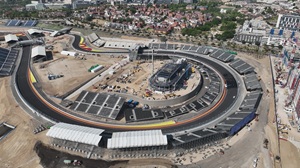
MADRING is a hybrid venue rather than a conventional permanent circuit built on an isolated plot. Formula 1’s current MADRING circuit guide gives the finished track length as 5.414 kilometers with 22 turns. The layout combines IFEMA land with public roads, while its most recognizable feature is the long, banked Turn 12 known as La Monumental.
The circuit contract pays for road creation, event-specific infrastructure, utilities work, temporary race elements, assembly and dismantling, and later road restoration. Eiffage’s construction description also says the project planned to reuse about 700,000 cubic meters of earth from the earthworks. Those requirements make a simple asphalt-per-mile comparison weak. The contract pays for a functioning FIA-grade event environment rather than a strip of pavement measured only by length.
One normalization is still useful if its limits stay attached. Divide the $96.51 million core-contract conversion by 5.414 kilometers and the result is about $17.83 million per kilometer, equal to roughly €15.37 million per kilometer in the original contract currency. That does not mean the asphalt costs $17.83 million per kilometer. The numerator includes temporary infrastructure, road works, event facilities, and restoration obligations that do not scale directly with track length.
Permanent vs Temporary Works
The venue’s mixed-use design changes how its construction cost should be interpreted. MADRING’s Pit Building description says the building includes 14 modular garages, with 11 for Formula 1 teams and three reserved for the FIA. The upper levels house Paddock Club lounges and terraces during the Grand Prix, while the permanent structure becomes part of IFEMA’s normal facilities outside race weekend.
Other pieces are designed to appear and disappear around the event. The core track contract explicitly includes installation and dismantling of temporary structures plus restoration of public roads. That repeated conversion work is part of the original construction agreement, which means the $96.5 million, equal to €83.2 million, contract is not purely a one-time permanent-asset purchase. It also contains obligations linked to making the hybrid circuit function as an annual event.
This is one reason MADRING does not compare neatly with a permanent Formula 1 venue built entirely on dedicated land. Readers comparing general circuit development can use the race track construction cost article for broader context. MADRING’s specific contracts are stronger evidence for this project because they reflect its public-road restoration, IFEMA reuse, and Formula 1 operational requirements.
Hospitality Is a Different Budget
 Another large MADRING number can be mistaken for construction cost. IFEMA and MATCH Hospitality announced a ten-year commitment worth about $464.0 million, equal to €400 million. The agreement runs from 2026 through 2035 and covers construction, setup, management, and commercialization of the Grand Prix’s VIP and hospitality areas.
That scope is much broader than building the circuit. Dividing the current $464.0 million conversion across ten years gives about $46.4 million per year, equal to €40 million per year in the original commitment currency. That annualized figure is a scale illustration only. It does not mean MATCH will spend exactly that amount on physical building work each year, because the agreement also covers commercial operations, services, hospitality production, and sales.
Adding the entire $464.0 million hospitality commitment to the $175.4 million construction-package total would create a misleading build figure. The two numbers cover different time periods and different activities. Premium-race readers can compare the separate F1 Paddock Club cost article, but hospitality spending should stay outside the answer to what MADRING cost to construct. The ten-year term also means the commitment extends long after the initial circuit works were finished, which makes it a poor substitute for a one-time build budget.
Build Cost vs Economic Impact
A PwC study published by MADRING estimates that the 2026 Spanish Grand Prix will generate about $541.7 million, equal to €467 million, in estimated economic impact and about $96.3 million, equal to €83 million, in taxes and social contributions. The same study estimates 8,850 jobs associated with the event. Those are regional economic-impact measures, not cash receipts that can be subtracted directly from construction spending.
For scale, the $541.7 million impact estimate is about 3.09 times the $175.4 million current-dollar value of the two principal construction contracts. That does not establish a 3.09-times financial return, a one-year payback, or profit to IFEMA. Economic-impact models count spending and activity across tourism, hospitality, transport, suppliers, and other sectors. Construction contracts measure what contractors are paid for defined works.
IFEMA’s original Formula 1 agreement described the Madrid project as financed with private capital and covering ten race seasons from 2026 through 2035. That long operating horizon is relevant when judging infrastructure intended to serve both Formula 1 and IFEMA’s normal exhibition business.
Use the $96.5 million figure when
- Referring to the main ACCIONA-Eiffage circuit construction contract itself.
- Comparing the winning track bid with the original tender base.
- Discussing track, road, temporary-infrastructure, and road-restoration scope.
Use the $175.4 million to $178.5 million range when
- Discussing the two principal physical construction packages together.
- Including the current technical-supervision contract in a broader build-related total.
- Explaining why the familiar $96.5 million headline understates the larger documented venue build scope.
Answers to Common Questions
How much did MADRING cost to build?
The main circuit construction contract was about $96.5 million, equal to €83.2 million. Counting the separate Pit Building package raises the two principal construction contracts to about $175.4 million, equal to €151.2 million.
Why are there different MADRING construction costs?
The $96.5 million figure covers the main circuit contract. The Pit Building, Paddock Club infrastructure, and technical supervision were contracted separately, so broader build-related totals are higher.
What is the broadest documented build-related total?
Adding the circuit, Pit Building, and modified supervision contract gives about $178.5 million, equal to €153.9 million. That is not presented as a final audited all-in project cost.
Did MADRING cost $464 million to build?
No. The roughly $464.0 million, equal to €400 million, figure is a ten-year MATCH Hospitality commitment covering construction, setup, management, and commercialization of VIP areas, not the racetrack construction bill.
How much did the original MADRING tender allow?
The main works tender base was about $128.7 million, equal to €110.94 million. The winning offer of about $96.51 million, equal to €83.21 million, was approximately 25% lower.
Disclosure: Educational content, not financial advice. Prices reflect public information as of the dates cited and can change. Confirm current rates, fees, taxes, and terms with official sources before purchasing. See our methodology and corrections policy.