
How Much Did the New Ryan Field Cost?
Published on | Written by Alec Pow
This article was researched using 14 sources. See our methodology and corrections policy.
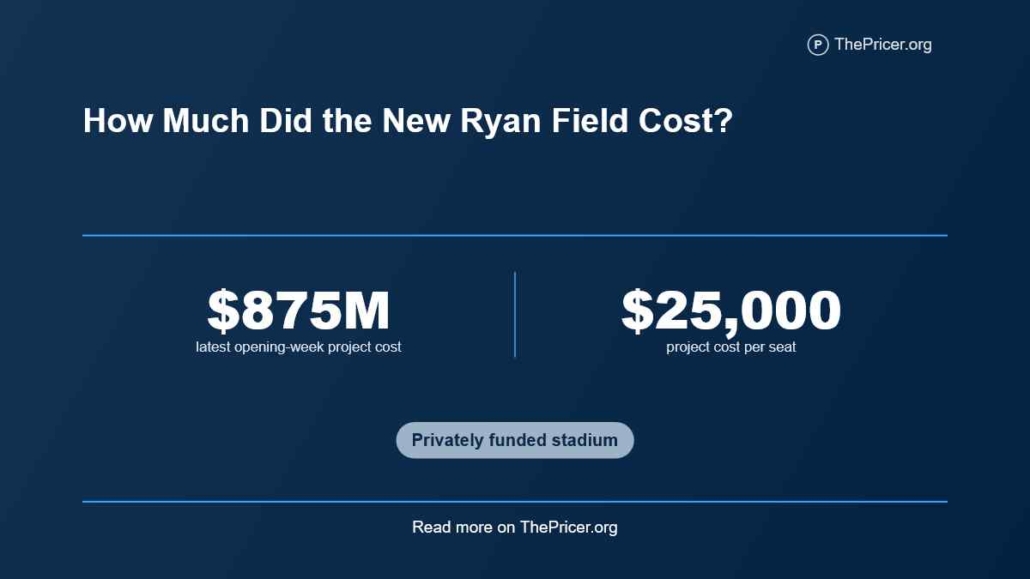
The new Ryan Field at Northwestern University cost about $875 million at opening in Evanston, Illinois, on October 2, 2026. The 35,000-seat stadium replaced Northwestern’s former football venue on the same Central Street site.
The cost question has several layers because the project moved through an early estimate, a higher design-stage total, value engineering, weather-related schedule pressure and a final construction push. Separate philanthropy, city fees and a long-term community agreement also appear beside the stadium budget but should not all be added together.
Article Highlights
Jump to sections
- Ryan Field opened with a latest reported project cost of about $875 million (at $30 per hour, earning that amount would take about 14 thousand years of full-time work, before taxes).
- The early public estimate was about $800 million, making the latest figure roughly $75 million, or 9.4%, higher.
- A design-stage total reportedly reached about $922 million before roughly $60 million was value-engineered out.
- At 35,000 seats, the project works out to about $25,000 per seat, although much of the money paid for space and infrastructure that cannot be assigned to a seat.
- At 740,000 square feet, the project cost is roughly $1,180 per square foot using the latest reported total.
- The stadium was built without taxpayer financing, but Northwestern separately committed $150 million over 15 years to a Community Benefits Agreement with Evanston.
How Much Did the New Ryan Field Cost?
The cleanest current answer is about $875 million (about 14 thousand years of full-time work at $30 per hour). Reuters described the newly opened Ryan Field as a $875 million stadium on October 2, 2026. That is the freshest published project figure available around opening night.
The number did not arrive in one jump. ESPN documented the project’s changing budget: the original goal was $800 million, the working design reached $922 million, then value engineering brought it down to $862 million. That history matters because an $862 million article from early 2026 and an $875 million article from opening week can both describe real stages of the same build.
| Project stage | Reported cost | What changed |
|---|---|---|
| Early public estimate | About $800 million | Initial redevelopment target |
| Design-stage peak | About $922 million | Scope, inflation and design development pushed the working total higher |
| Value-engineered budget | About $862 million | Roughly $60 million removed from the peak design |
| Spring 2026 working figure | About $870 million | Weather and schedule pressure raised expected cost |
| Opening-week figure | About $875 million | Latest widely reported project cost |
From the initial $800 million figure to $875 million, the increase is about $75 million, or 9.4%. From the value-engineered $862 million budget to the opening-week figure, the increase is about $13 million, or 1.5%.
What the New Ryan Field Is
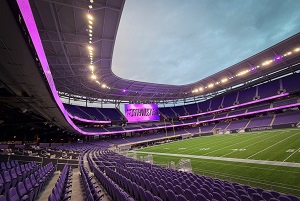
Ryan Field is Northwestern’s new football and events stadium on the site of the former Ryan Field in Evanston. The design uses a smaller seating bowl, wide concourses, multiple hospitality spaces, a canopy over every seat, broadcast and team facilities, outdoor plazas and a large community park. It is built for football, but the campus around it is also meant to handle concerts, festivals, corporate hospitality and community events.
The building is about 740,000 square feet and has roughly 35,000 seats. Perkins&Will says the field was lowered 21 feet below grade, helping bring spectators closer to the playing surface. Northwestern says the new stadium is 320,000 square feet larger than the previous Ryan Field even though it has fewer seats.
The project traded raw seating capacity for circulation space, clubs, hospitality, accessibility, technology, weather protection and outdoor event space. Seat count is no longer a useful proxy for building size.
Why the Budget Moved
The Peak Budget
The project reportedly climbed as high as $922 million (about 14.8 thousand years of full-time work at $30 per hour) before construction leaders cut roughly $60 million through value engineering. The resulting $862 million budget did not mean deleting the stadium’s central concept. It meant redesigning or repricing parts of the project so the same basic 35,000-seat plan could move forward at a lower total.
This is an important distinction in large-project pricing. An abandoned design-stage number is not money already spent. The $922 million figure shows what the project could have cost before scope and specification changes. The $875 million opening figure is closer to what readers mean when they ask what Ryan Field actually cost.
Weather and Overtime
Sports Business Journal reported that the construction team budgeted for 20 bad-weather days during the 2025-26 winter but recorded 45. The working budget reached about $870 million, with added workers helping recover schedule lost to weather. Pat Ryan Jr. said the Ryan family was prepared for a roughly 2% overrun to finish the stadium in time.
A 2% increase on an $862 million budget would be about $17.24 million. The jump from $862 million to the later $875 million report is roughly $13 million, which falls inside that range. That does not prove every extra dollar came from weather or overtime, but it shows that the final movement is consistent with the construction team’s publicly discussed risk range.
Who Paid for Ryan Field?
Ryan Field was built with private money rather than a direct taxpayer construction subsidy. Northwestern described the project from its early design stage as a privately funded stadium campus. The Ryan family supplied the lead philanthropy, and Northwestern and other donors also participated. That differs from stadium projects using public bonds, hotel taxes or state appropriations.
The often-cited $480 million Ryan family gift should not be treated as a stadium-only check. Northwestern’s leadership later said the gift included $145 million in new academic funding, and the original gift announcement also described support for medicine, economics and business research. The family later increased its support, while university fundraising was also tied to suites and other stadium units.
That means dividing $480 million by the $875 million project total and saying the Ryan family funded 55% of the stadium would be too simplistic. The announced gift covered both athletics and academics, and later family commitments changed the funding picture. The public announcements do not provide a final donor-by-donor construction ledger.
This is also why the project can be both privately funded and financially connected to the city. Private construction financing answers who paid to build the stadium. Fees, taxes and community commitments answer what money moves between Northwestern, contractors and Evanston because the project exists.
Why Capacity Shrunk
The old Ryan Field finished with 47,130 permanent seats. The replacement holds about 35,000, a reduction of 12,130 seats, or roughly 25.7%. That choice was deliberate. Northwestern wanted a more intimate bowl with better sightlines and more space devoted to clubs, concessions, circulation, accessibility and year-round uses rather than maximizing the number of people that could be packed into the structure.
The change also reflects a different revenue model. Premium clubs, suites, hospitality areas and other events can generate money without requiring a 50,000-seat football bowl every Saturday. More square footage can be devoted to spaces that earn revenue or improve the fan experience without adding another row of seats. A smaller football capacity can coexist with a larger building and a higher capital cost.
That design choice makes per-seat comparisons useful only as a warning flag. A reader who sees 35,000 seats and assumes Ryan Field should cost less than every 70,000-seat venue is comparing one output of the building with the entire construction program. The building program extends well beyond spectator chairs and the football bowl itself.
Cost Per Seat
Dividing $875 million by 35,000 seats gives about $25,000 per seat. Dividing the same project total by the 740,000-square-foot building gives about $1,182 per square foot. Neither figure is a contractor’s line-item price. They are scale measurements that make the project easier to compare with other venues.
The new building is 320,000 square feet larger than the old one, implying about 420,000 square feet for the former venue. Using the old 47,130-seat capacity gives roughly 8.9 building square feet per seat versus about 21.1 in the replacement.
The new Ryan Field has about 2.37 times as much building area per seat. Northwestern built a larger facility around a smaller football audience.
This is also why comparing Ryan Field only with larger stadiums can mislead. The relevant question is not simply how many spectators fit inside. Clubs, kitchens, media areas, circulation, accessible seating, back-of-house systems, canopy structure and public gathering areas all consume capital even when they do not add another row of seats. Similar accounting issues appear in the Mercedes-Benz Stadium cost and the new Highmark Stadium cost, where project price and seat count tell only part of the story.
Costs Outside the Build
The $875 million figure should not absorb every dollar associated with the stadium. Northwestern’s Community Benefits Agreement with Evanston is a separate $150 million commitment over 15 years. Spread evenly, that would equal $10 million per year, although the agreement contains different programs and payment structures rather than one flat annual stadium charge.
A tempting calculation is $875 million plus $150 million, which equals $1.025 billion. Do not call that the cost to build Ryan Field. The first number is the stadium project cost. The second is a long-term package supporting city services, housing, workforce programs, sustainability and other Evanston initiatives. Combining them is useful only to show the broader scale of commitments linked to the redevelopment.
Construction itself also generated city-facing fees and local contracting commitments. Those amounts describe how project spending is distributed around Evanston, not extras that should automatically be added to the $875 million total. Permit revenue is money flowing to the city from the construction process, while subcontracting targets describe who receives portions of the existing project spend.
The financing distinction matters for comparisons with publicly supported sports venues. Ryan Field’s construction was privately financed, while a project such as Highmark Stadium mixes private spending with large public commitments. A private funding label does not mean a stadium has no public economic effects, but it does mean taxpayers were not financing Ryan Field’s construction budget.
A 100-Year Cost Parallel
 The old and new stadiums opened exactly a century apart on October 2. The 1926 project also experienced a cost increase. Northwestern’s historical account says the original Dyche Stadium was estimated at $800,000 before finished at $1.425 million. That was an increase of $625,000, or about 78.1%, before any adjustment for inflation.
The new stadium’s early public figure moved from roughly $800 million to about $875 million, a rise of roughly 9.4%. The dollar scales are not comparable across a century, but the budget behavior is. The 1926 project exceeded its early estimate by a far larger percentage than the 2026 project did.
The physical strategy also reversed. The old stadium was built around putting as many spectators as practical into a relatively compact football venue and later expanded to more than 47,000 permanent seats. The new stadium deliberately reduced capacity to about 35,000 while increasing building area and adding premium and event spaces.
That makes the two Ryan Fields useful examples of how stadium economics changed. In 1926, expansion meant seats. In 2026, much of the economic case sits in hospitality, year-round events, premium inventory, accessibility and experience outside the actual football chair.
Choosing the Right Figure
Use about $875 million when the question is what the completed new Ryan Field cost as reported at its October 2026 opening. Use $862 million when discussing the earlier approved or value-engineered construction budget. Use about $870 million when describing the spring 2026 working projection before the building opened.
Do not mix those figures with the $480 million Ryan family gift, the $150 million Community Benefits Agreement or individual contractor values. Each measures something different.
Makes sense if
- You want the latest reported cost of the completed stadium project.
- You are comparing major sports-venue construction totals.
- You keep private financing separate from city and community commitments.
- You label per-seat and per-square-foot figures as calculations rather than invoices.
Does not make sense if
- You need a final audited construction ledger with every contract and change order.
- You are trying to identify exactly how much of the Ryan family’s philanthropy paid for stadium construction.
- You add the Community Benefits Agreement directly to construction cost.
- You treat the cost per seat as the price of installing one stadium chair.
For perspective, Ryan Field’s total is below the cost to build the Sphere, but the useful comparison is not which structure is cheaper. The venues have different purposes, capacities, technology packages and revenue models.
Answers to Common Questions
How much did the new Ryan Field cost?
The latest opening-week reporting puts the new Northwestern stadium at about $875 million. Earlier project figures included about $862 million and $870 million as construction progressed.
Who paid for Ryan Field?
The stadium was privately financed. The Ryan family provided the lead philanthropy, with Northwestern and other donors also contributing to the project.
Did taxpayers pay for Ryan Field?
No direct taxpayer financing was used to build and maintain the new stadium and plazas, according to Northwestern’s redevelopment materials.
Why did Ryan Field cost so much with only 35,000 seats?
The new venue is about 740,000 square feet and contains much more space per spectator than the old stadium, including clubs, hospitality areas, wide concourses, team and broadcast facilities, a canopy and event infrastructure. The smaller seating bowl is part of the design rather than evidence that the building itself is small.
Is the $150 million Evanston agreement part of the $875 million stadium cost?
No. The $150 million Community Benefits Agreement is a separate 15-year Northwestern commitment to Evanston programs and services. Adding it to construction would mix two different spending categories.
Disclosure: Educational content, not financial advice. Prices reflect public information as of the dates cited and can change. Confirm current rates, fees, taxes, and terms with official sources before purchasing. See our methodology and corrections policy.