
How Much Did The Sphere Cost to Build?
Updated on | Written by Alec Pow
This article was researched using 14 sources. See our methodology and corrections policy.
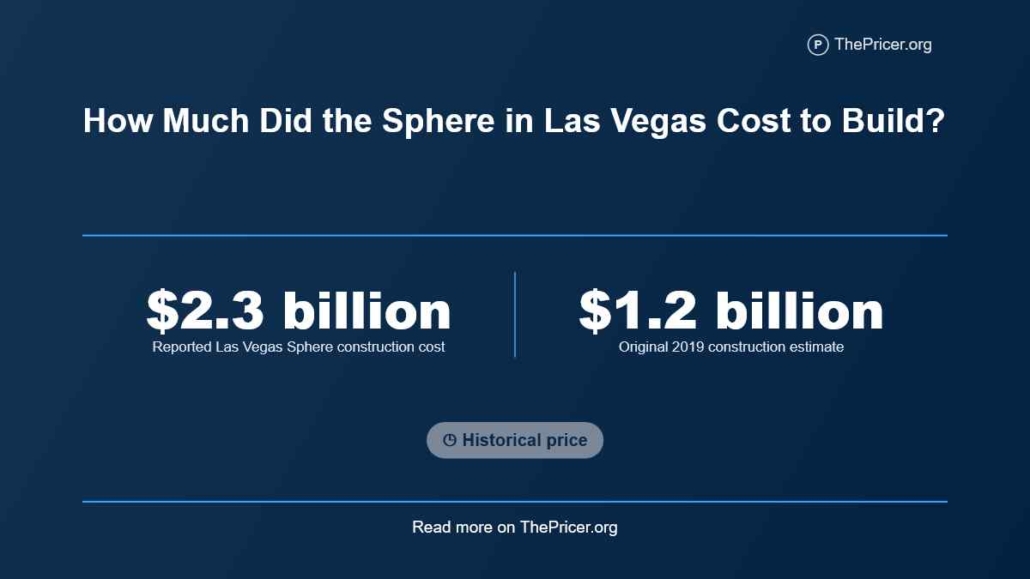
The Sphere in Las Vegas cost about $2.3 billion to build. Sphere Entertainment reported that figure in its August 2023 cost update, with about $2.25 billion already paid through August 18. The $2.3 billion number is the best headline answer for construction, but it is not a lifetime total for every dollar spent on productions, financing, operations and later improvements.
Article Highlights
Jump to sections
- Sphere’s reported Las Vegas construction cost was about $2.3 billion (at $30 per hour, earning that amount would take about 37 thousand years of full-time work, before taxes).
- The initial May 2019 estimate was only $1.2 billion, so the reported construction budget rose about 91.7%.
- The Venetian agreed to contribute $75 million toward certain construction costs, putting implied gross construction spending near $2.375 billion before that contribution.
- Sphere cost about 16.8% more than Allegiant Stadium’s documented $1.97 billion development cost.
- Sphere segment revenue reached $492.3 million in the first half of 2026.
- The planned Abu Dhabi Sphere has a stated construction-phase cost of $1.7 billion.
How Much Did the Sphere Cost to Build?
The best documented answer is about $2.3 billion (about 37 thousand years of full-time work at $30 per hour). That figure describes construction of the Las Vegas venue rather than the cost of every production, later operating year or future Sphere project. It is also different from a component estimate that tries to assign a price to every structural and technical system inside the building.
A useful second number is the $2.25 billion that Sphere Entertainment said had actually been paid through August 18, 2023. The gap between paid-to-date construction spending and the final $2.3 billion estimate was only about $50 million at that point, showing how close the project was to completion when the last estimate was issued. The final number should still be read as an approximate project figure rather than an audited invoice for every subcontract and component.
The public construction filings do not provide a line-by-line split assigning hundreds of millions to steel, LEDs, labor, permits, audio and every other component. Precise percentage allocations for those categories should be treated skeptically unless they come from project accounts. The documented price is the project-level construction figure. That distinction matters because a first-of-its-kind venue can attract plausible-looking estimates that are not supported by Sphere Entertainment’s filings.
How the Budget Doubled
The project became almost twice as expensive as its first formal estimate. The preliminary May 2019 budget was $1.2 billion (about 19.2 thousand years of full-time work at $30 per hour). By 2023, the figure had climbed to $2.3 billion. A construction-industry review tied much of that rise to inflation and supply-chain pressure during the pandemic, while Sphere Entertainment repeatedly warned that the unusual design made the job harder to price than a conventional venue.
The last major increase came near completion. Sphere Entertainment said its prior estimate had been $2.175 billion before it raised the figure to $2.3 billion. The final construction-phase update attributed the additional $125 million mainly to project complexity.
| Budget stage | Reported amount | Change from prior listed stage |
|---|---|---|
| May 2019 preliminary estimate | $1.2 billion | Starting point |
| Late 2022 estimate | $2.175 billion | +$975 million, about 81.3% |
| 2023 final construction estimate | $2.3 billion | +$125 million, about 5.7% |
From $1.2 billion to $2.3 billion, the increase was $1.1 billion, or about 91.7%. The project came very close to doubling its initial budget. The last $125 million increase was relatively small beside the earlier rise, which shows that most of the escalation had already occurred before the final months of construction.
What the Build Price Covers
The construction figure covered the venue itself, including core technology and soft costs, but it was not an all-in lifetime investment number. Sphere Entertainment’s 2023 annual filing said the construction estimate excluded significant capitalized and non-capitalized costs such as content creation, internal labor, capitalized interest and furniture and equipment. By June 30, 2023, the company had separately invested about $61 million in developing Postcard from Earth, its first original immersive production.
That creates a useful hidden-cost distinction. A reader asking what the building cost can use $2.3 billion. A reader asking how much Sphere Entertainment had to invest to create a working entertainment business needs a broader number that also reflects original content, financing costs, staff work, later production spending and expenses incurred after opening. The company has not published one clean total combining all of those categories.
The same rule applies to later shows and upgrades. A new production may use the existing building while carrying its own creative, technical, licensing, labor and marketing budget. Those expenses can be substantial without changing the historical construction price. Keeping construction and operating investment separate prevents a common double-counting problem when comparing Sphere with stadiums, theaters or future Sphere locations.
Why the Sphere Cost So Much
Sphere was built around technology that a normal arena does not carry. The venue’s display systems include a 160,000-square-foot interior LED plane at 16K by 16K resolution and a 580,000-square-foot exterior Exosphere. Those surfaces required structural support, power distribution, cooling, media processing and control equipment designed around enormous digital displays rather than conventional arena scoreboards.

The venue also combines beamforming audio, haptic seating and environmental effects with the visual systems. That changes the economics of both the building and the productions staged inside it. Artists and producers can create shows around an interior display that wraps over the audience, while the Exosphere creates a second commercial surface outside the venue.
The spending pressure was not solely technical. Pandemic-era disruptions hit while major construction was underway. Materials, freight, specialist labor and schedule changes became more expensive. Sphere kept refining the design while building systems with little direct precedent at this size. That combination is why a simple percentage split between structure, technology, labor and permits can mislead. Many categories overlap inside custom systems that had to be designed, fabricated, installed, tested and commissioned together.
Who Paid for the Sphere?
A 2024 annual filing says Sphere Entertainment self-funded the Las Vegas construction, The Venetian paid $75 million toward certain construction costs, and the ground lease runs for 50 years with no fixed rent. The Venetian can receive 25% of after-tax cash flow above specified return objectives. The contribution included funding tied to the pedestrian bridge connecting Sphere with The Venetian Expo.
Adding the $75 million contribution back to the reported $2.3 billion net construction figure gives an implied gross construction spend of about $2.375 billion. The contribution equals about 3.2% of that gross amount. The land deal also shows why a zero fixed-rent line should not be read as free land. Part of the economic cost can emerge later through variable rent if the venue clears the agreed return thresholds.
Later Sphere projects can use different financing structures. The proposed National Harbor venue makes that shift visible. Current plans call for a combination of public and private funding, including about $200 million in incentives from state, local and private sources. Its full construction price has not been announced, and the project remains contingent on definitive agreements, incentives and government approvals. That financing approach is materially different from the self-funded Las Vegas construction.
Sphere vs Allegiant Stadium
Sphere cost more than Allegiant Stadium, but the difference is far smaller than some comparisons suggest. The Las Vegas Stadium Authority lists Allegiant’s development budget at $1.97 billion, including the stadium, land, infrastructure and related development costs. Sphere’s $2.3 billion reported construction figure is about $330 million higher, or roughly 16.8%.
The financing structures differ just as much as the buildings. Allegiant Stadium’s plan included $750 million of public funding, equal to about 38.1% of its $1.97 billion development budget. Sphere Entertainment described its Las Vegas construction as self-funded, with The Venetian contributing $75 million toward certain construction costs. That makes a simple total-cost ranking incomplete because one project mixed public and private funding while the other relied on company capital and a private partner contribution.
The venues also spend money on different things. An NFL stadium needs a large seating bowl, football operations, premium hospitality and game-day infrastructure. Sphere devotes a large share of its physical and technical design to immersive displays, sound, production systems and the Exosphere. Readers comparing major projects can see similar differences in new NFL stadium costs, where land, infrastructure, public support and premium spaces can move the project total by hundreds of millions of dollars.
Is Sphere Earning It Back?
Revenue has grown quickly, but revenue is not the same as recovering the $2.3 billion construction investment. In the first half of 2026, Sphere generated $492.3 million of segment revenue, with adjusted operating income of $114.2 million and a GAAP operating loss of $94.5 million. The six-month revenue figure equals about 21.4% of the original construction cost, but operating expenses, depreciation, production spending and financing keep that from being a payback calculation.
One production shows why gross ticket sales can become enormous. The Wizard of Oz at Sphere passed $400 million in ticket sales by mid-June 2026. That gross ticket value equals about 17.4% of the $2.3 billion build cost, but production, staffing, marketing, rights, operating expenses and revenue sharing still sit between ticket sales and investment recovery. Current Sphere concert ticket prices show how much individual events can vary by date and package.
Makes sense if
- High-value residencies and Sphere Experiences keep the venue busy across the year.
- Advertising, suites, sponsorships and event revenue add meaningful income beyond ticket sales.
- Content developed for one Sphere can later earn money across multiple Sphere venues.
Does not make sense if
- The venue requires long gaps between profitable productions.
- New content costs rise faster than ticket and advertising revenue.
- Future locations fail to spread content and technology costs across a larger network.
What Future Spheres Cost
The next full-size Sphere has a lower announced construction-phase price than Las Vegas. The Department of Culture and Tourism Abu Dhabi plans a $1.7 billion construction investment, with completion expected by the end of 2029. The planned venue will have capacity for up to 20,000 people and will use the Sphere model for immersive shows, concert residencies, sporting events and branded events.
The stated Abu Dhabi construction figure is $600 million below Las Vegas, or about 26.1% lower. That does not prove a second full-size Sphere can always be built for 26% less. Land arrangements, labor, infrastructure, financing, design revisions, local procurement and which costs sit inside the announced construction figure can differ. It does show that Sphere Entertainment is no longer relying on the Las Vegas $2.3 billion figure as the only cost reference for a full-scale venue.
National Harbor adds a smaller-scale path. Incentives have been announced, but a full construction price has not. Scaling the Las Vegas $2.3 billion figure down by capacity would be unreliable because the building size, financing package and infrastructure scope differ. Related venue economics can be seen in stadium rental costs and large combat-sports event costs.
- Checked Sphere’s physical dimensions and 17,600-seat design against the architect’s project record.
- Confirmed the September 29, 2023 public opening through the company’s opening-quarter filing.
- Cross-referenced the venue’s 875,000-square-foot scale against the Las Vegas visitor bureau facts.
Answers to Common Questions
How much did the Sphere in Las Vegas cost to build?
The reported final construction figure is about $2.3 billion, net of a $75 million contribution from The Venetian toward certain construction costs.
How much was the Sphere originally supposed to cost?
The preliminary May 2019 estimate was $1.2 billion. The final reported construction figure was $1.1 billion higher, an increase of about 91.7%.
Did the $2.3 billion include everything spent on Sphere?
No. The construction estimate did not capture every business investment connected with the venue. Content development, some internal labor, financing-related costs, furniture and equipment and later operating expenses can sit outside the headline construction figure.
Did taxpayers pay to build the Las Vegas Sphere?
Sphere Entertainment described the Las Vegas construction as self-funded. The Venetian agreed to contribute $75 million toward certain construction costs. The financing plans for later Sphere locations use different structures.
How much will the Abu Dhabi Sphere cost?
The announced construction-phase investment is $1.7 billion. That is $600 million below the Las Vegas construction figure, though the two projects may not use identical accounting scopes.
Disclosure: Educational content, not financial advice. Prices reflect public information as of the dates cited and can change. Confirm current rates, fees, taxes, and terms with official sources before purchasing. See our methodology and corrections policy.