
How Much Do Chinese Prefab Homes Cost?
Published on | Written by Alec Pow
This article was researched using 14 sources. See our methodology and corrections policy.
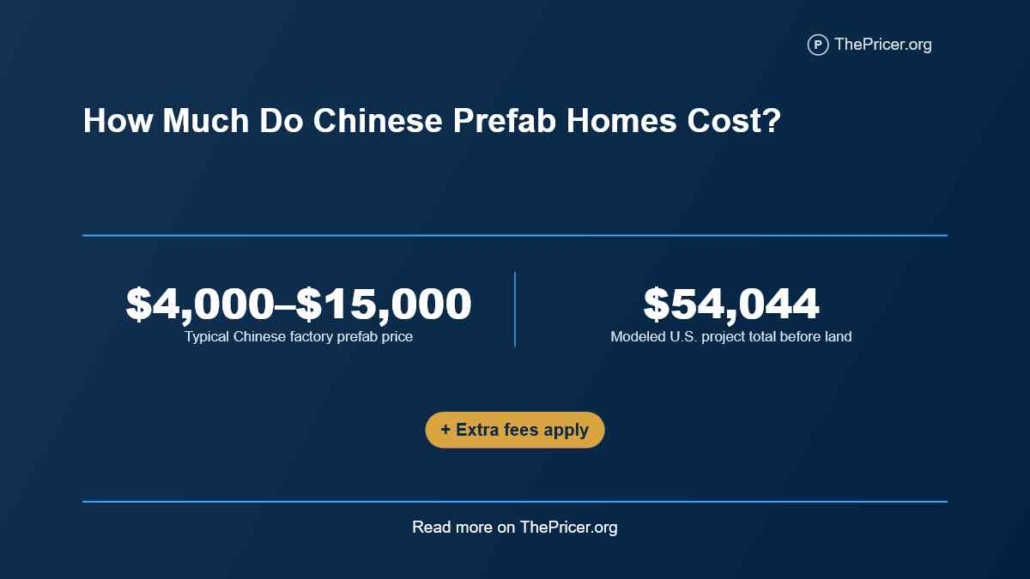
Chinese prefab homes can leave the factory for under $1,000 at the bare container-like end, while current 40-foot expandable models commonly run about $5,300 to $15,500. Reuters reporting on prefab exports documents the ultra-low end, while a current 40-foot manufacturer price range shows how finishes and configuration move the quote.
For a U.S. buyer, the usable project price is often several times the factory number. ThePricer’s worked example reaches about $54,044 before land after ocean freight, a modeled tariff scenario, destination handling, site work, foundation, utilities, permits, unloading, and local assembly.
Article Highlights
Jump to sections
- Many current Chinese expandable-home listings sit near $4,000 to $15,000 (at $30 per hour, earning that amount would take about 3.3 to 12.5 full-time workweeks, before taxes) before shipping.
- A 40-foot model with more complete finishes can run about $10,820 to $16,599 at the factory.
- September 2026 40HQ ocean freight from China to Los Angeles is about $6,500 in one current benchmark.
- A steel modular unit can face a much larger landed cost once current China tariffs and trade remedies are applied.
- In the worked example, a $10,820 factory home becomes about $54,044 before land.
- The factory home accounts for only about 20% of that modeled project total.
How Much Do Chinese Prefab Homes Cost?
Factory pricing varies sharply by size, fit-out, insulation, layout, glazing, kitchen and bathroom scope, and order quantity. The current 40-foot expandable catalog includes offers around $2,500 to $3,500 (about 2.1 to 2.9 full-time workweeks at $30 per hour) for some basic models and $4,399 to $5,599 for a three-bedroom unit sold with a one-piece minimum. Those are marketplace offers, not a standardized national average, and each seller defines its own materials and included systems.
Larger and better-equipped units move higher. Wanzhi lists a 73 to 76 square meter model at $10,820 to $12,588 and states that one unit occupies a 40HQ container. The price spread helps explain why the phrase Chinese prefab home covers several different products.
A low listing may describe a light shell intended for temporary accommodation, while a larger residential layout can include bedrooms, living space, a bathroom area, windows, flooring, wiring, and insulation. A single U.S. buyer should also budget from the one-unit or sample price rather than a bulk tier that assumes dozens of homes in one order. High-volume factory discounts may never apply to a private one-home purchase.
What Cheap Listings Include
A marketplace price can describe a structure rather than a finished American dwelling. Some offers include the steel frame, wall panels, flooring, doors, windows, wiring, and basic plumbing. Kitchens, bathrooms, HVAC equipment, appliances, upgraded insulation, furniture, exterior cladding, decks, and U.S.-standard electrical components may be optional. A supplier can also quote different prices for one sample unit and a large commercial order, which is why a bulk price should not be used for a single backyard purchase.
The inclusion list affects value as much as the sticker price. A $5,000 (about 4.2 full-time workweeks at $30 per hour) shell that needs a local bathroom, kitchen, electrical changes, and insulation work may cost more to finish than a $12,000 unit that arrives with those items factory-installed. The same issue appears in the current Capsule Castle cost analysis, where factory-market prices remain separate from freight, U.S. site work, utilities, and permitting.
Buyers should request a line-item specification before comparing sellers. Useful fields include expanded floor area, folded shipping dimensions, steel thickness, insulation type and thickness, window specification, plumbing fixtures, electrical voltage and certification, HVAC scope, kitchen scope, warranty terms, and packing method. Local approval belongs in the project budget before a deposit is paid.
Shipping Can Cost a lot
Container efficiency determines whether the factory discount survives the trip across the Pacific. Wanzhi’s 40-foot expandable home uses one 40HQ container for one unit. Current September freight data puts a 40HQ shipment from Shenzhen, Shanghai, or Ningbo to Los Angeles or Long Beach at about $6,500 per container. Against Wanzhi’s $10,820 low-end factory price, that ocean-freight benchmark equals about 60% of the home price before destination charges or inland trucking.
The shipping risk is larger on some routes. On September 17, current East Coast shipping data put a China to U.S. East Coast spot rate at $10,948 per 40-foot container. That single freight charge would slightly exceed the $10,820 factory price used in the worked example. A buyer ordering a smaller unit can sometimes spread freight across two or more homes when the packing design permits it, but a full-size 40-foot expandable often consumes a whole container.
Ocean freight is not the final delivery bill. Port handling, customs brokerage, bond charges, drayage, storage, chassis time, inland trucking, unloading, and crane or forklift work can remain outside the quoted ocean rate. The article’s worked example uses a separate $1,500 allowance for destination and customs handling plus $5,000 for unloading and local assembly. Those are transparent scenario assumptions, not national averages.
Tariffs Can Change the Landed Price
The U.S. Harmonized Tariff Schedule lists steel modular building units under 9406.20.00 with a 2.9% general duty rate. The U.S. tariff schedule identifies the classification as modular building units of steel. China-origin goods can also face additional Chapter 99 trade measures. A current tariff reference for 9406.20.00 shows a 25% Section 301 duty and a 25% steel-derivative measure on top of the base rate, producing a modeled 52.9% total rate when that complete stack applies.
That 52.9% figure should be treated as a classification scenario, not a promise that every Chinese prefab will clear at that rate. Material composition, exact imported condition, the HTS subheading, active exclusions, Chapter 99 notes, and entry date can change the duty calculation. Other prefab buildings can classify under 9406.90.01, and a shipment containing separate components may require a different analysis.
For the worked example, applying 52.9% to a $10,820 customs value produces about $5,724 of modeled duty. That one line is greater than half the factory price. A buyer who ignores tariffs when comparing a Chinese quote with a domestic prefab is not comparing the same scope. The safe sequence is to obtain the exact construction specification, proposed HTS classification, and current duty treatment before signing a purchase contract.
Will It Pass U.S. Building Codes?
 An imported module still has to satisfy the rules where it will be installed. The International Code Council states that foreign off-site components remain subject to destination requirements and that factories abroad can be subject to plan review and factory inspection. Its ICC off-site guidance also notes that many state modular programs require an approval label on closed construction produced away from the job site.
Modular and manufactured housing use different regulatory paths. HUD manufactured-home guidance describes a manufactured home as a dwelling built to the federal HUD Code on a permanent chassis, with certification labels on compliant transportable sections. Modular homes instead follow applicable state and local building codes. A Chinese expandable structure marketed as a residence does not become a legal modular or manufactured home merely because the seller calls it one.
The approval problem can create expensive rework. A local authority may require stamped plans, structural calculations, wind or snow-load documentation, compliant wiring and plumbing, energy-code evidence, fire ratings, anchoring details, factory inspection records, or a state modular label.
If those documents cannot be produced, the buyer may face engineering changes, opening finished walls for inspection, replacing systems, limiting the unit to a nonresidential use, or abandoning the project. Code review belongs before the shipping payment because freight and import charges are difficult to recover once the unit is already moving.
Foundation, Utilities, and Setup
A delivered module still needs a buildable site. Current modular home cost data puts land preparation around $4,000 to $11,000, foundations around $6,000 to $20,000, utility construction around $2,500 to $25,000, and permits around $500 to $4,000. These ranges are U.S. modular-project benchmarks, not prices unique to Chinese units.
The finished total depends on the property. A level serviced lot near the street can stay near the lower end. A rural parcel may need a well, septic system, long electrical run, trenching, driveway work, grading, drainage, or a more expensive engineered foundation. Coastal, high-wind, high-snow, wildfire, and seismic areas can add structural requirements that the base factory configuration was not designed to meet.
This is why a domestic modular guest house comparison can be useful even when its unit price is higher. The domestic estimate may already reflect a code path, local installation labor, familiar financing, and easier warranty service. Chinese factory pricing has the strongest advantage when the buyer owns suitable land, can document approval before ordering, has straightforward utilities, and can manage import logistics without expensive redesign after arrival.
A $10,820 Home Can Become a $54,044 Project
The following scenario starts with Wanzhi’s current $10,820 low-end price for a 73 to 76 square meter 40-foot expandable home. The manufacturer states that one unit uses one 40HQ container. The freight input is the current $6,500 Los Angeles benchmark, and the tariff input uses the 52.9% steel-modular scenario discussed above. U.S. site amounts are illustrative choices within the researched modular ranges.
| Project item | Modeled cost | Basis |
|---|---|---|
| Chinese prefab unit | $10,820 | Current one-unit factory price |
| 40HQ ocean freight | $6,500 | September Los Angeles benchmark |
| Modeled import duty | $5,724 | 52.9% scenario on factory value |
| Destination and customs allowance | $1,500 | Illustrative assumption |
| Site preparation | $5,000 | Illustrative assumption |
| Foundation | $8,000 | Illustrative assumption |
| Utility connections | $10,000 | Illustrative assumption |
| Permits | $1,500 | Illustrative assumption |
| Unloading and local assembly | $5,000 | Illustrative assumption |
| Total before land | $54,044 | Modeled project total |
The $10,820 home is only about 20% of the $54,044 modeled project. Freight equals about 60% of the factory price, the modeled duty adds $5,724, and site and setup lines total $21,000. This is not an average U.S. import bill. It is a reproducible scenario showing how a cheap factory quote can approach five times the advertised unit price.
The scenario also excludes land, financing, insurance, landscaping, septic or well work, major engineering revisions, storage charges, and expensive code corrections. A clean suburban lot with nearby utilities can cost less. A difficult rural or coastal property can cost much more. Buyers should replace every assumed line with a written local quote before treating the total as a budget.
Chinese Prefab vs. a U.S. Modular Home
Domestic modular homes often start with a higher unit price, but the buying path can be easier to document before money changes hands. The current BOXABL Casita pricing gives a U.S. factory-built comparison where the unit price and finished site cost remain separate.
A Chinese unit can still win on price, but the comparison must use matching endpoints. Factory-to-factory favors the Chinese offer. A permitted, utility-connected, occupiable home should be compared with another permitted, utility-connected, occupiable home. The savings are strongest when one container carries the needed unit efficiently, tariff classification is known before purchase, the model already has acceptable U.S. documentation, and the site needs modest work.
Makes sense if
- You already have buildable land and a clear local approval path.
- The supplier can provide structural, electrical, plumbing, and material documentation needed by the local authority.
- You have firm freight, customs, delivery, foundation, and utility quotes before paying the production balance.
- The completed imported total remains below a domestic modular alternative with similar size and finish.
Does not make sense if
- Your budget stops at the factory listing price.
- The seller cannot document a path to state or local approval.
- The site needs costly utilities, grading, septic work, or structural redesign.
- You need standard residential financing but have not confirmed classification, title treatment, insurance, and occupancy approval.
Answers to Common Questions
How much is a Chinese prefab home at the factory?
Many current expandable and container-style offers are about $4,000 to $15,000. Larger, more finished, or capsule-style units can reach $20,000 to $25,000+.
How much does it cost to ship a prefab home from China?
A September 2026 benchmark puts a 40HQ container to Los Angeles or Long Beach near $6,500. Live spot rates can be much higher on other routes, and port, customs, inland delivery, and unloading are separate.
Do Chinese prefab homes have U.S. import tariffs?
Yes, duties can apply. The exact rate depends on classification, materials, trade remedies, exclusions, and entry date. The worked example uses a documented 52.9% steel-modular scenario rather than claiming one rate for every home.
Can I legally live in a Chinese prefab home in the U.S.?
Possibly, but the unit must satisfy the applicable state, local, or federal regulatory path. Approval can require plan review, factory inspection, structural documentation, labels, permits, utility inspections, and site approval.
Is importing a Chinese prefab cheaper than buying a U.S. modular home?
It can be, especially on a simple site with documented code compliance and efficient shipping. The useful comparison is the fully landed and installed project, not the factory price by itself.
Disclosure: Educational content, not financial advice. Prices reflect public information as of the dates cited and can change. Confirm current rates, fees, taxes, and terms with official sources before purchasing. See our methodology and corrections policy.