
How Much Do Color Blind Glasses Cost?
Published on | Written by Alec Pow
This article was researched using 18 sources. See our methodology and corrections policy.
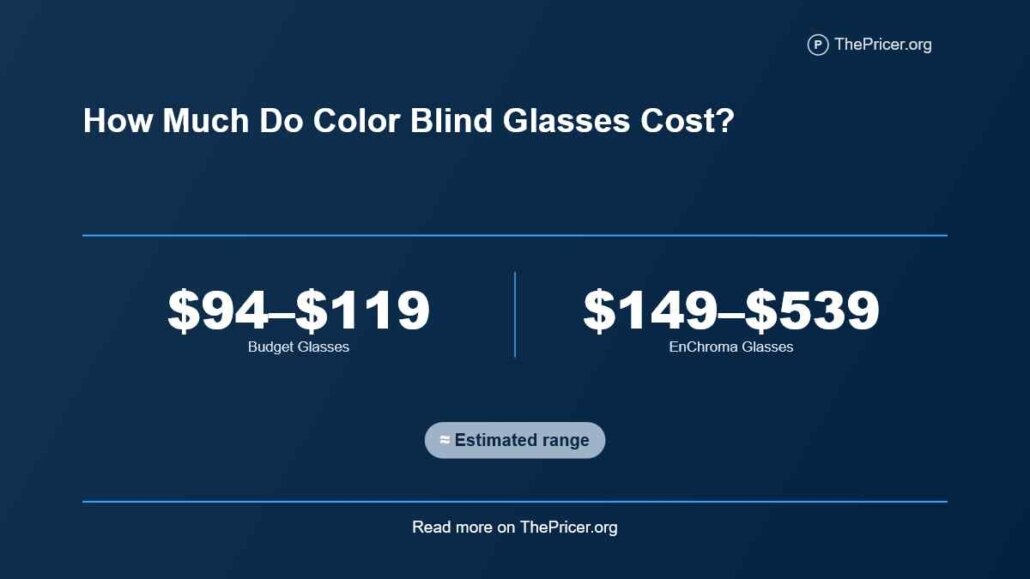
Color blind glasses cost approximately $94 to $539 per pair across the U.S. retail offers reviewed in November 2026. Budget-friendly Pilestone models are advertised around $99 to $119 at Walmart, while EnChroma’s current sale prices range from approximately $149 to $539, depending on the frame, lens type, and prescription. A practical budget is $100 to $150 for basic nonprescription glasses or $230 to $500+ for premium and prescription options.
These glasses filter selected wavelengths of light to change how certain colors appear. They may help some people with red-green color vision deficiency, but results vary substantially. They do not cure color blindness or restore typical color vision. Before spending several hundred dollars, the type of color deficiency, lighting conditions, and return policy deserve as much attention as the price.
Article Highlights
Jump to sections
- Budget glasses: Pilestone models advertised at Walmart range from about $94 to $119 for the examples reviewed.
- Premium glasses: EnChroma currently lists selected models between approximately $149 and $539, including temporary discounts.
- Prescription upgrades: Pilestone publishes additions of $70 for single-vision lenses and $100 for progressive lenses.
- Eye examination: A separate routine exam can add approximately $136 using a current U.S. self-pay benchmark.
- Return-policy difference: EnChroma accepts qualifying online prescription returns, while Pilestone excludes customized prescription glasses from refunds.
- Free alternative: Some libraries and public attractions lend color blind glasses to visitors.
How Much Do Color Blind Glasses Cost?
The largest price difference is between basic filtered lenses and premium frames or customized prescriptions. The underlying product is similar in purpose, but the lens selection, materials, indoor suitability, and purchase terms differ.
Walmart’s Pilestone listings provide independently displayed U.S. prices. The examples reviewed include children’s glasses at $99, indoor TP-021 glasses at $109, several adult models at $114 to $119, and GM-3 clip-ons at $94. Availability and third-party seller terms can change.
On the manufacturer’s side, EnChroma’s current eyewear collection shows selected discounted frames as low as $149, standard nonprescription options around $229 to $389, and higher-priced or prescription-capable configurations extending above $400. The site is running a promotional sale, so those figures should not be mistaken for permanent regular prices.
| Glasses option | Observed U.S. price | Buying consideration |
|---|---|---|
| Pilestone clip-ons | $94 | Attach to existing glasses |
| Pilestone children’s | $99 | Check sizing and lens type |
| Pilestone adult models | $109–$119 | Various indoor and outdoor lenses |
| EnChroma discounted models | $149–$229 | Selected styles and temporary offers |
| EnChroma standard models | $229–$389 | Frame and lens selection |
| EnChroma premium or Rx | $383–$539+ | Prescription and premium-frame options |
These are examples of advertised offers, not a statistical average of every color blind glasses model sold nationally. The high and low prices also describe different products. A clip-on filter and a customized prescription pair should not be compared as though they include identical features.
EnChroma vs. Pilestone
EnChroma generally occupies the higher-priced portion of this market. Its lineup includes outdoor Deutan and Protan lenses, indoor options, children’s frames, prescription models, and safety eyewear. The company offers multiple styles, but the most expensive pair is not automatically the most effective for every wearer.
The EnChroma prescription collection includes frames starting around $439 to $499 at regular listed prices, with selected sale offers below those amounts. Buyers must check the configuration shown on the individual product page because a price displayed as “from” can depend on the lens choice.
Pilestone costs less in many comparable nonprescription categories. Its manufacturer FAQ publishes prescription upgrade charges of $70 for single vision and $100 for progressives. Those additions apply to Pilestone’s own ordering process, not automatically to a pair bought from Walmart or another seller.
The companies also divide lens options differently. Pilestone offers lenses for different red-green deficiencies and a separate option marketed for blue-yellow deficiency. A useful distinction is that “universal” on a product label does not guarantee equal results across every type and severity of color blindness.
Buying comparison: The least expensive option is attractive for testing whether filtered lenses change your visual experience. The more expensive option may justify its premium through a preferred frame, prescription compatibility, or more favorable trial terms. Those benefits must be weighed against the possibility of little perceptible improvement.
Prescription Costs
People who normally wear prescription glasses face an additional decision. They can buy filtered glasses with prescription lenses, use a clip-on or fit-over product, or wear nonprescription color filters with contact lenses if their eye-care professional considers that arrangement appropriate.
According to EnChroma’s prescription guidance, single-vision and progressive prescriptions can be added to many frames for an additional charge. The company also offers fit-over eyewear for people who want to keep their existing prescription glasses.
A prescription does not necessarily mean paying for an entirely separate pair of ordinary eyeglasses. Yet buying color-filtering glasses without the vision correction needed for everyday use may leave the product impractical.
If an up-to-date examination is necessary, the additional expense is worth budgeting separately. Current U.S. figures in the eye exam cost guide place an average self-pay routine visit at approximately $136, although individual providers charge less or more.
The National Eye Institute’s testing guidance explains that eye-care professionals can identify color vision deficiency using color plates and, when necessary, additional tests. That matters because an ordinary eyeglass prescription and a color vision diagnosis answer different questions.
The Hidden Price of Returns
A return policy can make a larger difference than a modest discount. Color blind glasses are unusually difficult to evaluate from photographs, product descriptions, or videos. A buyer may discover only after wearing them that the effect is small or unhelpful.
EnChroma’s direct-purchase refund policy allows qualifying items to be returned within 60 days of shipment, excluding final-sale products. Its detailed return guidance also states that qualifying prescription glasses ordered online can be returned. Orders purchased through other retailers are governed by those sellers’ policies.
EnChroma advertises free U.S. shipping and domestic returns for eligible direct orders under its shipping and returns terms. Prescription processing is longer than shipping an in-stock nonprescription pair.
Pilestone’s return policy also provides a 60-day period for qualifying purchases. Its key exclusion is customized prescription eyewear, which is nonrefundable. The company advises customers to try nonprescription lenses before ordering a prescription pair.
This creates an important purchasing difference. Saving money on a prescription pair is less appealing if the lenses produce little benefit and cannot be returned. A temporary discount cannot be evaluated properly without its refund conditions.
Warranty protection is separate from the right to return an ineffective product. EnChroma’s two-year limited warranty concerns manufacturing defects and has conditions for prescription products. It does not promise that every customer will experience improved color perception.
A Worked Purchase Budget
Consider a U.S. buyer choosing an EnChroma Oakvale model with prescription lenses and paying for a routine eye examination. This is an illustrative purchase, not a customer invoice.
The Oakvale prescription listing is available through EnChroma’s prescription range, with selected sale configurations advertised from approximately $383. Assume the buyer qualifies for that configuration and pays the $136 routine eye-exam benchmark already identified.
- Illustrative Oakvale prescription glasses: $383
- Illustrative routine eye examination: $136
- Combined purchase budget: $519
The arithmetic is $383 + $136 = $519, before any applicable sales tax, additional examination services, or prescription-specific changes. The eye exam is only an extra purchase cost if the buyer needs one and does not already have a suitable current prescription.
Original cost comparison: EnChroma has also advertised a nonprescription Oakvale configuration at approximately $299 during its sale. Comparing the two starting configurations produces an $84 difference, or about 28% of the nonprescription starting price. This is a comparison of advertised starting configurations, not a fixed prescription surcharge for every Oakvale order.
That distinction matters because the headline price of a frame may represent only one lens configuration. The product page must be checked after choosing the actual prescription, rather than assuming the lowest advertised amount is the checkout total.
Do They Actually Work?
Color blind glasses change the light reaching the eyes. They do not replace missing or altered color-sensitive cells, and they cannot make everyone perceive colors normally. Some wearers report brighter or more distinct shades, particularly outdoors. Others notice very little.
The Cleveland Clinic’s clinical explanation cautions that these glasses do not cure color vision deficiency. The same discussion warns against using tinted color-enhancing eyewear in low-light situations where reduced light transmission becomes a safety problem.
Research findings are mixed. A 2022 systematic review of color vision devices found insufficient clinically significant evidence for broad improvements in color perception. A separate study of EnChroma color discrimination reported that certain benefits were small relative to adverse effects on distinguishing other colors.
More recent research has examined different products and measurements. A 2025 Pilestone study tested 16 participants using Ishihara color plates. Its small sample and test-specific findings should not be treated as proof of a predictable result for every buyer.
For someone choosing glasses for work or safety, this uncertainty is particularly important. The FAA’s color vision medical guidance does not accept color-correcting lenses as a means of meeting pilot color vision requirements. A consumer lens should never be purchased on the assumption that it will satisfy occupational testing.
Free and Lower-Cost Options
 Trying color blind glasses before purchasing them may be the best financial decision. Some public institutions lend glasses for short periods. This can reveal whether a particular lens changes the wearer’s experience in a useful way.
One documented option is Fairfax County’s free EnChroma lending program, announced in August 2026. Ellanor C. Lawrence Park offers six pairs for visitors, including adult, youth, and fit-over options. Availability and loan duration are limited by the park’s rules.
Digital accessibility tools cost less than specialty eyewear. Screen color filters, labels, and color-identification applications can help with practical tasks such as interpreting charts or identifying an object. The National Eye Institute describes visual aids as another option for people who have difficulty identifying colors.
These alternatives solve different problems. A phone app may identify the color of a shirt without changing how the shirt looks. Filtered glasses may make a landscape look different without reliably identifying every confusing shade.
The distinction also matters when comparing specialty lenses with ordinary prescription eyewear. Photochromic or transition lenses change their tint with lighting conditions, but they are not equivalent to lenses designed for color vision deficiency. Similarly, the costs involved in a retail optical examination concern vision testing and prescriptions rather than a guaranteed improvement in color discrimination.
Choosing the Right Pair
A useful purchase starts with the exact problem the buyer hopes the glasses will address. Red-green color deficiency, blue-yellow deficiency, and reduced color vision from an eye condition are not interchangeable.
Makes sense if
- You know the type of color vision deficiency and can select a suitable lens.
- You want to explore how outdoor scenes, artwork, or certain colors look through filters.
- You can try the glasses beforehand or use a meaningful return window.
- You have compared prescription, clip-on, and fit-over costs.
Does not make sense if
- You expect the glasses to cure color blindness or produce typical color vision.
- You need them to pass a professional color vision examination.
- You plan to rely on them for critical color-based safety decisions.
- The product is nonrefundable and you have not established that the filter helps you.
The most expensive purchase mistake is buying glasses for the wrong deficiency or assuming that a dramatic online demonstration predicts an individual result. A cheaper trial pair with favorable returns may offer better financial protection than an expensive custom order.
What We Verified
- Compared advertised U.S. prices from EnChroma and Walmart’s Pilestone listings.
- Checked prescription options, manufacturer return rules, shipping terms, and warranty limitations.
- Reviewed clinical guidance and published research on the benefits and limitations of filtered eyewear.
- Confirmed a documented public program offering free access to color blind glasses.
- Calculated an illustrative prescription purchase total and a same-model starting-price difference.
Answers to Common Questions
What is the cheapest pair of color blind glasses?
Among the U.S. listings reviewed, Pilestone clip-ons were advertised at approximately $94, with selected children’s and adult frames around $99 to $119. Prices and availability change.
How much are EnChroma glasses?
Current advertised EnChroma prices range from approximately $149 to $539 across selected discounted and premium styles. Prescription configurations may cost more than the lowest listed frame price.
Can prescription color blind glasses be returned?
Return eligibility depends on the seller. EnChroma currently permits qualifying online prescription returns within its return period. Pilestone states that customized prescription glasses are nonrefundable.
Will color blind glasses help with severe color blindness?
Results are less predictable for severe deficiencies, and some forms may receive little benefit. The type of color deficiency and the lens design matter. An eye-care professional can help identify the condition before purchase.
Does insurance cover color blind glasses?
Coverage is plan-dependent and should not be assumed. Ask the insurer whether the particular eyewear and prescription qualify, then request the expected out-of-pocket amount before ordering.
Disclosure: Educational content, not medical advice. Pricing varies by provider, location, and insurance. Confirm eligibility, coverage, and out-of-pocket costs with a licensed clinician and your insurer. See our methodology and corrections policy.