
How Much Do Concert Ticket Fees Add to Ticket Prices?
Published on | Written by Alec Pow
This article was researched using 18 sources. See our methodology and corrections policy.
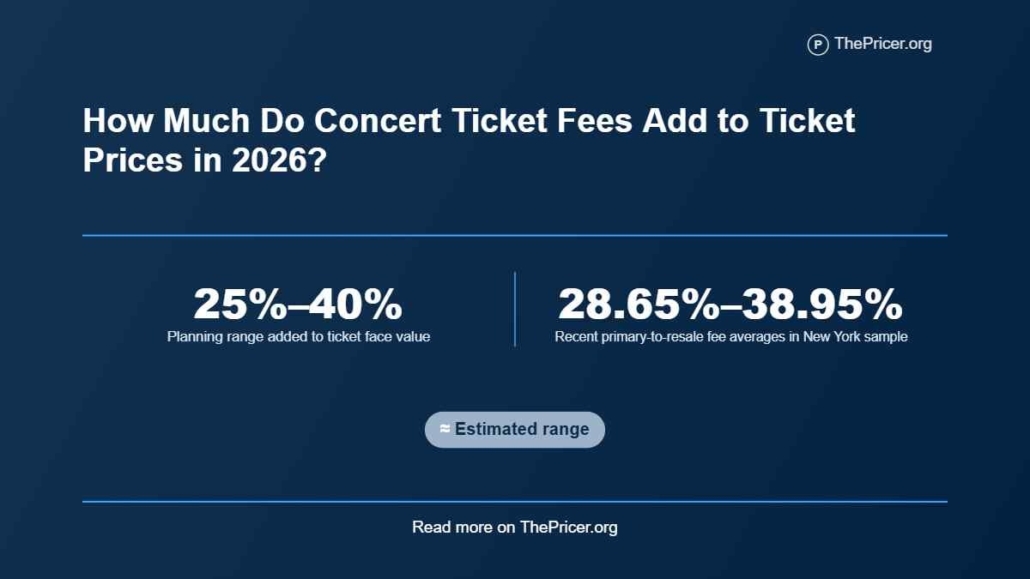
Concert ticket fees can add about 25% to 40% to face value when the starting number is a base ticket price rather than an all-in listing. The newest detailed concert-only sample located for this review covered New York and found primary fees averaging 28.65% of face value and resale fees averaging 38.95%, so those percentages are useful planning references rather than a current national average, according to a study of New York ticket fees. A $100 face-value ticket would reach about $128.65 at the sampled primary average or about $138.95 at the sampled resale average before taxes or optional extras.
For U.S. buyers in 2026, the price shown at the start of a ticket search should already include mandatory ticketing charges. Since May 12, 2025, sellers that advertise live-event ticket prices have had to disclose the upfront total while government charges, shipping, and optional extras may still be added later under the rules for mandatory upfront pricing. The FTC also states that the rule does not cap fee amounts. Adding another 25% to 40% to a current all-in listing would double count charges already included in the displayed ticket price.
Ticketmaster and AXS are major primary ticketing systems, while SeatGeek can span primary and resale sales and StubHub and Vivid Seats are prominent resale marketplaces. A 2026 congressional review notes that Ticketmaster, SeatGeek, and AXS operate in both primary and secondary markets.
Eventbrite and DICE use different organizer and venue contracts, which is one reason a fee percentage from one seller should not be applied automatically to another. This article compares fees per ticket, fees per order, face value, and all-in buyer totals rather than treating every platform charge as the same type of cost.
Article Highlights
Jump to sections
- A recent New York concert sample found primary-market fees averaging 28.65% of face value.
- The same study put fees on the sampled resale platforms at 38.95%.
- Primary tickets priced at $40 (at $30 per hour, earning that amount would take about 1.3 hours of work, before taxes) or less carried a 35.5% average fee load in that sample.
- An older federal review found average fees of 27% on primary tickets and 31% on secondary tickets in its nongeneralizable event sample.
- Under Eventbrite’s published U.S. rates, a one-ticket pre-tax model falls below a 10% effective platform-fee load only at about $56 of face value.
How Much Do Concert Ticket Fees Add to Ticket Prices?
The best recent concert-specific evidence found for this review comes from the National Independent Talent Organization. Its analysis studied 500 tickets across 68 venues and reported a 28.65% primary-market average, a 38.95% average across SeatGeek, StubHub, and Vivid Seats resale tickets, a 35.5% average for primary tickets priced at $40 (about 1.3 hours of work at $30 per hour) or less, an average fee of $17.51 on an average $69.70 face-value ticket, and primary averages of 34.73% for Ticketmaster and AXS versus 18.71% for other sampled providers.
The study excluded Platinum and other dynamically priced tickets, which matters because it was trying to isolate the fee layer rather than demand-driven changes in face value.
A broader federal reference is older and covers concerts, theater, and sports rather than concerts alone. A federal review published in 2018 found average fees of 27% on the primary market and 31% on the secondary market in its nongeneralizable sample.
Taken together, the two studies support a practical face-value budgeting allowance near one-quarter to two-fifths of base price, but they do not establish a single national 2026 fee average. Event, venue, contract, platform, and ticket price can move the percentage materially.
Face Value vs. All-In Price
Face value is the base amount assigned to a ticket before separate ticketing charges. An all-in price combines that base amount with required charges already known before purchase. Face value answers how much the fee layer added. All-in price answers what two available tickets cost before permitted exclusions such as tax or a chosen shipping method. Mixing those two numbers can make a fee-inclusive listing look expensive even when the final checkout totals are close.
Use face value for fee analysis and all-in price for shopping. If one listing shows only the base amount while another already includes mandatory charges, the cheaper-looking number is not yet comparable. Match the same event date, seat area, ticket type, and quantity before deciding which offer costs less. That same discipline matters when a screenshot or printed ticket shows face value after the marketplace now displays an all-in number.
A provider-specific companion page covers Ticketmaster fees and charges in greater detail. The practical rule is simple. Compare payable totals first, then use face value to explain where the difference came from.
Primary vs. Resale Fees
Primary tickets come from the event’s original sale channel. Resale tickets are listed after that first sale, so the buyer can face both a changed listing price and marketplace charges. StubHub says mandatory fees are built into its displayed prices and that service fees support marketplace operations and protections. The resale listing itself may still differ from original face value.
The New York averages cited earlier create a useful same-base calculation. The gap between 28.65% primary fees and 38.95% resale fees is 10.3 percentage points. On an illustrative $100 (about 3.3 hours of work at $30 per hour) base, that gap equals about $10.30 before tax. This is a ThePricer calculation from the study’s two averages, not an observed national resale premium. A real resale purchase can diverge much more when the seller changes the listing price.
Compare primary and resale offers by final buyer total for the same seat or section and the same quantity. Comparing primary face value with a resale all-in number mixes two pricing stages and can distort the apparent difference between the offers.
Why Cheap Tickets Get Hit Harder
Fixed-dollar charges can make a low-priced ticket carry a much larger fee percentage than an expensive ticket. Eventbrite publishes a U.S. standard service fee of 3.7% plus $1.79 per paid ticket and a 2.9% payment processing fee per order, while its tax guidance says processing uses the total order including service fees and tax. The calculation below excludes tax so the ticket-price effect stays visible.
For one $20 ticket, the service fee is $2.53. Applying 2.9% processing to the resulting $22.53 pre-tax order adds about $0.65, giving roughly $3.18 in modeled fees, or 15.9% of face value. For one $100 ticket, the same published structure produces about $8.55 in modeled fees, or 8.5%. The fixed $1.79 charge is spread across a much larger base in the second case.
ThePricer threshold calculation reaches a useful breakpoint near $56. Before tax, total modeled fees equal about 6.7073% of face value plus $1.84. Setting that amount equal to 10% of face value gives about $55.94, rounded to $56. This is an illustrative one-ticket Eventbrite calculation under the published standard rates, not a concert-market average and not a promise that every organizer passes the standard fees to the buyer.
What Each Fee Pays For
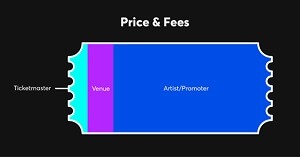 Fee labels can point to different parts of the ticketing contract rather than one standardized charge. Ticketmaster says its per-ticket service fee can be shared among parties involved in the event, while a facility charge is set by the venue and is not retained by Ticketmaster. Delivery can also depend on the method selected. The label alone does not reveal a universal percentage.
The buyer-side total is the better comparison. One large service charge can produce a lower final price than several smaller charges on another ticket. Match the same seat quality, date, ticket type, and quantity, then compare the all-in totals. A venue-related fee may be collected by the ticket platform even when the venue controls that part of the charge, so the platform name does not by itself tell you where every fee dollar goes.
Contracts can separate fee categories in ways buyers never see on the listing. DICE’s U.S. ticketing terms define service, transaction, postal, venue fees as separate concepts. Live Nation, speaking about its own Ticketmaster economics, says venues receive much of service-fee revenue. That company statement is useful for explaining the contractual split, but it should not be treated as an independent market-wide fee average.
Refund and cancellation terms belong in the cost check too. They do not raise the initial price, but they change how much of a purchase can be recovered if the event changes or the buyer cannot attend. Treat that risk separately from the fee percentage.
Real Ticket Totals
Three cases show why one percentage cannot describe every purchase. The first uses NITO’s sampled average, the second uses a documented high-fee ticket, and the third models a public fee formula. Taxes are excluded so the comparison stays focused on ticketing charges.
| Case | Base ticket amount | Ticket fees | Pre-tax total |
|---|---|---|---|
| NITO sampled primary average | $69.70 | $17.51 | $87.21 |
| Bethel Woods documented ticket | $18.00 | $33.00 | $51.00 |
| Four-ticket Eventbrite scenario | $100.00 | $14.07 | $114.07 |
A documented outlier put $33 in fees on an $18 Bethel Woods ticket. It shows how a low base price can produce an extreme percentage even though it should not be treated as a normal estimate.
The Eventbrite row is an itemized ThePricer scenario using four assumed $25 tickets. Face value is $100.00. The service formula produces $10.86 across four tickets, and 2.9% processing on the $110.86 pre-tax order adds about $3.21. The modeled total is $114.07, so fees add about 14.1% before tax.
The NITO average also changes a fixed group budget. A chosen $300 budget covers four sampled-average tickets at face value because four times $69.70 is $278.80. At the reported $87.21 pre-tax total per ticket, four cost $348.84, leaving room for only three at $261.63. That one-seat loss is a calculation from the cited sample, not a prediction for every group. Artist pages for Coldplay concert ticket prices and Noah Kahan ticket prices show how different starting prices change the budget before fees enter the picture.
Box Office vs. Online Buying
A physical box office can sometimes reduce ticketing charges, but it is not a universal no-fee route. AXS says some venues may offer reduced-fee tickets at a physical box office while required charges are included in its online starting total. The venue decides whether an in-person sale changes service or facility charges. Travel and box-office hours can erase a small saving.
Keep every comparison matched. Use the same date, section, ticket type, and quantity. A cheaper resale seat may be farther from the stage, while a box-office offer may draw from different inventory. Compare payable totals first, then check transfer and refund conditions before choosing the channel.
Makes sense if
- The venue publishes a reduced-fee physical box-office option.
- You compare primary and resale tickets by the current all-in total.
- You are buying several seats and want to see whether any per-order charge is spread across the group.
- You use face value only to measure the fee layer after finding the actual payable total.
Does not make sense if
- You automatically add 30% to a U.S. listing that already includes mandatory fees.
- You assume every venue box office removes service charges.
- You compare a resale all-in listing with a primary face-value number.
- You treat the New York sample as a national 2026 average.
What Can Still Change at Checkout
All-in pricing does not require the first displayed number to include every possible charge. SeatGeek says its displayed ticket price includes mandatory fees, while taxes, delivery fees, and optional services can still be added where applicable. A final payment can rise after mailed delivery, ticket protection, or local tax is selected or calculated.
For a 2026 buyer, the useful check is whether the number on screen is face value or an all-in total and which allowed or chosen charges remain. Tax is not a ticketing service fee. Optional insurance is not mandatory admission cost. Shipping for a physical ticket is different from a required online charge.
Compare the final payment with the first all-in listing before paying. If the difference is tax or a service you selected, include it in the trip budget without counting it as part of the face-value fee percentage. Also check whether the delivery choice changed after seat selection. A small mailing charge can be legitimate without being part of the mandatory ticket fee.
Answers to Common Questions
Do concert ticket fees still get added at checkout?
Mandatory fees that can be calculated upfront should already be inside the displayed U.S. total price. Taxes, shipping, and optional extras may still change the final payment amount.
What percentage should I budget for concert ticket fees?
If you only have face value, about 25% to 40% is a defensible planning allowance from the studies reviewed here. It is not a current national average, and individual tickets can fall outside that band.
Why are fees worse on cheap tickets?
A fixed-dollar component takes up a larger share of a low face value. Under the Eventbrite scenario used above, the effective modeled fee load is much higher on a $20 ticket than on a $100 ticket.
Can buying at the venue box office avoid fees?
Sometimes a venue offers reduced-fee box-office tickets, but there is no universal rule that in-person sales remove service or facility charges. Check the venue’s own policy before traveling there.
Are resale ticket fees higher than primary fees?
They were higher in both cited study samples. The newer New York study found a larger gap, but resale cost can also rise because the seller changes the listing price before marketplace fees are included.
Disclosure: Educational content, not financial advice. Prices reflect public information as of the dates cited and can change. Confirm current rates, fees, taxes, and terms with official sources before purchasing. See our methodology and corrections policy.