
How Much Do GPT-6 Sol and Luna Cost?
Published on | Written by Alec Pow
This article was researched using 12 sources. See our methodology and corrections policy.
GPT-6 Sol costs $2 per 1 million input tokens and $10 per 1 million output tokens on OpenAI Standard API pricing for prompts at or below 272,000 input tokens. GPT-6 Luna costs $0.10 per 1 million input tokens and $0.50 per 1 million output tokens. Cached input drops to $0.20 per million for Sol and $0.01 per million for Luna. Both models have a 1.05-million-token context window, but requests that cross 272K input tokens move to higher long-context rates. These API charges are separate from ChatGPT Work, Codex, ChatGPT subscriptions, and usage credits.
OpenAI released GPT-6 Sol and GPT-6 Luna on September 22, 2026. The official GPT-6 Sol and Luna launch announcement says the new API rates are 50% lower than the promotional pricing for their GPT-5.6 predecessors. Sol is positioned for complex coding and agentic work, while Luna is the lower-cost model for focused, high-volume jobs such as extraction, summarization, and repeatable processing.
Article Highlights
Jump to sections
- GPT-6 Sol Standard API pricing is $2 input and $10 (at $30 per hour, earning that amount would take about 20 minutes, before taxes) output per 1 million tokens for prompts up to 272K input tokens.
- GPT-6 Luna costs $0.10 input and $0.50 output per 1 million tokens under the same short-context conditions.
- Luna is 20 times cheaper than Sol at the same token volume across the listed input, cached-input, cache-write, and output rates.
- Crossing 272K input tokens changes the price of the entire request, not just the tokens above the threshold.
- Batch and Flex processing cut the applicable Standard token rates by 50%, while Fast mode charges 2 times the applicable rates.
- Prompt caching can reduce read costs by 90%, but cache writes are billed above the normal uncached input rate.
- API token charges should not be confused with ChatGPT Work or Codex billing, where plan allowances and optional credits can apply first.
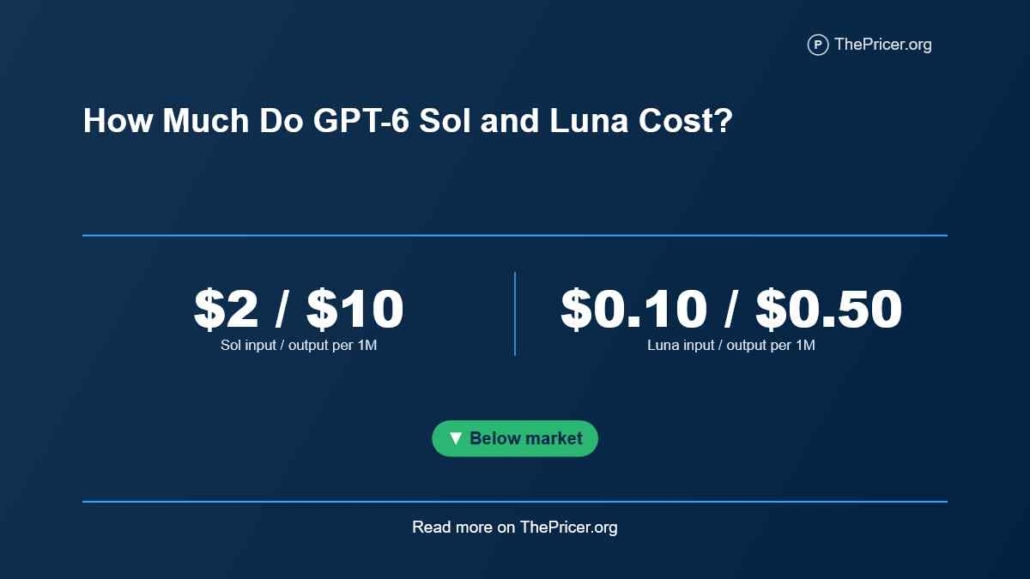
How Much Do GPT-6 Sol and Luna Cost?
The easiest way to budget the two models is to separate input, cached input, cache writes, and generated output. OpenAI’s current API rate card lists the following Standard prices per 1 million tokens.
| Model and context | Input | Cached input | Cache write | Output |
|---|---|---|---|---|
| GPT-6 Sol, up to 272K input | $2.00 | $0.20 | $2.50 | $10.00 (about 20 minutes at $30 per hour) |
| GPT-6 Luna, up to 272K input | $0.10 | $0.01 | $0.125 | $0.50 |
| GPT-6 Sol, over 272K input | $4.00 | $0.40 | $5.00 | $15.00 |
| GPT-6 Luna, over 272K input | $0.20 | $0.02 | $0.25 | $0.75 |
The predecessor comparison is slightly more interesting than the headline 50% claim. Sol moved from $4 to $2 input and $20 to $10 output, an exact 50% cut. Luna input moved from $0.20 to $0.10, also 50%, while Luna output fell from $1.20 to $0.50, a numerical reduction of about 58.3%. OpenAI presents the Sol and Luna generation change as 50% cheaper overall, but the Luna output line fell by more than half.
A simple Standard request with 100,000 uncached input tokens and 20,000 output tokens therefore costs $0.40 with Sol: 0.1 × $2 plus 0.02 × $10. The same token volume costs $0.02 with Luna: 0.1 × $0.10 plus 0.02 × $0.50. At identical token volume, that is a $0.38 difference per task and a $380 difference across 1,000 tasks.
The token rate is only the model portion of some API workloads. The same OpenAI rate card lists separate charges for tools such as web search, file search, and hosted containers. For example, web search is listed at $10 per 1,000 calls plus search content tokens billed at the selected model’s rate. A workflow that uses tools heavily can therefore cost more than a token-only estimate suggests.
What Changes the GPT-6 API Bill?
Prompt caching is one of the largest cost levers for agents and long conversations that repeatedly send the same prompt prefix. OpenAI’s prompt-caching documentation says cached reads can receive a 90% input discount. For Sol, the short-context read rate falls from $2 to $0.20 per million. For Luna, it falls from $0.10 to $0.01. Cache writes move the other way, costing $2.50 per million for Sol and $0.125 for Luna, so caching pays best when a written prefix is reused enough times.
Batch and Flex processing cost 50% of the applicable Standard token rates. That takes short-context Sol to $1 input and $5 output per million, while Luna falls to $0.05 input and $0.25 output. The Batch API documentation says a batch can include up to 50,000 requests and a 200 MB input file, making the discount most relevant for work that does not need an immediate answer.
Fast mode charges twice the applicable rate. At short-context pricing, Sol becomes $4 input and $20 (about 40 minutes at $30 per hour) output per million, while Luna becomes $0.20 input and $1 output. Long-context Fast rates climb further to $8 input and $30 output for Sol, and $0.40 input and $1.50 output for Luna.
Regional processing can add another 10% for eligible data-residency endpoints. OpenAI currently says EU data residency for GPT-6 Sol and Luna is available only with Standard processing. That means a team with strict regional requirements may not be able to pair EU residency with the cheaper Batch or Flex route.
The Hidden Price Above 272K Input Tokens
 The most important billing cliff is not the 1.05-million-token maximum context window. It is the 272,000-input-token pricing threshold. OpenAI’s GPT-6 Sol model documentation states that prompts above 272K input tokens are billed at 2 times the input and cache rates and 1.5 times the output rate for the full request. The GPT-6 Luna model documentation applies the same rule to Luna.
That full-request repricing creates a sharp jump around the boundary. A Sol request with 271,000 input tokens and 20,000 output tokens costs about $0.742. Increase the input to 273,000 tokens and the request moves to long-context pricing, producing a bill of about $1.392. Adding only 2,000 input tokens in this example raises the charge by about 87.6%.
Luna shows the same percentage effect. The 271K-input plus 20K-output example costs about $0.0371. At 273K input, the long-context version costs about $0.0696. The dollar difference is small because Luna is inexpensive, but the pricing cliff is still real. Developers near the threshold can save more by reducing context below 272K than by trimming a few thousand output tokens after the request has already crossed it.
What GPT-6 Costs in Real Use
Case 1: Short repeated requests
Suppose an application makes 1,000 Standard requests, each using 10,000 input tokens and producing 2,000 output tokens. One Sol request costs $0.04, so the run costs $40. One Luna request costs $0.002, so the same run costs $2. If capability is adequate for the job, moving this workload from Sol to Luna cuts the model bill by $38 per 1,000 requests.
Case 2: A heavier agent workload
At 100,000 input tokens and 20,000 output tokens per task, 1,000 Standard tasks cost $400 on Sol and $20 on Luna. If the workload can run through Batch or Flex, those totals fall to about $200 and $10. Fast mode moves them in the opposite direction, to about $800 and $40. Processing mode can therefore change this sample monthly bill by a factor of four between Batch or Flex and Fast.
Case 3: Long-context document work
A request using 500,000 input tokens and 50,000 output tokens is above the long-context threshold. At Standard pricing it costs about $2.75 on Sol and $0.1375 on Luna. Run that job 100 times and the model portion is roughly $275 with Sol or $13.75 with Luna, before tool calls, regional processing, or other metered services.
At a $30 hourly wage, the $400 Sol total in Case 2 represents about 13 hours and 20 minutes of gross work, while the $20 Luna total represents about 40 minutes. This is not a quality comparison. It simply shows how quickly a seemingly tiny per-token difference becomes material when an application runs the same workflow at scale.
Sol vs Luna and ChatGPT Billing
On pure token price, Luna is the cheaper model. The listed short-context rates make Sol exactly 20 times more expensive for uncached input, cached input, cache writes, and output. The long-context rates preserve the same 20-to-1 ratio. Batch, Flex, and Fast also preserve it because they multiply each model’s applicable rate by the same factor.
That does not mean Luna is automatically the lower-cost choice for every completed job. Sol is designed for demanding coding and agentic workflows, while Luna is aimed at focused, repeatable work at high volume. If a harder task requires retries, additional tool calls, or substantial human correction on the cheaper model, the finished-task cost can look different from the raw token ratio. For context, GPT-6 Astra is priced above both, so the Sol and Luna tiers exist partly to let developers trade some maximum capability for lower spend.
There is also a separate billing path inside ChatGPT. The current Work and Codex guidance says GPT-6 Sol and Luna are available in ChatGPT Work and Codex rather than ordinary Chat conversations, subject to plan and workspace access. At launch, Free and Go users could also access GPT-6 Luna in the desktop app. Signing into Codex with ChatGPT uses the ChatGPT plan’s usage and billing, while using an API key uses API pricing.
For eligible personal plans, the flexible-usage credit rules say included plan usage is consumed first and credits can cover supported features after the included allowance is reached. Those usage credits are separate from API credits. A person paying for ChatGPT should therefore not multiply every Work or Codex task by the API token rate and assume that number will appear as a separate charge.
If you are comparing the surrounding software budget, see our guides to ChatGPT pricing, GitHub Copilot costs, and cloud computing costs. Those products use different billing units, which is exactly why per-token API rates should not be compared directly with a monthly software seat without converting both to the same workload.
Sol makes more sense when the work is complex enough that stronger coding, reasoning, or agent performance can reduce retries and review. Luna makes more sense when the task is well-scoped, repeated at large volume, and the 20-to-1 token-price advantage matters more than using the stronger model for every call.
What We Verified
- We checked the September 22 API changelog entry to confirm the release date, the
gpt-6-solandgpt-6-lunamodel IDs, and the headline Standard rates. This anchors the article to the actual launch record rather than pre-release pricing. - We cross-checked the launch with TechCrunch through its independent launch coverage, which reported the lower API pricing and the distinction between Sol’s more demanding work and Luna’s high-volume role. That supports the use-case framing without relying only on vendor language.
- We compared the published figures with Ars Technica through an independent pricing report, which independently lists Sol at $2 input and $10 output and Luna at $0.10 input and $0.50 output per million tokens. No pricing conflict appeared.
- We reviewed VentureBeat through a separate launch analysis as a second independent check on the reduction from GPT-5.6-era pricing. That reinforced the decision to treat the new rates as a material price cut, not a minor promotional adjustment.
Answers to Common Questions
How much does 1 million tokens cost with GPT-6 Sol?
For Standard short-context API use, 1 million uncached input tokens cost $2 and 1 million output tokens cost $10. Cached input is $0.20 per million and cache writes are $2.50 per million. Prompts above 272K input use higher long-context rates for the entire request.
How much does 1 million tokens cost with GPT-6 Luna?
GPT-6 Luna Standard short-context pricing is $0.10 per 1 million uncached input tokens and $0.50 per 1 million output tokens. Cached input is $0.01 per million and cache writes are $0.125 per million.
Is GPT-6 Luna cheaper than GPT-6 Sol?
Yes on published token rates. Luna’s listed input, cached-input, cache-write, and output prices are all one-twentieth of Sol’s under the matching context and processing mode. Whether it is cheaper per successful completed task depends on how well it handles the workload.
Do ChatGPT users pay these GPT-6 API prices?
Not automatically. Direct API use is billed by token and other metered services. ChatGPT Work and Codex can use plan allowances and, where available, flexible credits. If you connect an API key instead, the API rate card applies to that API usage.
Takeaway: For Standard API requests at or below 272K input tokens, budget $2 input and $10 output per million tokens for GPT-6 Sol, or $0.10 input and $0.50 output for GPT-6 Luna. Then check three things before forecasting the full bill: whether prompts cross 272K, whether repeated context can be cached, and whether the workload can use Batch or Flex instead of Standard or Fast processing.
Disclosure: Educational content, not financial advice. Prices reflect public information as of the dates cited and can change. Confirm current rates, fees, taxes, and terms with official sources before purchasing. See our methodology and corrections policy.