
How Much Do Hand Grippers Cost?
Updated on | Written by Alec Pow
This article was researched using 13 sources. See our methodology and corrections policy.
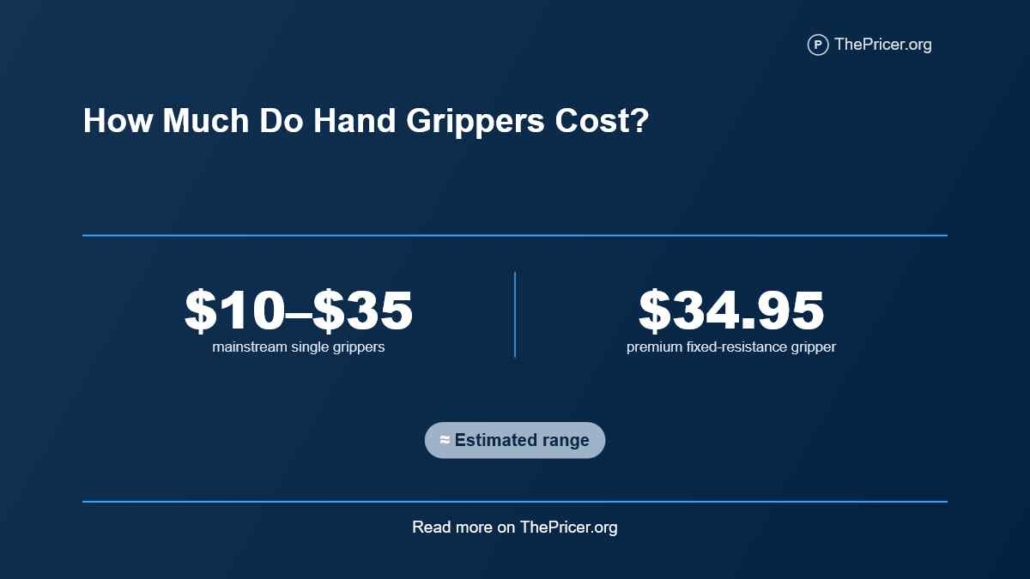
Current U.S. listings place many mainstream hand grippers at about $10 to $35 each. Basic adjustable models can sell for less than $15, finger-by-finger therapy exercisers commonly sit around $17 to $29, and premium fixed-resistance Captains of Crush grippers cost $34.95 each. Sets change the picture because buying several resistance levels at once can push the total above $100, with large progression sets reaching about $320.
The useful comparison is not simply cheap versus premium. Buyers should compare adjustable versus fixed resistance, single-tool versus set pricing, the number of usable resistance steps, and whether the product is meant for gym training, finger isolation, or therapist-directed hand exercise.
Article Highlights
Jump to sections
- Basic adjustable hand grippers currently start around $9 to $13 (at $30 per hour, earning that amount would take about 18 to 26 minutes, before taxes) in mass-market listings.
- DICK’S lists adjustable and spring grippers from $12.99 to $24.99 among its current hand exercisers.
- Prohands finger exercisers currently cost $16.95 to $28.95 for its main VIA, Gripmaster, Rehab, and PRO models.
- IronMind Captains of Crush grippers cost $34.95 each across widely different resistance levels.
- A five-gripper Captains of Crush set costs $146.95, about 16% less than buying five singles at current direct pricing.
- Prices above $100 are more common for multi-gripper sets or specialized grip equipment than for one ordinary hand gripper.
How Much Do Hand Grippers Cost?
Mass-market pricing starts below $10 (about 20 minutes at $30 per hour). Walmart currently lists a two-pack adjustable BN-LINK grip trainer at $8.70 online, though sale pricing can change quickly. DICK’S Sporting Goods provides a cleaner group of branded comparisons. Its current hand exerciser listings include a Fitness Gear adjustable trainer at $12.99, a GoFit Big Gripper at $19.99, and a GoFit Power Grab adjustable model at $24.99.
| Current product example | Price | Product type |
|---|---|---|
| BN-LINK two-pack adjustable gripper | $8.70 | Budget adjustable pair |
| Fitness Gear Adjustable Grip Trainer | $12.99 | Adjustable single gripper |
| Prohands VIA | $16.95 | Finger-by-finger exerciser |
| GoFit Power Grab | $24.99 | Adjustable single gripper |
| Prohands PRO | $28.95 | Higher-resistance finger exerciser |
| Captains of Crush single | $34.95 | Premium fixed-resistance gripper |
The table shows why a useful current single-gripper budget is about $10 to $35. Higher prices do exist, but they often belong to specialized adjustable systems, multi-piece kits, or a different type of grip trainer. A buyer can spend more than $50 on one product, yet that is not necessary to get a durable mainstream gripper for ordinary strength training.
What You Are Buying
Hand grippers fall into several product types that should not be priced as though they do the same job. A simple adjustable spring gripper gives one handle pair and a resistance mechanism that can cover several tension settings. A fixed-resistance torsion-spring gripper uses one calibrated difficulty level, so a user who wants progressive steps may eventually buy several. Finger exercisers such as Gripmaster divide resistance across individual fingers rather than asking the whole hand to close one spring.
The difference matters because a $13 (about 26 minutes at $30 per hour) adjustable model may replace several low-to-moderate resistance steps for a casual user, while a $34.95 fixed gripper buys one defined level in a larger progression system. Neither price alone shows which is the better match.
A climber, powerlifter, musician, rehabilitation patient, and office worker can all search for a hand gripper while needing very different resistance, handle geometry, and movement patterns.
Hand grippers also sit beside other grip tools rather than replacing them. Pinch blocks, extensor bands, wrist rollers, thick-bar attachments, and finger-extension devices train different actions. Someone building a small home setup may pair a hand gripper with larger equipment such as a treadmill, but the gripper itself remains one of the lowest-cost pieces of strength equipment.
Adjustable vs Fixed Resistance
Adjustable grippers offer the cheapest route to several resistance settings. The current DICK’S examples place mainstream adjustable models at $12.99 and $24.99. One adjustable tool can cover warm-up work and several harder settings without requiring another purchase each time the current level becomes easy. That makes the format attractive for a beginner who does not yet know which resistance will remain useful after a few months.
Fixed-resistance grippers trade that flexibility for a repeatable single level. IronMind currently lists the Captains of Crush line at $34.95 each. The No. 1 is rated at 140 pounds, the No. 1.5 at 167.5 pounds, and the No. 2 at 195 pounds, yet all three carry the same price. The broader line also keeps the same $34.95 price at much higher resistance levels.
That creates one of the useful corrections to the old pricing logic. Higher resistance does not automatically mean a higher purchase price. Within Captains of Crush, resistance changes which tool a buyer should choose, not what that single tool costs. The price issue appears later when a fixed-resistance user needs several steps. A person who buys three singles at $34.95 each spends $104.85, which is why set pricing starts to matter.
Therapy and Finger Trainers
Finger-by-finger exercisers form their own price tier. Prohands currently sells the VIA for $16.95, the standard Gripmaster for $21.95, Gripmaster Rehab for $23.95, and the PRO for $28.95 on its current product page. Its multi-packs start at $59.95. These tools use separate spring-loaded finger buttons rather than one torsion spring closed by the whole hand.
The word rehab on a product does not make it a substitute for a treatment plan. Hand pain, tendon injury, surgery recovery, arthritis, or nerve symptoms can change which motion and resistance are appropriate. The American Society of Hand Therapists maintains professional education on wrist and grip strengthening, which reflects how closely resistance work can be tied to clinical context. A consumer buying for recovery should follow the resistance and movement guidance provided by the treating clinician or hand therapist.
For healthy adults using grippers as strength equipment, research supports resistance training as a way to improve handgrip strength, but the response depends on the population and program. A 2025 systematic review of older adults with sarcopenia found improvement from resistance training across studied programs. That evidence does not support a universal promise that every hand-gripper buyer will gain a fixed percentage within two or four weeks.
Premium Grippers and Sets
Premium fixed-resistance grippers become expensive mainly through progression. A single Captains of Crush costs $34.95, but buying five individual resistance levels separately would cost $174.75. IronMind lists a five-gripper set at $146.95, or $29.40 per gripper. The set saves $27.80, about 15.9%, compared with five current $34.95 singles.
The larger set makes the progression discount easier to see. IronMind currently lists all 11 Captains of Crush strengths for $319.95, or $29.10 each. Eleven singles at $34.95 would total $384.45. The difference is $64.50, a saving of about 16.8%. This is useful only for a buyer who expects to use many resistance levels. Someone who needs one or two grippers spends less by buying only those levels.
Retailer pricing can differ from manufacturer set pricing. Rogue currently lists Captains of Crush singles at $34.95 and publishes its own bundled set prices, including three-gripper sets at $87.95 and a five-gripper Advanced Set at $146.95. Set size, exact resistance selection, shipping, and current promotions should be matched before deciding which checkout total is lower.
What Changes the Real Cost
Resistance rating is only one product attribute and, as the Captains of Crush pricing shows, it may have no effect on price inside a single product family. Construction, adjustability, finger isolation, included pieces, brand, calibration, and set size can matter more. Low-cost adjustable models rely on one mechanism to provide several settings. Premium fixed tools ask the buyer to pay for another unit when a new resistance step is needed.
The largest price jump often comes from moving outside the ordinary hand-gripper category. Rogue’s grip training catalog lists a Two-Finger Utility Gripper at $37.95, the Xtensor at $40, Twist Yo’ Wrist at $56.95, and an Anvil Grip at $125. Those are different grip tools, not evidence that a normal spring hand gripper routinely costs more than $100.
Shipping can change a small purchase more than buyers expect because the item itself is inexpensive. Prohands currently advertises free U.S. shipping once an order reaches $30. One VIA at $16.95 falls below that threshold, while two VIA units total $33.90 and clear it. Taxes and retailer shipping policies still depend on the order and destination, so the product price is not always the full checkout amount.
Worked Buying Scenarios
 A beginner who wants broad resistance coverage can start with one adjustable gripper instead of several fixed levels. Using the current Fitness Gear price of $12.99, the entire initial equipment cost can stay below $15 before tax or shipping.
Moving directly to one Captains of Crush single at $34.95 raises the equipment bill by $21.96. That premium buys a different type of tool rather than a simple increase in resistance range.
A balanced IronMind setup gives a cleaner itemized example. One Captains of Crush Trainer costs $34.95. IronMind’s set of 10 Expand-Your-Hand Bands costs $14.95. Buying those pieces separately would total $49.90.
IronMind also sells a two-way Trainer and band package for $41.95. The package saves $7.95, or about 15.9%, before shipping and tax. The saving comes from bundling two complementary products, not from changing the resistance of the Trainer.
A committed fixed-resistance user faces a different decision. Five separate Captains of Crush grippers total $174.75, while the five-piece direct set is $146.95. The $27.80 saving is large enough to matter, but only if the buyer intends to use all five steps. Buying a set simply because its per-unit price is lower can waste money when several levels are too easy or too difficult to be useful.
Choosing the Right Price Tier
The lowest-cost route is an adjustable gripper around $10 to $25. It suits someone who wants several resistance settings in one device, is still learning what feels appropriate, or wants a compact tool without building a collection. A finger trainer around $17 to $29 makes more sense when isolated finger resistance is the feature being purchased. Premium fixed grippers around $35 each fit users who care about a defined progression system and consistent resistance steps.
Makes sense if
- You choose an adjustable model because several resistance settings are useful now.
- You buy a fixed gripper only after identifying a resistance level you can use.
- You buy a set because most of its included levels fit your planned progression.
- You compare the full checkout cost, including shipping and tax.
Does not make sense if
- You assume a higher resistance number must cost more.
- You buy a large set only because its per-unit price is lower.
- You treat finger exercisers, torsion-spring grippers, and pinch tools as interchangeable products.
- You use a rehabilitation-labeled product as a substitute for clinical guidance after an injury.
Hand grippers remain inexpensive compared with larger home-fitness purchases. Someone comparing broader training expenses can also see current Peloton membership costs or the price of an Aaptiv subscription. The gripper decision is much narrower. Buy the resistance format and number of steps you will actually use.
Verification
- Checked current IronMind accessory prices, including $14.95 for 10 extension bands.
- Confirmed specialized grip equipment prices separately from ordinary hand grippers.
- Cross-referenced handgrip strength measurement research rather than treating one product’s resistance label as a clinical outcome.
Answers to Common Questions
How much does a good hand gripper cost?
A solid mainstream hand gripper usually costs about $10 to $35. Adjustable models tend to sit near the lower and middle part of that range, while premium fixed-resistance models can reach about $35 each.
How much are Captains of Crush grippers?
IronMind currently prices individual Captains of Crush grippers at $34.95 each. Multi-gripper sets reduce the effective per-unit price when several resistance levels are bought together.
Are expensive hand grippers harder to close?
Not necessarily. Captains of Crush models with very different resistance ratings share the same $34.95 individual price. Resistance and price are separate variables within that product line.
Is an adjustable gripper cheaper than buying a set?
Usually at the start. One adjustable gripper can cost about $13 to $25 and cover several settings, while a multi-level fixed-resistance set can cost $88 to $320 depending on the number of grippers included.
Disclosure: Educational content, not medical advice. Pricing varies by provider, location, and insurance. Confirm eligibility, coverage, and out-of-pocket costs with a licensed clinician and your insurer. See our methodology and corrections policy.