
How Much Do Hotel Resort Fees Add to a Vacation?
Published on | Written by Alec Pow
This article was researched using 13 sources. See our methodology and corrections policy.
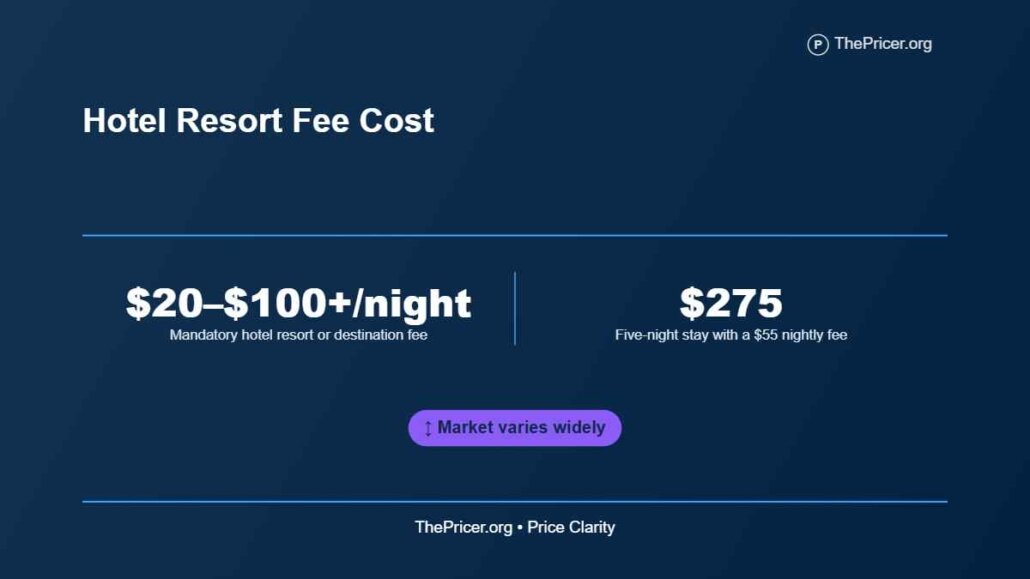
Hotel resort fees can add $20 to more than $100 per room per night to a U.S. vacation, with many major Las Vegas properties charging approximately $45 to $55 nightly before tax in October 2026.
A five-night stay at a hotel charging $55 per night adds $275 in mandatory fees, or more where lodging taxes apply. The charges can increase an inexpensive room’s effective price by 30% to 60% or more.
Resort fees may also be called destination fees, amenity fees, or facility charges. Hotels use them to cover bundled services such as Wi-Fi, pool access, fitness facilities, recreational activities, and dining credits. Guests generally owe mandatory charges even if they never use the included amenities.
Since May 12, 2025, federal regulations have required lodging sellers to display mandatory fees in the upfront total price. That makes comparison easier but does not eliminate the charges themselves.
Article Highlights
Jump to sections
- Many major Las Vegas hotels charge $45 to $55 nightly in resort fees before lodging tax.
- A seven-night stay with a $50 fee adds $350 before tax.
- Chicago Marriott Downtown Magnificent Mile lists a $30 nightly destination fee.
- Grand Wailea in Maui lists a $55 nightly resort charge.
- Mandatory resort fees must be included in advertised total prices under the FTC’s rule, although applicable taxes may be displayed separately until checkout.
- Eligible World of Hyatt award nights waive resort fees, subject to program exceptions.
How Much Do Hotel Resort Fees Add to a Vacation?
There is no universal U.S. resort-fee rate. Hotels set their own charges, and fees vary by property, market, amenities, and booking terms. The examples below come from individual hotel disclosures and current destination reporting, not a representative survey of all hotels.
| Hotel or destination | Nightly fee | Five-night fee total |
|---|---|---|
| Westin Galleria Houston | $25 | $125 |
| Westin Denver Downtown | $27 | $135 |
| Chicago Marriott Downtown Magnificent Mile | $30 | $150 |
| Major Las Vegas Strip properties | $45–$55 | $225–$275 |
| Grand Wailea, Maui | $55 | $275 |
Figures exclude applicable taxes. Five-night amounts are calculated from the listed daily fees, assuming the same fee applies throughout the stay.
The Westin Galleria Houston fee disclosure lists $25 per room nightly, including a daily $25 food-and-beverage credit and other amenities.
The Westin Denver Downtown accommodation details specify a $27 nightly destination fee covering a $13.50 dining credit and selected activities.
The Chicago Marriott Downtown disclosure lists a $30 per-room nightly destination fee, with a $15 daily food-and-beverage credit among its inclusions.
For a traditional resort, Grand Wailea’s resort information states that its daily charge is $55 per room, covering access to selected resort activities and amenities.
The independent October 2026 Las Vegas fee tracker documents approximately $45 to $55 nightly at many major Strip properties, with differences between hotels and occasional fee-free alternatives. Confirm the exact charge on the hotel’s own reservation summary before booking.
How Much Does a Longer Stay Add?
Resort fees typically apply per room, per night, rather than per guest. This means a couple sharing one room generally pays the same mandatory room fee as a solo traveler, assuming the booking otherwise has identical terms.
At a $50 nightly fee, a three-night getaway incurs $150, a five-night vacation incurs $250, and a seven-night stay incurs $350 before tax.
Staying fourteen nights raises the fee to $700. Two rooms for the same period would incur $1,400, assuming the charge applies independently to each room.
The percentage effect changes with the base room rate. A $50 fee added to a $100 nightly room raises the before-tax cost by 50%. The same fee on a $400 room increases it by only 12.5%.
This explains why mandatory fees can be especially consequential for budget travelers, even when a luxury guest pays the same amount.
Las Vegas Resort Fee Taxes
Hotel taxes can increase the cost beyond the posted resort-fee amount. The applicable tax depends on where the property is located and how local rules treat the charge.
The City of Las Vegas’s 2026 transient lodging tax schedule identifies a 13.38% rate inside its primary gaming corridor for covered properties with at least 75 rooms, and a 13% rate for certain properties outside that corridor. Tax jurisdiction matters, so this schedule should not be applied indiscriminately to every Las Vegas-area hotel.
Using a 13.38% tax assumption for a taxable resort fee, $55 becomes approximately $62.36 nightly. Over five nights, the fee and its associated tax total approximately $311.80.
That adds $36.80 beyond the advertised before-tax fee across the stay.
This tax calculation applies to the fee component alone. Room-rate taxes remain a separate part of the total hotel bill and should not be counted twice.
For a broader comparison of accommodation spending, Las Vegas hotel prices vary widely by property, room category, and season. Compare complete room-and-fee totals rather than choosing based on the cheapest headline room rate.
What Does the Fee Actually Buy?
 Hotels bundle different benefits into resort and destination fees. Wi-Fi, gym access, pool facilities, recreation equipment, dining credits, fitness classes, and local activities are common inclusions.
The July 2026 resort fee explanation from The Points Guy documents a broad range of charges and the common amenity categories they cover.
Benefits are not necessarily worth their advertised face value to every guest. A hotel may assign value to a bike rental, fitness class, or local tour that the traveler has no intention of using.
Dining credits are potentially useful but can be restricted to participating outlets, specified hours, eligible menu items, or one use per day. Unused credits may expire rather than accumulate.
Consider Chicago Marriott’s $15 daily dining credit within its $30 charge. A guest spending at least the eligible credit amount every day receives up to $75 in credit across five nights against $150 in destination fees.
The nominal remaining cost is $75 before tax. That is only the economically relevant offset if the guest would otherwise have made the qualifying purchases at comparable prices.
Unused Benefits
The most misleading comparison is often between a room with a mandatory fee and another room without one.
Suppose Hotel A advertises a $99 nightly room with a separate $55 mandatory resort-fee component already included in its displayed total. The effective before-tax nightly charge is $154.
Hotel B charges $145 nightly without a resort fee. Although Hotel A has the lower base room rate, Hotel B is actually $9 cheaper per night before tax.
Across seven nights, choosing Hotel B saves $63, assuming equivalent dates, room occupancy, and other mandatory charges.
The calculation is useful even if Hotel A includes amenities. The guest can compare the actual value of those amenities against the difference in room totals.
For properties with food credits, a separate issue is spending above the credit amount. A traveler might buy an expensive hotel breakfast merely to use a credit when a lower-priced meal elsewhere would have cost less.
The fee is mandatory, but using the benefit is optional. Keep those decisions separate.
A Five-Night Resort Budget
Consider an illustrative couple booking one Las Vegas hotel room for five nights. The room costs $120 nightly, with a mandatory resort fee of $55 per room per night.
Assume that both components are subject to a 13.38% lodging tax and that the couple books a room in an area where this rate applies.
- Five nights at $120: $600.00
- Five daily resort fees at $55: $275.00
- Taxable lodging subtotal: $875.00
- 13.38% tax on the combined subtotal: $117.08
- Total hotel bill: $992.08
Without the resort fee, the room and associated tax would cost $680.28. The mandatory fee therefore increases this modeled five-night hotel bill by approximately $311.80, or 45.8%.
The effective room cost is approximately $198.42 per night including the resort fee and modeled lodging tax, compared with the $120 base rate.
This is a constructed scenario, not a verified live hotel quote. It excludes parking, meals, entertainment, refundable incidental holds, and any additional room-specific charges.
Are Resort Fees Legal in 2026?
Yes. Resort fees are not universally prohibited in the United States. Federal regulation addresses how mandatory prices are presented to consumers, rather than banning hotels from charging them.
The FTC’s official short-term lodging fee guidance explains that the rule effective May 12, 2025, requires hotels and reservation platforms to display the total price including mandatory fees prominently before purchase.
Taxes and certain optional charges can initially be listed separately, but must be disclosed before the customer is asked to pay. A hotel cannot make a mandatory charge effectively invisible by calling it an amenity fee.
The FTC’s May 2025 implementation announcement confirms the rule’s effective date and its focus on preventing misleading total-price presentations.
New York City introduced additional hotel-fee protections in January 2026. The city’s hotel-fee consumer protection announcement addresses hidden lodging charges and unexpected credit-card holds.
A clearly disclosed mandatory fee may still be payable. A fee omitted or misrepresented during booking creates a different question about compliance and consumer remedies.
Can Resort Fees Be Waived?
Some hotel programs and booking arrangements provide qualifying fee waivers. There is no general right to demand a resort-fee waiver simply because you do not intend to use the pool or gym.
World of Hyatt’s published benefits state that resort fees are waived on eligible Free Night Awards for members and on qualifying paid rates for Globalists.
Hyatt’s broader program terms include exceptions, so confirm the benefit for the specific property and redemption. A Points + Cash booking does not automatically receive the same waiver as an eligible full Free Night Award.
Some hotels have promotional packages that expressly waive destination fees. The Westin Arlington package listing advertises an offer waiving its $25 destination fee.
However, a waiver package may have a higher room rate than a separate standard offer. Compare the complete totals before treating the waiver as savings.
For an international trip, also review Dubai vacation expenses, where local tourism fees and mandatory hotel-related charges follow different rules from U.S. resort fees.
Resort Fees vs Other Hotel Charges
A resort fee is not necessarily the only additional hotel expense. Parking, pet fees, early check-in, extra-person charges, and certain optional services may be separate.
Some hotels require a refundable incidental hold at check-in. That hold temporarily reduces available card funds but should not be treated as a final hotel expense unless some or all of it is retained for legitimate charges.
Parking may be a meaningful additional cost. At Monterey Marriott, the published daily valet rate is $42, separate from its $25 destination fee.
Five days of valet service would add $210 if charged each day. A traveler who does not bring a car would not incur that expense.
The broader hotel room cost comparison explains how accommodation type, room quality, and location influence the base price. Resort charges should be added only when they are not already incorporated in the quoted total.
Choosing the Lowest Total Cost
The best hotel deal is the one with the most suitable combination of total price, location, room quality, and amenities. A property with no resort fee is not automatically cheaper than a competing hotel whose final total includes one.
Makes sense if
- You compare the complete stay price including all mandatory fees.
- You will genuinely use dining credits or included amenities that replace planned purchases.
- A qualifying loyalty redemption or package waives the fee without increasing another cost.
- The hotel location avoids significant transportation or parking expenses elsewhere.
Does not make sense if
- You compare one hotel’s base room rate against another hotel’s all-in rate.
- You assign full value to credits or activities you would not otherwise purchase.
- You assume a loyalty membership automatically removes all mandatory fees.
- You omit separate parking, tax, and occupancy charges from the vacation budget.
Keep the reservation confirmation and the hotel’s fee disclosure. If the actual charge differs from the agreed terms, request an itemized explanation and raise the discrepancy with the hotel or booking platform.
Answers to Common Questions
How much are resort fees for a week?
At $25 to $55 per night, seven nights add $175 to $385 before applicable taxes. Premium properties can charge more.
Are resort fees charged per person or per room?
They are usually assessed per room, per night. Some properties have different occupancy-related charges, so check the exact booking terms.
Are hotel resort fees included in the advertised price?
Mandatory fees must be included in the prominent upfront total under the FTC’s rule. Hotels can still itemize them separately, and applicable government taxes may be displayed later before payment.
Can I refuse to pay a resort fee if I do not use the amenities?
Usually not when the charge was mandatory and properly disclosed. Qualifying booking packages, loyalty benefits, or a billing error may provide a separate reason for a waiver or adjustment.
Do resort fees apply when booking with hotel points?
It depends on the loyalty program and property. Eligible World of Hyatt Free Night Awards generally waive them, subject to stated exceptions. Other programs and booking types have their own terms.
Disclosure: Educational content, not financial advice. Prices reflect public information as of the dates cited and can change. Confirm current rates, fees, taxes, and terms with official sources before purchasing. See our methodology and corrections policy.