
How Much Do ICE Deportation Planes Cost?
Published on | Written by Alec Pow
This article was researched using 14 sources. See our methodology and corrections policy.
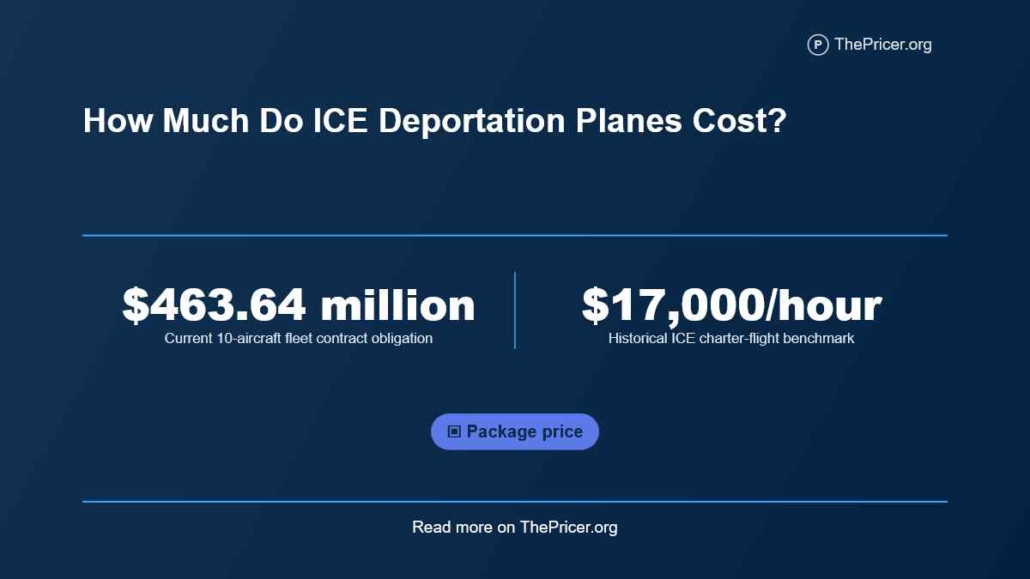
ICE deportation aircraft involve two price systems. The Department of Homeland Security has obligated about $463.64 million under a contract tied to a 10-aircraft fleet for Immigration and Customs Enforcement removal operations, while a commonly cited ICE charter benchmark is about $17,000 per flight hour.
The owned-fleet figure is in the news because several purchased Boeing 737s had still not entered deportation service by September 14, 2026, even as ICE cited limited flight capacity as one constraint on removals. Reuters reported the bottleneck as arrests rose sharply but removals stayed near 1,200 per day. The figures keep aircraft acquisition, charter service, military flights and cost per passenger separate.
Article Highlights
Jump to sections
- The Daedalus Aviation contract carries about $463.64 million (at $30 per hour, earning that amount would take about 7.4 thousand years of full-time work, before taxes) in federal obligations.
- Oversight records describe 10 aircraft connected to the purchase, including seven Boeing 737 passenger jets and three business jets.
- The original acquisition stage was reported at nearly $140 million for six Boeing 737s.
- A 2023 ICE benchmark put charter deportation flights at about $17,000 per flight hour.
- A five-hour charter at that benchmark costs about $85,000 before dividing the bill by the passenger count.
How Much Do ICE Deportation Planes Cost?
The clearest current acquisition figure is $463,638,746 (about 7.4 thousand years of full-time work at $30 per hour). Federal award data show that amount as the obligation on contract 70QS0326C00005002 to Daedalus Aviation Corporation for commercial aviation supporting ICE Enforcement and Removal Operations. The federal contract spending record identifies the award as firm fixed price and shows one offer under a sole-source procedure. The contract description does not assign a purchase price to each airplane.
Senate oversight material describes the related acquisition as 10 aircraft consisting of seven Boeing 737 passenger jets and three business jets. The August aircraft oversight letter says most of those aircraft had sat idle for months and asks DHS to provide individual purchase, retrofit, maintenance and operating costs. Those requests matter because the public contract total is not the same thing as a disclosed airplane-by-airplane price.
A simple division gives $46.36 million per aircraft across 10 planes. That result should not be called the price of an ICE Boeing 737. The group contains aircraft with different market values and missions, and the contract may cover services beyond bare aircraft acquisition. The mixed-fleet average is useful only as a scale check on the federal obligation.
| Cost measure | Amount | Scope |
|---|---|---|
| Current owned-fleet contract | $463.64 million | 10 mixed aircraft and related aviation support |
| Initial six-737 stage | Nearly $140 million | Reported December 2025 acquisition stage |
| Historical ICE charter rate | $17,000 per hour | 2023 testimony, not a 2026 quote |
| Five-hour charter model | $85,000 | ThePricer calculation from the historical rate |
Why the Contract Grew
The program began at a much smaller level. In December 2025, The Washington Post reported that DHS had signed a deal worth nearly $140 million (about 2.2 thousand years of full-time work at $30 per hour) to obtain six Boeing 737 aircraft for deportation operations. DHS said the initiative would save taxpayers $279 million through more efficient flight patterns, but the department did not publish the calculation behind that claim in the report. The initial Boeing fleet report also documented ICE’s shift from a charter-only model toward government ownership.
Federal transaction data put the initial obligation at $139,888,495 and the later total at $463,638,746. The increase is $323,750,251. Dividing that increase by the initial obligation gives about 2.314, which means the obligation rose by roughly 231 percent. Put another way, the final amount is about 3.31 times the original obligation. That is a ThePricer calculation from the published federal transaction values, not a separate government estimate.
The expansion also changed what readers should picture when they hear “ICE deportation planes.” The later fleet is not simply six identical passenger aircraft bought at one known unit price. Business jets entered the mix, and oversight records show that some aircraft were assigned or planned for government travel rather than routine removal flights. Those changes make the full $463.64 million unsuitable as a clean numerator for calculating one deportation 737’s purchase price.
What a Charter Flight Costs
ICE historically relied on private charter providers rather than owning a large dedicated fleet. A Government Accountability Office decision describes an ICE Air procurement that required the contractor to provide aircraft, pilots and crews, guards, nurses, personnel, materials and services needed for secure transportation of people in federal custody. The GAO charter procurement record also explains that fuel could be invoiced separately under the solicitation structure. That scope is wider than renting an empty airplane.
The best public hourly benchmark for a typical ICE deportation charter is dated rather than current. Reuters reported that acting ICE Director Tae Johnson told lawmakers in April 2023 that deportation flights cost about $17,000 per flight hour for 135 people and typically lasted five hours. A former ICE official told Reuters in early 2025 that the cost had risen somewhat since then. The ICE charter cost comparison makes the 2023 date important, so $17,000 should be treated as a benchmark rather than a 2026 guaranteed rate.
Current federal spending also shows the size of the charter program. A 2025 delivery order to CSI Aviation for daily scheduled large-aircraft and special high-risk charter flights shows $562,049,742 obligated. The CSI Aviation award record lists a potential award amount of about $585.49 million. That is a contract-level commitment covering many flights and services, not the price of one trip.
Cost Per Person on a Flight
Passenger count changes the cost per person even when the aircraft-time bill stays the same. One worked charter example uses the reported historical rate and an assumed full 135-person load.
- Assumed flight time of five hours.
- Historical rate of $17,000 per hour.
- Aircraft-time total of $85,000.
- Assumed passenger count of 135.
- Aircraft-time share of about $630 per person.
At 100 passengers the same model becomes $850 per person. At 75 passengers it rises to about $1,133 per person, and at 50 passengers it reaches $1,700 per person.
This calculation shows why load factor matters. The same five-hour mission becomes about 2.7 times more expensive per transported person when passenger count falls from 135 to 50. The aircraft does not become more costly to fly under this simplified model. The fixed flight-time cost is spread across fewer people. Real invoices can differ because route length, fuel, airport charges, escort needs, medical staffing and positioning flights may change.
ICE’s own reporting also makes clear that not every removal uses an ICE Air charter. Its FY2024 annual report says ERO carried out 271,484 removals and used chartered flights, commercial flights and land transport depending on the case and destination. The FY2024 removal report records 271,484 removals to 192 countries. A related full deportation cost analysis covers the wider case costs that sit outside aircraft transportation.
Buying Planes vs Chartering Them
The purchase-versus-charter question cannot be answered by comparing $463.64 million with a single hourly rate. Owned aircraft still need crews, maintenance, fuel, insurance, storage, airport services, regulatory work and scheduling support. A charter rate bundles many of those functions into a service contract. The government gains control over an asset when it buys a plane, but it also takes on costs that a charter operator previously carried.
A useful scale calculation starts with the older charter benchmark. Five hours at $17,000 per hour equals $85,000. Dividing the current $463,638,746 acquisition contract by $85,000 produces about 5,455 five-hour charter missions. That number is not a break-even point because it omits every operating expense on the purchased fleet and uses a charter benchmark that predates the current contract environment. It does show how large the acquisition commitment is relative to a typical historical mission.
Historical data reinforce the scope difference. A 2015 DHS Inspector General audit found ICE Air paying an average of $8,419 per flight hour, with charter vendors supplying aircraft, pilots, flight crew, security personnel, a flight nurse and maintenance while the rate also covered fuel, insurance, landing fees and taxes. The DHS charter audit is too old to serve as a current price, but it shows why an hourly charter charge and an aircraft purchase price cover different economic bundles. The forced removal cost comparison gives the broader taxpayer context without treating air transport as the entire removal expense.
Why the Planes Are in the News
The purchased fleet is in the news because ownership has not immediately translated into removal-flight capacity. Reuters reported on September 14, 2026 that ICE arrests reached nearly 51,000 in August while deportations remained around 1,200 per day. The report identified limited flight availability and constraints imposed by receiving countries among the reasons removals had not risen at the same pace. It also said the Boeing 737s purchased for deportations were still going through FAA checks and had not yet entered service.
FAA records do show government registration for at least one acquired Boeing 737. The FAA aircraft registry entry for N475US identifies a 2004 Boeing 737-752 registered to the U.S. Department of Homeland Security care of Daedalus Aviation. A valid registration does not prove the plane was available for ICE removal missions on any particular day, and the FAA page warns that registry information alone does not establish current airworthiness.
Congressional oversight has added a second news issue. Senate Appropriations Democrats said in August that DHS had acquired 12 aircraft across several programs and stated that three of seven passenger 737s purchased with ICE funds were expected to support deportation flights. The Senate aircraft use letter also questioned the use of other purchased aircraft for official travel. Those are lawmakers’ oversight claims and requests, while DHS has defended the broader acquisition as a way to improve operational efficiency.
Military Flights Cost More
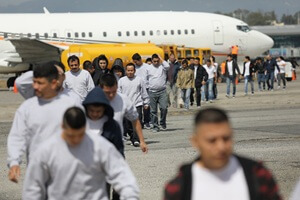 Military deportation flights use a different cost structure from ICE charters. Reuters reported in January 2025 that a U.S. official estimated C-17 operating cost at about $28,500 per flight hour. A Guatemala mission took roughly 10.5 hours in the air and carried 64 people. Multiplying the hourly rate by the flight time produces about $299,250 in aircraft operating cost before ground preparation or other costs. Reuters calculated at least $4,675 per person for that mission.
Against the ICE charter example of about $630 per person, the military case was roughly 7.4 times higher on a per-person basis. The calculation is $4,675 divided by $630. It does not mean every military flight costs 7.4 times as much as every ICE charter. Passenger load, route length, aircraft type and what each cost measure includes can all change the ratio.
The distinction also prevents a misleading headline. Saying “an ICE deportation plane costs $4,675 per migrant” would wrongly turn one military C-17 mission into a standard ICE Air price. ICE charters, government-owned 737s and military aircraft are separate transportation models. A related ICE enforcement cost analysis covers detention and arrest spending that should not be added to an aircraft price without defining the full case scope.
What Taxpayers Still Don’t Know
The largest missing number is the individual purchase price of each aircraft. The public knows the mixed-fleet contract obligation and has reports on the aircraft count, but the reviewed records do not publish a line-item acquisition price for each 737 and each business jet. That prevents a defensible statement that one ICE 737 costs $46.36 million. The mixed-fleet arithmetic average is not a model-specific sale price.
The second gap is lifetime ownership cost. Public oversight requests seek aircraft-specific retrofit spending, operations and maintenance estimates, and flight records. Until those figures are available, DHS’s earlier claim of $279 million in taxpayer savings cannot be independently reproduced from the public data reviewed here. A valid comparison would need acquisition cost, expected service life, annual utilization, maintenance, crew, fuel, storage, financing or capital treatment, residual value and the charter rates that government ownership is supposed to replace.
Comparison fits if
- You are comparing federal aircraft acquisition with chartered removal service.
- You keep operating costs separate from aircraft purchase obligations.
- You treat the $17,000 hourly figure as a dated benchmark rather than a live quote.
Comparison does not fit if
- You need the undisclosed purchase price of one specific 737.
- You mean the entire cost of arrest, detention and removal for one person.
- You treat a military C-17 mission as a standard ICE Air charter.
Answers to Common Questions
How much did ICE’s new deportation planes cost?
The current federal contract tied to the 10-aircraft ICE removal fleet carries about $463.64 million in obligations. The government has not published a purchase price for every individual aircraft.
How much does an ICE deportation flight cost?
A widely cited 2023 ICE benchmark was about $17,000 per flight hour. At five hours, that equals roughly $85,000, but current charter pricing can differ.
How much does a deportation flight cost per person?
Using the historical five-hour ICE example with 135 passengers gives about $630 per person in aircraft-time cost. Lower passenger loads raise the per-person share.
Are the new ICE planes already flying deportation missions?
Reuters reported on September 14, 2026 that the purchased Boeing 737s were still undergoing FAA checks and had not yet entered service for deportations.
Disclosure: Educational content, not financial advice. Prices reflect public information as of the dates cited and can change. Confirm current rates, fees, taxes, and terms with official sources before purchasing. See our methodology and corrections policy.