
How Much Do Jurors Get Paid?
Published on | Written by Alec Pow
This article was researched using 14 sources. See our methodology and corrections policy.
Jury service can produce very different payments depending on the court that issued the summons. Federal courts use one national attendance fee, while state courts may pay a flat daily amount, raise the rate after several days, shift part of the obligation to employers, or reimburse travel separately.
For a US juror, the money can include a daily attendance fee, mileage, transit reimbursement, lodging, or continued employer wages. Exact payment depends on jurisdiction, the number of service days, whether normal wages continue, and whether the court reimburses expenses.
Juror compensation is measured mainly per service or attendance day. The biggest modifiers are federal versus state court, stepped rates for longer trials, employer wage rules, and travel allowances.
Juror pay ranges from very small state stipends to much larger daily allowances, and longer service can change the rate substantially.
How Much Do Jurors Get Paid?
Jump to sections
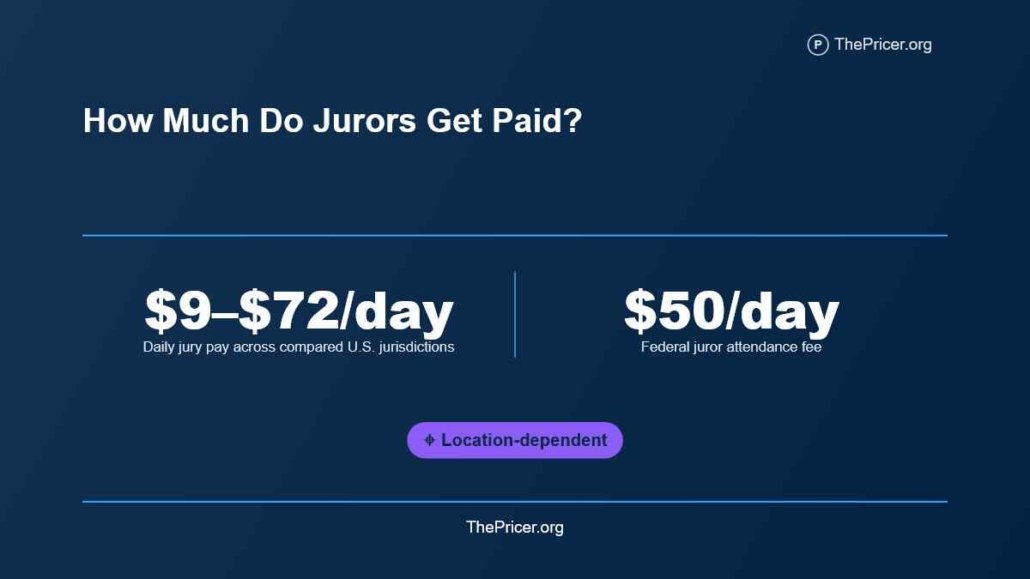
- Federal jurors receive $50 (at $30 per hour, earning that amount would take about 1.7 hours of work, before taxes) per day.
- New York’s jury fee is $72 per day.
- Texas pays at least $20 on day one and at least $58 per day after that.
- California pays $15 per day starting on the second day.
- North Carolina rises from $12 on day one to $40 per day after five days.
What this is in plain terms
Juror pay is money tied to reporting for jury service or sitting on a jury. It is not a normal wage from the court. Federal, state, county, and local courts can use different payment systems, and an employer may have a separate obligation or policy for wages missed during service. Travel reimbursements can also sit outside the daily fee.
This money is separate from the expenses paid by the parties in a lawsuit. Filing charges and attorney bills belong to the cost of filing a lawsuit, while expert work such as forensic accountant fees can add another litigation expense. Juror compensation goes to the citizen called to serve, not to either side of the case.
A federal jury payment worked example
Federal law gives a useful worked example because the base fee and long-service threshold are fixed. A petit juror receives $50 (about 1.7 hours of work at $30 per hour) per attendance day, and after more than 10 days in one case a judge may authorize an extra amount of up to $10 per day, producing a maximum daily attendance fee of $60 for those later days under federal juror fee law.
- Days 1 through 10, 10 × $50 = $500
- Day 11 with the full authorized increase = $60
- Total attendance compensation through day 11 = $560
The calculation also shows the limit of the long-trial increase. Crossing the 10-day threshold adds only $10 to the next day’s maximum attendance fee. A worker who loses a much larger daily wage can still face a sizable income gap. Federal mileage, parking, tolls, meals, and lodging are separate from this attendance calculation, so an actual payment can be larger than $560 when eligible reimbursements apply.
How much jurors get paid across the US
There is no single state jury rate. The table below compares federal service with eight state systems using official court or statutory material checked in September 2026. It shows why quoting one national daily figure misses much of the search intent. Some states start paying immediately, some delay the daily stipend, and others raise compensation after a set number of days.
The strongest differences appear in stepped schedules and employer-funded systems. A short assignment can pay very little in California or Pennsylvania, while New York uses a much larger daily fee. Massachusetts handles the first part of service through employer wages before state compensation begins.
| Jurisdiction | Juror compensation | What the rule means |
|---|---|---|
| Federal courts | $50 (about 1.7 hours of work at $30 per hour) per day, with up to $60 per day after the petit-jury long-service threshold. | The District of South Dakota also lists $0.76 per mile for round-trip travel. Its Rapid City overnight subsistence allowance runs from $178 to $232 per day depending on season. Hidden-cost callout. Those lodging allowances show that travel-related payments can exceed the attendance fee when overnight service is approved under district juror payment rules. |
| California | $15 per day starting on day two, plus $0.34 per mile round trip starting on day two. | Day one has no standard daily stipend. Public transit users can receive up to $12 per day beginning on day one under California jury service rules. |
| Texas | At least $20 for day one and at least $58 per day after day one. | Mini case 1. The first two service days pay at least $78, calculated as $20 + $58, under Texas jury compensation rules. |
| Florida | $15 per day for the first three days when regular wages do not continue, then $30 per day from day four. | Mini case 2. A qualifying juror without continued wages receives $45 across the first three days, calculated as 3 × $15, according to Florida jury compensation guidance. |
| New York | $72 per day. | The state or employer can be responsible for the fee depending on employment and service-day rules. Service beyond 30 days can receive an extra $6 per day when authorized, according to New York jury FAQs. |
| Oregon | $10 per day for days one and two, then $25 per day. | Circuit-court jurors also receive $0.20 per mile for round-trip travel under current Oregon juror payment rules. |
| North Carolina | $12 on day one, $20 per day after that, then $40 per day after more than five days. | Mini case 3. The first five days total $92, calculated as $12 + 4 × $20, under North Carolina jury rules. |
| Pennsylvania | $9 per day for the first three days, then $25 per day. | Jurors also receive $0.17 per mile for travel outside the First Judicial District under Pennsylvania juror compensation law. |
| Massachusetts | Employer-paid regular wages for the first three days, then $50 per day from the Commonwealth. | The state payment begins on day four under Massachusetts trial jury rules. |
Mileage, lodging
The daily stipend does not tell a juror how much cash will remain after service. Driving, parking, transit, meals, childcare, and missed work can all affect the result. Court systems also treat those expenses differently. California pays mileage from the second day or offers a transit payment, Oregon pays circuit-court mileage, Pennsylvania has a statutory mileage allowance outside one judicial district, and federal districts can reimburse transportation and approved overnight expenses.
A reimbursement should not be treated as extra earnings when it merely repays money spent to reach the courthouse. A juror who receives money for mileage but spends a similar amount on fuel and vehicle use has a different result from a juror who receives the same amount as an attendance fee.
Overnight service can move the payment much further because lodging and meal allowances can exceed the daily juror stipend. Childcare is another possible household expense, yet reimbursement is not uniform across courts. The summons and local court instructions matter because they identify which travel or expense categories that court will pay.
What we verified
- Checked the federal $50 daily fee and the possible increase to $60 after extended petit-jury service against U.S. Courts payment guidance.
- Confirmed New York’s increase to $72 per day, effective June 8, 2025, using the state compensation bulletin.
- Cross-referenced the financial burden created by low jury compensation with the 2023 NCSC juror report, used here as historical policy context.
Three jury-service cases
The mini cases in the comparison table reveal three different payment designs. Texas makes the largest change immediate ly after the first service day, so even a short assignment moves quickly from the opening payment to the higher later-day minimum.
Florida bases its opening three-day payment on whether regular wages continue, then moves every juror covered by the statute to a higher daily court payment from the fourth day. North Carolina uses another stepped structure and raises the daily amount again after five days.
These schedules create very different cash patterns without changing the civic obligation. The Texas case rewards later days much more heavily than the first. The Florida case puts employment status at the center of the opening period. The North Carolina case makes trial length increasingly important once service crosses its second payment threshold.
California adds another contrast because the standard daily stipend does not begin until the second day, while Massachusetts places the first three days largely on the employer rather than the state. This is why a useful jury-pay article has to show the schedule, not just one headline number.
Longer trials
Service length is one of the strongest payment drivers. Federal petit jurors can move from $50 to as much as $60 per day after the statutory threshold when the judge authorizes the increase. Texas moves from its first-day minimum to at least $58 per day immediately afterward. Oregon changes from $10 to $25 per day after day two. Florida moves from its opening wage-dependent rule to $30 per day from day four, and North Carolina reaches $40 per day after more than five days.
The stepped design matters more as a case extends. A one-day summons may expose only the entry-level rate. A multiweek trial can spend many days at the higher tier. That still does not mean juror compensation catches up with regular earnings. Even the larger statutory rates can fall below a worker’s normal daily wage, especially for employees on unpaid jury leave or self-employed people who cannot perform paid work from the courthouse. Longer service also increases commuting days and the chance that meals, childcare, or other household expenses accumulate.
Court-paid compensation
The court payment is only one side of the financial calculation. Federal labor law does not require private employers to pay workers for time not worked because of jury duty, according to current Department of Labor guidance. State statutes, employment agreements, union contracts, and company policies can produce a different result.
Massachusetts is a strong illustration because employers are required to cover regular wages during the opening part of jury service before the Commonwealth payment starts. New York also links the jury fee to employer wage obligations in certain situations. Florida uses continued wages to decide whether a juror receives the opening court stipend.
This creates a much better way to measure the personal cost of jury service. Start with work income that disappears, then add wages that continue, court-paid attendance compensation, and reimbursed expenses. After that, subtract expenses the court does not repay. A salaried employee whose employer keeps paying can finish service in a much stronger position than an hourly worker on unpaid leave, even if both jurors sit in the same courtroom and receive the same court fee. The difference can be substantial.
Who this cost makes sense for
Jury service is not an optional purchase, so this block is best used as a financial-impact test. The payment is easier for a household to absorb when regular wages continue, the courthouse is inexpensive to reach, and the service period is short. The financial hit grows when each court day replaces paid work, requires childcare, or creates commuting expenses that are not fully reimbursed.
A juror can estimate the household effect by separating four buckets, lost earnings, continued employer wages, court compensation, and reimbursed expenses. Personal costs that remain unpaid should be kept outside the court-payment total. That calculation gives a better answer than comparing only daily stipends because two people receiving the same juror fee can finish service with very different cash results.
Makes sense if
- Your employer keeps paying your normal wages during service.
- Your court reimburses much of your transportation expense.
- Your assignment ends before lost work income becomes large.
- Your state raises the daily fee during longer service.
Doesn’t make sense if
- You lose a full workday of wages whenever you report.
- You are self-employed and courthouse time replaces paid client work.
- Childcare, meals, or transportation leave a sizable unpaid balance.
- A long trial keeps you away from work without continued employer pay.
Article Highlights
- Federal jurors receive $50 per day, with a possible higher rate during extended service.
- State rates differ sharply, and some states use several payment tiers.
- New York pays a $72 jury fee, while California’s standard daily stipend is $15 starting on day two.
- Texas, Florida, Oregon, North Carolina, and Pennsylvania change the amount as service progresses.
- Massachusetts shifts the first three days of wage compensation to employers.
- Mileage and lodging payments should be separated from the daily juror fee.
Answers to Common Questions
How much do federal jurors get paid per day?
Federal jurors receive $50 per service day. Petit jurors can receive up to $60 per day after more than 10 days in one case when the judge authorizes the increase.
Which states pay jurors the most?
There is no permanent national ranking because state laws change and some employer-payment rules affect the court amount. Among the jurisdictions compared above, New York uses a $72 per day jury fee, while Texas pays at least $58 per day after the first day.
Do jurors get paid for the first day?
That depends on the jurisdiction. Texas pays at least $20 on the first day, North Carolina pays $12, and California’s standard $15 daily stipend starts on the second day.
Does jury pay replace lost wages?
No national rule makes the court stipend full wage replacement. Employer policies and state laws decide whether regular wages continue, and the court payment can be much smaller than the earnings a worker gives up.
Disclosure: Educational content, not financial advice. Prices reflect public information as of the dates cited and can change. Confirm current rates, fees, taxes, and terms with official sources before purchasing. See our methodology and corrections policy.