
How Much Do Meta VR Glasses Cost?
Published on | Written by Alec Pow
This article was researched using 12 sources. See our methodology and corrections policy.
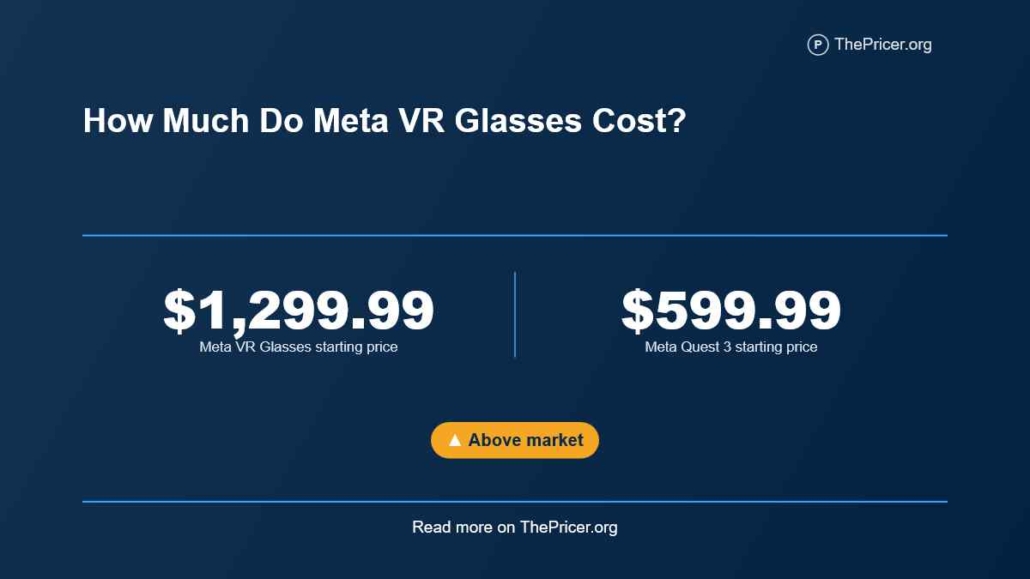
Meta VR Glasses will cost $1,299.99 in the United States when they go on sale in spring 2027. Meta announced the new virtual reality glasses at Meta Connect on September 23, 2026. The price buys the approximately 100-gram glasses and their tethered compute-and-battery puck, but buyers may spend more for Touch Plus controllers, prescription inserts, expanded microSD storage, games, subscriptions, and sales tax.
Meta VR Glasses are a new product category inside Meta’s hardware lineup. They are much lighter than a conventional Quest headset, but they still deliver full VR rather than the limited display or AI features found in Meta smart glasses. Meta’s official VR Glasses product page lists a $1,299.99 launch price, a spring 2027 release, a 5K micro-OLED display, hand and eye interaction, access to the Quest software catalog, and a pocket-sized puck that contains the processor, battery, and storage.
Article Highlights
Jump to sections
- Meta VR Glasses will start at $1,299.99 (at $30 per hour, earning that amount would take about 1.1 full-time workweeks, before taxes) in the U.S. in spring 2027.
- The glasses weigh about 100 grams, while a separate tethered puck holds the battery, compute hardware, and storage.
- The announced model has 128GB of internal storage plus a microSD slot supporting up to 1TB.
- Touch Plus controllers are compatible but are not included with the standard package.
- The glasses cost about $700 more than the current $599.99 Meta Quest 3.
- They are about $2,199 cheaper than the $3,499 Apple Vision Pro.
How Much Do Meta VR Glasses Cost?
YOU HAVE TO GIVE ME A PRICE! The confirmed U.S. starting price is $1,299.99 (about 1.1 full-time workweeks at $30 per hour). Meta has announced only one storage configuration so far, with 128GB built in and expandable microSD storage. There is no higher-capacity factory SKU with a separate price at the time of writing.
| VR device | Current or announced U.S. price | Difference vs Meta VR Glasses |
|---|---|---|
| Meta Quest 3S | $349.99 | Meta VR Glasses cost $950 more |
| Meta Quest 3 | $599.99 | Meta VR Glasses cost $700 more |
| Steam Frame | $1,059 | Meta VR Glasses cost $240.99 more |
| Meta VR Glasses | $1,299.99 | Base price |
| Apple Vision Pro | $3,499 | Meta VR Glasses cost $2,199.01 less |
The current Meta Quest lineup starts at $349.99 for Quest 3S and $599.99 for Quest 3. That makes VR Glasses roughly 2.17 times the price of Quest 3 and about 3.71 times the price of Quest 3S.
At a $30 hourly wage, earning the $1,299.99 hardware price represents about 43.3 hours of gross work, or approximately 5.4 eight-hour workdays before taxes.
What Comes With the $1,299.99 Price?
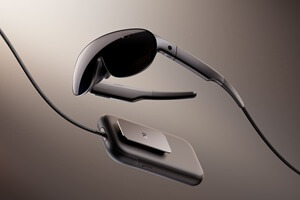
Meta’s launch announcement describes a two-piece system. The glasses contain the displays and sensors, while a small puck connected by an optical tether handles processing, battery power, and storage.
The glasses use what Meta calls a 5K Infinite Display built from micro-OLED panels. Independent technical coverage reports a resolution of 2,412 × 2,288 pixels per eye, up to a 120Hz refresh rate, and 37 pixels per degree. Meta also includes Dolby Vision support and Dolby Atmos spatial audio.
The compute puck contains Qualcomm’s Snapdragon Reality Elite processor. Meta rates the puck for up to three hours of continuous high-resolution media playback and includes support for 45W fast charging.
Meta is also putting Meta AI directly into the operating system. Users can control the interface through a combination of eye tracking, hand gestures, and voice. A controller is therefore not required for the basic interface or for games specifically designed around hand tracking.
The Hidden Costs
The biggest missing item from the $1,299.99 (about 1.1 full-time workweeks at $30 per hour) package is a traditional pair of VR controllers. UploadVR’s launch report says Touch Plus controllers are not included with the standard VR Glasses package.
Existing Touch Plus controllers from a Quest 3 or Quest 3S can be paired with the glasses. Meta also plans to sell compatible controllers separately, and UploadVR reports that controller bundles will be available through some retail channels. Meta has not announced the retail price of those bundles yet.
This distinction matters because Meta says more than 75 games will support controller-free hand gestures at launch, but the glasses also run the wider Quest library. Some existing Quest games were designed around physical controllers, so a buyer who wants full compatibility may need to budget above $1,299.99.
A buyer who already owns Quest 3 or Quest 3S controllers has an advantage because those controllers can be reused. A new buyer should not assume that the $1,299.99 box contains every input device needed for every Quest game.
Prescription Lenses Cost Extra
People who need vision correction may have another additional expense. Meta states that prescription inserts will be sold separately for VR Glasses. The frames are not designed around wearing a normal pair of eyeglasses underneath them.
Road to VR’s detailed hardware report says Meta is working with Zenni Optical on prescription inserts and that the glasses support manual interpupillary-distance adjustment from 56 to 70 mm.
Prescription-insert pricing has not been announced. That means the correct current budget is $1,299.99 plus an unknown optical charge for prescription users rather than guessing a price from Meta’s existing Quest or Ray-Ban products.
Storage Can Add Another Cost
The first announced Meta VR Glasses configuration includes 128GB of built-in storage. The compute puck also has a microSD slot supporting cards up to 1TB, according to the published hardware specifications.
A microSD card is not included. That means buyers who download many large VR games, 3D films, or local media may want to add removable storage.
This setup is different from Quest 3, where higher internal capacity means buying a different headset configuration. With Meta VR Glasses, the announced 128GB internal capacity can be supplemented later through the storage slot rather than forcing the buyer into a more expensive factory storage tier.
The practical hidden price will depend on the size and speed of the card a buyer chooses. Since Meta has not announced an official branded storage bundle, it would be misleading to add an arbitrary memory-card price to the base total.
Games and Horizon+
 The hardware price does not include every piece of content. Meta VR Glasses run the Quest software catalog, where games and apps may be free, individually purchased, or available through a subscription.
Meta Horizon+ currently costs $7.99 per month or $59.99 per year, according to Meta’s current Horizon+ subscription page. The service includes a catalog of more than 100 titles, monthly additions, discounts, and a basic Xbox Game Pass benefit.
If that $59.99 annual price remains unchanged when VR Glasses launch, the hardware plus one year of Horizon+ would cost about $1,359.98 before tax. Three years of annual Horizon+ would add $179.97, taking the combined hardware-and-subscription total to about $1,479.96.
Horizon+ is optional. Buyers can purchase individual Quest titles instead, and Meta says Xbox Cloud Gaming can also be used with a Bluetooth gamepad. Streaming services such as Disney+, Prime Video, YouTube, HBO Max, and others may carry their own subscriptions as well.
A Realistic Checkout Total
There is not yet enough published pricing to calculate one universal fully equipped VR Glasses package. Controllers and prescription inserts have no confirmed launch price, while U.S. sales tax varies by location.
For a simple example, an 8% sales tax applied to the $1,299.99 hardware would add about $104. The resulting checkout would be approximately $1,403.99. Add a $59.99 year of Horizon+ and the first-year hardware-and-subscription budget becomes roughly $1,463.98, excluding any tax on the subscription.
A gaming-focused buyer may spend more because of controllers and games. A prescription user may spend more for optical inserts. A heavy offline-media user may buy a microSD card. The $1,299.99 price is therefore a good hardware floor, not necessarily the final amount every owner will spend.
More Expensive Than Quest 3
The $700 gap over the current Quest 3 is substantial. Meta VR Glasses cost about 116.7% more than the $599.99 Quest 3.
The extra money buys a very different physical design. Meta says the VR Glasses weigh about 100 grams on the face, roughly one-fifth of Quest 3’s weight. Processing and battery hardware have been moved into the external puck, eliminating the traditional head strap and much of the mass worn on the user’s face.
Display density is another difference. Meta’s developer specifications put Quest 3 at 25 pixels per degree, while independent reporting on VR Glasses puts the new micro-OLED system at 37 pixels per degree. That is about a 48% increase in angular pixel density, although the VR Glasses use a narrower field of view.
For current pricing across the broader category, see our VR headset cost guide. The $1,299.99 Meta model lands well above mass-market Quest hardware but below the most expensive spatial-computing systems.
Meta VR Glasses vs Steam Frame
Valve’s recently released Steam Frame is a particularly relevant comparison because it also targets buyers who want something beyond entry-level standalone VR. Valve currently lists the Steam Frame at $1,059.
Meta VR Glasses cost $240.99 more, or approximately 22.8% above the Steam Frame price. The price gap is much smaller than the comparison with Quest 3.
The products also prioritize different things. Valve’s device centers heavily on Steam gaming, while Meta is selling VR Glasses as a combination of cinema, productivity display, Quest gaming system, AI device, and lightweight travel screen.
We also track the Valve device separately in our Steam Frame cost guide.
Meta VR Glasses vs Apple Vision Pro
At the other end of the market, Apple’s current Vision Pro with the M5 chip starts at $3,499. Apple confirmed that price in its latest Vision Pro pricing announcement.
Meta VR Glasses are therefore $2,199.01 cheaper, a difference of about 62.8%. Put another way, the Vision Pro starting price is about 2.69 times the Meta VR Glasses price.
That does not make the two products identical. Apple uses a larger headset-style design with its own hardware priorities and software ecosystem. The important pricing point is that Meta has positioned its new flagship well above Quest but far below Apple’s $3,499 starting level.
For a detailed cost breakdown of Apple’s system, see our Apple Vision Pro pricing guide.
The $1,299.99 Design is Different
The most unusual aspect of the new Meta product is where the weight went. Instead of placing the processor and battery on the user’s head, the system moves those components into an approximately 300-gram puck connected to the glasses by an optical cable.
TechCrunch’s launch coverage reports that the glasses use micro-OLED displays and Qualcomm’s Snapdragon Reality Elite processor and highlights Meta’s focus on movies, productivity, and immersive entertainment.
The glasses are also the first VR device Meta describes as IMAX Enhanced certified. Meta is working with Disney on 3D films and immersive cinema experiences and says there will be more than 100 immersive live sporting events per year once the glasses launch.
The Meta Connect roundup from The Verge independently confirmed the $1,299 launch price, 100-gram design, 128GB storage, 12GB of RAM, and spring 2027 release window.
When Can You Buy Meta VR Glasses?
Meta says the glasses will go on sale in spring 2027. It has not announced an exact retail date, and preorders are not open yet.
Independent Meta Connect coverage from Engadget also identifies the VR Glasses as the headline VR announcement from the September 2026 event.
Road to VR reports planned availability across 25 countries, including the United States, Canada, the United Kingdom, much of Western Europe, Japan, South Korea, Singapore, Australia, and New Zealand. Meta has not yet published final local-currency pricing for all of those markets.
That means $1,299.99 is currently the confirmed U.S. anchor. European and other international buyers should wait for official regional prices rather than converting the U.S. figure directly because VAT, retail pricing, and local product positioning can change the actual checkout price.
Who Is Paying the Extra $700?
The strongest case is for someone who already wants full VR but dislikes wearing a conventional half-kilogram headset. A roughly 100-gram pair of glasses changes where the device can comfortably be used, especially for films, flights, work sessions, and long viewing periods.
It also makes sense for users who value high display density and want a private multi-screen workspace connected to a Mac or Windows PC. Meta says users can connect a computer wirelessly or through USB-C and use virtual displays while still seeing their keyboard, phone, and surroundings through color passthrough.
The weaker price case is straightforward Quest gaming. A current Quest 3 costs $599.99 and includes Touch Plus controllers. Someone whose main goal is playing existing VR games can save about $700 before considering the fact that a new VR Glasses buyer may still need to purchase controllers separately.
Meta’s AI glasses are another different category entirely. Current Ray-Ban Meta and Meta display glasses are intended for everyday wearable AI and lighter visual functions rather than full immersive VR. Our Meta smart glasses cost guide covers those products separately.
What We Verified
- Meta’s official product and newsroom pages both state that Meta VR Glasses will go on sale in spring 2027 for $1,299.99.
- Meta says the glasses weigh approximately 100 grams and place processing, battery, and storage inside a separate puck.
- Meta’s Newsroom announcement confirms more than 75 controller-free games at launch and the company’s emphasis on films, sports, productivity, and gaming.
- UploadVR and Road to VR independently report 128GB internal storage, expandable storage, and separate Touch Plus controller support.
- The closest current price anchors are $599.99 for Quest 3, $1,059 for Steam Frame, and $3,499 for Apple Vision Pro.
Answers to Common Questions
How much will Meta VR Glasses cost?
Meta VR Glasses will start at $1,299.99 in the United States when they go on sale in spring 2027.
Do Meta VR Glasses include controllers?
The standard package does not include Touch Plus controllers. The glasses support hand and eye interaction, and more than 75 launch titles will work without controllers. Existing Quest 3 or Quest 3S Touch Plus controllers can also be paired.
Are Meta VR Glasses cheaper than Apple Vision Pro?
Yes. The Meta glasses start at $1,299.99 compared with $3,499 for the current Apple Vision Pro. The Meta hardware is about $2,199 cheaper at the starting-price level.
How much should I budget for Meta VR Glasses?
Use $1,300 as the minimum hardware budget. A more realistic first-year budget can rise above $1,400 after sales tax and optional Horizon+, then increase further if you need Touch Plus controllers, prescription inserts, a microSD card, or paid games.
Disclosure: Educational content, not financial advice. Prices reflect public information as of the dates cited and can change. Confirm current rates, fees, taxes, and terms with official sources before purchasing. See our methodology and corrections policy.