
How Much Do Morgan Wallen Tickets Cost?
Updated on | Researched and reviewed by Alec Pow, Founder & Pricing Investigator
Prices, claims, and calculations checked against 11 cited sources. See our research methodology and corrections policy.
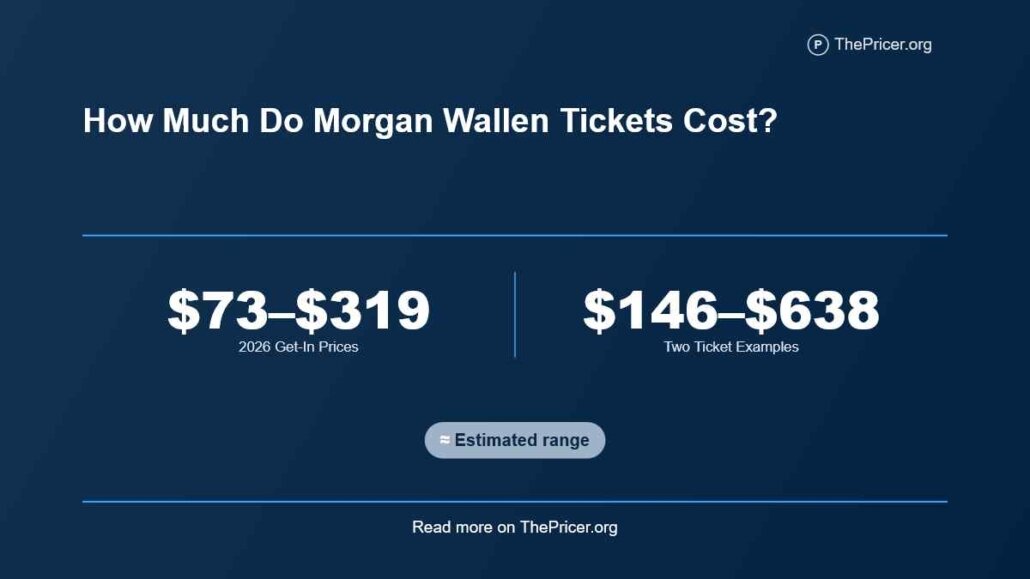
Morgan Wallen tickets cost as little as $73 to $319 per person in selected 2026 stadium-show resale listings, including mandatory fees. Those figures represent the cheapest available tickets approximately 90 minutes before each concert, not average ticket prices or guaranteed prices for future shows. Premium seats, floor sections, and VIP packages can cost considerably more.
The important update is that Wallen’s Still the Problem Tour ended on August 1, 2026. His record label confirmed that the tour sold out all 23 stadium performances across 12 North American cities. There are no remaining tickets for those concerts.
For anyone planning to attend a future Wallen show, the completed tour provides useful evidence of what tickets actually cost, how much prices differed between consecutive nights, and why the lowest advertised seat price is only part of a concert budget.
How Much Do Morgan Wallen Tickets Cost?
Jump to sections
The most useful starting point is the historical get-in price: the lowest available ticket listing for a particular performance. It tells you what a budget-conscious buyer might have paid to enter the stadium, although it says nothing about the view from that seat.
According to TicketData’s concert records, selected 2026 Morgan Wallen performances had final get-in prices between $73 and $319 per ticket. All figures in that dataset include estimated mandatory marketplace fees.
| Ticket category | Price evidence | What it means |
|---|---|---|
| Lowest recorded 2026 example | $73 | Cheapest listed entry at Clemson on June 27 |
| Selected 2026 get-in range | $73–$319 | Historical cheapest-seat listings, not all seating categories |
| Chicago, June 19 | $105 | Final Friday get-in listing |
| Chicago, June 20 | $319 | Final Saturday get-in listing |
| Early 2026 tour listings | $133–$227 | Selected all-in offers documented in November 2025 |
| Floor, pit, or VIP | No fixed verified range | Price depends on the event, section, package, and demand |
The early-tour figures come from a November 2025 ticket survey. The lower final get-in figures were recorded much closer to the actual performances. These are two different market snapshots, so neither should be presented as a permanent ticket price.
There is also a crucial distinction between the price of the cheapest seat and the amount an average fan spends. A $73 get-in does not mean that floor seats, lower-bowl seats, and VIP tickets were available for $73. It means at least one qualifying low-priced listing was observed under the tracking service’s methodology.
2026 Price Examples
The 2026 tour provides an unusually useful comparison because Wallen played consecutive nights in several stadiums. The following figures are historical final get-in prices from the same tracking service, allowing a consistent comparison across events.
| City and stadium | First date | Second date | Difference |
|---|---|---|---|
| Chicago, Soldier Field | Fri., June 19: $105 | Sat., June 20: $319 | +$214 |
| Baltimore, M&T Bank Stadium | Fri., July 17: $98 | Sat., July 18: $178 | +$80 |
| Indianapolis, Lucas Oil Stadium | Fri., May 8: $94 | Sat., May 9: $179 | +$85 |
| Denver, Empower Field | Fri., May 29: $197 | Sat., May 30: $281 | +$84 |
| Clemson, Memorial Stadium | Fri., June 26: $86 | Sat., June 27: $73 | −$13 |
| Las Vegas, Allegiant Stadium | Fri., May 1: $141 | Sat., May 2: $118 | −$23 |
These prices are per ticket, not per pair. TicketData generally tracks the cheapest available ticket in a listing suitable for two buyers, rather than an isolated single seat. Its methodology explanation specifies that the figures are observed resale listings, not completed transactions.
That limitation matters. A listing could disappear, sell, or change before a buyer completes checkout. Nevertheless, comparing recorded prices from the same provider offers a stronger basis for estimating relative costs than combining unrelated marketplace averages.
Does the Date Matter?
Yes, but there is no reliable rule that Saturday tickets always cost more.
Chicago offers the clearest example. The June 20 Saturday get-in of $319 was about 204% higher than Friday’s $105. A couple purchasing the cheapest qualifying pair would have faced approximately $638 on Saturday versus $210 on Friday, a difference of $428 before parking or travel.
Indianapolis showed a similar direction, although a smaller difference: Saturday’s $179 was about 90% above Friday’s $94. Baltimore’s Saturday entry was approximately 82% higher.
However, the pattern reversed in Clemson and Las Vegas. At Clemson, Saturday’s $73 was lower than Friday’s $86. Las Vegas had a $118 Saturday get-in compared with $141 on Friday.
The conclusion is more useful than a general claim about weekends: compare individual performances rather than assuming a particular day is cheaper. Different opening acts, available inventory, local demand, and resale activity can outweigh the calendar.
City comparisons require similar caution. Chicago was not universally expensive, and smaller cities were not uniformly cheap. The specific performance, timing of the price check, and remaining seats mattered more than a city’s reputation alone.
Seating and VIP Costs
The lowest get-in price usually points toward an inexpensive available section. At stadium concerts, that can mean an upper deck, an end-zone-style view, or a seat with greater distance from the main stage.
Lower-bowl seats often provide a better balance between proximity and overall visibility. Floor tickets put fans closer to the performance area but can have their own trade-offs, including a flatter sightline and the possibility of standing spectators obstructing the view.
Do not treat every expensive ticket as a VIP package. Ticketmaster’s Platinum Ticket explanation makes clear that these are desirable seats priced according to market demand. A Platinum designation does not automatically provide special merchandise, a meet-and-greet, or access to an exclusive area.
A true VIP package may include benefits such as dedicated entry, merchandise, hospitality, or access to a particular viewing area. Those benefits vary by event and package. Buyers should verify the included items individually instead of assuming a high price means backstage access.
Before selecting an expensive section, compare the stadium seating chart with photographs from similar concert layouts. A moderately priced lower-bowl seat with a direct view may offer better value than a more expensive floor position far from the stage extension.
For perspective on how another major stadium act’s seating and resale market works, see our guide to Coldplay concert ticket costs.
Fees and Final Prices
Concert tickets commonly carry service, facility, and order-related charges. However, an important federal pricing change means buyers should no longer have to discover unavoidable marketplace fees only at the final payment screen.
Since May 12, 2025, the Federal Trade Commission’s ticket-fee disclosure rule has required sellers to display the total price, including mandatory charges they know and can calculate upfront. Government charges, shipping, and genuinely optional extras can be handled separately under the rule.
Ticketmaster still explains the different categories of charges on its ticket-pricing help page. Those fees remain part of the transaction. The change primarily concerns how clearly they are presented.
This distinction prevents a common budgeting mistake. If a resale listing already says $150 including mandatory fees, adding another estimated 20% or 30% in service fees would double-count charges already reflected in the displayed figure.
The FTC has also continued enforcing the rule. In April 2026, it announced a $10 million StubHub refund resolution over allegations involving deceptive ticket-fee displays. This reinforces why shoppers should check the final payment total even when an initial listing is described as all-in.
Taxes and optional purchases may still alter the final charge. If a marketplace offers ticket insurance, a parking pass, or another add-on, decide whether it provides value rather than accepting it automatically.
A Realistic Concert Budget
The ticket is often the largest expense, but it may not represent the full cost of attending. Parking, transportation, accommodations, food, and merchandise can substantially change what a concert night costs.
Here is an illustrative two-person budget built around Chicago’s actual 2026 final get-in listing for Friday, June 19. The ancillary amounts are planning assumptions, not documented prices charged at that concert.
| Expense | Two-person example |
|---|---|
| Two get-in tickets, including fees | $210 |
| Parking or local transportation allowance | $35 |
| Food and nonalcoholic drinks | $50 |
| Merchandise allowance | $45 |
| Total | $340 |
The same allowances paired with Chicago’s $319 Saturday get-in would produce a $768 two-person budget. That is $428 more for the same number of tickets, without assuming different food, parking, or merchandise spending.
This calculation reveals a useful travel trade-off. If a pair could attend Friday instead of Saturday, they had a theoretical $428 ticket-price advantage. Even additional travel expenses might have left Friday cheaper, although actual seat availability and schedules could change that calculation.
For buyers traveling from another city, add a separate hotel allowance before comparing dates. A cheap ticket may not be a bargain if it requires an expensive overnight stay.
Another option is to skip optional merchandise and buy food before entering the venue, where permitted. Those choices will not change the ticket price, but they make the overall evening more predictable.
When Should You Buy?
There is no universally cheapest purchasing window. Early access can provide greater seating choice, while later resale listings may become less expensive when sellers reduce asking prices. The opposite can happen when inventory becomes scarce.
For the 2026 tour, an early published resale survey identified selected starting prices between $133 and $227, including fees. Several concerts later had lower final get-ins, but that observation does not prove every buyer would have saved money by waiting.
Consider the May 1 Las Vegas performance. TicketData’s event price history shows a final get-in of $141, compared with approximately $133 three days earlier. That was roughly a 6% increase approaching the show, demonstrating that last-minute prices do not always fall.
Use a practical three-part strategy:
- Set a full-budget ceiling. Decide the maximum per-ticket price after mandatory fees, then reserve money for travel and other purchases.
- Compare equivalent listings. Check the same date, seating area, ticket quantity, and fee-inclusive price across more than one reputable marketplace.
- Track rather than predict. If you have flexibility, monitor multiple show dates and be ready when a suitable listing falls within your budget.
Buying early is especially reasonable when you need adjacent seats, accessible seating, or a particular section. Waiting may offer potential savings, but it also introduces the risk that your preferred seats will disappear.
Our article about Billie Eilish ticket prices offers another comparison of how seat selection and resale demand can affect concert budgets.
Future Shows and Festivals

As of November 8, 2026, Ticketmaster’s Morgan Wallen artist page states that the 2026 North American tour has concluded. Buyers should therefore avoid ticket listings that misleadingly describe its April-through-August stadium dates as upcoming.
One separate event does appear on AXS’s Wallen event listing: the Sand in My Boots festival scheduled for May 21–23, 2027, in Gulf Shores, Alabama. The listing includes Wallen among a substantial group of performers.
Festival passes should not be compared directly with a one-night stadium ticket. They may cover multiple days and performers, but they also create additional transportation, accommodation, and food costs. Specific access tiers, schedules, and package terms need to be checked on the official event listing.
For future standalone concert announcements, follow Wallen’s verified artist channels and authorized primary sellers. A resale page displaying an artist’s name does not, by itself, confirm that a new tour has been announced.
Fans who are mainly interested in comparing major concert expenses can also consult our guide to Taylor Swift ticket costs.
What We Verified
Tour status: Wallen’s record label confirmed that the 2026 tour concluded on August 1 after 23 sold-out stadium shows. Ticketmaster independently identifies the tour as concluded.
Ticket figures: The $73–$319 examples come from historical resale listings recorded by TicketData. They are fee-inclusive cheapest-seat observations, generally based on listings available for two tickets. They are not average selling prices or proof of completed purchases.
Price comparisons: Friday-versus-Saturday differences were calculated from listings for the same stadium. The comparisons describe those particular performances and do not establish a universal pricing rule.
Fees: The FTC’s live-event ticket pricing rule requires clear upfront disclosure of mandatory ticket charges, subject to specified exclusions.
Unverified claims removed: We did not retain the previous article’s broad $800 city-average claims, assumed VIP price ranges, or purported current 2026 ticket offers because they could not be treated as consistently verified, current prices.
Answers to Common Questions
What was the cheapest Morgan Wallen ticket in 2026?
Among the selected final resale records reviewed, the lowest was $73 for the June 27 show at Clemson Memorial Stadium. That was the cheapest observed entry listing, including fees, rather than an advertised face-value price for every seat.
How much would two Morgan Wallen tickets cost?
Using selected 2026 final get-in examples, two tickets could total approximately $146 to $638, including mandatory resale fees. Those figures describe historical cheapest-seat listings and exclude transportation, food, accommodations, and optional extras.
Were Saturday tickets always more expensive?
No. Saturday cost considerably more than Friday for the Chicago, Baltimore, and Indianapolis examples. However, Saturday’s final get-in was lower in Clemson and Las Vegas. The cheapest day depended on the individual event.
Are ticket fees already included in displayed prices?
Mandatory charges that sellers can calculate upfront generally must be included in the displayed total under the FTC’s federal rule. Government charges, shipping, and optional extras may be handled separately. Always inspect the payment summary before purchasing.
Are Platinum tickets the same as VIP tickets?
No. Platinum tickets are desirable seats offered at market-based prices and do not automatically include special experiences. VIP packages are defined by the particular benefits included, which should be listed explicitly before purchase.
Can I still buy tickets for the 2026 Still the Problem Tour?
No. That tour ended on August 1, 2026. Any old date shown on a marketplace should be treated as a past event. Check verified sellers for new concerts or separately announced festival appearances.
Prices are in U.S. dollars. Historical listing figures reflect 2026 concerts and should not be interpreted as quotations for future performances. Research updated November 8, 2026.
Disclosure: Educational content, not financial advice. Prices reflect public information as of the dates cited and can change. Confirm current rates, fees, taxes, and terms with official sources before purchasing. See our methodology and corrections policy.