
How Much Do UPS Notary Services Cost?
Updated on | Written by Alec Pow
This article was researched using 10 sources. See our methodology and corrections policy.
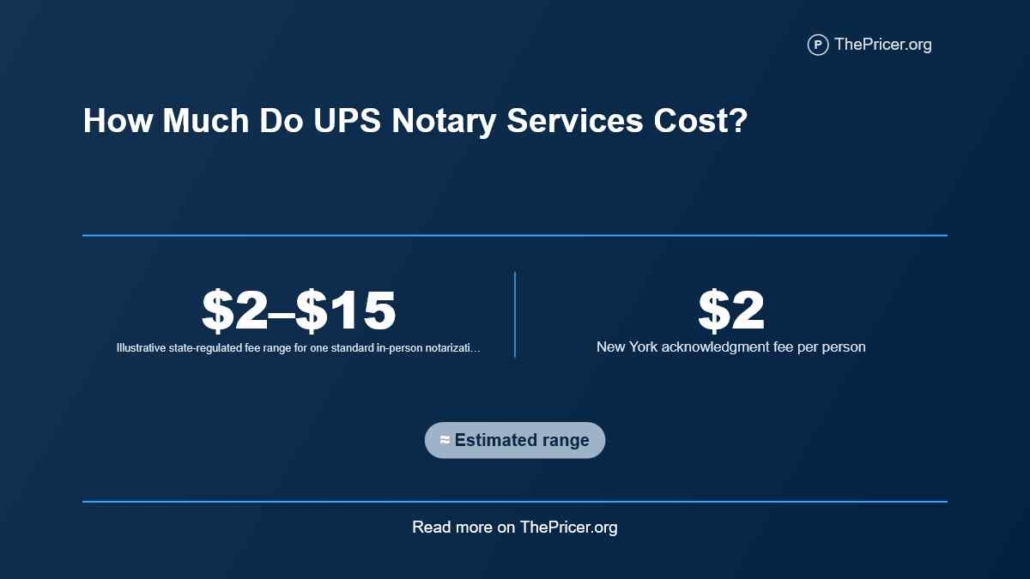
Notary services at The UPS Store can cost approximately $2 to $15 per signature or notarial act in states with the fee limits discussed below. However, there is no nationwide UPS Store notary price list. In New York, a traditional acknowledgment generally costs no more than $2 per person, while Florida allows up to $10 per notarial act and California allows up to $15 per acknowledged signature.
Those figures come from state fee schedules, not confirmed quotes from individual UPS Store locations. The actual bill depends on the state, number of signers, type of notarization, and any separately purchased copying or shipping services.
Notary service is available at participating UPS Store locations. Before visiting, confirm that a commissioned notary will be present, that the store accepts your document, and whether witnesses or an appointment are needed.
Article Highlights
Jump to sections
- The UPS Store does not publish a single national notarization price.
- New York permits $2 for a standard acknowledgment by one person.
- Florida generally caps traditional notarial acts at $10 (at $30 per hour, earning that amount would take about 20 minutes, before taxes).
- California permits up to $15 per signature for an acknowledgment.
- Two signatures or several separate notarial acts can increase the total.
- Participating UPS Store locations may offer appointments, copying, and shipping, but witnesses and document eligibility require confirmation.
How Much Do UPS Notary Services Cost?
The UPS Store states in its franchise pricing information that services, prices, and hours differ between locations. Notary fees are also governed by the laws of the state where the notarization occurs.
These differences prevent any single price from accurately representing every UPS Store. The National Notary Association’s 2026 fee comparison documents substantial variation between states, including states with no generally prescribed maximum.
| State | Maximum fee | What the amount covers |
|---|---|---|
| New York | $2 | Standard acknowledgment by one person |
| Texas | $10 (about 20 minutes at $30 per hour) | First acknowledgment signature |
| Texas additional signature | $1 | Each additional signature under the applicable acknowledgment fee provision |
| Florida | $10 | One traditional notarial act, subject to statutory exceptions |
| California | $15 | Each acknowledgment signature or a qualifying jurat |
These are statutory ceilings for the identified services, not a survey of UPS Store checkout prices. Some notaries may charge less, and different rules can apply to electronic notarization, special documents, or related services.
New York’s Executive Law Section 136 establishes the $2 fee for a traditional acknowledgment by one person, with another $2 for each additional person. This is considerably less than the original article’s broad national price estimate.
The Texas Secretary of State fee schedule permits $10 for the first signature on a qualifying acknowledgment and $1 for each additional signature. Its schedule also lists $10 for administering an oath or affirmation with a certificate and seal.
Under Florida’s 2026 notary statute, the usual maximum is $10 for one traditional notarial act. California’s 2026 Notary Public Handbook identifies the $15 maximum for each signature on an acknowledgment and for specified jurat services.
What Changes Your Total?
The most important pricing variable is the number and type of notarial acts required. A document’s length does not necessarily determine its notarization charge. A lengthy agreement requiring one acknowledgment may have a lower notarization fee than two short documents requiring separate acknowledgments.
There is also a difference between the number of pages, signatures, and notarial certificates. Counting all three as chargeable units would produce an inflated estimate in many jurisdictions.
The National Notary Association’s April 2026 fee explanation describes how multiple acknowledged signatures may constitute separate chargeable acts even when recorded on one certificate. Exact treatment depends on state law.
Document type matters when it determines which notarial procedure is necessary. An affidavit may require a jurat involving an oath or affirmation, while a deed may require an acknowledgment. The notary cannot simply choose a cheaper procedure when the document or receiving institution requires another.
Extra services can raise the transaction total. Printing documents before signing, photocopying completed paperwork, or shipping the notarized originals are separate purchases. A statutory notary-fee limit should not automatically be interpreted as the total price of an entire retail transaction.
Three Realistic Cost Scenarios
Consider three hypothetical visits using the statutory fees already established. These are calculations based on state maximums, not recorded UPS Store receipts.
New York affidavit. One person requires an eligible traditional notarization. At the applicable $2 statutory rate, the notarization costs at most $2. Printing or copying would be separate if purchased.
Texas deed with two signatures. The document requires acknowledgments from two people. The state’s fee schedule permits $10 (about 20 minutes at $30 per hour) for the first acknowledgment signature and $1 for an additional signature under the specified provision. The modeled maximum is $11.
California agreement with three signatures. Assume three individuals each require their signature acknowledged. At the $15 maximum per signature, the notarization could cost $45. The total is driven by three notarizations, not by the agreement’s page count.
This last example also explains why a multi-signature visit can exceed an advertised one-signature price without necessarily violating a state fee ceiling. The customer should identify the number of required notarial acts before requesting a quote.
A Complete UPS Notary Bill
A customer who needs both notarization and document handling should estimate the entire transaction. The UPS Store’s national notary service page confirms that participating centers can help with document copying and shipping after notarization.
Consider an illustrative California transaction involving two acknowledged signatures and additional retail services.
- Two acknowledgments at the state maximum: $30
- Printing allowance for a prepared document: $3
- Photocopying allowance: $2
- Shipping allowance: $15
The modeled total is $50. Only the $30 notarization component is calculated from the state’s documented fee ceiling. Printing, copying, and shipping are hypothetical amounts that must be replaced with the selected store’s prices.
Notarization represents 60% of this illustrated bill, leaving 40% for optional document-handling services. A customer who needs only the notarization would avoid the modeled $20 in extra spending.
This distinction is useful when comparing The UPS Store with a bank, independent notary, or other provider. A cheaper notarial act may not create meaningful savings if the customer must make an additional trip for printing or delivery.
Witnesses and Document Restrictions
One common source of unexpected expense is assuming that a notary can also provide the independent witnesses required by a document. The UPS Store warns that its notaries may not be legally permitted to serve simultaneously as signature witnesses and that stores may not have other witnesses available.
A local UPS Store notary service page tells customers to contact the center beforehand about additional witnesses and acceptable documents. It also directs customers to bring valid identification and complete paperwork.
Wills are another important exception. Although the national service page lists wills among documents that may require notarization, it warns that many stores do not notarize them. The same warning applies to I-9 Employment Eligibility Verification forms.
Notarization is not a guarantee that a will, contract, or real estate document meets every legal requirement. Some instruments need separate witnesses, special execution formalities, or other legal steps. A notary verifies the matters required for the particular notarial act but does not determine whether a document is legally sufficient.
Notaries at The UPS Store generally cannot draft legal documents or provide legal advice unless independently authorized to do so. If a document’s execution requirements are uncertain, the customer should obtain instructions from the receiving organization or qualified legal counsel.
Appointments and Preparation

The UPS Store advertises online appointment scheduling at more than 3,900 locations nationwide. Appointments are useful for confirming that a commissioned notary will be available, particularly when several signers must attend together.
The national service description does not establish a standard appointment discount. Claims that walk-in notarization costs $30 while booked appointments automatically cost $10 to $15 should not be treated as a company-wide policy.
Before visiting, identify every person who must appear and confirm the identification accepted under local notary law. Bring the entire document, including relevant attachments and the required notarial certificate where provided.
Some documents require the signature to be made in the notary’s presence. Others permit an existing signature to be acknowledged when the signer personally appears and meets the legal requirements. Because these procedures differ, customers should avoid signing in advance unless the document instructions and the notary permit it.
The store should confirm its exact charges, whether an appointment is required, and whether its notary can perform the requested act. This preparation reduces the risk of an unsuccessful visit.
Other Places to Get Documents Notarized
For customers who need one straightforward notarization, a bank or credit union may be a cheaper option than a retail notary. Some financial institutions offer complimentary notary services to eligible customers, although services, accepted documents, and appointment availability vary.
The comparison should be based on actual access. An account holder who can receive a qualifying notarization without a fee saves the entire notary charge. A noncustomer may have to pay, may face document restrictions, or may not be eligible for the service.
Independent notaries and mobile notaries are additional options. Mobile service can be convenient for multiple signers, people unable to travel, or documents requiring coordinated appointments. Travel and scheduling charges must be evaluated separately from the legally regulated notarial fee, subject to applicable state rules.
Remote online notarization may also be available where permitted. It uses electronic identity verification and an approved remote-notarization process rather than an ordinary in-person signature appointment. Customers must confirm that the receiving organization accepts the electronic document and that the procedure is lawful for their circumstances.
A standard notarization also is not interchangeable with a Medallion Signature Guarantee. Financial institutions may require the latter for securities transfers, and an ordinary notary stamp cannot replace it.
Keeping UPS Notary Costs Down
The simplest way to control expenses is to identify the number of notarial acts before arriving. A customer who assumes a transaction involves one signature when it actually requires three acknowledgments may substantially underestimate the cost.
Ask the store to distinguish the notary charge from printing, copying, shipping, and other optional retail services. Existing documents can sometimes be prepared and printed before the visit, eliminating the need to purchase printing at the counter.
The UPS Store has also advertised a California photocopy promotion providing up to five copied pages with a qualifying notary-service purchase. The published promotion expires December 31, 2026, applies only at participating California stores, and has other restrictions.
That offer reduces a related document-handling charge rather than the underlying statutory notarization fee. Customers should confirm acceptance of the promotion before relying on it.
When finished paperwork must be delivered, the cost of UPS fax services or shipping may be relevant. Buyers regularly using a franchise location for correspondence can also compare its private mailbox costs, although mailbox rental and notarization remain separate services.
When UPS Notarization Makes Sense
The UPS Store can be convenient for customers who want an in-person notary alongside copying and document shipping. Its value comes from the combination of available services and accessibility, not necessarily from offering the lowest notary fee.
Makes sense if
- A participating nearby store has confirmed a notary appointment.
- The document requires a standard in-person notarial act the store can perform.
- Printing, copying, or shipping will also be needed.
- The confirmed total is reasonable compared with other available providers.
Does not make sense if
- Your bank provides the required notarization without a fee.
- The document needs witnesses the store cannot supply.
- The store cannot perform the required notarial procedure.
- A mobile or remote option better serves the signers’ circumstances.
The important comparison is the complete cost of successfully executing and delivering the document. A low posted fee has little value if the customer arrives without the correct witnesses, identification, or document instructions.
Answers to Common Questions
Does every UPS Store have a notary?
No. Notary services are available at participating locations. Contact the selected store or use its appointment information to verify availability before visiting.
How much does UPS charge to notarize one signature?
The amount varies by state and store. State maximums for certain traditional notarial acts include $2 in New York, $10 in Florida, and $15 in California. These are legal limits, not guaranteed UPS Store prices.
Can UPS notarize a document with two signatures?
Potentially, yes. Both signers must meet the relevant identification and appearance requirements. The total fee depends on the state’s rules and the number of required notarial acts.
Will The UPS Store provide witnesses?
Not necessarily. Some stores cannot supply independent witnesses, and the notary may be prohibited from serving as one. Confirm witness availability before making an appointment.
Can I get documents notarized for free?
Some banks and credit unions provide complimentary notary services to eligible customers. Availability and document restrictions vary, so the customer should confirm that the institution can perform the required act.
Disclosure: Educational content, not financial advice. Prices reflect public information as of the dates cited and can change. Confirm current rates, fees, taxes, and terms with official sources before purchasing. See our methodology and corrections policy.