
How Much Do XREAL AURA XR Glasses Cost?
Published on | Written by Alec Pow
This article was researched using 14 sources. See our methodology and corrections policy.
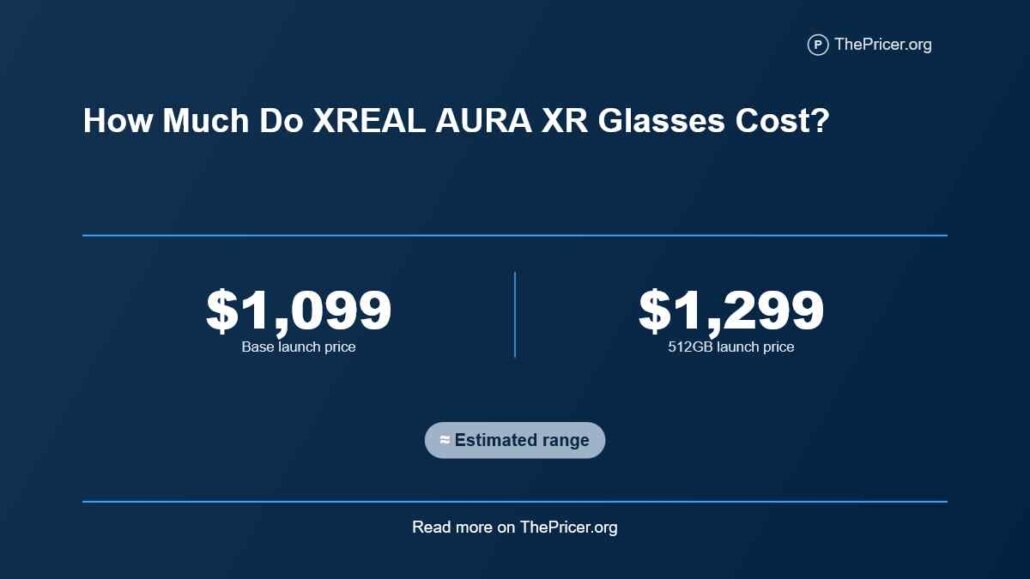
XREAL AURA XR glasses cost $1,099 to $1,299 in the United States during the introductory promotion running through December 2026. The regular retail prices are $1,279 for the 12GB RAM/256GB model and $1,499 for the 16GB RAM/512GB model. Both configurations include the wired glasses and their separate Android XR computing puck. Prescription lenses, optional input accessories, and applicable sales tax can increase the total.
The glasses launched on October 28, 2026, following a preorder period that began earlier in the year. XREAL and Google developed the product around Android XR, combining transparent optical displays, spatial applications, and Gemini assistance. U.S. ordering is open, with initial shipments expected in mid-November. The two memory configurations share the same main display system, so the higher price primarily buys additional RAM and storage.
Article Highlights
Jump to sections
- The introductory U.S. price is $1,099 for 12GB/256GB or $1,299 for 16GB/512GB through December 2026.
- Regular retail prices are $1,279 and $1,499, respectively.
- The base glasses package includes the computing puck, carrying case, USB-C cable, nose pads, and prescription-lens frame.
- Optional productivity and gaming bundles start at $1,178 and $1,198.
- Prescription lenses start at $59.90 and are a separate purchase.
- Initial U.S. shipments are expected in mid-November 2026, with delivery timing dependent on order priority and inventory.
How Much Do XREAL AURA XR Glasses Cost?
XREAL lists two configurations with different memory and storage capacities. The company’s current launch pricing announcement confirms the promotional prices and the amounts that buyers save against the original retail figures.
| XREAL AURA configuration | Launch price | Regular price | Promotional savings |
|---|---|---|---|
| 12GB RAM, 256GB storage | $1,099 | $1,279 | $180 |
| 16GB RAM, 512GB storage | $1,299 | $1,499 | $200 |
The launch discounts amount to approximately 14.1% for the entry-level version and 13.3% for the higher-capacity version. Those percentages compare each promotional price with its corresponding regular price, not with a third-party retailer’s advertised offer.
The October 7 preorder announcement used the higher regular prices before the company introduced its October 28 promotion. Older articles quoting $1,279 as the starting price are describing that earlier offer.
The difference between the two launch configurations is $200. Moving to the larger model adds 4GB of RAM and 256GB of storage, while both versions use XREAL’s Android XR computing architecture. Buyers who mainly stream content or work with a limited collection of applications may find the base configuration sufficient. People planning to install more applications or store larger amounts of media locally have a stronger reason to consider the upgrade.
What the Hardware Includes
AURA is a two-part spatial computing device. The glasses provide transparent optical displays and sensing hardware, while a wired companion unit called the Puck supplies processing, battery power, and physical controls.
Google’s October 28 Android XR announcement describes the 70-degree field of view, Gemini integration, and lightweight glasses design. Unlike a conventional headset that replaces the user’s view with camera-generated surroundings, AURA uses transparent lenses to place digital content over the directly visible environment.
XREAL’s product specifications identify Sony Micro-OLED panels with 1,920 × 1,200 resolution per eye, refresh rates reaching 120Hz, and five levels of electrochromic lens dimming. The glasses also include motion tracking, cameras, microphones, and audio tuned by Bose.
The computing puck contains Qualcomm’s Snapdragon Reality Elite platform, a 4,455mAh battery, and connectivity hardware. The glasses use XREAL’s X1S spatial coprocessor.
The official U.S. product listing identifies the following standard package contents.
- XREAL AURA glasses
- Companion computing puck
- Carrying case
- USB-C cable
- Multiple nose pads
- Prescription-lens frame
The puck is included in the advertised hardware price. Buyers do not need to purchase a separate XREAL Beam Pro to operate AURA as its intended Android XR system.
The included prescription frame should not be confused with completed prescription lenses. Those are sold separately.
Productivity and Gaming Bundles
XREAL sells accessories that turn AURA into a more practical portable workstation or gaming device. The bundles are optional, since users can interact through hand gestures, voice, the puck’s touchpad, and compatible Bluetooth input devices.
The official Productivity Bundle listing starts at $1,178. It combines the base AURA system with an XREAL keyboard, adding $79 to the introductory glasses price.
The Gaming Bundle starts at $1,198, adding $99 for a dedicated controller.
Buyers who want both accessories can select the All-in-One Bundle, currently advertised from $1,277.
There is a useful pricing distinction. The All-in-One Bundle costs exactly the same as the base promotional glasses plus the two accessory additions, using the listed bundle figures.
$1,099 + $79 + $99 = $1,277.
Consequently, the advertised bundle does not demonstrate an additional saving over buying those components at the same implied promotional prices. Its advantage is purchasing the complete accessory combination together. The actual prices of separately purchased accessories should be checked if a buyer is considering that route.
For someone who already owns a suitable Bluetooth keyboard or controller, purchasing the basic package could avoid unnecessary accessories. Compatibility should be checked for the intended applications, particularly games requiring specific input methods.
Prescription Lens Costs
XREAL AURA supports prescription inserts for users who need vision correction. The company currently advertises AURA prescription lenses starting at $59.90, reduced from a displayed regular price of $159.90.
The ordering process includes lens-index and lens-type choices, along with prescription strength and pupillary-distance information. Buyers should confirm the final lens price after selecting the required specifications.
XREAL identifies an important purchasing restriction. The lenses are customized products, normally nonreturnable except for qualifying quality issues. They are supplied through a third-party optical partner, with stated production and international delivery periods separate from the glasses shipment.
Using the advertised starting lens price, a prescription user choosing the base AURA configuration would spend $1,158.90 before tax.
The higher-capacity AURA with those same starting-price prescription lenses would total $1,358.90 before tax.
These figures assume the selected prescription qualifies for the advertised lens price. Buyers with more demanding optical requirements should confirm their actual lens configuration before using either total as a budget.
Reservations, Credits, and Refunds
AURA’s preorder history creates a pricing complication for people who reserved the glasses before general ordering opened.
During the initial reservation campaign, XREAL offered a $99 payment that provided $199 in purchase credit. It subsequently offered other priority and Founder reservation arrangements. Those credits were associated with specific accounts and redemption terms.
The company’s June 2026 reservation announcement documents the original promotional arrangement. It should be treated as historical offer information, since general purchasing rules have changed since that announcement.
Reservation payments should not automatically be added to the full retail price. Depending on the pass, they may represent prepaid purchase credit or a promotional credit exceeding the amount originally paid.
Those arrangements also should not be assumed to stack with the current launch discount. XREAL’s purchase instructions restrict orders to one redemption code, and the earlier credit terms prohibit combining certain promotions unless expressly permitted.
Existing customers must follow the redemption instructions associated with their original reservation. The final amount depends on their specific pass and the eligible offer applied at checkout.
There is also protection for buyers who paid the original hardware price before October 28. XREAL says qualifying fully paid orders are eligible for a refund of the difference created by the later launch promotion. The company expects to initiate those refunds within 30 days, returning the money through the original payment method.
A Realistic Checkout Budget
The advertised price is the hardware price before any applicable sales tax. XREAL’s U.S. store advertises free shipping above $100, which covers the listed AURA packages, although the buyer should still verify the destination-specific checkout amount.
Consider an illustrative U.S. buyer who wants the entry-level AURA, both XREAL input accessories, and standard prescription lenses. Assume an 8% sales-tax rate applied to the entire purchase. That rate is a calculation assumption, not a claim about the tax rate in a particular city or state.
- 12GB/256GB AURA glasses and puck: $1,099.00
- XREAL keyboard addition: $79.00
- XREAL controller addition: $99.00
- Prescription lenses at advertised starting price: $59.90
- Subtotal: $1,336.90
- Illustrative 8% sales tax: $106.95
- Calculated total: $1,443.85
This is a calculated purchase scenario, not a completed customer transaction. It excludes separately purchased applications, subscriptions, replacement parts, and any additional charges that might appear for a particular destination or prescription.
The total is approximately $345 above the base advertised glasses price. Of that increase, $237.90 comes from the optional accessories and prescription lenses, while the rest represents the illustrative sales tax.
For comparison, the base $1,099 glasses alone would cost $1,186.92 under the same assumed 8% sales tax. The buyer who already owns suitable input devices and does not require prescription lenses therefore has a much lower initial spending requirement.
Shipping, Warranty, and Ownership
XREAL expects initial U.S. orders to start shipping in mid-November 2026. Shipments are scheduled in batches, with earlier reservation groups receiving priority under the company’s published fulfillment arrangements.
Google’s launch information specifies U.S., Canadian, and South Korean ordering from October 28, with Japanese ordering starting November 2. Google’s AURA product page also displays the introductory U.S. starting price.
Broader international availability remains a separate question. A country appearing on an earlier reservation list does not establish that local retail delivery is available at the U.S. launch price.
For U.S. orders, XREAL advertises a one-year warranty. Its published warranty policy governs covered defects and service conditions. Buyers should retain their purchase documentation and review the applicable coverage for the glasses, puck, and accessories.
The company also advertises a 30-day product return window, with the return and refund policy setting out the conditions. Customized prescription lenses have more restrictive return treatment than standard hardware.
There is no separately advertised mandatory monthly AURA hardware subscription in the reviewed product offer. Paid applications, media streaming, cloud services, or other digital purchases can still create ongoing expenses. Users should not assume every Android XR application or Gemini-related service will remain available without additional charges.
Replacement pricing for the AURA computing puck and battery system was not established in the inspected retail information. Because the puck supplies essential processing and power, a damaged or lost puck would be a more consequential ownership issue than a missing ordinary eyeglass accessory. Buyers should ask XREAL about replacement availability instead of assigning an unsupported repair figure.
AURA vs Other XR Devices
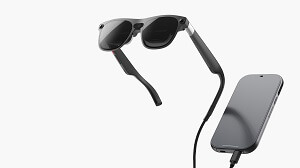 AURA occupies a different part of the wearable-computing market from simple Bluetooth smart glasses. Its integrated displays, tracking system, and Android XR software support spatial applications that audio-only glasses cannot provide.
At the introductory $1,099 price, AURA also undercuts Meta’s announced $1,299.99 VR Glasses price by $200.99. The two products are not directly equivalent. Meta’s device is designed for immersive VR, while AURA prioritizes transparent optical viewing and applications placed within the visible environment.
Readers comparing the two can examine the Meta VR Glasses cost breakdown. Meta’s planned release is in spring 2027, so its announced price is not a currently purchasable alternative to AURA’s October 2026 ordering offer.
Independent Road to VR launch coverage also confirms AURA’s temporary configuration prices and identifies the different supported interpupillary-distance sizes.
At the premium end, Apple’s Vision Pro starts at $3,499 in its current M5 configuration. Compared with the promotional base AURA, the difference is $2,400. The Apple Vision Pro pricing guide covers that larger headset and its ownership expenses.
Vision Pro has a different enclosure, display arrangement, operating system, and interaction design. The price difference should not be interpreted as a measured performance difference.
Buyers interested mainly in calls, spoken AI assistance, or audio may find substantially cheaper products. The Ray-Ban Meta Audio glasses start at $349, but do not provide AURA-style spatial displays.
TechCrunch’s October 28 launch report independently confirms the two AURA configurations, temporary discounts, and expected mid-November shipping schedule.
Who Should Buy AURA?
AURA’s pricing makes more sense for people seeking a portable spatial-computing system than for buyers who only want ordinary smart-glasses functions. The value depends on how much of Android XR’s application and multitasking capability the owner will actually use.
Makes sense if
- You want transparent XR displays for spatial applications and multitasking.
- You prefer a lighter glasses-style device with processing handled by a separate puck.
- You want to explore Android XR and Gemini within one dedicated wearable system.
- You can purchase during the introductory discount period.
Does not make sense if
- You mainly want music, calls, and voice assistance without visual displays.
- You require a completely wireless, self-contained pair of glasses.
- You primarily want traditional immersive VR gaming and the Quest software catalog.
- You need guaranteed immediate delivery or local availability outside the initial markets.
Potential buyers should also measure their interpupillary distance before selecting the frame size. The advertised medium and large options accommodate different measurements, and selecting the correct fit affects how comfortably the displays can be viewed.
Answers to Common Questions
How much are XREAL AURA XR glasses?
The introductory U.S. prices are $1,099 for 12GB/256GB and $1,299 for 16GB/512GB through December 2026. Regular prices are $1,279 and $1,499.
Does XREAL AURA include the computing puck?
Yes. The computing puck, glasses, carrying case, USB-C cable, nose pads, and prescription-lens frame are included in the standard package.
When will XREAL AURA ship?
Initial U.S. shipments are expected in mid-November 2026. Actual timing depends on inventory, destination, and fulfillment priority.
Do you need a subscription to use XREAL AURA?
No mandatory recurring hardware subscription is listed in the reviewed purchase offer. Individual applications, games, media services, and other digital content may require separate payments.
Are XREAL AURA prescription lenses included?
The mounting frame is included, but prescription lenses are purchased separately. XREAL currently advertises compatible custom lenses starting at $59.90.
Disclosure: Educational content, not financial advice. Prices reflect public information as of the dates cited and can change. Confirm current rates, fees, taxes, and terms with official sources before purchasing. See our methodology and corrections policy.