
How Much Does 1X NEO Home Robot Insurance Cost?
Published on | Written by Alec Pow
This article was researched using 14 sources. See our methodology and corrections policy.
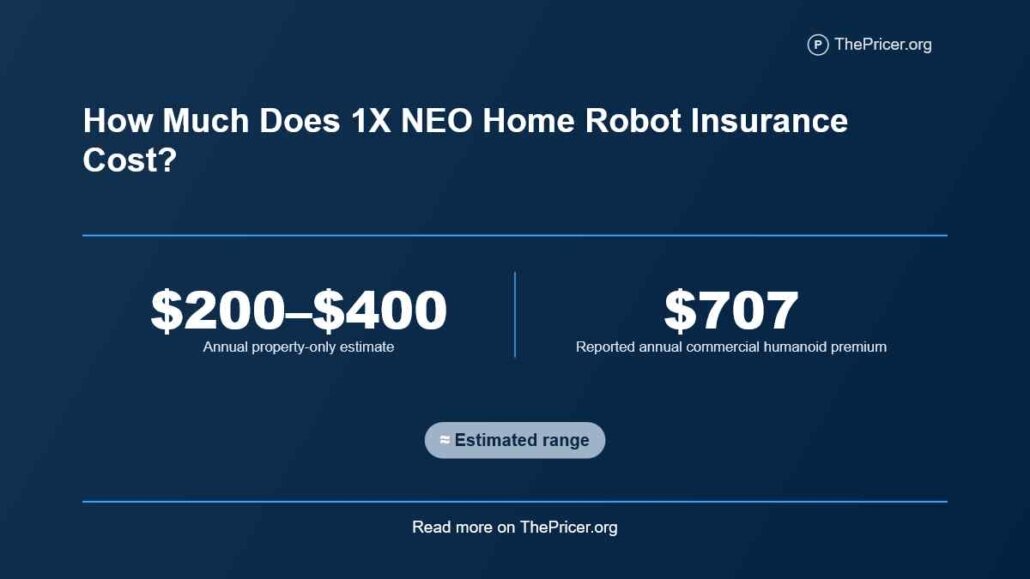
Insurance for a $20,000 1X NEO home robot could cost approximately $200 to $400 per year for protection against theft and accidental physical damage, based on published rates for high-value personal property. This is a property-only budgeting estimate, not a quoted premium for NEO. Insurance covering injuries or damage the robot causes to other people or their belongings would require separate confirmation and could increase the bill.
There is now a real price reference from the humanoid insurance market. A Chinese institution reportedly paid approximately $707 per robot for one year for insurance covering physical damage and third-party liability. That policy was written for commercial research robots, not the 1X NEO or a US household. It demonstrates that insurers are issuing robot-specific policies, but its premium cannot be treated as an American consumer rate.
The newest development is a UK household policy launched on October 29, 2026, by Tokio Marine HCC International and Adrian Flux. It covers several risks associated with domestic humanoid robots, but its premiums are individually quoted. US buyers still need written confirmation from their own insurer that NEO is eligible for coverage.
Article Highlights
Jump to sections
- $200–$400 per year: Illustrative NEO property-insurance budget based on scheduled-valuables rates, excluding robot-caused liability.
- $707 per robot: Reported annual premium for a Chinese institutional humanoid policy covering physical damage and third-party liability.
- $20,000: Official 1X NEO Early Access purchase price, including a three-year warranty.
- $499 per month: NEO subscription price, with insurance responsibilities not specified in the public pricing summary.
- £5,000: Published UK policy limit for certain sudden damage caused by an insured robot to the home or its contents.
- $600–$1,200: Three-year property-insurance budgeting range if the modeled annual premiums remain unchanged.
How Much Does 1X NEO Home Robot Insurance Cost?
The most useful starting point is NEO’s insured value. The official 1X order page lists Early Access ownership at $20,000, including a three-year warranty, premium support, and priority delivery. The alternative Standard subscription costs $499 monthly. Neither advertised price identifies a separately priced insurance policy.
For an owner purchasing the robot outright, one possible insurance route is a scheduled personal property endorsement. This type of coverage lists an individual valuable item and assigns it an insured value. However, an insurer would first have to determine whether an autonomous humanoid qualifies under its underwriting rules.
NerdWallet’s scheduled-property research puts the cost of insuring eligible valuables at roughly 1% to 2% of their value annually. Applying those percentages to NEO produces a conditional estimate of $200 to $400 per year.
| Insurance benchmark | Annual cost | Coverage scope |
|---|---|---|
| Scheduled property at 1% | $200 | Modeled protection for NEO’s physical value |
| Scheduled property at 1.5% | $300 | Midpoint of the illustrative range |
| Scheduled property at 2% | $400 | Upper end of the illustrative range |
| Chinese institutional humanoid policy | About $707 | Reported physical-damage and liability coverage for a different robot |
| UK domestic humanoid policy | Individual quote | Property, specified robot-caused damage, and liability |
| US NEO-specific policy | No verified public premium | Eligibility and covered risks require confirmation |
The first three rows are calculations, not insurer offers. The Chinese price comes from a different market and includes liability protection, making it a stronger indication that robot-specific insurance exists but a weaker comparison for a US homeowner’s actual premium.
A separate Policygenius pricing study reports approximately $100 per $10,000 insured annually for scheduled property in one category. That supports the 1% reference but does not establish that a moving robot receives the same rate as a camera, piece of jewelry, or collectible.
A Real Humanoid Insurance Premium
One of the clearest published examples comes from China. In a report on humanoid robot insurance, China Daily documented a policy purchased by Huazhong University of Science and Technology Business Incubator for two humanoid robots weighing approximately 60 kilograms each.
The reported annual premium was 5,000 yuan, approximately $707 per robot. The policy provided maximum compensation of 500,000 yuan for damage occurring within the insured year. It included protection for physical damage and third-party liability.
The insurer, PICC Property and Casualty, described risks including collisions, falls, overturning, fire, electrical failures, and certain abnormal operations. Its liability protection addressed injuries or property damage caused to third parties during robot operation.
This is a real reported transaction, not an invented market estimate. Yet it has limits as a NEO comparison. The insured robots were used in an institutional setting involving research and business activity. Their purchase values, deductibles, underwriting conditions, and exact liability limits are not interchangeable with a US consumer’s household policy.
Nor should the reported compensation ceiling be mistaken for the robot’s replacement value. The two numbers answer different questions. The premium tells us what that institution reportedly paid, while the compensation figure describes a maximum payment under the policy.
Another development comes from Japan. Tokio Marine & Nichido’s October 26 insurance announcement describes a product beginning in November 2026 for commercial AI robots, including humanoids. It provides coverage for equipment damage, liability, and certain business-continuity expenses.
The Japanese insurer states that premiums and conditions are determined individually according to the robot’s use and operating environment. Its published terms also exclude damage arising directly or indirectly from cyber incidents. That is a meaningful limitation for connected robots, even when the policy otherwise covers physical accidents.
The New UK Policy
On October 29, 2026, Tokio Marine HCC International announced a partnership with Adrian Flux to provide household insurance for domestic humanoid robots in the UK. The underwriter’s announcement confirms that the product is distributed through Adrian Flux’s home insurance offering.
The policy is important because it brings several robot-specific risks into one household arrangement. Rather than treating the machine solely as an expensive possession, it addresses certain damage caused by the machine itself.
Adrian Flux’s published coverage details identify several possible protections.
- Accidental physical damage to the robot.
- Fire, theft, and attempted theft.
- Emergency recovery or safe disablement after an unforeseen malfunction.
- Sudden damage the robot causes to the home or insured belongings.
- Personal liability associated with ownership of the robot.
For certain sudden damage to the home or contents, Adrian Flux identifies a £5,000 limit. It also describes replacement of a stolen robot on a new-for-old basis, subject to the actual policy terms.
The broker has not published a standard annual premium. A customer must obtain an individual quotation. The policy is also a UK offering, and the public description does not establish that every NEO model or configuration is automatically accepted.
Independent coverage of the launch identified additional information that remains unpublished, including the policy’s full wording and excess. Without those details, assigning the new UK product a specific premium would be speculative.
What Coverage Matters?
NEO owners need to distinguish three kinds of financial risk. Each may require a different part of an insurance contract.
Damage to the robot
Physical-damage insurance may reimburse an eligible owner if the robot is stolen or damaged by a covered event. A mechanical fault is not necessarily an insured accident. Damage caused by wear, poor maintenance, or an excluded software problem may receive a different response.
State Farm’s personal articles policy description includes certain electronics among potentially eligible valuables and discusses theft, accidental damage, and replacement-cost protection. It does not identify NEO as an accepted item. That distinction matters before using its product as a pricing comparison.
Damage caused by NEO
A household robot could damage furniture, knock over equipment, or accidentally injure a visitor. These losses are not identical to damage suffered by the robot itself.
The National Association of Insurance Commissioners explains that homeowners insurance commonly combines personal property protection with certain legal liability coverage. Whether autonomous movement, remote operation, or software-directed behavior falls within an individual policy is a separate question.
A liability policy intended to protect you when you injure another person might not pay to replace your own damaged television. Likewise, insurance covering NEO against theft does not automatically protect you if the robot damages someone else’s property.
Cyber and remote-operation risks
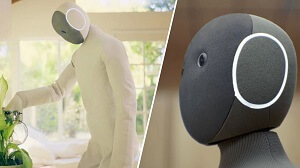
NEO has a camera-based perception system and an Expert Mode that permits scheduled remote assistance for unfamiliar tasks. An insurer may want to know when the robot operates autonomously and when someone else controls it.
Commercial robotics insurers distinguish these exposures. Swiss specialist 1B Assurance lists separate humanoid coverage modules addressing physical injury, robot damage, autonomy malfunction, and sensing-related privacy risks. Its offering is designed for commercial customers and does not supply a household NEO premium.
The lesson for a buyer is practical. A policy can cover accidental collisions while excluding certain cyber events. The exact triggering event matters as much as the insured amount.
US Homeowners Coverage
A US homeowner should start by asking the existing insurer whether NEO qualifies as personal property and, if it does, which losses are covered. The answer should identify the robot by model, purchase value, and expected use.
Homeowners insurance may already cover some losses to ordinary household belongings. Adding NEO’s value to the home inventory does not automatically create accidental-damage coverage, though, and standard personal property protection can have exclusions or limits.
Renters need a similar review. The NAIC’s policy guidance separates property coverage, liability protection, deductibles, and endorsements. Renters should also ask whether damage to a landlord’s property would be covered when caused by the robot.
The insurer should answer five concrete questions.
- Can NEO be listed for its full $20,000 value?
- Are falls, collisions, accidental damage, and theft covered?
- Does personal liability apply when NEO injures a visitor?
- Are remote operation and software malfunctions excluded?
- What deductible, annual premium, and claim limits would apply?
If the existing policy provides adequate protection, a separate endorsement might not be necessary. If the insurer will cover only theft or fire, the buyer still needs to decide whether other exposures justify specialist insurance.
Three-Year Insurance Costs
ThePricer’s calculated three-year budget for property-only insurance on an owned $20,000 NEO is $600 to $1,200, assuming a constant premium equal to 1%–2% of the original purchase value. This is a conditional estimate derived from scheduled-property rates, excluding third-party liability, tax, deductibles, and changes at renewal.
Consider an illustrative owner whose insurer accepts NEO at a 1.5% annual property rate. The cost model is itemized below.
- NEO purchase price: $20,000
- Assumed first-year property premium: $300
- Assumed second-year premium: $300
- Assumed third-year premium: $300
- Three-year premiums: $900
- Three-year purchase plus property insurance: $20,900
The model assumes the robot remains insured at its original value and premiums do not change. It does not price liability insurance. The owner’s warranty may address qualifying defects, but it should not be credited as payment for an accident unless the actual warranty covers that event.
Deductibles can change the value of a policy. Suppose a covered incident causes $5,000 in repair costs and the policy has an assumed $1,000 deductible. Subject to adequate limits, the insurer would pay $4,000. The owner would pay the deductible, plus any premiums already paid.
With a $300 annual premium, one such covered incident could create a much larger benefit than the year’s insurance expense. A small repair costing less than the deductible would produce no claim payment. These are hypothetical examples, not observed NEO claims.
The choice also depends on whether the policy pays replacement cost or depreciated value. The NAIC’s replacement-value explanation shows why actual cash value can produce a smaller payment for older property. That difference could be substantial for an expensive electronic machine whose replacement market is still developing.
Buying vs. Subscribing
 NEO’s subscription changes the insurance decision because a subscriber does not make the same upfront purchase as an owner. Yet the advertised monthly fee alone does not tell the customer who must insure the machine or pay for accidental damage.
At $499 per month, subscribing for 36 months costs $17,964. Buying costs $20,000 before insurance. Adding three years of modeled property premiums raises the ownership outlay to $20,600–$21,200.
That makes the subscription’s three-year cash outlay $2,636–$3,236 lower in this limited comparison. The difference is not a complete economic saving. The owner still possesses an asset, while a subscriber’s return obligations, repair charges, and insurance responsibilities depend on the final agreement.
There is also a useful break-even calculation. Ignoring resale value and all costs except the published purchase/subscription prices, the subscription reaches the $20,000 purchase amount during month 41. If an owner pays the modeled annual insurance equivalent of $200, the equal-cash-outlay point moves into month 42. At $400 annually, it moves into month 43.
The calculation uses the equation of purchase price plus modeled insurance accrued over time versus $499 multiplied by elapsed months. It shows how even a comparatively modest property premium moves the purchase-versus-subscription threshold. It does not assume 1X includes insurance with the subscription, which remains unconfirmed.
A final cost issue concerns the reservation deposit. The 1X pre-order agreement says the $200 deposit is refundable until 14 days after an order invitation is sent, after which it becomes nonrefundable. It also states that final pricing and add-ons can change before acceptance. Buyers should check the final contract before treating an advertised subscription as their complete commitment.
Choosing a Policy
The best insurance arrangement is the one that covers the losses most relevant to the robot’s actual use at a defensible premium. A low-priced property endorsement may protect NEO against theft but leave its owner exposed to a claim after an accidental injury. A broader specialist policy could address both categories, although its exclusions and limits still determine the value.
Makes sense if
- The insurer confirms NEO eligibility in writing.
- The policy covers the accidents that would create the largest potential bill.
- Replacement-cost protection materially improves the likely claim payment.
- The premium and deductible are reasonable relative to the covered exposure.
Does not make sense if
- The policy excludes autonomous operation, its main source of concern.
- Its coverage duplicates protection already confirmed under an existing policy.
- The deductible absorbs most of the damage likely to be claimed.
- The insurer cannot explain who bears responsibility during remote operation.
For context, the 1X NEO purchase cost is a separate decision from its insurance. Competing machines in the Unitree humanoid lineup have different purchase values and uses, so their insurance needs may differ. The AiMOGA Mobo home robot has a different commercial status, making any direct premium comparison premature. Our collectibles insurance cost guide explains how scheduled-property premiums and limits work for established categories of valuable possessions.
Answers to Common Questions
Can you insure a 1X NEO for $200 a year?
Possibly, but no insurer quote confirms that price. $200 per year is 1% of NEO’s $20,000 purchase value, using a benchmark from scheduled personal property insurance. Robot eligibility and the actual premium require an individual insurer’s approval.
Does the new UK robot policy cover 1X NEO?
It is intended for domestic humanoid robots, but the public description does not guarantee acceptance of every NEO configuration. Adrian Flux must confirm eligibility, premium, excess, and the applicable terms.
Does NEO’s three-year warranty include accidental damage insurance?
The advertised warranty does not establish broad theft or accidental-damage coverage. Buyers need the warranty conditions and any insurance agreement to determine which events qualify for repair, replacement, or reimbursement.
Does the $499 NEO subscription include insurance?
The public pricing summary does not identify an included insurance policy. The buyer should confirm responsibility for theft, accidental damage, repairs, and third-party claims under the actual subscription agreement before accepting the robot.
Disclosure: Educational content, not financial advice. Insurance pricing depends on underwriting, coverage limits, deductibles, and region. Confirm quotes and policy terms with a licensed insurer. See our methodology and corrections policy.