
How Much Does 3D Printing A Mask Cost?
Updated on | Researched and reviewed by Alec Pow, Founder & Pricing Investigator
Prices, claims, and calculations checked against 10 cited sources. See our research methodology and corrections policy.
3D printing a decorative mask at home can cost approximately $3 to $15 in filament, electricity, and basic finishing supplies if you already own a suitable printer. A more complete DIY budget, including equipment wear and the value of your time, can reach $20 to $60 or more per mask. Custom-printed cosplay masks from independent sellers can cost $75 to $150 or more, depending on size, design work, and finishing.
These are different cost categories, not a verified average price for every 3D-printed mask. A lightweight PLA costume mask requires less material than a full helmet. Detailed resin prints, custom sizing, elaborate painting, and professional fabrication can increase the total substantially. This article focuses on decorative, theatrical, and cosplay masks rather than medical or respiratory protective equipment.
Article Highlights
Jump to sections
- A basic decorative mask can cost approximately $3 to $15 in DIY consumables, excluding printer ownership and labor.
- Bambu Lab’s September 2026 U.S. price for PLA Basic refills is $15.99 per kilogram.
- A 150-gram mask requires approximately $2.40 of PLA at that price, before support waste.
- A complete illustrative DIY mask costs $39.97 when equipment, finishing, and two hours of labor are counted.
- One inspected custom-printing offer costs $152.46, while another commission starts at $117.05.
- Buying a printer solely for one mask can cost considerably more than outsourcing the project.
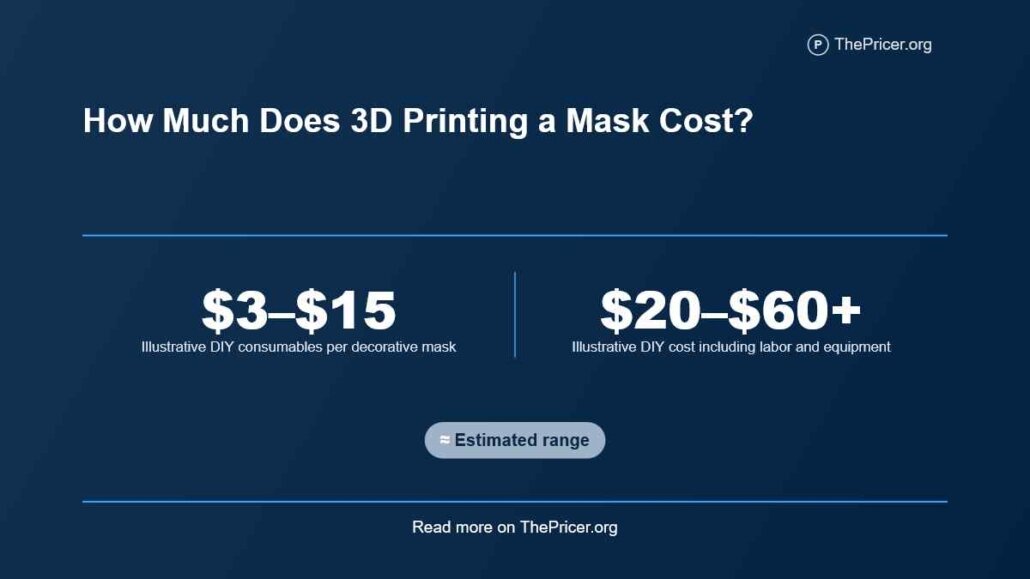
How Much Does 3D Printing a Mask Cost?
Costs depend on whether you are printing a model yourself, purchasing a raw print, commissioning a custom design, or ordering a painted costume piece.
A current custom PLA mask printing listing advertises a $152.46 service using a customer-supplied STL design. A separate wearable cosplay mask commission starts at $117.05 and advertises custom modeling, sizing, and optional finishing.
These are individual marketplace listings, not a statistically representative U.S. price range. Exact specifications and included services vary.
| Mask production option | Estimated or listed cost | What the price includes |
|---|---|---|
| 150 g PLA mask | $2.40 | Filament only, calculated |
| 300 g PLA mask | $4.80 | Filament only, calculated |
| Basic home print | $3–$15 | Illustrative consumables budget |
| DIY with labor and equipment | $20–$60+ | Illustrative production budget |
| Custom cosplay commission | From $117.05 | One seller’s advertised starting price |
| Custom PLA mask or helmet print | $152.46 | One seller’s advertised service |
A printed mask may arrive with visible layer lines and support marks. Ask whether the quoted price includes sanding, priming, painting, padding, straps, and shipping. These details can matter more than a small difference in advertised print prices.
Filament and Resin Costs
Fused deposition modeling, commonly called FDM, creates objects by depositing heated filament in layers. It is well suited to many decorative masks, especially larger hollow designs that will be sanded and painted.
Bambu Lab’s September 2026 pricing announcement lists U.S. refill prices of $15.99 for 1 kg of PLA Basic and $13.99 for PETG Basic. Discounts may apply to larger purchases, but those discounts should not be assumed for one spool.
At $15.99 per kilogram, PLA costs approximately 1.6 cents per gram. A model using 150 g costs $2.40 in filament. A 300 g version costs $4.80. Support structures and rejected prints increase consumption.
Material selection also affects durability. PLA is relatively convenient for indoor display and costumes. PETG may offer improved toughness for some applications. ABS and ASA can be more demanding to print because of temperature control and ventilation requirements.
Resin printing offers fine detail, but the process involves uncured liquid resin, washing, curing, and additional handling precautions. A smooth-looking resin surface should not automatically be assumed suitable for prolonged skin contact.
For a deeper breakdown of PLA, PETG, resin, and specialty materials, see our 3D printer material cost guide. The material’s price per unit is only one part of a finished mask’s budget.
A Complete DIY Mask Budget

Counting only filament understates the cost of making a finished decorative mask. A proper estimate includes machine operation, electricity, hands-on preparation, print cleanup, finishing supplies, and a reasonable allocation for equipment wear.
The Prusa 3D printing calculator uses filament weight, machine time, electricity, preparation, post-processing, and equipment costs to estimate production expenses. These are the right categories to consider when putting a price on custom work.
Worked Example for One PLA Mask
Consider an illustrative project using a 150 g decorative mask plus 30 g of support material and waste. Assume six hours of printing at an average draw of 100 watts, two hours of hands-on work, and a printer already owned by the maker.
- 180 g of PLA at $15.99 per kilogram: $2.88
- Electricity, 0.6 kWh at an assumed $0.15 per kWh: $0.09
- Sandpaper, filler, and paint allowance: $4.00
- Allocated equipment and maintenance expense: $3.00
- Two hours of labor at an assumed $15 per hour: $30.00
- Calculated total: $39.97
ThePricer calculated scenario: $39.97 per finished mask. The electricity rate, finishing allowance, equipment allocation, labor rate, and print duration are assumptions, not published averages.
The actual consumable spending in this scenario is $6.97. Including equipment allocation raises production costs to $9.97. Assigning a value to the maker’s two hours of work raises the complete cost to $39.97.
This explains why a hobbyist might describe a mask as costing under $10 while a commercial seller must charge considerably more for a similar object.
Printer Ownership and Machine Costs
A desktop printer’s purchase price is a fixed investment. The cost attributed to one mask depends on how often the machine is used and whether it serves other projects.
Our 3D printer purchase cost guide explains the differences among entry-level machines, larger consumer printers, and professional systems. For mask production, build volume is particularly important because a small printer may require a full-face design to be divided into sections.
Suppose someone buys a printer for an illustrative $300. Making only one mask effectively commits the entire equipment purchase to that project. Producing 10 masks distributes the acquisition expense at $30 per mask, while producing 100 reduces it to $3 per mask.
Those allocations exclude maintenance, upgrades, and the printer’s remaining value. They also assume the printer produces no other useful objects.
The strongest reason to buy a printer is usually repeated use, not the low cost of plastic for one object. Someone who needs only a single Halloween mask may save money by buying an existing print or ordering a custom service.
FDM vs. Resin Printing
FDM and resin printing have different strengths. For a lightweight wearable costume mask, an FDM printer often provides adequate structural detail at an accessible material cost. Surface ridges can be reduced with careful printing and finishing.
Resin machines can reproduce small sculpted features more precisely, making them useful for ornamental details. Their practical limits include build size, support placement, cleaning requirements, curing, and the suitability of the cured material for the intended use.
A pricing model should consider actual material consumption and finishing time rather than assuming that one technology always costs less.
The independent 3D Price estimating guide incorporates print time, materials, electricity, machine wear, labor, and pricing margins. Its distinction between a slicer’s material estimate and the full service price is particularly useful when comparing technologies.
If a resin design produces a more detailed surface but needs extensive support cleanup or multiple pieces, the finishing expense can outweigh its visual advantage. A larger FDM print may require more sanding, yet avoid splitting the model into numerous small sections.
Hidden Costs of Printing and Finishing
Printing failure, design modification, and finishing are among the most important hidden costs. A model that does not fit correctly may need to be scaled again. A failed print can consume filament and machine time without producing a usable mask.
One independently published production pricing calculator includes failed-print allowances alongside filament, electricity, machine depreciation, and labor. Those categories are appropriate for professional quotations, although the correct allowance depends on the actual process.
Return to the worked PLA example. If one full attempt fails after consuming another 180 g of filament, material spending increases from $2.88 to $5.76. If that failure also requires a complete six-hour reprint, machine occupancy increases by another six hours even though hands-on labor may not double.
Painted masks also need supplies. Filler primer, abrasives, paints, clear coats, elastic straps, magnets, foam padding, and replacement fasteners may all be relevant. These should be quoted individually when a design requires them rather than added as a universal fee.
Custom modeling is another expense. Purchasing a physical print does not necessarily include ownership of the digital design or permission to reproduce it commercially.
DIY vs. Professional Printing
Professional printing services can be attractive because the provider handles machinery, print preparation, and failed production attempts. The buyer still needs to understand whether the service includes custom modeling or only printing a supplied digital file.
One current marketplace collection of custom masks displays a wide spread of products, from inexpensive accessories to substantial cosplay commissions. The collection includes digital-only offers alongside physical goods, so low listing prices must not be treated automatically as finished mask prices.
A buyer supplying a print-ready STL may receive a lower quotation than someone requesting a model sculpted from photographs or sketches. Shipping and final surface finishing can create further differences.
Makes sense if
- You already have a compatible printer and know how to prepare the model.
- You plan to make several masks or other 3D-printed projects.
- You can handle sanding, painting, straps, and fit adjustments yourself.
- The printer’s build volume accommodates the mask or manageable sections.
Does not make sense if
- You only want one mask and would need to buy a printer specifically for it.
- The design requires precision or materials your equipment cannot handle.
- A commercial quote includes useful finishing work you cannot perform economically.
- You need approved respiratory protection rather than a decorative costume object.
The appropriate comparison is a finished wearable product against another finished wearable product. Comparing raw filament costs with a painted commission misrepresents what the buyer receives.
Safety and Mask Design
Decorative printed masks are not equivalent to respirators. A design can cover the nose and mouth without providing reliable filtration, fit, breathability, or protection against hazardous particles.
The NIH 3D printing guidance cautions that desktop-printed protective equipment may not provide the performance of commercially approved products. Small gaps, unsuitable materials, and inconsistent printing processes are important limitations.
A published study of printed respirator prototypes documents how leakage and breathing resistance interfered with achieving required protective performance. That evidence concerns protective masks, not the decorative products priced in this article.
Workshop safety matters as well. NIOSH’s 3D printing safety guidance identifies exposure risks from ultrafine particles, chemical emissions, solvents, hot parts, and moving machinery. Appropriate ventilation and handling precautions depend on the machine and materials used.
A costume mask should be checked for visibility, ventilation, weight, sharp edges, secure straps, and comfort. Skin-contact suitability must not be inferred from how smooth or attractive a printed surface looks.
Answers to Common Questions
How much filament does a 3D-printed mask use?
It depends on size, wall thickness, support requirements, and design. At $15.99 per kilogram, 150 g of PLA costs approximately $2.40, excluding additional waste.
How long does it take to 3D print a mask?
A small decorative mask may take several hours, while a full helmet or highly detailed design can take much longer. The slicer’s print-time estimate is the best starting point for a specific model.
Is resin better than PLA for masks?
Resin can reproduce fine details, while PLA is often convenient for larger costume pieces. Neither material should be assumed safe for prolonged skin contact or respiratory protection without suitable evidence.
Can I sell a mask made from a downloaded STL?
Only if the design’s license or the rights holder permits the intended commercial use. Free access to a digital model does not necessarily grant permission to sell printed copies.
Is buying a 3D printer worth it for one mask?
Usually not on cost alone. Equipment acquisition can outweigh the low material expense. Printer ownership becomes more attractive when the machine will support many projects.
Disclosure: Educational content, not financial advice. Prices reflect public information as of the dates cited and can change. Confirm current rates, fees, taxes, and terms with official sources before purchasing. See our methodology and corrections policy.