
How Much Does a 0.25% Fed Rate Hike Cost You?
Published on | Written by Alec Pow
This article was researched using 14 sources. See our methodology and corrections policy.
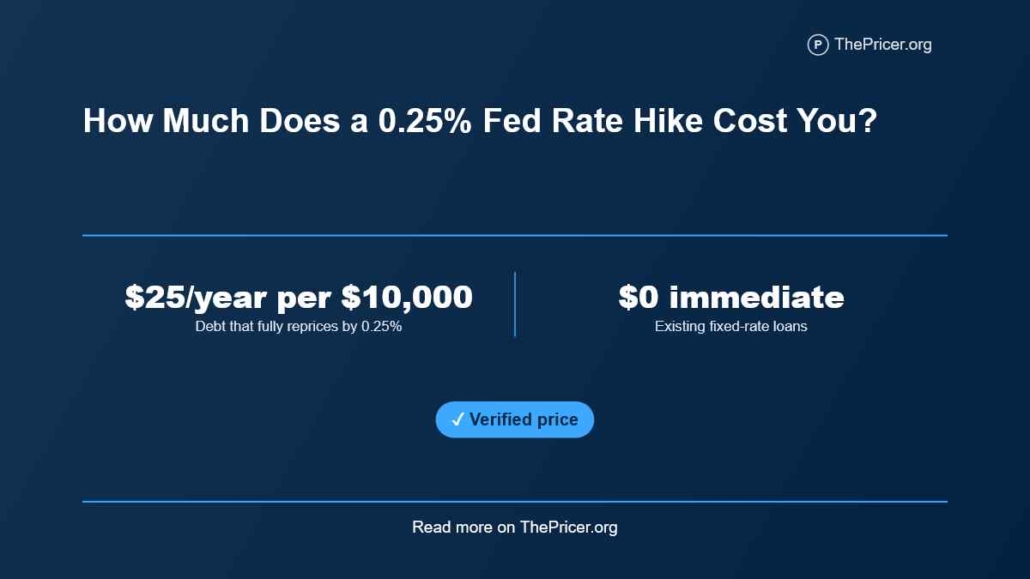
A 0.25 percentage-point Federal Reserve rate hike adds about $25 a year for every $10,000 of debt that fully reprices by the same 25 basis points. The Federal Reserve raised its target federal-funds range to 3.75%-4.00% on September 16, 2026, after a quarter-point policy increase.
That simple rule works best for variable debt tied closely to prime or another short-term index. An existing fixed-rate mortgage or fixed auto loan can have $0 of immediate added cost. The wider household effect can still arrive through mortgage quotes, market yields, savings rates, asset values, the dollar, inflation, housing demand, and labor conditions.
Article Highlights
Jump to sections
- A full 25-basis-point repricing costs about $2.50 per $1,000 (at $30 per hour, earning that amount would take about 4.2 full-time workdays, before taxes), $25 per $10,000, or $125 per $50,000 of unchanged balance each year.
- Existing fixed-rate mortgages and most fixed auto loans do not reset just because the Fed changes its policy rate.
- Prime-linked cards and HELOCs can react faster than long-term market rates.
- A modeled 25-basis-point mortgage-rate increase cuts borrowing power by about $10,037 on a $400,000 loan at a fixed monthly payment.
- Taxable savings may need a larger balance than variable debt to offset the same rate move after federal tax.
How Much Does a 0.25% Fed Rate Hike Cost You?
The cleanest direct calculation is balance multiplied by 0.0025. On a constant balance, a full 25-basis-point increase adds $2.50 a year for each $1,000 (about 4.2 full-time workdays at $30 per hour), $25 for each $10,000, $125 for $50,000, and $250 for $100,000. Those figures describe added simple annual interest from the rate change alone. A real credit-card balance can rise or fall during the year, and card issuers often calculate finance charges from daily balances, so the statement total can differ.
The shortcut is strongest when the contract actually passes through the full increase. It is weak for products whose pricing comes from market conditions rather than a contractual link to the federal-funds rate. The 25-basis-point policy move is an input, not a universal repricing instruction. The same decision can produce a near one-for-one change in one account and no immediate change in another.
The first task for a household is to identify the account type, current balance, index, margin, and reset schedule. A reader with no variable-rate debt may have no direct interest bill from the hike. A reader with large prime-linked balances can feel the increase quickly even if the change looks small in percentage terms.
Which Rates Follow the Fed
Short-term variable credit tends to have the clearest link. Major U.S. banks raised prime from 6.75% to 7.00% after the September Fed decision, according to Reuters prime-rate reporting. A variable credit-card APR may use prime plus a fixed margin. CFPB says a variable APR changes with its stated index. A cardholder agreement controls the formula and timing.
HELOCs often behave in a similar way. CFPB says HELOC rates are usually variable, which means payments can change as the rate changes. The loan may still have its own margin, floor, cap, billing method, or reset schedule. A 25-basis-point increase in prime does not mean every HELOC payment changes on the same date by an identical dollar amount.
The direct path is best pictured as policy rate to bank reference rate to contract index to borrower APR. Longer-term rates follow a different path. Mortgage lenders, bond investors, auto lenders, and deposit-taking banks respond to expectations about inflation, future Fed policy, credit risk, competition, funding costs, and market demand. That is why the article separates contractual repricing from market repricing rather than treating every interest rate as a copy of the Fed’s overnight target.
How Markets Reprice the Decision
The September market reaction shows why a Fed move and a market move are not the same thing. Treasury’s daily yield curve data show the 2-year yield rising from 4.67% on September 15 to 4.74% on September 16, a 7-basis-point increase. The 10-year moved from 5.00% to 5.01%, only 1 basis point, while the 30-year slipped from 5.36% to 5.35%. The Fed moved its policy range by 25 basis points, but the market did not add 25 basis points across the curve.
Markets can price expectations before the meeting and then react to the decision, the policy statement, incoming data, and new expectations about future rates. The Fed’s monetary-policy framework describes longer-term rates, asset prices, housing, and exchange rates as channels through which policy reaches the economy. A one-day stock or bond move is still not a personal bill created by one Fed action.
This is why a retirement account should not be converted into a supposed Fed-hike cost from one trading session. Stock and bond prices react to many inputs. The household-budget value of the market section is narrower. It explains why new mortgage quotes, bond-fund values, borrowing conditions, and exchange rates can change even when an existing loan contract does not.
Cards and HELOCs
Credit cards can make a quarter point expensive because the starting APR is already high and balances may revolve for months. The Federal Reserve’s latest consumer-credit data put the 2026 second-quarter average APR on credit-card accounts assessed interest at 22.15%. The same consumer-credit rate data show why the quarter-point increase should be viewed as an incremental cost on top of an already expensive borrowing rate, not as the main cost of carrying card debt.
Take a constant $10,000 (about 8.3 full-time workweeks at $30 per hour) card balance whose variable APR rises by the full 0.25 percentage point. The incremental simple annual interest is about $25. A $50,000 HELOC balance with the same full pass-through adds about $125 a year. Together, those two balances add about $150 a year before any balance changes, fees, compounding effects, or payment-rule differences.
The dollar amount may look small beside the balance, but repeated hikes accumulate. Four separate quarter-point increases that all pass through would equal a full percentage point. On an unchanged $50,000 balance, that is about $500 a year of added simple interest. The useful action is to inspect the index and margin in the agreement rather than assuming the September move will hit every variable account at once.
Mortgages and Auto Loans
 An existing fixed mortgage does not reset when the Fed meets. The same is true for most existing auto loans. CFPB says most auto loans are fixed. New offers can still become more or less expensive as lenders respond to market funding costs, Treasury yields, borrower credit, competition, and expectations.
Freddie Mac reported a 30-year fixed mortgage average of 6.76% on September 10, 2026. Using that current mortgage benchmark, a modeled $400,000 30-year loan has principal and interest near $2,597.05 per month. At a hypothetical 7.01%, the payment becomes about $2,663.90. The difference is about $66.85 per month, $802.14 per year, and $24,064 across 360 scheduled payments if the loan is held for the full term. This is a sensitivity case, not a claim that the Fed hike forces mortgage rates up exactly 25 basis points.
The stronger affordability result is borrowing power. If the buyer keeps the original $2,597.05 monthly principal-and-interest budget, a 7.01% rate supports only about $389,963 of principal. That is roughly $10,037 less borrowing capacity, a 2.51% reduction. Readers comparing a refinance can weigh that rate effect against mortgage closing costs. A buyer considering discount points can also compare the reverse calculation through the cost to buy down a rate.
Savings Can Offset Part of It
Higher policy rates can help savers, but banks choose how much of the increase to pass into deposit yields. A saver should compare the actual APY before and after the move rather than assume a full 25-basis-point increase. The gross arithmetic is still useful. A full 0.25 percentage-point increase on $30,000 of savings adds about $75 a year of interest before tax.
Federal tax reduces that offset for taxable accounts. The IRS says bank interest is usually taxable. Using 24% as an illustrative marginal rate from the 2026 federal tax brackets, a full 0.25-point savings increase leaves 0.19 percentage point after that federal tax assumption. The calculation is 0.25% multiplied by 76%. Under those assumptions, a household needs about $1.32 of taxable savings for every $1 of fully repricing variable debt to offset the incremental interest cost after federal tax.
That ratio is a ThePricer calculation, not a tax rule. State tax, deductible interest, tax-advantaged accounts, partial deposit pass-through, and changing balances can alter the result. The comparison still exposes an easy budgeting mistake. Equal debt and savings balances do not always cancel when borrowing rates and taxable deposit yields rise by the same amount.
Your Household Net Cost
Consider a household with a $10,000 variable credit-card balance, a $50,000 variable HELOC balance, and $30,000 in taxable savings. Assume the card and HELOC each rise by the full 0.25 percentage point. Assume the savings account also gains the full quarter point, then apply the illustrative 24% federal marginal rate to the added savings interest.
| Budget item | Modeled annual change | Method |
|---|---|---|
| Variable credit card | +$25 | $10,000 multiplied by 0.25% |
| Variable HELOC | +$125 | $50,000 multiplied by 0.25% |
| Taxable savings before tax | +$75 | $30,000 multiplied by 0.25% |
| Taxable savings after modeled federal tax | +$57 | $75 multiplied by 76% |
| Net direct household cost | +$93 | $150 added debt interest minus $57 retained savings interest |
The direct modeled hit is about $93 a year, or roughly $7.75 per month. That is the part the household can calculate from balances and assumed pass-through. A home purchase is separate. If the same household is shopping for a $400,000 mortgage and its quote moves from 6.76% to 7.01%, the modeled payment difference is another $66.85 per month. It should not be merged into the $93 direct total because that mortgage move is market-mediated, not a contractual one-for-one consequence of the Fed decision.
Readers with an auto loan should make the same distinction. A fixed loan already on the books stays fixed. A new or refinanced loan can change with market pricing, so the useful comparison is between actual lender offers and any car refinancing costs.
Budget Effects
The later household effects go beyond account repricing. If financing becomes more expensive, a family may face a smaller home-buying budget, while businesses may reconsider investment or hiring. Asset values and exchange rates can also alter household wealth or purchasing power. Those outcomes depend on many forces, so one Fed meeting cannot be assigned a precise personal dollar result.
Inflation is one reason those slower effects matter. Higher borrowing costs can restrain demand over time, which can reduce price pressure. The same mechanism can cool housing demand, business investment, and hiring. These links unfold over different timelines and are affected by energy prices, fiscal policy, productivity, credit conditions, and other forces, so the effect of one quarter-point move cannot be isolated cleanly in a household budget.
These later effects should not be turned into fake personal price tags. It would be misleading to claim that one quarter-point hike makes groceries $20 cheaper, cuts a salary by $500, or removes $2,000 from a retirement account. The defensible rule is different. Calculate direct account changes. Measure market moves as market moves. Describe the later economic channels with their uncertainty intact.
Makes sense if
- You carry prime-linked or other variable-rate debt.
- You are comparing mortgage or auto-loan offers after the Fed decision.
- You keep a meaningful taxable cash balance and want to compare saver gains with borrower costs.
- You want to separate a policy-rate move from a market-rate move.
Does not make sense if
- You apply the $25 per $10,000 shortcut to an existing fixed loan.
- You assume every mortgage rate must rise exactly 0.25 percentage point.
- You assume a savings bank must pass the full hike into APY.
- You assign a precise personal dollar amount to inflation, wages, or investment values from one Fed meeting.
Answers to Common Questions
How much does a 0.25% rate increase cost on $10,000?
If the full 0.25 percentage-point increase reaches the account and the balance stays at $10,000, the added simple annual interest is about $25.
Will my fixed mortgage payment rise after a Fed hike?
A standard fixed-rate mortgage does not reset because the Fed changes its policy rate. Taxes, insurance, or other escrow items can still change the total monthly payment.
Does a Fed hike always raise mortgage rates?
No. Mortgage rates are market rates shaped by longer-term yields, inflation expectations, lender pricing, and expectations about future policy. They can move before the meeting or move by a different amount afterward.
Can higher savings rates cancel the borrowing cost?
They can offset part or all of it, but pass-through and taxes matter. In the article’s 24% federal-tax illustration, it takes about $1.32 of fully repricing taxable savings to offset the incremental cost on $1 of fully repricing debt.
Disclosure: Educational content, not financial advice. Prices reflect public information as of the dates cited and can change. Confirm current rates, fees, taxes, and terms with official sources before purchasing. See our methodology and corrections policy.