
How Much Does a 2,000-Pound Bomb Cost?
Published on | Written by Alec Pow
This article was researched using 14 sources. See our methodology and corrections policy.
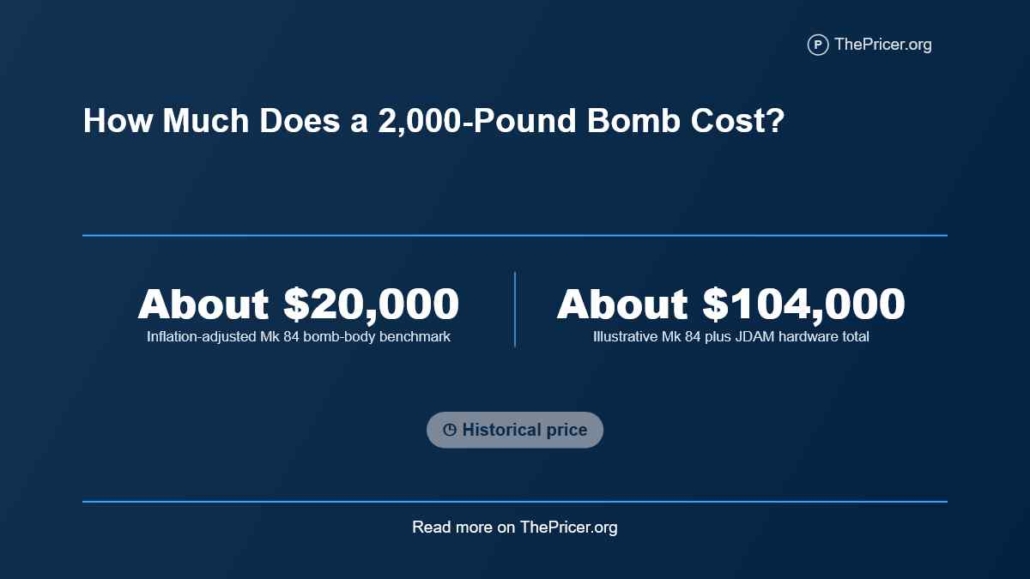
A basic U.S. Mk 84 2,000-pound bomb is reasonably benchmarked near $20,000 in 2026 dollars, based on the $16,000 FY2021 figure in a Pentagon budget cost review and the U.S. CPI index table. A modern guided configuration can reach roughly $104,000 in an illustrative model using the Air Force’s FY2026 JDAM allocation. The subject is in the news because September 2026 sale reporting says the Trump administration is planning a $2.8 billion Israel munitions package containing 20,000 Mk 84s and 20,000 BLU-117 2,000-pound bombs. The planned sale had been informally communicated to relevant congressional committees as of September 15.
Article Highlights
Jump to sections
- An unguided Mk 84 benchmarks near $20,000 (at $30 per hour, earning that amount would take about 3.8 months of full-time work, before taxes) in 2026 dollars using the last clean Air Force unit figure and general inflation.
- A current Air Force JDAM allocation works out to about $84,267 per kit.
- An illustrative Mk 84 plus JDAM hardware total is about $104,000, not a published Pentagon invoice.
- The proposed Israel package is valued at $2.8 billion and includes 40,000 2,000-pound bombs.
- The package price cannot be divided by the bomb count and reported as a true unit cost.
How Much Does a 2,000-Pound Bomb Cost?
The most useful baseline is the unguided Mk 84 general-purpose bomb. The cited FY2021 budget review put the Mk 84 at about $16,000 (about 3.1 months of full-time work at $30 per hour) per bomb and kept that bomb-body price separate from guidance-kit procurement. The figure is dated, but it is cleaner than assigning every dollar in a modern multi-item export package to one bomb type. No reviewed 2026 contract publishes both a new Mk 84 quantity and a complete unit price.
General inflation gives a current-dollar reference rather than a current procurement quote. The cited CPI table lists the 2021 annual CPI-U average at 270.970 and August 2026 at 334.980. Multiplying $16,000 by 334.980 and dividing by 270.970 gives about $19,780, which can be rounded to roughly $20,000. Defense manufacturing costs do not necessarily move with consumer inflation, so this is an inflation translation rather than evidence that the Pentagon pays exactly $19,780 for a new Mk 84 today. It is best used as a purchasing-power benchmark until newer bomb-specific procurement exposes both quantity and price. A future contract could move the real production figure higher or lower because metals, explosives, labor and order size do not track household inflation in a fixed ratio.
What 2,000-Pound Bomb Means
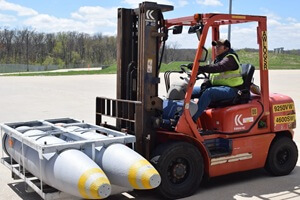
“2,000-pound bomb” describes a weight class, not one product with one price. The Mk 84 is a general-purpose bomb body. The U.S. Army identifies the BLU-117 as a 2,000-pound general-purpose bomb that is identical to the Mk 84 class apart from its explosive filler. Its current bomb catalog also separates general-purpose bodies from the BLU-109 2,000-pound hard-target penetrator. Those weapons can occupy the same broad weight class while using different construction and serving different procurement needs.
A JDAM-equipped GBU-31 adds guidance hardware to a compatible 2,000-pound body or penetrator. That changes what a procurement number represents. A buyer can purchase bomb bodies, guidance tail kits, fuzes, penetrator warheads and support under different contract lines.
A price for one of those lines is not automatically the price of an assembled guided weapon. Readers comparing a guided 2,000-pound weapon with a much larger penetrator can use current bunker-buster bomb pricing without treating the weight classes as the same asset. A useful price claim should name the bomb body, guidance configuration and support scope before attaching a dollar figure.
From Bomb Body to JDAM
JDAM adds GPS and inertial guidance hardware to compatible bomb bodies. The cited FY2026 weapons budget assigns the Air Force 1,500 JDAM units and $126.4 million (about 2 thousand years of full-time work at $30 per hour) in procurement. Dividing those figures produces about $84,267 per kit. The same budget describes a JDAM family that can use the 2,000-pound Mk 84 or BLU-117, a BLU-109 penetrator and smaller bomb bodies. The arithmetic is a program allocation across the Air Force buy rather than a model-specific retail price for one KMU-556 tail kit.
A worked hardware model combines that allocation with the inflation-updated Mk 84 benchmark.
- Inflation-updated Mk 84 reference of about $19,780.
- FY2026 Air Force JDAM allocation of about $84,267.
- Illustrative hardware subtotal of about $104,047.
Rounded for the uncertainty in the inputs, a modern guided 2,000-pound configuration can reasonably be discussed near $104,000 in this model. The calculation excludes a separately valued fuze and any export logistics or services. It also does not prove Boeing charges $84,267 for every tail kit. A related JDAM-ER cost analysis shows how wings and export support can push a guided-bomb package above standard JDAM procurement.
Export Packages Cost More
Foreign Military Sales figures are broader than factory prices. The Defense Security Cooperation Agency’s Foreign Military Sales guidance says FMS uses a total-package approach that can include training, spare parts and support, that eligible partners can use their own funds or U.S. government assistance, and that administrative charges fund the FMS program itself. A weapons case financed with U.S. aid can still carry purchaser-funded administrative charges.
A 2025 Israel case shows how much can sit around the physical bomb. The official 2025 munitions package covered 35,529 Mk 84 or BLU-117 bomb bodies, 4,000 I-2000 penetrator warheads, spare parts, consumables, accessories, repair support, transportation and government and contractor services for an estimated $2.04 billion. It did not assign a separate dollar amount to each bomb body. Dividing $2.04 billion by one selected quantity would transfer support costs into the weapon price and hide the other hardware.
The notified ceiling is best treated as a national acquisition envelope rather than the invoice for one round. Two countries buying the same bomb body can show very different package allocations if one case carries more transportation, engineering, repair support or spare parts.
The Israel Sale Plan
As of September 16, 2026, the latest package is planned rather than final. The current arms-sale report says the administration intends to provide 20,000 Mk 84s and 20,000 BLU-117s in a package valued at $2.8 billion, that Congress has been informally notified, and that most of the package is expected to use U.S. Foreign Military Financing. AP also reports that a 2024 shipment of 2,000-pound bombs was paused over concerns about potential mass casualties in Gaza and that President Trump later lifted the hold.
The sale’s current status matters to the cost answer. A planned package is not the same as a signed production contract, a paid invoice or a completed delivery. Quantities and support content can be clarified as the case advances. The reported $2.8 billion value should be treated as the proposed package amount rather than money already spent solely on bomb bodies.
The reported penetrator quantity adds 20,000 I-2000 penetrator warheads to the 40,000 general-purpose bombs. That raises the number of listed major bomb bodies and penetrator warheads to 60,000 before any support content is counted, which materially changes package-division math.
Who Pays for the Sale
The proposed sale is reportedly financed largely through Foreign Military Financing, which means U.S. appropriated assistance can be used by Israel to buy American defense articles and services. A Congressional Research Service summary records $3.3 billion per year in FMF through FY2028 and $500 million per year for cooperative missile-defense programs under the 10-year aid memorandum, subject to congressional appropriations.
The planned $2.8 billion package equals about 84.8 percent of one normal $3.3 billion annual FMF level. The calculation is $2.8 billion divided by $3.3 billion. That ratio gives readers a scale reference, but it does not mean 84.8 percent of one fiscal year’s FMF appropriation will be spent on this package. Foreign Military Sales cases can run across several years, and Israel has cash-flow financing eligibility that can support multiyear procurement commitments.
The weapons may also be ordered and delivered on a schedule different from the timing of congressional appropriations. The taxpayer question and the delivery-timing question are related, but they are not the same accounting event. Payment timing can extend beyond one budget year.
Package Division Misleads
 The simplest division produces the wrong impression. Taking the proposed $2.8 billion value and dividing it by the 40,000 Mk 84 and BLU-117 bombs gives $70,000 per bomb. That looks like a unit price, but it assigns the full package to those bombs while giving no value to the 20,000 reported I-2000 penetrator warheads or any support that may appear in the final case. The arithmetic is correct and the interpretation is not.
Using all 60,000 reported major bomb bodies and penetrator warheads changes the allocation to about $46,667 per listed major item. The $70,000 result is 50 percent higher simply because one-third of the reported major hardware was left out of the denominator. Neither number is a factory price. They are package-allocation exercises that show how denominator choice can distort a headline answer.
This is the hard-to-find cost issue behind many arms-sale headlines. A package can fund hardware with different manufacturing costs, plus transportation, spares and program services. A reader seeking the price of one Mk 84 should use a bomb-specific benchmark and keep package arithmetic labeled. The same issue appears in current glide bomb cost data, where support-heavy export ceilings produce much larger per-weapon allocations than narrower production awards.
How the Sale Compares
The new planned package is about 37.3 percent larger in headline value than the official $2.04 billion Israel munitions case notified in February 2025. The arithmetic is the $760 million difference divided by $2.04 billion. The older package listed 35,529 Mk 84 or BLU-117 bomb bodies plus 4,000 I-2000 penetrator warheads, for 39,529 listed major bodies and warheads. The new reporting lists 60,000 across those three categories, about 51.8 percent more major items.
Those growth rates do not prove unit prices rose or fell. The packages are not matched contracts. The 2025 case explicitly included spare parts, transportation and technical and logistics support, while the 2026 plan has not yet reached a public final notification that itemizes every support line. A larger quantity can also change negotiated production economics. The sound comparison is that the proposed headline value is higher and the reported hardware count is larger, with the exact mix of support still incomplete.
The price table below keeps the evidence classes separate rather than turning them into one range.
| Cost signal | Amount | Meaning |
|---|---|---|
| FY2021 Mk 84 | About $16,000 | Historical unguided unit benchmark |
| Inflation translation | About $19,800 | 2026-dollar reference, not a new contract |
| FY2026 Air Force JDAM | About $84,267 | Blended allocation per guidance kit |
| Modeled guided Mk 84 | About $104,000 | Bomb benchmark plus current JDAM allocation |
| Planned Israel package | $2.8 billion | National package, not a unit price |
Production and Unknown Costs
A large proposed order also raises a production question that the public price alone cannot answer. The United States maintains an industrial base for bomb bodies, explosives, loading and assembly, and guidance kits. Public records show continuing investment and contracting, but they do not provide a current delivery calendar for the 40,000 general-purpose bombs in the September proposal. It would be misleading to convert plant capacity statements into a promised shipment rate without an official schedule.
The final government cost can also diverge from the proposed ceiling. Foreign Military Sales cases are estimates at the notification stage, and later contracting determines actual obligations for articles and services. Production lots may draw from existing inventory, new manufacturing or a mix, while replacement procurement can occur under separate U.S. budget lines. None of the reviewed public material assigns a 2026 factory price to one new Mk 84 inside the proposed Israel package.
Answers to Common Questions
How much does an unguided 2,000-pound bomb cost?
The last clean Air Force Mk 84 benchmark was about $16,000 in FY2021. A simple inflation translation puts that near $19,800 in August 2026 dollars, but no clean public 2026 Mk 84 unit contract was found.
How much does a 2,000-pound JDAM cost?
An illustrative current model is about $104,000, combining an inflation-updated Mk 84 benchmark with the FY2026 Air Force JDAM allocation. The figure is a modeled hardware total rather than a published complete-weapon invoice.
Does the $2.8 billion sale mean each bomb costs $70,000?
No. The $70,000 figure comes from assigning the entire package to 40,000 bombs while ignoring 20,000 reported penetrator warheads and other package content.
Are U.S. taxpayers paying for the proposed Israel package?
Current reporting says most of the $2.8 billion package is expected to use U.S. Foreign Military Financing. The final payment schedule, contracts and deliveries have not been publicly itemized.
Disclosure: Educational content, not financial advice. Prices reflect public information as of the dates cited and can change. Confirm current rates, fees, taxes, and terms with official sources before purchasing. See our methodology and corrections policy.