
How Much Does a Baby Cost in the First Year?
Published on | Written by Alec Pow
This article was researched using 14 sources. See our methodology and corrections policy.
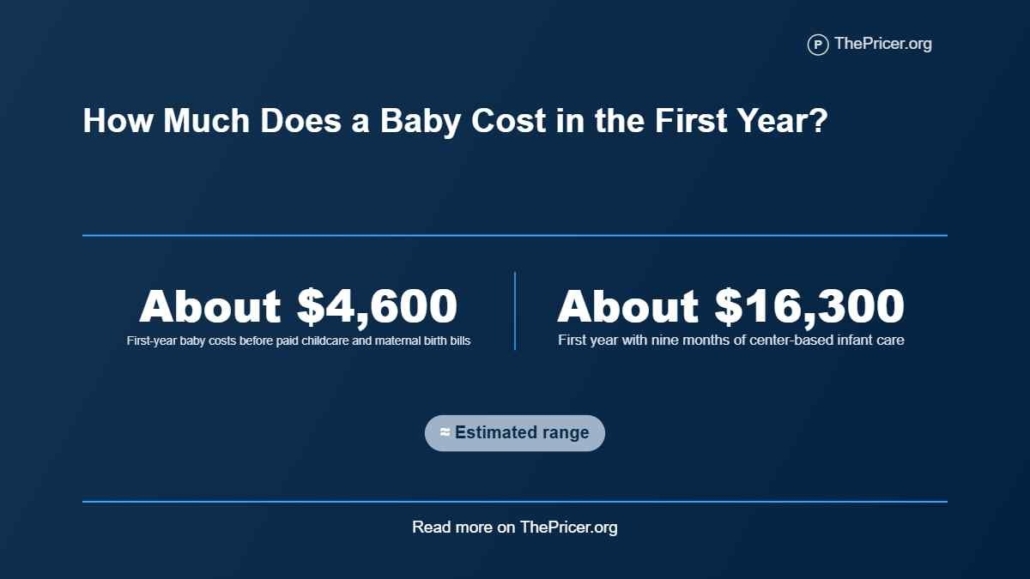
A baby can cost about $4,600 in the first year in a moderate U.S. spending model before paid childcare and the mother’s pregnancy and birth bills. Add nine months of center-based infant care and the same model rises to about $16,300.
A full year of center care plus ready-to-feed formula pushes the comparable baby-side model to about $21,500. These are calculated scenarios, not national household averages. Childcare, feeding method, insurance design, gifts, hand-me-downs, and local prices can move the bill by thousands of dollars.
Article Highlights
Jump to sections
- A moderate baby-side model lands near $4,600 (at $30 per hour, earning that amount would take about 3.8 full-time workweeks, before taxes) before paid childcare.
- Nine months of center care lifts the modeled first-year bill to about $16,300.
- The childcare timing calculation changes the first-year total by about $3,909 when center care starts three months after birth instead of immediately.
- The feeding model produces about a $1,316 gap between Enfamil NeuroPro powder and ready-to-feed liquid.
- Maternal pregnancy, birth, and postpartum cost sharing is kept outside the baby-only total so two different medical bills are not blended together.
What the First Year Includes
A useful first-year budget separates purchases by who receives the product or service and when the cash leaves the household. Baby gear such as a crib, mattress, stroller, and infant car seat is bought once or only a few times. Diapers, wipes, formula, clothing, and feeding supplies repeat. Childcare is a service paid by week or month. Newborn medical cost sharing belongs to the baby’s side of the budget, while pregnancy and delivery charges belong to the mother’s care.
That separation prevents a common comparison error. One published total may count daycare, another may assume family care, and another may include childbirth. A family that receives a stroller at a baby shower and uses family childcare can spend far less cash than a family buying new gear and paying for full-time center care. Housing upgrades, a larger vehicle, college saving, and lost earnings are excluded here because they are household choices or opportunity costs rather than required purchases for every baby.
The unit also matters. A box of powdered formula should be compared by prepared fluid ounce, not dry ounce. Childcare should be matched to the months actually purchased. Clothing should reflect how quickly sizes change. These distinctions turn a vague baby-cost number into a budget that can be adjusted for a real household.
Three First-Year Cost Scenarios
The three scenarios below use one moderate basket so the effect of care duration and feeding format is visible. September 2026 examples include a Delta Children Heartland crib at $120 (about 4 hours of work at $30 per hour) on a current Walmart crib listing, a full-size Delta Children crib mattress at $62.97 on a current mattress listing, and a Graco Verb travel system with infant car seat at $239.99 on a current Target travel system.
The care model uses Child Care Aware of America’s Method 1 infant figures of $15,636 a year for center care and $11,673 for a family child care home from its 2025 child care report. The medical basket uses KFF’s employer-plan analysis, which found average newborn out-of-pocket spending of $475 for newborns with fewer than three months of enrollment and maternal pregnancy, birth, and postpartum out-of-pocket spending of $2,743 in its pregnancy and infant analysis. Maternal spending is shown outside the baby-side total.
| Scenario | Baby-side first-year estimate | What changes |
|---|---|---|
| Family care | About $4,600 | Moderate new gear, powder formula, diapers, clothing, newborn cost sharing, no paid childcare |
| Center care after three months | About $16,300 | Same core basket plus nine months of center-based infant care |
| Full-year center care and liquid formula | About $21,500 | Twelve months of center care and ready-to-feed formula replace the lower-cost assumptions |
These are planning cases, not invoices. The moderate basket also assumes $500 for wipes, bottles, early solids, toiletries, and small replacements. Gifts, sales tax, shipping, special medical needs, and household income effects are not added. Childcare changes the math fastest.
Gear You Buy Once
Nursery and transportation purchases can arrive in one expensive month, but they do not need to dominate the full-year bill. The moderate basket uses one standard crib, one compatible mattress, and one travel system that already includes an infant car seat. Buying a stroller and car seat as separate products can shift the total, as can adding a second car-seat base, bassinet, carrier, monitor, dresser, or changing table.
The current baby stroller cost guide shows how wide one gear category can run. Its April 2026 examples range from an entry stroller at $19.98 (about 40 minutes at $30 per hour) to a mid travel system at $449.99 and a premium stroller at $1,499. That spread is a reason to define the configuration before setting a gear budget. A travel system can front-load spending while reducing the need to shop for a separate infant seat or adapters.
Used gear can cut the cash requirement, but savings depend on the item. Clothing, dressers, and many strollers are easier to inspect than safety equipment with an unknown history. A hand-me-down crib also needs all parts and a compatible mattress. The budget move is to build a short must-have list, accept gifts before duplicating purchases, and delay convenience items until daily routines show which ones solve a real problem.
Feeding Costs by Method
Formula format creates a measurable first-year price gap even within the same brand. Walmart lists a 36.4 oz box of Enfamil NeuroPro powder at $59.97 on its current powder formula listing. Enfamil’s mixing directions for NeuroPro specify 8.8 g of powder for a 2 fl oz bottle. Converting 36.4 oz of powder to grams and applying that mixing ratio gives about 234.5 prepared fl oz per box, or roughly $0.256 per prepared fl oz at the listed price.
Target lists a 32 fl oz bottle of Enfamil NeuroPro ready-to-feed formula at $12.99 on its ready-to-feed formula page, equal to about $0.406 per fl oz. For a budgeting scenario that uses 28 fl oz a day for six months and 20 fl oz a day for the next six months, annual volume is 8,760 fl oz. The powder model is about $2,240. Ready-to-feed is about $3,556. The difference is about $1,316.
The volume assumption is a planning choice, not a feeding recommendation. CDC guidance says formula intake changes with age and that babies from 6 to 12 months gradually need less formula as solid foods increase, which supports using an age-varying model rather than one fixed daily amount. See the CDC formula feeding guidance. Families comparing brands can use the same method in the baby formula cost guide.
Diapers, Clothes, and Supplies
Recurring supplies look small at checkout but become material across 12 months. Walmart’s 246-count Parent’s Choice Size 4 box was listed at $30.92, or 12.6 cents per diaper, on a current bulk diaper listing. Using seven diapers a day as an explicit budgeting assumption produces 2,555 diapers for the year. At 12.6 cents each, that model comes to about $322. Real spending will move as sizes, brands, pack counts, and daily use change.
Clothing behaves differently because the baby grows out of sizes before wearing items out. The current baby clothes cost analysis puts a practical new first-year wardrobe at about $250 to $750, with a mostly secondhand wardrobe around $75 to $250. The worked basket uses $637 for a practical-new wardrobe scenario. Gifts and hand-me-downs can cut that line sharply without changing how much clothing the baby actually uses.
Wipes, bottles, nipples, pacifiers, toiletries, simple toys, and early solid-food supplies are harder to model from one product listing because families buy different combinations. The worked example assigns a chosen $500 reserve to that group. It is not presented as a market average. Tracking this reserve separately also prevents a stroller upgrade or extra furniture purchase from disappearing inside a vague miscellaneous category. The diaper pricing page gives a separate path for readers comparing brands and pack sizes.
The itemized moderate example is $120 for the crib + $62.97 for the mattress + $239.99 for the travel system + $637 for clothing + $322 for diapers + $2,240 for powder formula + $475 for newborn cost sharing + the chosen $500 reserve. That totals about $4,597, rounded to $4,600.
Childcare Is the Biggest Swing
 Paid care can exceed every gear and consumables line combined. Using the previously cited Child Care Aware Method 1 figure, full-year center-based infant care is $15,636. If a family begins center care after three months of leave or family help, nine paid months model to $11,727. The arithmetic is $15,636 multiplied by 9 and divided by 12. That timing choice changes first-year cash spending by about $3,909 compared with buying all 12 months.
Setting matters too. The same report gives Method 1 infant care in a family child care home at $11,673 a year. Nine months models to about $8,755. Against nine months of center care, the difference is about $2,972. This is a national scenario built from one of the report’s three national methods, not a quote for a local provider. Child Care Aware also publishes state data, and the report’s other national methods produce different infant figures.
That distinction changes how a family should use a national number. Do not multiply an all-age childcare average by 12 and call it an infant daycare quote. Match the child’s age, setting, location, and months of purchased care. Timing matters. A start date three months after birth can move the first-year total more than many nursery purchases combined.
Medical and Insurance Costs
Medical spending needs two ledgers. The baby’s care starts after birth, while pregnancy, delivery, and postpartum care belong to the mother’s medical episode. The KFF figures used in the scenario come from claims for people with employer-sponsored insurance, so they describe insured out-of-pocket spending in that population rather than a cash-pay hospital price. That scope is why the $2,743 maternal figure is not folded into the baby-only total.
The modeled basket uses the cited $475 newborn figure, not a full 12-month medical estimate. Adding the maternal benchmark to the moderate family-care scenario raises combined modeled cash spending from about $4,600 to about $7,300. Adding it to the nine-month center-care scenario moves the combined figure from about $16,300 to about $19,100. These additions are illustrations of scope, not promises about any family’s deductible or delivery bill.
Insurance can also change through payroll deductions after a baby is enrolled, but the increment depends on the employer plan, existing coverage tier, and household composition. A single national family premium is not the same thing as the marginal price of adding one newborn. For planning, compare the current paycheck deduction with the post-birth election, then keep that change outside the direct medical-bill line so premiums and claims are not counted as the same expense.
Where Families Can Cut Costs
The biggest savings usually come from changing a large category or avoiding duplicate gear, not from chasing pennies across every small purchase. A three-month shift in paid center care changes the modeled bill by about $3,909. The powder-versus-liquid formula scenario changes it by about $1,316. Hand-me-down clothing can move another few hundred dollars. Those differences are large enough to deserve attention before decorative nursery purchases.
Use safety and benefit rules as boundaries around bargain hunting. Check insurance before buying a breast pump, check recalled products before accepting used gear, and verify a secondhand car seat’s history rather than treating every free item as equal. Families with employer dependent-care benefits should also check the current plan rules before enrollment because the tax treatment can affect the net cost of paid care.
Makes sense if
- Childcare is budgeted only for the months that will actually be purchased.
- Formula is compared by prepared fluid ounce rather than dry powder weight.
- Clothing gifts and hand-me-downs are counted before buying every size new.
- Large gear is matched to daily transport and storage needs.
Does not make sense if
- A national childcare number is treated as a local provider quote.
- Breastfeeding is entered as $0 without checking pump, supply, or support needs.
- A used car seat is accepted when its crash or recall history is unknown.
- Pregnancy and birth bills are mixed into a baby-only total without a label.
Answers to Common Questions
How much should I budget for a baby’s first year without daycare?
A moderate model can land near $4,600 before paid childcare and maternal pregnancy or birth bills. Formula choice, gifts, special medical needs, and gear preferences can move that figure.
How much does daycare add in the first year?
Using the cited Method 1 national infant-center figure, 12 months is $15,636. Nine months models to $11,727. Local prices can be very different.
Is formula or childcare the bigger cost?
In the modeled cases, paid childcare is much larger. The formula-format difference is about $1,316, while nine months of modeled center care alone is $11,727.
Should childbirth be included in the baby’s first-year cost?
It can be shown beside the baby budget, but keeping maternal pregnancy and delivery cost sharing separate makes comparisons clearer. The two bills cover different patients and depend on different insurance claims.
Disclosure: Educational content, not financial advice. Prices reflect public information as of the dates cited and can change. Confirm current rates, fees, taxes, and terms with official sources before purchasing. See our methodology and corrections policy.