
How Much Does a Bedrock Robotics Autonomous Excavator Cost?
Published on | Written by Alec Pow
This article was researched using 12 sources. See our methodology and corrections policy.
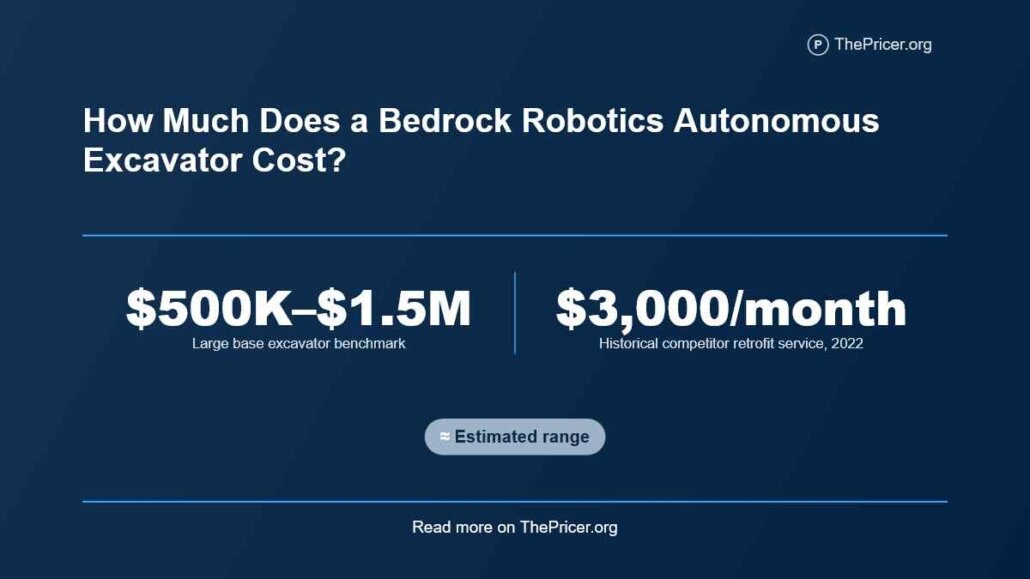
A Bedrock Robotics autonomous excavator combines an existing heavy excavator with the company’s Bedrock Operator self-driving technology. Contractors typically invest $500,000 to $1.5 million in the large excavators discussed by Bedrock’s CEO, but the company does not publish a separate price for its autonomy retrofit or service. The total depends on the underlying machine, deployment duration, supervision, support and negotiated contract terms.
A documented competing system provides a reference point: Built Robotics charged $3,000 per machine per month plus variable hourly usage fees in 2022. That was a historical competitor price, not a current Bedrock quotation. Any estimate using it must be labeled accordingly.
Bedrock’s equipment is now performing paid autonomous excavation on U.S. construction sites. On October 26, 2026, the company announced $600 million in new funding to expand deployments, making the economics of autonomous earthmoving a more immediate question for contractors.
Article Highlights
Jump to sections
- Bedrock does not publish a fixed excavator autonomy-retrofit price or commercial subscription rate.
- The underlying large excavator can cost approximately $500,000 to $1.5 million, according to Bedrock’s CEO.
- Built Robotics historically charged $3,000 monthly per machine plus hourly fees for a competing retrofit in 2022.
- A hypothetical $3,000-per-month service would cost $36,000 annually before hourly charges, but is not an observed Bedrock price.
- Bedrock supports retrofits across excavators weighing approximately 20 to 80 tons.
- The company announced a $600 million funding round at a $4.1 billion valuation on October 26, 2026.
How Much Does a Bedrock Robotics Autonomous Excavator Cost?
Bedrock Robotics develops the Operator autonomy system, which attaches to an excavator already used by a construction company. It does not manufacture and sell a standalone hydraulic excavator.
The company has not published an official per-machine installation fee, monthly subscription amount, hourly autonomy rate or guaranteed project price. An October 2026 independent evaluation of Bedrock pricing similarly found no published contract schedule or fee structure.
The manufacturer’s business is nevertheless operating beyond demonstration projects. Contractors are using equipped excavators on paid infrastructure and earthmoving work.
The most defensible budget separates known excavator values from undisclosed Bedrock commercial charges.
| Cost component | Published price or status | Scope |
|---|---|---|
| Existing excavator purchase | $500,000–$1.5 million | Large-machine figures discussed by Bedrock’s CEO |
| Bedrock Operator retrofit | Not publicly priced | Sensors, onboard computing and integration |
| Bedrock ongoing service | Not publicly priced | Contract terms and operational support |
| Built Robotics historical autonomy service | $3,000/month plus usage | Competing product, reported in 2022 |
| Large excavator rental | $1,500–$3,000+ per day | Conventional 30- to 50-ton rental benchmark |
| Construction equipment operator wage | $28.66/hour median | May 2025 national employee wage, excluding benefits |
These figures are not interchangeable. Machine acquisition, equipment rental, autonomy services and operator wages represent different expenses, and the historical competitor figure does not establish what Bedrock currently charges.
How Bedrock Operator Works
Bedrock’s Operator system adds cameras, LiDAR, positioning equipment, sensors and onboard computers to conventional excavators.
Its August 2026 deployment announcement describes a retrofit that can be installed within a workday without permanently altering the underlying machine.
The technology has been tested and deployed on excavators ranging from 20 to 80 tons, including Caterpillar production machines.
Unlike conventional machine guidance, which assists a person operating the controls, Bedrock Operator can perform excavation tasks without anyone in the cab.
A site manager still establishes the work plan and supervises operations. The autonomy system detects obstacles, plans movements and controls the equipment within the assigned work area.
The system uses safety mechanisms that stop the machine when people or unauthorized objects enter unsafe proximity.
Those features do not eliminate the need for site safety management, utility locating, maintenance, traffic coordination or responsible supervision.
What the Excavator Itself Costs
The physical machine represents a substantial part of the total investment for a contractor starting without its own fleet.
In an interview about equipment economics, Bedrock CEO Boris Sofman discussed excavators costing approximately $500,000 and sometimes reaching $1.5 million.
Those are large production-equipment examples, not a universal price range for every compatible excavator.
Caterpillar’s Cat 352 excavator specifications describe a machine weighing around 107,800 pounds, with 443 horsepower and substantial digging capacity.
The manufacturer quotes prices through dealers rather than displaying a universal retail amount. The final machine bill changes with configuration, attachments, dealer pricing and financing.
Contractors that already own suitable equipment may avoid a second machine purchase. That is the main attraction of Bedrock’s retrofit strategy.
A rental fleet offers another comparison. Current excavator rental costs for large production machines commonly reach $1,500 to $3,000 or more per day before transport, fuel, protection and operator charges.
A contractor should not assume any ordinary rental machine can be equipped with Bedrock technology without approval from the equipment owner and autonomy provider.
What a Competing Retrofit Costs
There is a historical commercial price for a different company’s excavator autonomy technology.
TechCrunch reported in April 2022 that Built Robotics charged $3,000 monthly per machine for its Exosystem, plus location-dependent hourly usage charges.
This is valuable as evidence that autonomy can be sold as a recurring service rather than a complete machine purchase.
It is not a verified 2026 offer, and Bedrock’s pricing arrangement could differ entirely.
Built Robotics now directs prospective customers through a project-specific commercial inquiry rather than a public price list. Its work includes autonomous construction and solar pile-driving systems.
The two companies are comparable in their retrofit approach, but their tasks, maturity, service coverage and contract arrangements are not identical.
A buyer should obtain separate quotations specifying the machinery, operating hours, autonomous tasks, supervision services and project duration before comparing them.
A First-Year Cost Scenario
A numerical model helps contractors understand what needs to be quoted without inventing Bedrock’s rates.
Assume a company already owns a suitable excavator. For illustration only, apply Built Robotics’ historical $3,000 monthly benchmark to an autonomy service for 12 months.
The hypothetical recurring base becomes $36,000 annually, excluding usage fees, installation and other costs.
Suppose the contractor also assumes $10,000 for commissioning and site integration and $6,000 for additional connectivity and support. Neither amount is an observed Bedrock price.
The illustrative first-year total would be:
- Hypothetical autonomy subscription: $36,000.
- Assumed commissioning and integration: $10,000.
- Assumed additional support allowance: $6,000.
- Calculated first-year total: $52,000.
The scenario deliberately excludes the excavator’s purchase, financing, depreciation, fuel, conventional maintenance and any usage-based autonomy charges.
It is an example of budgeting structure, not a Bedrock quotation or prediction of what a contractor will be invoiced.
A company that must also acquire a $500,000 excavator would face a hypothetical combined acquisition-and-first-year-autonomy amount of $552,000 under these assumptions, before taxes and other equipment operating costs.
Operator Wages
 Labor economics explain why contractors are evaluating autonomous heavy equipment.
The U.S. Bureau of Labor Statistics reported a median construction equipment operator wage of $28.66 per hour, or $59,600 annually, for May 2025.
That is an employee wage measure, not the contractor’s fully burdened cost. Payroll taxes, benefits, insurance, overtime and supervision add further expenses.
Suppose a machine performs 1,500 productive hours annually. At the national median wage, direct operator pay would be approximately $42,990 for that operating time.
Under the illustrative $52,000 first-year autonomy scenario, removing every one of those paid hours would still leave a difference of $9,010 before considering other operating impacts.
That calculation does not establish a loss from autonomy. It demonstrates that labor replacement alone may be insufficient to justify a deployment.
Autonomy could create additional value through increased operating hours, reduced schedule delays or more consistent production. But those benefits must be measured against supervision, utilization and maintenance requirements.
A supervisor may monitor multiple machines, although Bedrock has not published a universally applicable machines-per-supervisor ratio or verified wage-savings guarantee.
What Production Gains Are Proven?
Bedrock’s progression from supervised tests to paid excavation provides useful evidence of commercial maturity.
In November 2025, its supervised deployment announcement reported more than 65,000 cubic yards moved on a 130-acre manufacturing-site project with Sundt Construction.
In August 2026, the company announced fully autonomous work on several active construction sites.
Contractors involved included Sundt Construction in Nevada, Champion Site Prep in Texas and Zachry Construction on a 1.2-million-cubic-yard civil sitework project.
Independent Construction Dive deployment coverage described the move from supervised testing to commercial excavation.
The public record supports that autonomous machines performed actual construction work. It does not establish a universal percentage productivity improvement, labor reduction or equipment payback period.
Contractors must measure completed cubic yards, accepted grades, operating hours, interventions, fuel use and rework against comparable conventional shifts.
For large projects, even a small improvement in productive equipment hours could have meaningful consequences, but the value varies with soil, truck availability and site scheduling.
Hidden Costs
The autonomy retrofit does not eliminate ordinary excavator expenses.
Diesel, hydraulic components, wear parts, tracks, buckets, machine servicing and transportation remain necessary. Additional sensors and computers may introduce their own replacement and calibration requirements.
The main unresolved contract questions concern installation, remote supervision, software licensing, support availability, connectivity and responsibility for machine downtime.
A construction liability assessment identifies further questions involving site safety, equipment operation and insurance when no operator is physically seated in the cab.
Contractors should establish who is responsible when equipment stops unexpectedly, encounters unforeseen obstacles or damages a utility.
The presence of automated emergency stopping does not guarantee that every construction-site hazard has been eliminated.
Commissioning also takes project resources. Surveying, digital work plans, connectivity testing and staff instruction may be necessary before the first productive autonomous shift.
Insurance carriers and project owners may require documentation beyond the manufacturer’s technology demonstration.
These costs are real budget categories even where the provider has not disclosed universal prices.
Funding and Expansion
Bedrock’s newest financial milestone is not an equipment sale.
On October 26, 2026, the company announced a $600 million Series C investment at a $4.1 billion post-money valuation.
The financing brought cumulative company funding to nearly $1 billion. The round was co-led by CapitalG and Emergence Capital.
TechCrunch’s independent funding report described the company’s shift toward expanding commercial deployments.
New contracts and deployments are planned across multiple construction markets, with additional operators and field-service capability supporting the rollout.
The investment amount cannot be divided by the number of excavators in the field to produce a machine price. It finances the company’s research, personnel, commercialization and broader expansion.
For contractors, the more relevant development is the company’s effort to build repeatable field support rather than rely solely on experimental trials.
Bedrock vs Other Automation
Bedrock is most directly comparable with retrofit systems that automate existing excavation machinery.
Built Robotics is one such alternative, though its present commercial focus also includes solar construction. Other systems provide operator assistance, grade control and remote operation without offering the same autonomous task execution.
The distinction is important. A machine fitted with 2D or 3D grade guidance still generally requires an operator, while Bedrock aims to perform specific excavating tasks without anyone in the cab.
A contractor choosing between these technologies should compare the work actually completed, the required supervision and the full service charge.
For conventional earthmoving alternatives, bulldozer purchase and rental costs show why machine weight, attachments and utilization matter to heavy-equipment budgeting.
Neither the lowest software fee nor the most advanced autonomy description guarantees the cheapest completed project.
A deployment should be evaluated according to accepted work output, cost per cubic yard and schedule performance rather than machine movement alone.
When Autonomous Excavation Pays
Bedrock’s technology is intended for contractors with substantial excavation volume and a need to increase production capacity.
Large projects may benefit when autonomous shifts can continue safely while skilled workers attend to other site tasks. Existing compatible equipment can reduce the initial capital requirement.
Makes sense if
- The contractor already owns compatible large excavators.
- Excavation volume justifies investment in planning and integration.
- Operator shortages or scheduling constraints are limiting production.
- Actual pilot data establish acceptable productivity and supervision requirements.
Does not make sense if
- Excavation is infrequent or the project is nearly complete.
- Site conditions prevent safe operation under the available autonomy system.
- The provider cannot establish complete support, liability and pricing terms.
- Conventional equipment and staffing meet the schedule at a lower verified cost.
Answers to Common Questions
How much does a Bedrock autonomous excavator cost?
Bedrock does not disclose a standard equipment retrofit or autonomy-service price. The underlying large excavator can represent $500,000 to $1.5 million in equipment value, while the autonomy contract must be quoted separately.
Can Bedrock retrofit an existing excavator?
Yes. Bedrock’s technology is designed to retrofit compatible excavators, including machines in the 20- to 80-ton class, without requiring permanent structural changes.
Is Bedrock cheaper than hiring an excavator operator?
It depends on the complete autonomy service charge, supervision, utilization and productivity. U.S. construction equipment operators earn a median $28.66 per hour in direct wages, but no published Bedrock price establishes a general break-even point.
How much does a competing autonomous excavator retrofit cost?
Built Robotics was reported charging $3,000 per machine monthly plus hourly usage fees in 2022. That is historical competitor pricing, not Bedrock’s current rate.
Are Bedrock excavators working on real projects?
Yes. Bedrock announced paid fully autonomous deployments in August 2026 with contractors including Sundt Construction, Champion Site Prep and Zachry Construction.
Disclosure: Educational content, not financial advice. Prices reflect public information as of the dates cited and can change. Confirm current rates, fees, taxes, and terms with official sources before purchasing. See our methodology and corrections policy.