
How Much Does a Beginner Adventure Motorcycle Cost?
Published on | Written by Alec Pow
This article was researched using 14 sources. See our methodology and corrections policy.
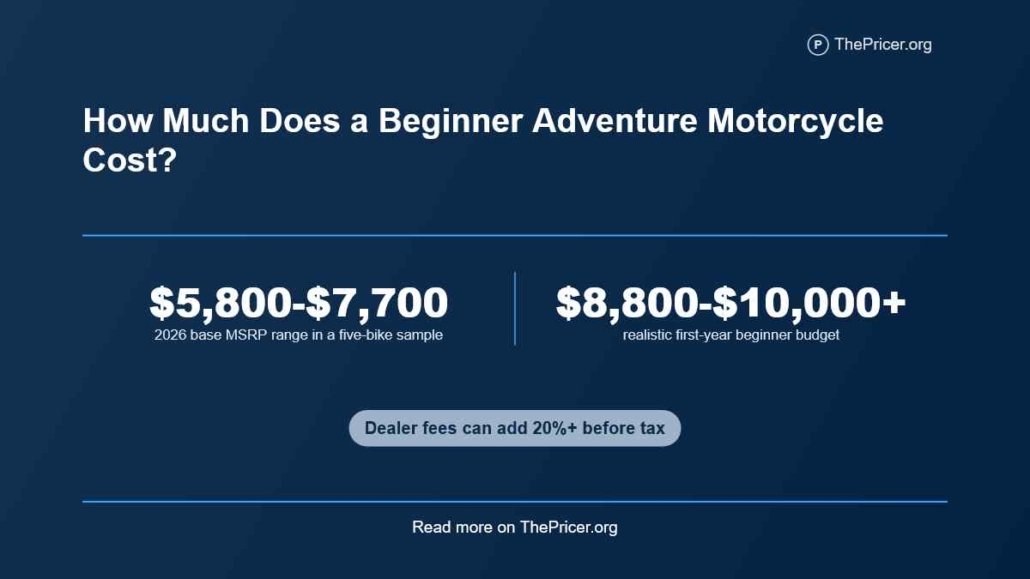
A new beginner adventure motorcycle costs about $5,800 to $7,700 in base MSRP across a current sample of popular 2026 U.S. models, with many landing close to $6,500. The actual amount needed to leave the dealer and start riding is often closer to $7,000 to $9,000 before a full year of insurance, riding gear and training are counted.
A realistic first-year beginner budget can reach roughly $8,800 to $10,000+ even when the motorcycle itself starts below $7,000. Freight, dealer setup, documentation fees, sales tax, registration, insurance, rider training and protective equipment can add thousands to the advertised motorcycle price.
This price range covers lightweight adventure motorcycles roughly in the 300cc to 500cc class. It does not include larger middleweight bikes such as the Yamaha Ténéré 700 or premium adventure models where purchase prices move well beyond beginner-bike territory.
Article Highlights
Jump to sections
- A five-bike 2026 beginner-ADV sample runs from $5,799 (at $30 per hour, earning that amount would take about 4.8 full-time workweeks, before taxes) to $7,699 in base MSRP.
- The median base MSRP in that sample is $6,499, while the simple average is $6,579.
- Honda adds a published $600 destination charge to the NX500, while Kawasaki adds $650 to the Versys-X 300 and KTM lists $600 freight on the 390 Adventure R.
- Dealer freight, setup and documentation charges can push a $6,499 motorcycle close to $7,900 before tax and registration.
- A modeled first year with a Honda NX500, insurance, training, gear, tax and registration reaches about $9,933.
- Luggage and crash protection can add another $500 to $1,000+ before a rider takes the bike on a multi-day trip.
How Much Does a Beginner Adventure Motorcycle Cost?
The table uses five current U.S. entry-level adventure motorcycles that span road-oriented touring, mixed-surface riding and more dirt-focused use. It is a handpicked comparison of current models, not a national average of every motorcycle sold.
| 2026 motorcycle | Base MSRP | Known freight or destination | Price before tax and local fees |
|---|---|---|---|
| Kawasaki Versys-X 300 ABS | $5,799 (about 4.8 full-time workweeks at $30 per hour) | $650 | $6,449 |
| Royal Enfield Himalayan 450 | $5,999 | Dealer dependent | Varies |
| CFMOTO Ibex 450 | $6,499 | Dealer dependent | Varies |
| Honda NX500 | $6,899 | $600 | $7,499 |
| KTM 390 Adventure R | $7,699 | $600 | $8,299 |
The 2026 Versys-X 300 pricing makes Kawasaki the lowest base-price motorcycle in this sample at $5,799. Its $650 destination charge raises the manufacturer’s pre-tax figure to $6,449.
A 2026 Royal Enfield Himalayan 450 dealer listing shows $5,999 MSRP. The Honda NX500 starts at $6,899 plus a published $600 destination charge, while KTM lists its 390 Adventure R at $7,699 plus $600 freight.
Across the five motorcycles, the simple base-MSRP average is $6,579 and the median is $6,499. The spread from the $5,799 Kawasaki to the $7,699 KTM is about 32.8%.
That price spread buys different capabilities. The lower-priced Versys-X is more road-biased. The KTM’s higher price includes a more off-road-focused chassis and suspension package. A beginner should not choose solely by engine size or MSRP.
MSRP Is Not Out-the-Door
The first hidden cost is the difference between a manufacturer’s advertised MSRP and the dealer’s pre-tax selling total. Adventure motorcycles are a useful case because freight, crate, setup and documentation charges vary sharply by brand and dealer.
Honda’s $600 NX500 destination charge adds about 8.7% to its $6,899 base MSRP. Kawasaki’s $650 destination charge adds about 11.2% to the $5,799 Versys-X 300. KTM’s $600 freight charge adds about 7.8% to its $7,699 base motorcycle price.
Dealer-specific charges can be larger. One current CFMOTO dealer lists a 2026 Ibex 450 at $6,499 MSRP plus $650 freight, $355.63 setup and $399 documentation. That produces a pre-tax dealer total of $7,903.63.
The extra $1,404.63 is 21.6% of the advertised MSRP before tax, title and licensing enter the bill.
The Royal Enfield example shows the same issue. The $5,999 Himalayan listing cited above adds $545 freight, $468 setup and $85 documentation, reaching $7,097 before tax and registration. Those charges add $1,098, or about 18.3%, to the base MSRP.
These are dealer examples, not mandatory national fee schedules. A buyer should compare the complete out-the-door quote rather than deciding that one $6,499 motorcycle is cheaper than another before seeing freight, setup and documentation charges.
What First Year Really Costs
The motorcycle itself is only the largest line item. A first-time rider may also need training, insurance, registration and an entire set of protective equipment.
The Motorcycle Safety Foundation says hands-on Basic RiderCourse tuition ranges from under $100 to more than $300 depending on the state, location and rider age. The course price can include the online component, so buying a separate eCourse may not be necessary.
Gear is another meaningful upfront purchase. RevZilla’s 2026 beginner gear guide uses about $300 for a helmet and $200 for a jacket as baseline entry-level pricing. Boots, gloves and riding pants add to that. A complete first setup can easily absorb several hundred dollars beyond those two pieces.
Insurance changes more with the rider than with the motorcycle’s MSRP. ValuePenguin’s 2026 data puts average motorcycle insurance for a 21-year-old at about $634 per year. Its estimate for an 18-year-old is about $945 per year. Location, driving record, coverage level and motorcycle model can move either number substantially.
A $9,933 Beginner Example
Consider a 21-year-old rider buying a new Honda NX500. Honda’s published motorcycle-plus-destination price is $7,499.
For an illustrative first-year total, assume a 6% sales tax, $250 for title and registration, the published $634 21-year-old insurance figure, $200 for a rider course and $900 for a full gear package. The tax and registration inputs are scenario assumptions because those charges depend on jurisdiction.
- Honda NX500 plus destination was $7,499
- Assumed 6% sales tax adds about $450
- Assumed title and registration adds $250
- One year of modeled insurance adds $634
- Rider training adds an assumed $200
- Helmet, jacket, pants, boots and gloves add an assumed $900
- Modeled first-year total is about $9,933
The motorcycle’s published $7,499 price accounts for only about three-quarters of that first-year budget. The remaining $2,434 raises the initial cost by about 32.5%.
A rider who already owns gear, qualifies for cheaper insurance or lives in a low-tax state could spend much less. A young rider with higher insurance, expensive registration or a dealer charging setup and documentation fees could cross $10,000 on a bike advertised below $7,000.
Adventure Accessories Add Up Fast
Adventure motorcycles invite accessory spending earlier than many road bikes. Crash bars, handguards, luggage, taller screens, skid plates, phone mounts and heated grips can turn a cheap starter motorcycle into a substantially more expensive setup.
Royal Enfield’s current Himalayan accessory catalog illustrates the scale. Aluminum adventure panniers list at $664.99, while crash protection and handguards can each add another three-figure amount.
A hypothetical Himalayan package with $664.99 panniers, $149.99 compact engine guards and $139.99 rally handguards totals $954.97 before installation or any required luggage mounting hardware.
That accessory bundle equals about 15.9% of a $5,999 motorcycle.
This is one place where a beginner can save real money. Protection for parts likely to touch the ground can be useful for trail riding, but a complete aluminum luggage system is not necessary for learning basic control. Buying every touring accessory with the motorcycle can erase much of the value of choosing a lower-priced beginner bike.
Used Bikes Can Narrow the Gap
A lightly used beginner adventure motorcycle can avoid some new-bike freight and setup charges, but the discount is not automatic. Popular low-mileage m odels can remain close to current new-bike pricing.
MotoHunt currently shows used 2024 and 2025 Honda NX500 listings ranging from roughly $5,950 to around $7,000 across many visible examples, with occasional listings outside that band. Those are asking prices from a live market page, not completed-sale values.
A used bike becomes more attractive when the previous owner has already absorbed dealer freight and setup charges and included useful accessories. A $6,200 used motorcycle with crash protection and luggage can beat a $6,500 new motorcycle that becomes $8,000+ after dealer charges and accessories.
The opposite can happen if the used bike needs tires, chain and sprockets, brake work or major scheduled service. Repair economics are worth comparing with the cost of major motorcycle engine work before buying a very cheap high-mileage motorcycle with unclear service history.
Adventure Bike vs. Dual Sport
A beginner who expects mostly dirt riding may be paying for the wrong motorcycle category. Adventure bikes provide road comfort, wind protection, fuel range and luggage capacity, but those features add weight and cost.
A lighter dual sport can cost less and be easier to pick up after a trail fall. The broader dirt bike price range also shows how off-road machines use a different cost structure because many are not designed around highway touring, windscreens or luggage.
The reverse is true for a rider who expects regular highway miles. Paying more for a twin-cylinder NX500 or similar road-friendly ADV can make more sense than turning a lightweight trail bike into a touring motorcycle with windscreens, seats, luggage and gearing changes.
For the broader ownership picture, the cost of owning a motorcycle includes insurance, maintenance and other expenses that continue after the purchase year.
Which Budget Makes Sense?
A base budget around $6,000 to $6,500 puts a rider near the Versys-X 300, Himalayan 450 and Ibex 450 class before dealer charges. Around $7,000 to $8,300 opens the NX500 and more off-road-focused KTM 390 Adventure R once published destination or freight is included.
The cheaper bike is not always the cheaper purchase. A dealer charging another $1,400 on a $6,499 motorcycle can bring it within a few hundred dollars of a higher-MSRP bike with a cleaner fee structure.
Makes sense if
- You want one motorcycle for commuting, back roads and light trail use.
- You can afford the bike plus gear, training and insurance without relying on the MSRP alone.
- You choose seat height, weight and power delivery that match your current skill level.
- You plan to keep the motorcycle long enough for useful accessories to earn their value.
Does not make sense if
- The dealer’s add-on fees erase the price advantage that attracted you to the model.
- You are financing accessories and luggage before knowing whether you will use them.
- You mainly want technical trail riding where a lighter dual sport would fit better.
- Your insurance quote makes the first-year ownership cost uncomfortable even though the monthly bike payment looks affordable.
Answers to Common Questions
How much should a beginner spend on an adventure motorcycle?
A realistic new-bike target is about $6,000 to $8,000 before tax and many ownership expenses. The complete first-year budget can move closer to $9,000 to $10,000+.
What is the cheapest new beginner adventure motorcycle?
Among the five 2026 models compared here, the Kawasaki Versys-X 300 has the lowest base MSRP at $5,799. Its published destination charge raises the manufacturer figure to $6,449.
How much are dealer fees on a beginner motorcycle?
They vary sharply. Current examples show freight, setup and documentation adding roughly $1,100 to $1,400 to some motorcycles before sales tax and registration.
How much motorcycle gear does a beginner need to budget for?
A helmet and jacket alone can total around $500 using current beginner gear benchmarks. Gloves, riding pants and protective boots can push a complete setup several hundred dollars higher.
Is it cheaper to buy a used adventure motorcycle?
It can be, especially if the motorcycle already includes crash protection or luggage and avoids new-bike setup charges. Check tire condition, chain and sprockets, service history and upcoming maintenance before comparing the used asking price with a new-bike MSRP.
Disclosure: Educational content, not financial advice. Prices reflect public information as of the dates cited and can change. Confirm current rates, fees, taxes, and terms with official sources before purchasing. See our methodology and corrections policy.