
How Much Does a Boeing 767 Cargo Plane Cost?
Updated on | Written by Alec Pow
This article was researched using 12 sources. See our methodology and corrections policy.
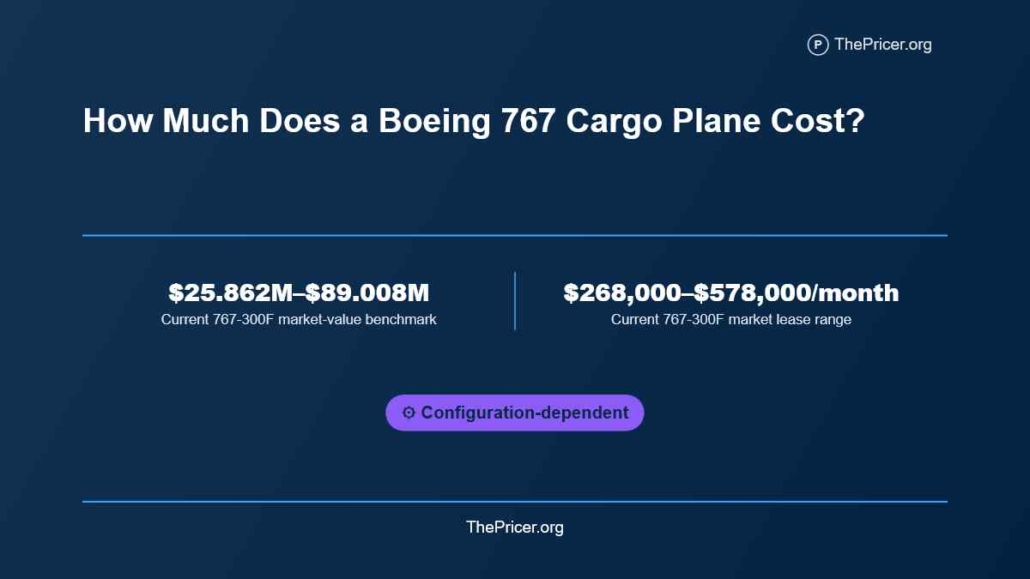
A Boeing 767 cargo plane currently carries a market value of roughly $25.862 million to $89.008 million per aircraft, depending heavily on age and condition. July 2026 market data from IBA also places 767-300F lease rates at $268,000 to $578,000 per month and passenger 767-300ER values at $8.526 million to $16.262 million. Those passenger aircraft can serve as feedstock for cargo conversions.
The familiar $220.3 million figure attached to the 767-300F is an old list price, not a current 2026 purchase quote. Buyers now face three distinct routes: an existing production freighter, a converted passenger aircraft, or a lease. That distinction changes the answer.
Article Highlights
Jump to sections
- A current 767-300F market-value benchmark spans $25.862 million to $89.008 million (at $30 per hour, earning that amount would take about 0.4 to 1.4 thousand years of full-time work, before taxes).
- Market lease rates span $268,000 to $578,000 per month.
- Passenger 767-300ER feedstock carries current values of $8.526 million to $16.262 million.
- The old $220.3 million 767-300F list price should not be treated as a current selling price.
- A modeled conversion using a current $9.5 million donor and a historical $14 million conversion benchmark reaches $23.5 million before maintenance and transaction expenses.
How Much Does a Boeing 767 Cargo Plane Cost?
The current market is wide because a Boeing 767-300F is not priced merely by model name. IBA’s 2026 data reports half-life current market values from the oldest to newest aircraft rather than one universal transaction price. An older aircraft near the bottom of the appraisal span can differ sharply from a younger example with more remaining economic life. A seller’s asking amount can also sit above or below an appraised market value.
| 767 pricing measure | 2026 benchmark | Scope |
|---|---|---|
| 767-300F market value | $25.862M-$89.008M (about 0.4 to 1.4 thousand years of full-time work at $30 per hour) | IBA half-life current market value, oldest to newest |
| 767-300F monthly lease | $268,000-$578,000 | IBA market lease rate, oldest to newest |
| 767-300ER passenger value | $8.526M-$16.262M | Potential conversion feedstock benchmark |
| Historical 767-300F list price | $220.3M | Published 2021 reference, not a 2026 quote |
The distinction between market value and a real transaction matters. Aircraft deals can include maintenance adjustments, records requirements, delivery conditions, deposits, financing arrangements, spare equipment, or lease attachments. Private pricing is common here. A useful acquisition budget should start with the aircraft’s age and technical status rather than treating either endpoint in the appraisal range as a guaranteed sale amount.
What Counts as a 767 Cargo Plane
The phrase Boeing 767 cargo plane covers aircraft that can reach a similar cargo mission through different acquisition paths. The purpose-built 767-300F left the factory as a freighter. A 767-300BCF begins as a passenger 767-300ER and receives a Boeing passenger-to-freighter modification. Other approved 767 conversion programs also exist. A passenger 767 offered for sale is not yet a cargo aircraft, even when a buyer intends to convert it.
Boeing’s current freighter specifications list both the 767-300F and 767-300BCF as medium-widebody freighters with a gross structural payload near 57 tonnes and published range near 3,300 nautical miles at that payload. The shared mission does not make their purchase economics identical. A production freighter already contains its cargo configuration. A conversion project requires a donor aircraft, modification work, downtime, technical review, and any maintenance needed before commercial service.
This article also keeps military 767 derivatives outside the purchase comparison. A KC-46A procurement package has a different buyer, configuration, equipment scope, support structure, and contracting process. Dividing a military contract into an apparent commercial 767 unit price would produce the wrong answer for an airline or aircraft lessor.
The New-Aircraft Number Is Different
Reuters reported a 767-300F list price of $220.3 million (about 3.5 thousand years of full-time work at $30 per hour) in its 2021 freighter comparison. That figure remains easy to find online, yet it answers a historical list-price question. It does not show what Boeing is charging an operator for a remaining delivery in 2026, and it says little about the amount needed to buy an existing aircraft on the secondary market.
Boeing announced in 2024 that it would deliver the remaining customer orders and end commercial 767 freighter production in 2027. Current factory aircraft are tied to customer orders and negotiated commercial contracts rather than a public retail price sheet. A buyer entering the market now cannot assume that paying the historical list figure produces an available new delivery slot.
ThePricer calculation shows how far the secondary market has separated from that old headline figure. Comparing the current appraisal endpoints with the historical $220.3 million list price puts the oldest current-value benchmark about 88.3% below that list figure and the newest benchmark about 59.6% below it. This is not same-aircraft depreciation. It is a comparison between an old factory list price and current used-aircraft value benchmarks, which is why those numbers should not be blended into one average.
Passenger-to-Freighter Conversion
 Conversion can start with a passenger 767-300ER rather than an existing freighter. Boeing confirmed in July 2026 that it had an agreement with SCAT Airlines to convert a 767-300ER into a 767-300BCF. Boeing did not disclose the contract price. That makes the program current while leaving the present provider fee private.
Older public evidence gives a useful benchmark without pretending to be a 2026 quote. AVITAS material included in an SEC filing reported that 767-300ER freighters were known to cost about $25 million after conversion in 2016 and put the conversion component near $14 million, including the P2F kit and cargo loading system. The historical conversion appraisal is valuable for scope, but it should not be inflated or relabeled as today’s Boeing fee.
Combining that historical $14 million work benchmark with today’s passenger-aircraft appraisal range produces a modeled donor-plus-conversion subtotal of $22.526 million to $30.262 million. The model excludes maintenance catch-up, engine work, landing-gear work, ferrying, financing, taxes, paint, records corrections, and other transaction costs. A buyer should use it as a sensitivity benchmark, not as a turnkey 2026 conversion quote.
Leasing a 767 Freighter
Leasing changes the capital commitment without making the aircraft cheap. The cited IBA dataset places current 767-300F market lease rates between $268,000 and $578,000 per month. Multiplying those endpoints by 12 gives gross annual rent of $3.216 million to $6.936 million. That cash requirement can suit an operator that needs capacity without purchasing the asset outright.
A second ThePricer calculation compares each lease endpoint with the matching market-value endpoint. The oldest-value benchmark of $25.862 million equals about 8.0 years of rent at $268,000 per month. The newest-value benchmark of $89.008 million equals about 12.8 years at $578,000 per month. Those figures are gross rent-equivalent periods, not financial break-even dates.
An owner retains an aircraft with residual value. A lessee returns or otherwise deals with the asset according to the lease contract. Financing cost, maintenance reserves, return conditions, deposits, tax treatment, residual-value risk, and fleet utilization can move the economics in either direction. The rent-equivalent calculation is most useful as a first capital screen. It shows that a few years of leasing does not automatically equal the price of buying, while a long commitment deserves a full purchase-versus-lease model.
What Moves a 767’s Value
Age explains part of the wide 767 price span, but technical condition can change what a low purchase number really buys. Flight hours and cycles affect remaining life. Engine condition can create a large near-term maintenance exposure. Landing-gear status, heavy checks, corrosion findings, avionics configuration, cargo-system condition, modification history, records quality, and damage history can alter both value and the amount needed before revenue service.
That is why a buyer should not compare a bare airframe price with a service-ready freighter as though the two offers have equal scope. An aircraft approaching major engine or airframe work may carry a lower selling price because part of the economic obligation has merely moved from acquisition into maintenance. A younger aircraft with stronger records and favorable maintenance status can command much more while requiring less immediate work.
Specification matters too. Engine type can affect maintenance planning, spare-engine access, and fleet commonality. Winglets and approved modifications can affect mission economics. Cargo loading equipment must match the intended operation. None of these items creates one fixed premium that can be added to every aircraft. The buyer needs aircraft-level records and maintenance forecasts before turning an advertised amount into a usable acquisition budget.
Worked Acquisition Comparisons
A live marketplace example shows why public freighter pricing can be difficult to pin down. Controller listed a 1996 Boeing 767-300F in August 2026 with the price withheld, while a 1997 passenger 767-300ER on the same Boeing 767 listings page carried an asking price of $9.5 million. The freighter had more than 94,000 hours and more than 20,000 landings listed, while the passenger aircraft had fewer than 44,000 hours and fewer than 20,000 landings. Those details make a model-year comparison alone inadequate.
For an itemized conversion scenario, take the current $9.5 million passenger asking price and pair it with the historical $14 million conversion benchmark. The arithmetic gives $9.5 million + $14 million = $23.5 million before technical catch-up, engines, ferrying, paint, financing, tax, and transaction work. The conversion input is historical. The result is a modeled subtotal rather than an advertised turnkey freighter price.
A useful threshold follows from the same inputs. To stay below the oldest current production-freighter appraisal of $25.862 million, a donor could cost no more than $11.862 million if conversion still cost $14 million. If a buyer uses an assumed $20 million conversion stress case, the donor ceiling falls to $5.862 million. That sensitivity shows why conversion is not automatically the cheaper route.
Real deals can remain private. Titan Aircraft Investments announced the May 2026 sale of a 767-300ERF to Cargo Aircraft Management without publishing the transaction amount.
Costs After the Purchase
The aircraft purchase figure is only the capital entry point. A freighter operator also has to budget for fuel, scheduled and unscheduled maintenance, engines, crew, insurance, ground handling, landing charges, navigation charges, training, spares, parking, financing, and compliance work. A converted aircraft can also spend time out of service before it begins earning cargo revenue.
Fuel deserves a separate operating model because its cost changes with route, payload, uplift location, contract structure, and market prices. Current U.S. fuel benchmarks are covered in the related jet fuel cost data. Buyers comparing the 767 with a larger freighter can also use the Boeing 747-8 cost comparison as a next step, while keeping payload and aircraft generation differences in view.
Makes sense if
- The network regularly needs medium-widebody cargo capacity.
- The operator already has 767 crew, maintenance, spares, or support infrastructure.
- A technically strong used aircraft can be acquired without a large maintenance catch-up bill.
- Long planned utilization supports an ownership commitment.
Does not make sense if
- A smaller freighter can perform the same mission at adequate capacity.
- The low acquisition price depends on an aircraft approaching expensive technical work.
- Cargo demand is temporary enough that leasing better matches the operating period.
- The business case relies on the old $220.3 million list price instead of current market evidence.
Answers to Common Questions
How much is a used Boeing 767 freighter?
July 2026 appraisal data places Boeing 767-300F half-life current market values at $25.862 million to $89.008 million from the oldest to newest aircraft. An actual sale can differ based on age, hours, cycles, engines, maintenance status, configuration, and contract terms.
How much does a new Boeing 767 freighter cost?
There is no public 2026 retail price that can be treated as a current new-aircraft quote. The widely published $220.3 million figure is historical. Boeing plans to finish remaining commercial 767 Freighter orders and conclude production in 2027.
How much does it cost to convert a 767 into a freighter?
Current Boeing conversion agreements do not disclose a standard public fee. Historical AVITAS evidence put the conversion component near $14 million in 2016, including the P2F kit and cargo loading system. That figure is useful as an old benchmark, not a current provider quote.
How much does it cost to lease a Boeing 767 freighter?
Current appraisal data places 767-300F market lease rates at about $268,000 to $578,000 per month, depending on aircraft age and market position. Contract length, credit, maintenance conditions, deposits, and return requirements can change the payable lease economics.
Disclosure: Educational content, not financial advice. Prices reflect public information as of the dates cited and can change. Confirm current rates, fees, taxes, and terms with official sources before purchasing. See our methodology and corrections policy.