
How Much Does a Capsule Wardrobe Cost?
Updated on | Written by Alec Pow
This article was researched using 18 sources. See our methodology and corrections policy.
A capsule wardrobe can cost a few hundred dollars when you already own useful basics, while an all-new wardrobe can approach $1,000 at mainstream U.S. retailers. ThePricer’s current 20-piece benchmark totals $952.10 before sales tax, using regular listed prices checked on September 21, 2026.
The capsule wardrobe price depends on the number of pieces still needed, the shopper’s existing closet, retailer tier, new or secondhand condition, season, climate, footwear, outerwear, tailoring, and optional styling. This U.S. model covers everyday T-shirts, shirts, knitwear, jeans and trousers, a blazer, a trench coat, sneakers, and loafers, so the price reflects a defined 20-piece clothing unit rather than an undefined minimalist closet.
The starting closet changes the bill sharply. Keeping five higher-cost anchor pieces from the same model reduces the shopping requirement to $548.50, while four standard pant hems could raise an all-new purchase to $1,012.10 to $1,052.10. Those figures are modeled scenarios rather than a claimed national average, and they exclude underwear, socks, sleepwear, activewear, bags, jewelry, sales tax, and uncertain shipping charges.
Article Highlights
Jump to sections
- A 20-piece all-new mainstream capsule in our current model costs $952.10 before tax.
- Keeping five expensive anchor pieces cuts that modeled purchase bill to $548.50.
- Those five retained pieces represent 25% of the wardrobe but 42.4% of its modeled purchase value.
- Four standard pant hems add $60 to $100 in the fit-sensitive scenario.
- A published 20-piece summer capsule offers a narrower comparison at about $514.83.

How Much Does a Capsule Wardrobe Cost?
The worked benchmark uses current U.S. regular prices rather than stacking temporary promotions. Most garments come from UNIQLO so the basket stays within one mainstream pricing tier, while the leather loafers come from Quince. The result is a coherent shopping model rather than a blend of unrelated luxury, clearance, and thrift prices. The benchmark reflects prices available on September 21, 2026.
| Capsule category | Quantity | Current unit price | Modeled total |
|---|---|---|---|
| Crew Neck T-Shirts | 6 | $19.90 | $119.40 |
| Flannel Boxy Shirts | 3 | $39.90 | $119.70 |
| Merino knit pieces | 3 | $49.90 | $149.70 |
| Straight jeans and pants | 4 | $49.90 | $199.60 |
| Relaxed Tailored Jacket | 1 | $89.90 | $89.90 |
| UNIQLO Trench Coat listing | 1 | $129.90 | $129.90 |
| UNIQLO Combination Sneaker listing | 1 | $59.90 | $59.90 |
| Italian Leather Soft Loafer | 1 | $84.00 | $84.00 |
| Total | 20 | $952.10 |
The arithmetic is six times $19.90, three times $39.90, three times $49.90, four times $49.90, then the four single-item prices. That produces $952.10. It is a benchmark for this exact basket, not an assertion that every 20-piece wardrobe costs the same amount. Color, size availability, fabric preference, climate, and retailer choice can move a real cart higher or lower.
What Counts in the Capsule
A capsule wardrobe is a limited set of clothes chosen to work together across repeated outfits. There is no single required piece count, and a small seasonal capsule is not the same purchase as a four-season everyday wardrobe. That difference explains why capsule cost estimates can look contradictory even when each one is internally reasonable. A list built for warm-weather weekends may need little outerwear, while a work-focused collection may need structured layers, office shoes, and several trouser options.
This article uses 20 pieces as a defined comparison unit rather than treating that number as a universal rule. The model contains six T-shirts, three shirts, three knit pieces, four bottoms, one blazer, one trench coat, one pair of sneakers, and one pair of loafers. Shoes count toward the 20 pieces. Underwear, socks, pajamas, activewear, formal-event clothing, handbags, jewelry, and closet storage do not. Tailoring and paid styling are handled separately because they are services rather than garments.
The useful question is not how many pieces a capsule is supposed to contain. It is how much of the defined wardrobe you still need to buy. Someone with a suitable coat, blazer, jeans, and shoes faces a different bill from someone rebuilding from an empty closet. Existing clothes change the math.
Where the Money Goes
The basket shows why piece count alone is a poor budget guide. The six tees are 30% of the wardrobe by count but only $119.40, or about 12.5% of the modeled spend. The blazer, trench coat, sneakers, and loafers make up four pieces yet cost $363.70 together, close to 38.2% of the total. A capsule with inexpensive tops can still become costly once footwear and outerwear enter the cart.
The three shirts and three knit pieces add $269.40, while the four bottoms add $199.60. Tops, shirts, and knitwear combined reach $388.80. That gives the shopper two very different ways to cut spending. Buying fewer duplicate tops trims many low-cost units, while retaining one coat or one blazer removes a much larger amount with a single decision. The second route can have greater impact even though fewer pieces disappear from the shopping list.
A useful comparison comes from a seller-created summer wardrobe. Zeagoo published a 20-piece summer capsule at about $514.83, including an approximate shoe allocation. Its structure includes dresses, accessories, and warm-weather layers, so it is not a like-for-like substitute for the four-season model here. The comparison shows how scope can move the answer by hundreds of dollars without either total being mathematically wrong.
Reuse Before You Buy
The largest practical saving may come from not replacing clothes that already do the job. In the 20-piece model, assume the shopper keeps a trench coat worth $129.90, the $89.90 blazer, the $84.00 loafers, and two $49.90 pairs of jeans. Those five retained items account for $403.60 of the modeled basket. Subtracting them from $952.10 leaves a shopping requirement of $548.50 for the other 15 pieces.
The key finding is the imbalance between item count and purchase value. Five retained garments equal 25% of the capsule by count, but they remove 42.4% of the new-purchase cost. A closet audit is financially useful when it identifies expensive categories that do not need replacement. It is less useful when it becomes an excuse to discard functional coats, shoes, or denim so every item matches a new color scheme.
Jeans deserve a separate check because one or two usable pairs can shift the budget quickly. Shoppers replacing denim can compare current American Eagle jeans prices with the $49.90 per-pair assumption used here. The goal is not to reproduce this basket exactly. It is to identify which wardrobe gaps require cash and which can be filled from clothes already owned.
Sales and Secondhand
Sale pricing can lower the bill, but a promotion should not be treated as the stable cost of a capsule. A discounted size or color may disappear before the rest of the wardrobe is selected. Deep clearance can also create a false comparison if one article uses final-sale prices while another uses current regular prices. For budgeting, regular prices make a cleaner baseline, then actual discounts can be subtracted once the shopper confirms size, return terms, and stock.
Current retail pages show how wide that gap can become. Old Navy displays regular and promotional jeans prices on the same product page, while Everlane has shown a final-sale pant price of $41 against a former $138 price. Those snapshots can lower a real cart, but they are better treated as dated opportunities than as permanent inputs for the headline wardrobe cost.
Secondhand shopping changes the calculation in another way. ThredUp’s current resale listings for the collection include an Ines de la Fressange for UNIQLO blazer at $32.99, a cardigan at $17.99, a coat at $32.99, and jeans at $21.99 before an introductory code. These are individual items with specific sizes and conditions, not a nationwide secondhand price average.
Those four base listing prices total $105.96. The comparable four categories in the new-retail model, using one blazer, one knit, one coat, and one pair of jeans, total $319.60. That gap is useful as an observed shopping example, but it does not prove a fixed resale discount. Availability is the tradeoff. A low-priced coat in the wrong size contributes nothing to a working capsule.
Tailoring and Styling Costs
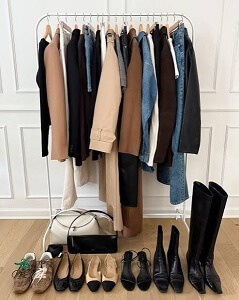 Fit can push an apparently sub-$1,000 wardrobe above that line. Alterations Express lists blind, topstitch, and double-stitch pant hems at $15 to $25 in its pant hemming price guide, updated May 27, 2026. More involved hem types are priced higher. If all four bottoms in this model need a standard hem, tailoring adds $60 to $100. The modeled acquisition total becomes $1,012.10 to $1,052.10, an increase of about 6.3% to 10.5%.
Paid wardrobe help belongs in a separate budget line because a stylist does not replace the cost of the garments. The economic effect also depends on how the service is billed. A stand-alone consultation raises the amount spent on the wardrobe project. A fee that becomes store credit can shift when the shopper pays without adding the same amount to net clothing spend, provided the credit is fully used on purchases the shopper intended to make.
Sterling Personal Styling currently lists a personalized capsule planning service at $247, with a version that includes a 90-minute fit session at $597. Those charges buy planning and styling rather than the garments, so they should sit beside the clothing budget instead of being folded into the item prices.
That distinction prevents a common comparison error. Two services can display different charges yet produce similar net spending if one amount is reusable as merchandise credit. For the worked capsule, tailoring remains the direct modeled add-on because it can be tied to a clear garment count and a published per-item range.
Three Budget Scenarios
The same capsule concept produces very different totals once the shopper’s starting closet and fit needs are stated. These scenarios use the same 20-piece structure so the comparisons stay consistent. They are illustrations built from the sourced prices above, not records of three actual customers.
Gap-fill shopper
This shopper already owns the trench, blazer, loafers, and two suitable jeans. The five retained pieces remove $403.60 from the full basket, leaving $548.50 to buy 15 pieces. This is the most relevant model for someone who wants a capsule without replacing functional higher-cost items.
All-new shopper
This shopper buys every modeled garment at the current regular prices used in the table. The clothing total is $952.10 before sales tax. No professional styling or tailoring is included. Temporary promotions could lower the cart, but the model does not assume that every required size, color, and category will be discounted at the same time.
Fit-sensitive shopper
This shopper buys the same $952.10 wardrobe and needs four standard hems. Using the sourced $15 to $25 range, fit work adds $60 to $100, producing $1,012.10 to $1,052.10. If only two bottoms need hemming, the added amount would fall to $30 to $50. The quantity of altered garments is the assumption that drives this range.
When the Capsule Pays Off
A capsule is financially useful when it reduces purchases you would otherwise make, not merely when it contains fewer garments. The strongest saving in this model comes from retaining costly pieces, not from chasing the smallest possible item count. Cutting five useful anchor pieces from the shopping list saves $403.60. Cutting one $19.90 tee saves far less, even though both actions reduce the capsule by one item.
Frequency of wear gives another personal test. If the $84.00 loafer is worn 80 times before replacement, its clothing cost works out to about $1.05 per wear. If it is worn eight times, the figure is $10.50 per wear. The arithmetic says nothing about comfort or durability, but it exposes a weak purchase quickly. A similar cost-per-wear framework is useful for frequently worn uniforms such as medical scrubs.
Use the capsule as a buying filter rather than a fixed rule. A shopper who wears a blazer twice a week may get better value from one dependable blazer than from several cheaper pieces that rarely leave the closet. Someone whose life requires uniforms, outdoor gear, formal clothing, and casual clothes may need more categories. The useful test is whether each purchase fills a repeatable need and whether the expected wear justifies its share of the budget.
Broader spending data offers context without defining an individual capsule budget. The U.S. Bureau of Labor Statistics reported $2,001 in 2024 apparel and services spending for the average consumer unit in its consumer expenditure results. The agency’s consumer unit averaged 2.4 people, so that figure should not be treated as a one-person capsule wardrobe target.
Makes sense if
- You already own several expensive anchor pieces.
- You repeat the same clothing categories across many weeks.
- You can identify specific gaps before buying.
- Your climate and work needs fit within a compact rotation.
Does not make sense if
- You would replace functional clothing solely to match a new aesthetic.
- Your job or activities require several separate clothing systems.
- A strict piece count pushes you toward items you rarely wear.
- You depend on temporary discounts that are unavailable in your size.
Answers to Common Questions
Can you build a capsule wardrobe for $500?
Yes, especially when you keep useful clothes or build a narrower seasonal capsule. A fully new 20-piece basket at the regular mainstream prices modeled here costs more than $500, while the published summer example is about $514.83.
How much is the 20-piece wardrobe in this model?
The regular-price clothing total is $952.10 before sales tax. It includes 18 garments and two pairs of shoes, with the exclusions stated near the start of the article.
How much can existing clothes save?
In the illustrated gap-fill scenario, keeping a coat, blazer, loafers, and two jeans removes $403.60 from the basket and leaves $548.50 to spend. A different closet will produce a different saving.
Should tailoring be part of the capsule budget?
Yes when fit work is likely. Four standard hems in the worked scenario add $60 to $100, enough to move the modeled all-new wardrobe above $1,000.
Disclosure: Educational content, not financial advice. Prices reflect public information as of the dates cited and can change. Confirm current rates, fees, taxes, and terms with official sources before purchasing. See our methodology and corrections policy.