
How Much Does a Celebrity Security Detail Cost?
Published on | Written by Alec Pow
This article was researched using 8 sources. See our methodology and corrections policy.
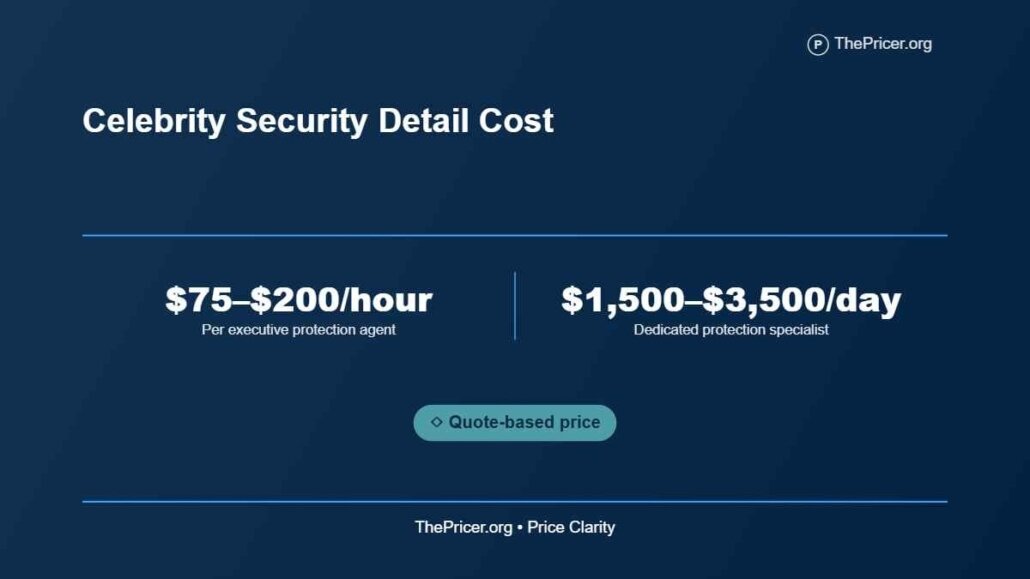
A celebrity security detail can cost about $75 to $200 per hour per protection agent, while a dedicated executive-protection specialist may cost roughly $1,500 to $3,500 per day. Current U.S. pricing puts unarmed executive protection at $75 to $150 per hour and armed protection at $100 to $200 per hour, commonly with 8-to-12-hour minimums.
Once several agents, advance work, protective transportation, travel coverage, residential protection, or continuous staffing enter the assignment, the bill can reach tens of thousands of dollars per month and potentially seven figures per year.
A celebrity security detail can connect an executive protection agent, detail leader, advance agent, protective driver, residential security officer, threat analyst, venue security team, tour manager, production company, event promoter, hotel, airport, secure vehicle provider, and local law enforcement.
The principal may move among a residence, studio, airport, hotel, restaurant, concert, red carpet, media appearance, and private event in one itinerary. Each location changes the exposure, staffing, route planning, transportation, access control, and coordination requirements, which is why celebrity protection is priced as a security operation rather than simply one bodyguard standing beside a famous person.
The useful question is not simply what one bodyguard charges. A one-agent appearance, a traveling two-agent team, a multi-agent event detail, and a 24/7 protection program are fundamentally different purchases.
The final cost depends on how many protective positions are required, how many hours each position must be staffed, the client’s threat profile, whether armed personnel are appropriate and lawful, and whether advance planning, protective driving, vehicles, travel, lodging, overtime, and residential coverage sit outside the quoted labor rate.
Article Highlights
Jump to sections
- Current published executive-protection rates commonly fall around $75 to $200 per hour per agent, depending on assignment and qualifications.
- A dedicated protection agent can cost roughly $1,500 to $3,500 per day under published 2026 pricing.
- Four agents working an assumed eight-hour appearance can create $2,400 to $4,800 in base protection labor before advance work and travel.
- Continuous coverage is much more expensive because a 24/7 protective position requires 168 staffed hours each week.
- Secure transportation, travel time, lodging, per diem, overtime, and advance work may sit outside the base agent rate.
- Generic security-guard prices are poor substitutes for celebrity executive-protection pricing.
How Much Does a Celebrity Security Detail Cost?
Current commercial pricing gives a useful starting point. An August 2026 industry guide places professional protection at $75 to $150 per hour per agent, dedicated agents at roughly $1,500 to $3,500 per day, and full-time protection programs beginning around $250,000 per year. Those figures should be treated as market guidance rather than a celebrity-specific rate card.
Published provider pricing also puts single-agent assignments at $75 to $125 per hour and a three-agent high-threat detail at roughly $1,500 to $3,000 per day. Team pricing is especially useful because celebrities often need more than one protective function during a public appearance or trip.
| Protection scope | Planning price | What the figure represents |
|---|---|---|
| Broader bodyguard market | $45 to $65 per hour | Lower-cost comparison, not a celebrity-detail proxy |
| Executive protection agent | $75 to $150 per hour | One professional protection agent |
| Armed executive protection | $100 to $200 per hour | One appropriately qualified agent where applicable |
| Dedicated protection agent | $1,500 to $3,500 per day | Published daily executive-protection pricing |
| Three-agent high-threat detail | $1,500 to $3,000 per day | Published multi-agent provider example |
| Full-time protection program | $250,000+ per year | Starting benchmark for ongoing program coverage |
At the lower end, broader consumer data places the national bodyguard average around $45 to $65 per hour, with executive protection reaching about $150 per hour. The lower figure is useful as a boundary, but using it as the expected price of a celebrity detail can understate the required skill, staffing, and planning.
Event and Travel Security
 Event protection may start before the celebrity arrives. Advance work can cover entrances, exits, holding areas, vehicle locations, routes, hotel arrangements, and coordination with event security. The executive-protection provider may charge that planning time separately from the hours when the principal is physically present. This is one reason an advertised hourly agent rate cannot by itself establish the cost of a public appearance.
Travel introduces another layer. Historical celebrity-specific reporting found that protection providers could charge travel expenses and meal per diems separately from protection labor. That reporting is from 2016 and should not be used as a current rate quote, but the cost structure remains useful evidence of how a celebrity assignment can differ from a local guard shift.
Consider a three-day trip with two agents working an assumed 12 hours each day. At $75 to $150 per hour, base agent labor would be $5,400 to $10,800 before any separately billed advance time. Airfare, hotel rooms, ground transportation, meals, and travel-day billing can sit on top of that calculation. If the celebrity travels by charter aircraft, private flight costs belong to the travel budget rather than the protection-agent rate.
A short assignment can also carry minimum booking requirements. An agent needed for a two-hour appearance may still be subject to a longer minimum shift. That makes the effective hourly cost of short celebrity appearances different from simply multiplying two hours by a posted rate.
Continuous Protection Costs
Continuous protection changes the economics because one around-the-clock post represents 168 staffed hours each week. No single agent can sustainably provide that coverage alone. A standing program needs personnel rotation, days off, scheduling, and replacement coverage. A celebrity who needs both close protection and residential coverage may have several positions to staff rather than one.
The scale becomes clearer through arithmetic. At $75 to $150 per hour, one continuously staffed position represents $12,600 to $25,200 per week. Multiplying by 52 weeks gives approximately $655,200 to $1.31 million per year. This is a straight-line ThePricer staffing model using the previously cited published hourly range. It is not a claim that providers bill every annual contract that way. Long-term programs may use salaries, retainers, contracted teams, or other pricing structures.
Adding a second continuously staffed position doubles that simple labor model to roughly $1.31 million to $2.62 million annually before vehicles, management, residences, travel, or other security layers. That calculation explains how seven-figure celebrity security spending can coexist with an individual agent rate measured in hundreds rather than thousands of dollars per hour.
A related example appears in the analysis of Prince Harry’s security costs, where a high-end continuous family protection program is modeled at about $2.5 million to $4 million per year. That estimate concerns a specific high-profile protection scenario and should not be treated as the normal celebrity budget.
What Pushes the Price Higher
Agent qualifications affect the rate. Armed protection can cost more than unarmed coverage, while specialized backgrounds, protective-driving capabilities, medical skills, or experience with elevated threats can change the quote. Armed status should not be treated as an automatic upgrade. The assignment, applicable law, client needs, and provider’s risk plan determine the appropriate personnel.
Threat level affects staffing too. A recognizable performer attending a controlled private dinner creates a different problem from a client dealing with stalking, threats, hostile crowds, or repeated unwanted approaches.
Higher exposure can lead to more advance work, more agents, tighter transportation planning, or added residential coverage. A large entourage can create coordination work even when those people are not themselves protection agents.
City, schedule, and notice can alter costs. Current marketplace guidance places specialist executive protection around $85 to $180 per hour, illustrating how commercial rates extend above basic guard pricing. Short-notice assignments can also limit the pool of suitable personnel and complicate travel arrangements.
Long days are another source of cost exposure. A celebrity’s working day may include an early airport departure, rehearsals, media appearances, an evening event, and a late hotel return. Even if the public sees the celebrity for two hours, the protection team’s billable day can be much longer.
A Celebrity Event Budget
Consider an illustrative high-visibility event requiring four executive-protection agents for eight hours. At the current $75 to $150 per-hour benchmark, four agents create $2,400 to $4,800 in event-day labor. Assume one agent also performs a separate eight-hour advance shift. That adds $600 to $1,200, producing a modeled protection-labor budget of $3,000 to $6,000.
The arithmetic at the low end is 4 agents × 8 hours × $75, plus 8 advance hours × $75, which equals $3,000. At the high end, the same 40 combined agent-hours × $150 equals $6,000. This example keeps the assumptions visible rather than presenting the result as a national event-security average.
Now assume the booking requires a separately priced secure vehicle, a protective driver, two hotel rooms, airfare, parking, and meal allowances. Those expenses are excluded from the $3,000 to $6,000 labor result because reliable national prices for that exact bundle cannot be applied to every celebrity assignment. The same applies to venue guards supplied by an event promoter. Mixing those costs into the executive-protection rate would make the calculation less useful.
Current booking examples also show how team configuration changes real quotes. Published marketplace examples include a four-person Miami assignment around $7,160 before displayed discounts. That is a provider example rather than a national average, but it supports the broader point that a team assignment can move well beyond the price of one agent.
Comparing Security Quotes
Ask every provider to quote the same assignment. State the dates, locations, expected schedule, number of principals, public appearances, travel requirements, known concerns, and whether transportation is required. The proposal should identify agent count, minimum hours, advance time, travel-day treatment, overtime, vehicle charges, lodging, airfare, per diem, and any cancellation terms. Without those details, two prices may describe different services.
Check whether a daily quote is per agent or for the complete detail. A quoted $2,000 per day can mean one specialist, while another provider might use a similar figure for a specific multi-agent package. Separate published consumer pricing places executive protection around $85 to $175 per hour, but a per-agent rate still cannot tell the reader how many agents a particular celebrity assignment needs.
Makes sense if
- The client has a high public profile or faces repeated unwanted approaches.
- Public appearances create crowd, arrival, departure, or transportation exposure.
- Travel requires coordinated protection across airports, hotels, vehicles, and venues.
- A documented threat or recurring security problem calls for professional protective planning.
Does not make sense if
- You are pricing ordinary fixed-post venue guarding rather than personal protection.
- You are comparing one agent’s hourly rate with the total cost of a multi-agent detail.
- You assume a celebrity’s public entourage represents the number of paid protection agents.
- You use an unverified media estimate about a celebrity as a substitute for a defined service quote.
Answers to Common Questions
How much does one celebrity bodyguard cost per day?
Published executive-protection pricing can range from several hundred dollars for a shorter shift to roughly $1,500 to $3,500 per day for a dedicated specialist. The service scope and minimum booking period matter.
How much can a four-person celebrity security team cost?
Using a current $75 to $150 per-hour executive-protection benchmark, four agents working eight hours produce an illustrative labor cost of $2,400 to $4,800 before advance work, transportation, or travel expenses.
Why does 24-hour celebrity security cost so much?
One continuously staffed position requires 168 coverage hours each week and several people rotating through that post. A celebrity may also need multiple simultaneous positions, travel protection, residential coverage, vehicles, and program management.
Does a celebrity pay for security while traveling?
Private clients commonly bear the cost of their privately contracted protection. Travel-related expenses can include agent labor, airfare, lodging, meals, ground transportation, and advance work, depending on the agreement and who commissioned the protection.
Is an armed bodyguard always more expensive?
Published U.S. pricing can place armed executive protection around $100 to $200 per hour, compared with roughly $75 to $150 per hour for unarmed work. The appropriate assignment depends on legal requirements and the protection plan rather than price alone.
Disclosure: Educational content, not financial advice. Prices reflect public information as of the dates cited and can change. Confirm current rates, fees, taxes, and terms with official sources before purchasing. See our methodology and corrections policy.